
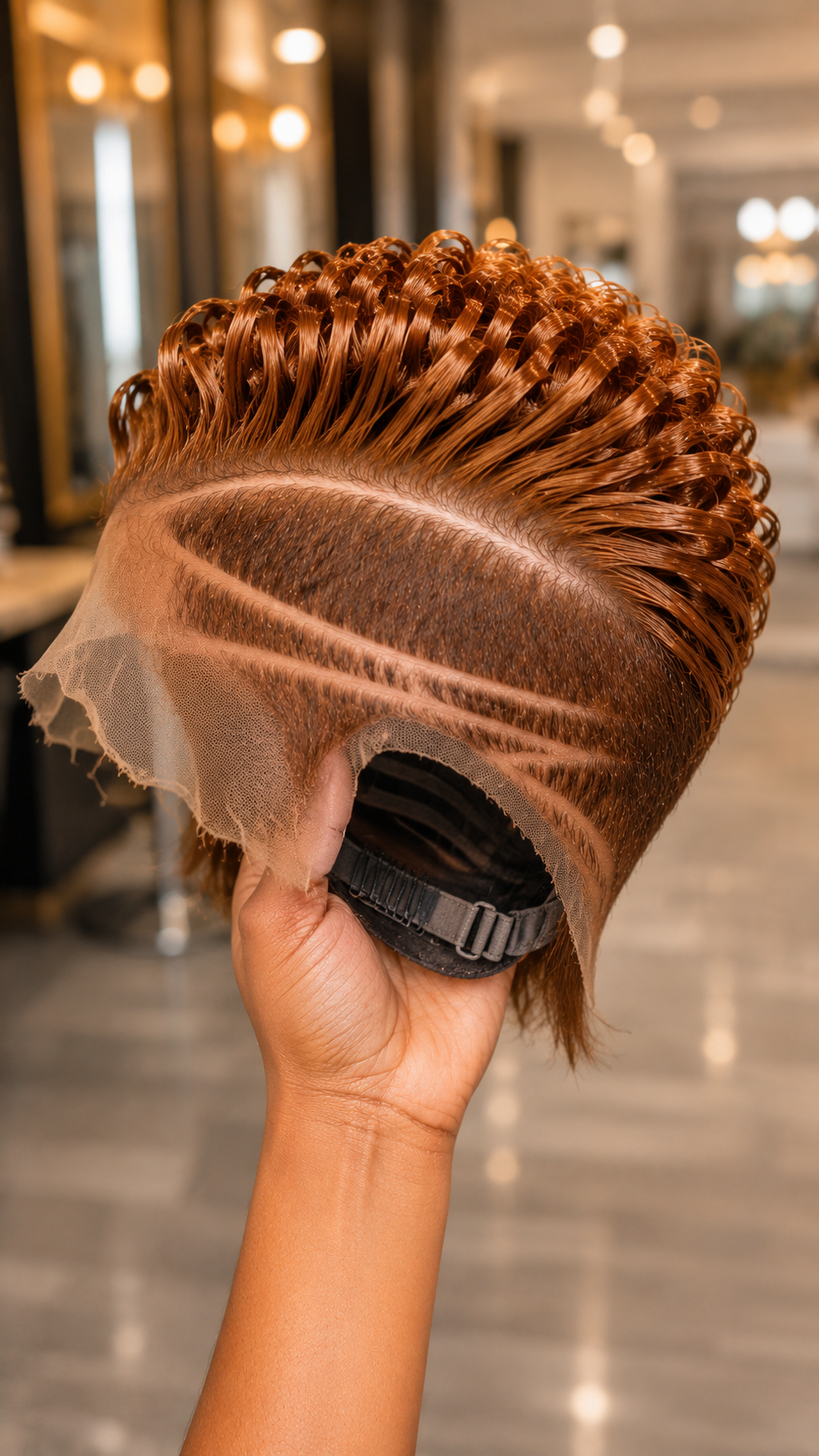
Trace the part on this unit from front to crown and watch whether the lace disappears into a scalp line or shows as a pale strip. That part, the line where the hair splits and the scalp shows through, is the second place after the hairline where a wig has to pass as skin, and it is the one most buyers never inspect. They study the hairline, fall for the curls, and never look at the part, which is exactly where a unit can give itself away. On a parted style like this copper loop set, the part is doing as much realism work as the front, and how it is built decides whether it reads as a clean scalp line or a seam of visible lace.
A convincing part has to do a few things at once. The lace along it must be fine and tinted to your own scalp tone, so it vanishes rather than glowing pale against your skin. The hairs on either side must be knotted to fall away from the parting line, the way real hair grows outward from a part, not standing straight up or crowding the line. And the line itself must be clean and the right width, neither a hard dense seam nor a gaping strip. Get those right and the part looks like scalp; get them wrong and it looks like a pale channel down the head, which no amount of good hair above it can rescue.
So when a unit has a part, judge the part with the same care you give the hairline. It is the other window where skin is supposed to show, and a wig that nails the hairline but fumbles the part still looks like a wig from the top down.
Where To Buy A Parted Pixie Wig With A Convincing Part
Custom makers who knot parts well can tint the part to your scalp and knot the hairs to fall away cleanly, so ask how the part is built and whether it is scalp-tinted. A maker who understands parts will describe the directional knotting; one who does not may give you a dense, unconvincing seam.
Instagram and TikTok sellers show the styled top but rarely a close part, so ask for close video of the parting line. A parted pixie wig proves itself where the lace meets the scalp along the part, and a distant shot hides whether that line disappears or shows.
Etsy works with makers who photograph the part close up and have reviews mentioning how natural it looked. The risk is a listing that shows the style but not the part line. Read reviews for anyone describing the part as visible or scalp-like.
Marketplaces like Amazon, AliExpress, and Temu often ship parts that are dense or untinted, reading as a pale seam, since a fine tinted part is costly to build. If a natural part matters, scrutinise close-up photos, because the price cut often shows exactly there. Judge the part, not just the style.
Local beauty supply shops and salons let you see the part against your own scalp tone and check whether it disappears. You pay a premium in-store, but the part is a detail a photo flatters, so seeing it in person helps.
Vendors and wholesalers direct vary in part quality, and a fine tinted part is the better end of the range. For a natural parted look, a maker who tints and knots the part beats stock that leaves it pale.
Regionally, convincing parts come strongly out of Lagos, Accra, Atlanta, London, and across South Africa, where makers who knot and tint parts by hand are easy to find on video.
Vet the seller on the part: check the account age, look for real buyer photos, time a plain question for a genuine reply, and ask for a close video of the part and whether it is scalp-tinted. A seller who only shows the styled top is not showing you the line that matters.
Red flags: a part shown only from a distance, a pale untinted strip along the part, hairs crowding or standing up at the line, and no answer on how the part is built.
When you order, send your measurements and your scalp tone, and ask for a fine, tinted part with the hairs knotted to fall away from the line. That tells the maker the part matters to you as much as the hairline.
On payment, thirty to fifty percent down with the balance before shipping is standard for custom work. Use a method you can dispute, and ask for a close photo of the finished part before releasing the last part of the payment.
How Much It Costs
A parted pixie wig costs a little more to build well than a no-part one, because a convincing part is skilled knotting and tinting, and that is where cheaper units cut a visible corner.
Human hair, full build with a fine, tinted, directionally knotted part, glueless with bleached knots and a fine lace, in this warm copper: roughly $200 to $430, with the colour adding around $55 to $115 over black. Human hair, mid build with a simpler part: about $150 to $310. Human hair, basic cap with a plain or dense part: around $70 to $180. Good synthetic: $60 to $140, though synthetic parts can look denser. Basic synthetic: $20 to $55.
The part is a small area with an outsized effect, so paying for it done well is worth it on a parted style. A fine tinted part with hairs knotted to fall away is the difference between a scalp-like line and a pale seam, and it is not something you can fix after the fact the way you can style the hair. If a unit is parted, the part quality is part of what you are buying, so weigh it, not just the hair above it.
Shipping and any customs charge sit outside the price and change with where you live, so plan a realistic band and confirm your own country’s import rate rather than trusting a single quoted figure.
Then the later costs, small here. The part may want a touch of scalp-tone tint or powder to blend perfectly to your skin, plus the usual curl and colour upkeep. First-year math, honestly: a parted human unit plus shipping plus any customs plus a small kit plus upkeep tends to land between a low three-figure total and roughly double the sticker, with the part being a build-quality feature rather than a running cost.
Per wear, a unit with a natural part looks real from the top as well as the front, so it wears convincingly from every angle, while one with a pale seam gives itself away whenever the part shows. A low price on a parted unit often means an untinted, dense part, so read a cheap part as the seam it usually is.
Deposits follow the custom pattern: thirty to fifty percent to start, balance before shipping, and a close photo of the finished part before the last payment clears.
Shipping, Delivery, And What To Expect After Ordering
A parted unit arrives with its part set, so checking that line on arrival is as important as checking the hairline. Ask that it ship so the part and style are not crushed, choose a tracked service for custom work, and confirm your country’s import charge before it lands. When it arrives, look at the part against your own scalp in daylight: a fine, tinted part disappears into a scalp line, while a pale or dense one shows and may need a little tint to blend. What you unbox should read as scalp along the part, and if it glows pale, a scalp-tone tint helps but a well-built part should barely need it.
The Part Is The Second Place Skin Should Show
A wig has two windows where scalp is meant to appear: the hairline and the part. Buyers guard the hairline and forget the part, but both have to pass as skin, and a part that reads as lace undoes a perfect front. On a parted style the eye travels along that line, so it gets seen constantly. Treat the part as a second hairline in terms of the scrutiny it deserves, because it is exposed to the same test.
Hairs Must Fall Away From The Part
What makes a part look grown rather than sewn is the direction of the hairs beside it. Real hair splits and falls away from a part on both sides, so a convincing part is knotted the same way, with the hairs leaning away from the line rather than standing up or crossing it. A part where the hairs crowd or stand straight reads as false however fine the lace is. When you judge a part, look at how the hair sits beside it, not just the lace along it.
Not Every Short Style Needs A Part
It is worth knowing that many short styles are worn with no part at all, swept back or forward, which sidesteps the whole question. This unit has a deliberate part, which is a style choice that commits you to that line and its upkeep. If a flawless part feels like a lot to judge and maintain, a no-part swept style avoids it entirely. Choose a part because you want that look, knowing it adds a line you have to get right, not by default.
Before You Pay
- Is the part fine and tinted to a scalp tone, or a pale visible strip?
- Are the hairs knotted to fall away from the parting line naturally?
- Can I see the part close up and against my own scalp tone?
- Does the part commit me to a fixed style direction I am happy with?
- Would a no-part swept style suit me better and avoid the part entirely?
Trimming The Lace
The lace comes off the front the usual way, and on a parted unit you leave the lace along the part alone, since that lace is doing the scalp-line job and is not meant to be cut. Trim only the front hairline lace in small offset steps, leaving a shallow margin rather than cutting flush, and keep well clear of the part. If this is your first parted unit, let a stylist handle the front and show you how to blend the part to your scalp, since the part is a finished feature to preserve, not an edge to trim.
Search Terms
parted pixie wig · part pixie wig · curly pixie wig with part · tinted part short wig · copper loop pixie unit · glueless parted pixie lace · scalp part short curly wig · natural part pixie wig
Final Thoughts
This unit has a part, and a part is the detail buyers scrutinise least and see most from the top. Like the hairline, it is a window where scalp is supposed to show, so it has to be built to pass as skin: fine tinted lace along the line, hairs knotted to fall away from it, and a clean, natural width. Done well it reads as a scalp part; done badly it reads as a pale seam that betrays an otherwise convincing unit.
Buy a parted pixie wig by judging the part as carefully as the hairline, looking at it close up and against your own scalp, and paying for the fine, tinted, directionally knotted line that makes it disappear. If that feels like a lot to get right, a no-part swept style avoids the question altogether. But if you want a part, make it a good one, because the top of your head is on show as much as the front, and a wig gives itself away along a bad part just as surely as along a bad hairline.