
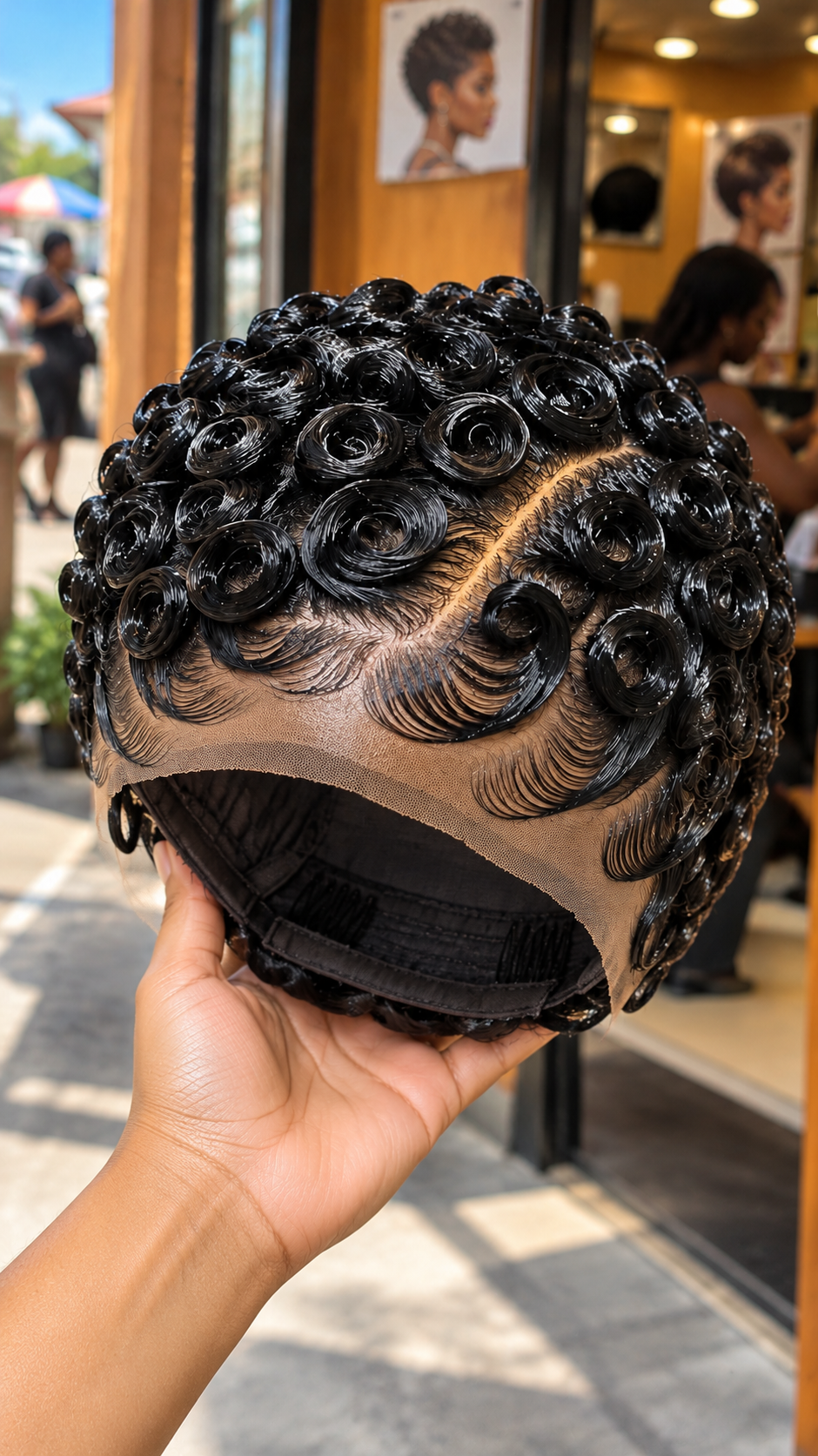
Some pixie wigs are designed around a simple haircut, while others resemble a carefully arranged piece of salon artistry. This glossy black wig belongs to the second category. Its crown is covered with circular rosette curls, but the real attraction lies in the sweeping finger waves that travel beneath a diagonal parting and frame the front of the hairstyle. The combination creates a compact, elegant look with a striking amount of detail.
The photograph shows the wig being held outside a neighborhood hair salon. Natural daylight illuminates the black strands, revealing the individual layers of the circular curls and the carefully arranged waves near the hairline. The wig has not yet been installed. Beige lace extends beyond the front and sides, while the dark interior cap, stitching, and several comb-like attachment components are visible underneath.
Unlike a conventional curly pixie with small spirals distributed evenly across the entire head, this design uses distinct styling zones. The upper section contains numerous rolled circular curls. A diagonal parting creates a directional division through the front-side region. Beneath it, wide finger waves sweep across the forehead and descend toward the temple, where smaller curved sections complete the arrangement.


The hair appears consistently black, with bright reflections created by the daylight and glossy styling. There are no clearly identifiable colored highlights, contrasting blonde strands, or decorative shaved geometric patterns. The hairstyle achieves its visual impact through curl placement, wave direction, and the relationship between the raised crown and the flatter front sections.
For anyone considering a black rosette pixie wig, understanding these construction and styling details is essential. The right purchase is not simply a black curly wig of approximately the same length. It is a unit that reproduces the circular crown, diagonal parting, sweeping waves, and carefully arranged hairline while fitting comfortably and allowing the styling to be maintained.
The Most Important Detail Is the Movement Between the Curls
At first glance, the numerous circular curls across the crown attract attention. Looking more closely, however, the hairstyle becomes interesting because of the movement between those curls.
Some ringlets face outward, revealing rounded central openings. Others sit at an angle and overlap neighboring curls. The arrangement creates a flowing progression from the upper center toward the sides rather than a rigid grid of identical spirals.
Near the diagonal parting, the circular curls gradually transition into flatter, directional strands. These strands form the foundation of the sweeping finger-wave arrangement.
The contrast is particularly noticeable where a large circular curl sits directly above a curved wave. The raised curl creates height, while the wave beneath it follows the lace foundation closely.
This relationship gives the hairstyle depth without requiring excessive volume. The crown looks full, but the front remains controlled and close to the intended hairline.
A custom wig maker should pay attention to this transition. Replacing the front waves with additional circular curls would produce a noticeably different hairstyle, even if the overall silhouette remained similar.
Rosette Curls That Give the Crown Its Personality
The upper hair contains numerous rounded curls that resemble small rosettes. Several prominent examples sit near the center and upper-right portion of the crown, while smaller formations fill the spaces around them.
The individual curls are not completely identical. Some have broad circular openings, while others are more tightly wound or slightly elongated.
This variation is important because it prevents the hairstyle from looking like a uniform collection of identical rings.
The visible crown has a rounded silhouette with most of its fullness concentrated above the diagonal parting. The curls continue toward the visible rearward portion, although the photograph does not show the complete back of the wig.
Near the front, some curls sit relatively close to the parting, creating a gradual transition into the finger-wave sections.
Why Curl Diameter Should Be Discussed Before Ordering
The diameter of the circular curls affects the entire appearance of the wig.
Smaller spirals would create a tighter, more densely coiled crown. Larger curls could produce a looser, bulkier silhouette.
The reference combines medium-sized circular openings with smaller curls arranged between them.
A custom stylist should consider the size of the curls in relation to the overall head shape rather than selecting one diameter for every section.
Customers should also ask how the curls are formed and whether they can retain their appearance after washing.
The photograph does not establish whether rollers, heat tools, finger setting, or another technique was used.
The Diagonal Parting Creates the Main Styling Boundary
A prominent diagonal parting travels across the upper front-side section of the wig.
The exposed channel appears lighter than the surrounding black strands because the foundation beneath the separation is visible.
The parting begins near the front and continues toward the upper side, separating neighboring curl groups.
Above the channel, the hair forms compact circular rosettes. Beneath it, the strands follow sweeping curves that create the decorative finger-wave arrangement.
The parting is not merely an isolated line. It determines the direction of the surrounding hair and influences the proportions of the front section.
Its position also affects how the curls sit relative to the forehead and temple.
Why the Parting Should Not Be Moved Randomly
Moving the diagonal parting too high could reduce the apparent width of the circular crown.
Placing it too low could enlarge the front-wave section and change the balance of the hairstyle.
A stylist should establish the intended parting position before completing the curl arrangement.
The wearer should also confirm whether the design should appear on the left or right side when installed.
Because the photograph shows a handheld wig, the exact wearing orientation should be discussed rather than assumed.
Broad Finger Waves Create an Elegant Front
Beneath the diagonal parting, the hair forms a series of broad, sweeping finger waves.
The upper wave begins near the parting and curves toward the front before turning downward and backward.
Its strands remain closely aligned, creating a raised ridge that reflects light along its curved surface.
Below this wave, additional strands follow related paths, producing a layered appearance across the forehead area.
The waves are not perfectly straight or evenly spaced. Their natural-looking curves give the hairstyle a softer appearance.
Near the temple, the wave arrangement becomes more compact, with smaller curved sections following the side of the wig.
The result is a front hairline that looks decorative without relying on shaved lines or contrasting color.
Why the Finger Waves Should Remain Separate from the Rosettes
The rosette curls and finger waves have different visual functions.
The circular curls provide rounded volume, while the finger waves create directional movement close to the hairline.
If the waves are made too bulky, they may compete with the crown. If they are flattened excessively, their curved ridges may become difficult to recognize.
A faithful reproduction should preserve the contrast between the raised curls and the closely arranged front strands.
The photograph does not reveal which styling products were used, so the appropriate maintenance method should be confirmed with the maker.
The Temple Has Its Own Decorative Rhythm
The visible temple contains several curved sections that continue downward from the broad front waves.
Some strands form elongated arcs, while others curve into smaller loops near the lower side.
The arrangement follows the contour of the wig rather than extending outward into long curls.
This keeps the temple compact and allows the upper crown to remain the main source of volume.
Several circular curls sit close to the side, connecting the temple arrangement to the rosette-covered crown.
The photograph does not show an elaborate carved or razor-shaved geometric design. The decorative effect comes from the placement of the hair itself.
Customers should therefore avoid requesting additional side lines if the goal is to reproduce the reference accurately.
Why the Black Color Is So Effective
The visible hair appears consistently black throughout the crown, front, and sides.
Bright reflections along the curved strands create subtle charcoal-gray highlights under the daylight.
These reflections should not automatically be interpreted as separate gray or silver-colored hair.
The overall appearance remains that of a glossy black wig.
Black works particularly well with this arrangement because the raised curl surfaces catch light while the circular openings remain darker.
The same effect occurs along the finger waves, where the curved ridges reflect light differently from the spaces between them.
This creates depth without additional color processing.
Natural Black or Jet Black?
Natural black often contains subtle brown or charcoal undertones, while jet black generally appears deeper and more uniform.
The photograph suggests a rich black appearance, but the exact commercial shade cannot be confirmed.
Customers should request daylight photographs of the actual hair before selecting a specific color number.
For a custom order, explain whether the desired result should retain subtle natural reflections or have a deeper jet-black appearance.
The Lace and Interior Cap Are Important Buying Clues
The wig is displayed before installation, with beige lace extending beyond the front and side hairline.
The lace remains untrimmed, making its perimeter clearly visible.
Inside the opening, dark cap fabric and stitched sections can be seen. Several black comb-like attachment components are also visible along the interior.
These details provide useful information about the unit’s construction, but they do not establish every specification.
The photograph does not confirm the exact lace grade, fiber composition, or complete cap dimensions.
The presence of fine mesh does not prove that the wig uses HD lace.
Buyers should request a complete underside photograph before purchasing.
What to Ask About the Attachment System
Confirm the number and placement of the interior combs.
Ask whether the cap includes adjustable straps or other securing components.
Find out whether the wig is intended for adhesive installation or can be worn securely using its existing attachment system.
The visible combs alone do not establish that the wig is suitable for glueless wear.
Comfort and security depend on the actual construction and the wearer’s individual needs.
Why Cap Measurements Matter for This Hairstyle
The decorative front waves must sit in the intended position when the wig is worn.
An incorrectly sized cap could shift the parting and wave arrangement relative to the wearer’s forehead.
Measurements such as head circumference, front-to-nape distance, and ear-to-ear width can help determine an appropriate size.
The lace should be trimmed only after the correct wearing position has been established.
Any adjustments should preserve the front strands and the temple curls.
A professional fitting can help ensure that the hairstyle maintains its intended proportions.
Where to Buy a Similar Black Rosette Pixie Wig
Customers can begin with specialist wig salons, independent wig makers, and online businesses offering custom pixie styling.
Look for portfolios containing circular pin curls, sweeping finger waves, and carefully arranged lace hairlines.
A general curly wig seller may offer similar black units without demonstrating the ability to reproduce the rosette arrangement or broad front waves.
Before ordering, review photographs of previous work.
Look for examples showing balanced crown shapes, detailed front styling, and properly prepared lace hairlines.
Send the reference photograph to the wig maker and explain which elements are most important.
For this hairstyle, those elements include the black rosette crown, diagonal parting, sweeping finger waves, and compact temple arrangement.
Preparing a Custom Wig Order
Confirm the desired black shade, curl diameter, crown height, and parting orientation.
Ask whether the wig will arrive fully styled or require additional salon work after delivery.
Request photographs of comparable completed wigs.
The seller should also provide information about the hair material, cap construction, measurements, and available installation options.
For online orders, obtain written confirmation of the agreed design, production time, shipping arrangements, and revision policy.
Ready-Made Wigs Versus Custom Styling
A ready-made black curly pixie may provide a similar color and general silhouette at a lower initial cost.
However, many ready-made wigs contain ordinary loose curls rather than the circular rosettes shown in the reference.
They may also lack the diagonal parting and carefully arranged finger-wave hairline.
Customers who want these details reproduced accurately may prefer a custom wig.
A ready-made base could still be suitable if its hair length, density, and cap construction allow the stylist to create the desired arrangement.
Before purchasing a base unit for later customization, ask the intended stylist whether it can support the required alterations.
Estimated Prices for Black Rosette Pixie Wigs
The potential cost of this hairstyle depends on the selected hair material, cap construction, circular curl styling, lace preparation, and labor involved in creating the sweeping finger waves.
The following USD amounts are illustrative planning estimates only. They are not verified live retail prices or quotations for the photographed wig.
| Wig Category | Illustrative USD Range | Relevant Cost Considerations |
|---|---|---|
| Premium Custom | $370–$875+ | Individual rosette curl placement, detailed sweeping finger waves, custom cap fitting, and carefully arranged lace hairline. |
| Standard Custom | $190–$445 | Customized circular curls and front-wave styling on a suitable prepared wig foundation. |
| Basic Human Hair | $105–$285 | A possible starting unit requiring additional curl setting, parting work, and hairline customization. |
| Premium Synthetic | $75–$205 | A potential pre-styled black curly alternative if the fiber and construction support the intended arrangement. |
| Basic Synthetic | $30–$100 | A lower-budget black curly option that may not reproduce the precise rosette curls or sweeping finger waves. |
The photograph does not establish whether the displayed wig contains human hair, synthetic fiber, or a blend. These categories describe possible purchasing options rather than verified characteristics of the product.
Additional charges may include lace trimming, cap adjustment, professional installation, shipping, and future styling restoration.
When comparing quotations, ask whether the completed rosette curl arrangement and sweeping finger waves are included in the price.
Maintaining the Circular Rosette Curls
The upper curls depend on retaining their compact circular shapes and visible openings.
Repeated brushing could disturb their arrangement and reduce the individual curl structure.
Customers should avoid pulling the curls apart simply to increase volume.
Ask the wig maker whether the curls can be refreshed at home or whether professional restyling is recommended after washing.
If the wig contains human hair, cleansing should account for any setting products used during preparation.
If synthetic fiber is used, follow the manufacturer’s instructions and confirm heat tolerance before attempting to restyle the hair.
Protecting the Sweeping Finger Waves
The front waves depend on the strands remaining aligned along their curved paths.
Repeated rubbing or combing across the hairline may disturb the wave ridges.
A stylist should explain how to refresh the waves without flattening the upper curls or changing the diagonal parting.
Any cutting or permanent adjustment should be performed cautiously because the finger-wave arrangement is an important part of the hairstyle’s appearance.
Styling Ideas for Different Occasions
This black rosette pixie can complement a variety of clothing styles and accessories.
For formal occasions, simple earrings and neutral clothing can allow the glossy curls to remain the focal point.
For everyday wear, the compact silhouette may appeal to women who prefer a hairstyle that does not extend far beyond the head.
The consistent black color also offers flexibility when coordinating different outfits.
Because the circular curls and sweeping finger waves already contain considerable detail, additional decorative hair accessories may not be necessary.
A Pixie That Combines Artistry and Everyday Appeal
The most appealing aspect of this hairstyle is the way compact circular rosettes meet broad, sweeping finger waves along the front and temple.
The diagonal parting provides a clear directional boundary, while several prominent curls extend toward the side to create a more dimensional appearance.
The exposed beige lace and visible interior combs also make proper fitting and construction verification important before installation.
For customers seeking a faithful reproduction, the priority should be a wig maker who understands the relationship between the rounded rosette curls, diagonal parting, and flowing front waves.
When these elements are reproduced accurately, the result offers a distinctive black pixie hairstyle with beautiful salon styling and a compact, flattering silhouette.
Search Terms
Black rosette curls with finger waves · Glossy black circular pixie wig · Diagonal part black lace hairpiece · Sweeping front wave rosette hairstyle · Black pin curl crown wig · Beige lace pixie with interior combs · Compact black spiral rosette hair · Sculpted temple waves black wig