
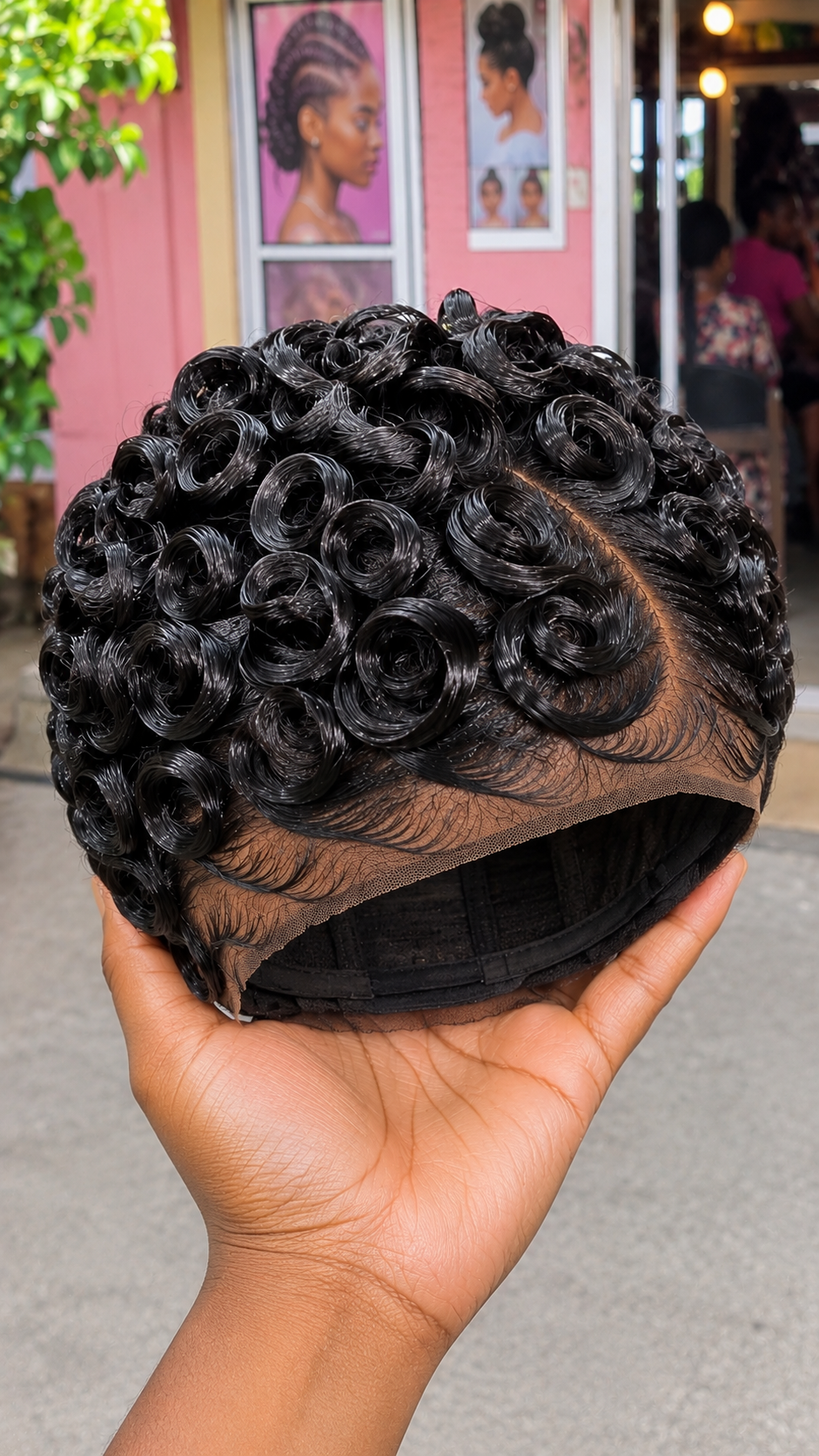
A short black hairstyle becomes especially memorable when its beauty comes from the arrangement of every curl rather than from dramatic length or bright colors. The gorgeous pixie wig pictured here combines glossy ebony spiral rosettes, a softly sweeping side part, and delicate finger-wave detailing along the front hairline. Together, these elements create a beautifully sculpted hairstyle that celebrates the precision of short curls while maintaining a rounded, feminine silhouette.
The photograph presents a compact black wig held in one hand outside a neighborhood beauty salon. Its crown is covered with circular curls arranged in closely grouped sections. Several larger rosettes sit around the upper front and center, while smaller loops fill the sides and continue toward the lower perimeter. The hair appears uniformly deep black, with narrow glossy reflections revealing the direction of individual strands.
One of the most attractive characteristics is the way the curls gradually transition into the front styling. A diagonal side part separates selected upper rings from the hair beneath them, while fine strands form elegant curved movements across the visible lace. These waves lie flatter than the raised crown curls, creating a pleasing contrast between volume and precision.


The wig is shown before installation, with a section of beige-tan lace extending beyond its hairline and a dark interior cap visible beneath the opening. This perspective makes it possible to appreciate not only the hairstyle itself but also several construction details that buyers should consider before purchasing a similar piece.
For women interested in glamorous short pixie wigs, this hairstyle offers an appealing combination of classic black hair, circular curls, and decorative front waves. It is particularly suitable as a reference for anyone seeking an intricate curly appearance without relying on long extensions, elaborate color combinations, or closely shaved geometric sides.
The Beauty Begins with the Ebony Curl Crown
The crown provides the most striking visual feature of the hairstyle. Numerous circular curls are arranged closely together, creating a rounded surface filled with open spiral loops. The individual curls resemble small rosettes because their strands follow inward circular paths around recognizable central openings.
Several prominent rings appear near the upper central section, while smaller circular curls occupy the surrounding spaces. This variation gives the crown a layered appearance without making it look uneven.
The curls are positioned at slightly different angles. Some openings face toward the camera, while others turn upward or toward the visible side. This variation creates depth and makes the hairstyle appear more sculptural than a collection of identical coils.
Although the crown has noticeable fullness, the overall wig remains relatively compact. The curls do not hang into long spirals around the face, and the lower sections follow a rounded pixie silhouette.
The deep black color reinforces this appearance. Light catches the outer curves of each loop, revealing their glossy surfaces and helping distinguish individual curls from the darker spaces between them.
Open Spiral Rosettes Give the Hairstyle Its Signature Look
Not every curly pixie wig features the same type of curl. Some hairstyles use tiny spring coils, while others rely on loose spirals or soft waves that fall naturally around the forehead.
This design is different because many of its curls form recognizable open circles. Their shapes remain distinct rather than blending into one continuous fluffy surface.
The rings vary in diameter, with several larger loops establishing the hairstyle’s main character. Smaller curls help fill the crown and maintain a rounded appearance.
For a faithful reproduction, the wig maker should preserve this variation instead of creating completely uniform curls.
Extremely small coils would make the crown appear denser and less sculptural. Oversized loops could produce excessive height and change the compact pixie proportions.
The ideal result should maintain clearly visible circular openings while allowing the curls to sit naturally beside one another.
When ordering a custom wig, ask the stylist to show examples of open spiral rosettes rather than simply requesting curly hair. This description provides a more accurate starting point for matching the photograph.
A Sweeping Side Part Creates Beautiful Direction
A diagonal separation travels through the upper front-side section, dividing selected circular curls from the flatter hair beneath them. The exposed parting provides an attractive visual break between the raised crown and the decorative front waves.
The part appears lighter than the surrounding black hair because the underlying foundation is visible between the strands.
Its curved diagonal direction complements the circular movement of the neighboring curls. Rather than creating a rigid straight division, the parting follows the natural flow of the styled sections.
Several prominent rosettes sit close to the separation, helping emphasize its shape.
The front hair beneath the parting follows a different direction, creating a graceful transition toward the forehead.
For custom styling, the parting should remain visible without becoming excessively wide. If surrounding curls cover it completely, the hairstyle may lose one of its recognizable details.
Conversely, an overly broad channel could interrupt the balance between the upper curls and the lower waves.
The photograph shows a wig rather than a shaved natural haircut, so the exposed separation should not automatically be described as a razor-cut design.
Delicate Finger Waves Add a Graceful Hairline
The front perimeter contains numerous fine strands arranged into flowing finger waves. These strands lie relatively close to the lace foundation and follow gently curved paths beneath the raised circular curls.
Near the center, several sections bend into elongated S-shaped movements. Toward the visible side, the waves continue in smaller curves that follow the contour of the hairline.
The contrast between the flatter finger waves and the raised circular curls is especially attractive.
Instead of adding a separate fringe, the hairstyle uses carefully directed strands to frame the front.
The individual hairs appear closely aligned, creating a flowing surface with recognizable wave boundaries.
These details require careful styling because their appearance depends on strand direction rather than simply on curl size.
For women who appreciate decorative hairlines, the waves provide an elegant finishing element without making the hairstyle excessively long or complicated.
The Difference Between Finger Waves and Baby Hair
Finger waves and baby-hair styling are often discussed together, but they can create different visual effects.
Small baby-hair curls typically emphasize short decorative strands near the hairline. Finger waves can involve broader sections of hair arranged into continuous flowing curves.
The photographed wig uses delicate hairline strands that form sweeping movements beneath the circular crown.
These waves are not simply random curls placed around the forehead. Their paths follow the direction established by the side parting and surrounding hair.
Replacing them with unrelated small spirals would change the appearance of the front.
When ordering a similar hairstyle, explain that the hairline should contain smooth, coordinated wave movements rather than exaggerated decorative swirls.
A stylist experienced in precision finger-wave work will be better positioned to maintain the balance between these fine strands and the larger rosettes.
The Rounded Silhouette Makes the Pixie Appealing
The wig has a relatively compact shape despite the number of curls across its crown. The upper rings create fullness while the smaller curls continue downward toward the visible side.
This gradual transition helps maintain a rounded outline.
The lower curls sit closer to the foundation, avoiding long strands that might alter the hairstyle’s short proportions.
Unlike a pixie with an exposed shaved temple, this hairstyle maintains curl coverage along much of the visible side.
The result is a compact appearance that combines fullness with control.
For everyday wear, this type of silhouette may appeal to women who want a noticeable curly hairstyle without long hair around the shoulders.
However, the compact length does not automatically make maintenance effortless. The rosettes and finger waves still require appropriate handling to preserve their shapes.
Why Deep Black Complements the Circular Curls
The photograph shows predominantly deep black hair without clearly visible colored highlights. The glossy reflections follow the curved strands and emphasize their rounded construction.
The dark spaces inside the circular loops create depth, while reflected light reveals the fine strands forming each curl.
This combination makes the hairstyle visually rich without requiring additional colors.
Commercial black shades can vary. Some suppliers offer natural black, off-black, and jet black as separate choices.
Natural black may contain subtle brown undertones, while jet black often has a deeper and more uniform appearance.
When seeking a close match, request a neutral-daylight photograph of the actual wig.
The visible gloss does not establish whether the hair is human, synthetic, or blended. Different materials can produce reflective surfaces depending on their manufacturing and styling.
Understanding the Wig’s Visible Lace
A section of beige-tan lace extends beyond the front hairline. The mesh appears untrimmed, indicating that the unit is being presented before its final installation preparation.
The lace supports the styled hairline, allowing the fine waves to extend across the visible front area.
Its color contrasts with the deep black strands, making the decorative hairline easier to examine while the wig is being held.
However, the photograph does not provide enough information to identify the exact lace grade, thickness, transparency, or full dimensions.
The mesh should not automatically be described as HD lace simply because it appears fine.
For buyers, the important considerations include how the lace looks against their skin, whether the cap fits correctly, and whether the hairline can be positioned comfortably.
A professional stylist should evaluate the wig before trimming the lace because removing too much material can affect the decorative waves and overall appearance.
What the Interior Cap Reveals
The photograph shows a dark interior cap beneath the hairline opening. Fabric sections and structural stitching are visible, indicating that the wig contains an internal foundation supporting the styled hair.
However, the entire underside cannot be examined from this angle.
The image does not confirm the total number of combs, adjustable straps, elastic sections, or other attachment components.
It also does not establish that the wig can be worn securely without adhesive.
Before purchasing, ask the seller to provide a complete underside photograph.
Request cap circumference, ear-to-ear width, and front-to-nape measurements.
These dimensions are important because the side part and front waves should align properly when the wig is placed on the wearer’s head.
A poor fit can change the appearance of even a beautifully styled wig.
Choosing the Right Wig Cap Construction
Several construction options may be available when purchasing a similar curly pixie.
Standard adjustable caps may offer convenient everyday wear, while closure and frontal designs provide different areas for parting and hairline customization.
A closure generally contains a more limited lace section. A frontal may provide greater flexibility across the front hairline, depending on its dimensions.
These are general purchasing alternatives rather than confirmed specifications of the photographed unit.
The best construction depends on the desired styling, cap measurements, and installation preferences.
For this particular hairstyle, the front lace must support the curved finger waves and the visible side parting.
Ask the seller whether the chosen cap can reproduce these details without revealing unsuitable foundation materials.
Buyers interested in glueless wear should confirm the adjustment features and actual fit rather than assuming that every lace wig is suitable for adhesive-free installation.
Hair Density and Curl Size Should Work Together
Hair density influences how full the crown appears and how clearly the circular rosettes remain separated.
If the wig contains too little hair, unwanted gaps may appear between the loops. Excessive density can make the curls appear crowded and reduce the visibility of individual openings.
The photographed design achieves noticeable fullness while retaining recognizable circular shapes.
When discussing density with a wig maker, consider the number of rosettes, their diameter, and the desired finished crown height.
Hair length is another important factor.
Strands arranged into circular loops can appear significantly shorter than they would when stretched straight.
For that reason, a finished curl-height measurement may be more useful than the original strand length alone.
The photograph does not establish an exact density percentage or hair length. Those specifications should be requested from the supplier.
Where to Find Similar Ebony Pixie Wigs
Women interested in this hairstyle can explore online wig stores, local beauty supply shops, and custom wig makers who specialize in sculpted curls and decorative hairlines.
However, a listing described simply as a black curly pixie may feature a very different curl structure.
Some products contain tiny spring coils, while others use loose spiral curls without recognizable circular openings.
When comparing options, examine actual product photographs rather than relying exclusively on the product title.
Look for a compact crown filled with open rosettes, a sweeping side part, and fine finger waves along the hairline.
A ready-made wig may be appropriate when those details are already present.
For women seeking closer control over the curl arrangement, a custom wig maker may provide greater styling flexibility.
The photograph does not identify the verified manufacturer or seller of the displayed wig.
How to Order a Similar Sculpted Pixie
Begin by sharing the reference photograph with a supplier or professional wig maker.
Explain that the desired hairstyle features a deep black rounded crown of open circular curls, a visible sweeping side part, and delicate finger-wave detailing along the front.
Specify that the curls should remain relatively compact instead of extending into long loose spirals.
Ask the maker to preserve the recognizable openings within the larger rosettes.
Discuss the intended crown height, curl diameter, hair density, and cap measurements.
Confirm whether the wig will arrive fully styled or require additional salon work.
Request photographs from the front, both sides, rear, and underside before shipping.
If the wig is custom-made, ask whether progress photographs can be supplied before the final styling is approved.
Before paying a deposit, verify production time, shipping arrangements, fiber composition, and return conditions.
Choosing Between Ready-Made and Custom Styling
A ready-made curly pixie can be convenient for women who find an existing product that closely resembles their preferred hairstyle.
It may also reduce the amount of additional styling required after delivery.
However, ready-made wigs can vary in curl diameter, crown shape, and front hairline arrangement.
A product with the correct black color may still differ substantially if its curls are too small or its parting is positioned incorrectly.
Custom styling may offer greater control over those details.
The maker can discuss the intended rosette sizes, wave direction, and overall silhouette before constructing or finishing the wig.
Custom work may involve additional labor and expense, so buyers should compare completed examples and available specifications.
A higher price does not automatically guarantee that the wig will match the reference more accurately.
Booking a Professional Wig Stylist
A stylist experienced in short sculpted curls, finger waves, and lace preparation is a suitable professional for installing this hairstyle.
When booking, explain that the wig contains two different styling patterns.
The crown uses raised circular curls, while the front hairline relies on flatter flowing waves.
Show the reference photograph so the stylist can assess the desired relationship between these areas.
If the wig is purchased separately, schedule the appointment after delivery so its construction can be inspected.
The stylist should check the fit, hairline placement, and condition of the curls before making permanent adjustments.
Any lace trimming should occur only after the wig has been positioned correctly.
The final styling should preserve the circular rosettes and sweeping waves rather than introducing unrelated decorative elements.
Glueless and Adhesive Installation Choices
Installation preferences vary between wearers.
Some women prefer glueless wigs that can be removed without applying adhesive to the hairline.
Others choose adhesive-based installations depending on their preferred wearing routine and the actual wig construction.
The photograph does not establish which method is appropriate for this particular unit.
A glueless installation requires a suitable cap and secure fit. Adjustment features may help, but they should be evaluated on the actual product.
Adhesive installations require appropriate products and careful application, particularly for wearers with sensitive skin.
Regardless of the method, the front finger waves should remain aligned with the intended hairline.
A stylist can help determine the most suitable attachment approach after inspecting the cap and discussing the wearer’s preferences.
Illustrative Prices for Sculpted Ebony Pixie Wigs
The cost of a similar hairstyle can vary according to hair material, cap construction, circular curl placement, decorative finger-wave styling, and professional finishing.
The following USD amounts are illustrative planning estimates rather than verified live prices or quotations for the photographed wig.
| Wig Tier | Illustrative Price Range | Potential Features |
|---|---|---|
| Budget | $25–$90 | Basic synthetic pixie wigs with standard cap construction and limited styling customization. |
| Value | $65–$170 | Better-finished synthetic options with more consistent circular curls and selected adjustment features. |
| Mid | $125–$310 | Selected human-hair or higher-quality base wigs that may require additional sculpted curling and hairline preparation. |
| Premium | $250–$540 | Custom circular rosette placement, chosen cap construction, and more detailed finger-wave styling. |
| Salon-Grade | $430–$1,050+ | Bespoke construction, individual cap measurements, specialist curl arrangement, professional fitting, and finishing. |
These tiers represent possible purchasing categories rather than confirmed descriptions of the product shown.
Actual costs depend on the country, seller, fiber composition, workmanship, and services included.
Individually arranged circular curls may involve greater styling labor than ordinary loose-curly wigs.
Detailed front waves and custom cap preparation may also increase the total cost.
Ask whether the quoted price includes the base wig, completed styling, lace preparation, cap adjustment, shipping, and installation.
Evaluating Quality Beyond the Selling Price
Price alone is not a reliable measure of how closely a wig matches a desired hairstyle.
For this design, the arrangement of circular curls is particularly important.
A moderately priced wig with accurate rosette placement may resemble the reference more closely than an expensive product with the wrong curl pattern.
Evaluate the crown, side part, hairline, and cap construction before comparing quotations.
Ask whether the curls can be restored after cleaning and whether additional styling services are available.
The quality of the attachment system and the comfort of the cap should also be considered.
For custom orders, review photographs of the maker’s previous work to assess consistency and attention to detail.
Maintaining the Open Circular Curls
The most important maintenance concern is preserving the recognizable shape of the rosettes.
Repeated brushing, aggressive finger separation, and compression can disturb the circular openings.
Because the crown contains many closely arranged curls, changing one section may affect the surrounding loops.
Ask the supplier how the curls were originally formed and whether they can be safely repositioned after washing.
Synthetic hair should not be exposed to heated styling tools unless the manufacturer explicitly permits them.
Human hair may allow different styling methods, but its condition and previous processing should be considered before applying heat.
When handling the wig, avoid pulling individual strands out of the circular arrangements.
If significant restyling becomes necessary, professional assistance may be preferable to aggressive home manipulation.
Keeping the Finger Waves Beautiful
The front waves require a different approach from the raised crown curls.
Their appearance depends on fine strands following coordinated paths along the foundation.
Repeated combing or rubbing can disturb those paths and make the hairline appear less organized.
Excessive styling products may create buildup and change the appearance of the closely arranged strands.
Ask the wig maker which products are suitable for the confirmed fiber composition.
During storage, avoid placing pressure directly on the decorative hairline.
If the waves become displaced, professional resetting may help restore their original shape.
Protecting the Wig During Storage
A suitable storage method can help preserve the compact rounded crown.
Use a wig stand or supportive form that does not stretch the cap or flatten the circular curls.
Avoid placing heavy objects on the wig or compressing it into a small bag for extended periods.
Before storage, inspect the crown for flattened loops and check whether the front waves remain in position.
After cleaning, allow the wig to dry completely according to the manufacturer’s instructions.
If the product contains lace, protect the mesh from unnecessary pulling or stretching.
For travel, ask the supplier whether a particular packing method is recommended for sculpted curls.
A Practical Maintenance Schedule
Maintenance frequency should depend on how often the wig is worn, the amount of styling product used, and the environment in which it is exposed.
After each wear, inspect the circular loops and front waves for changes in shape.
During frequent use, evaluate the hairstyle weekly for product buildup, tangling, or displaced strands.
Cleaning should follow the actual fiber specifications rather than a universal fixed schedule.
Occasional wear may require less frequent washing, provided the wig is stored appropriately.
Professional maintenance may be useful when the circular curls become compressed or the finger waves lose their intended direction.
These recommendations are general considerations rather than a fixed routine for every wig.
Advantages of the Ebony Rosette Pixie
One advantage of this hairstyle is its compact silhouette. The crown provides noticeable fullness without requiring long hanging hair.
The deep black color creates a consistent appearance, allowing the circular curl structure to become the main attraction.
The sweeping side part adds direction, while the delicate finger waves provide an elegant finish around the front.
The hairstyle also maintains curl coverage along the visible side rather than relying on exposed shaved sections.
For women who appreciate short sculpted hairstyles, this combination offers an expressive alternative to conventional curly pixie wigs.
The decorative details may also reduce the need for additional hair accessories because the curls and hairline already create substantial visual interest.
Potential Limitations to Consider
The elaborate curl arrangement may require more careful handling than a casual loose-curly hairstyle.
The circular loops can lose their openings when compressed, while the fine finger waves may shift with repeated manipulation.
A highly accurate custom reproduction may also involve additional styling costs.
Cap fit is especially important because incorrect placement can change the appearance of the side part and hairline.
Another consideration is the availability of professional styling services if the curls require restoration.
Before purchasing, evaluate your preferred maintenance routine and intended frequency of wear.
The hairstyle’s intricate appearance is appealing, but maintaining that appearance may require patience and appropriate care.
Styling the Pixie for Everyday Occasions
The deep black color makes this hairstyle compatible with many clothing and accessory choices.
For daytime wear, small earrings and understated accessories can complement the circular curls without distracting from them.
For evening occasions, gold jewelry or contrasting clothing may help emphasize the glossy black crown.
The rounded silhouette also allows the hairstyle to remain a focal point without requiring additional decorative pieces.
Large clips or heavy ornaments should be used carefully because they may interfere with the rosette arrangement.
Whether paired with casual clothing, professional outfits, or evening fashion, the hairstyle’s most important feature remains its carefully arranged circular curls.
What to Check Before Making a Final Purchase
Before ordering a similar wig, examine photographs showing the actual circular curls and their distribution across the crown.
Confirm that the side parting is positioned appropriately and that the front waves resemble the intended style.
Request the fiber composition, cap measurements, and complete underside photographs.
Ask whether the wig can be worn glueless or requires another installation method.
Determine whether the curls are fully styled before shipping and whether professional maintenance will be necessary.
For custom orders, confirm the production schedule, final approval process, and any limitations on changes after construction.
These checks can help buyers make more informed decisions and avoid relying exclusively on promotional photographs.
A Beautiful Expression of Short Black Hair Styling
The appeal of this hairstyle comes from its glossy ebony rosettes, sweeping side part, and delicate finger waves. The raised curls create a rounded crown filled with recognizable circular openings, while the flatter front strands provide a graceful contrast.
The compact silhouette offers fullness without excessive length, and the consistent black color allows the curl arrangement to remain the central attraction.
For buyers seeking a close reproduction, the most important considerations are curl diameter, crown density, parting placement, hairline styling, and cap construction.
Before purchasing, compare actual product photographs and verify the material and installation specifications.
With careful construction, comfortable fitting, and appropriate maintenance, a similar pixie wig can provide an elegant short hairstyle that celebrates the beauty of sculpted black curls and flowing front waves.
Search Terms
Ebony pixie spiral rosette wig · Black circular curls with sweeping side part · Glossy short black sculpted coil crown · Ebony finger wave lace pixie · Open ringlet black pixie hairstyle · Rounded black rosette curls hairpiece · Short ebony wig with flowing front waves · Black spiral pixie with diagonal parting