
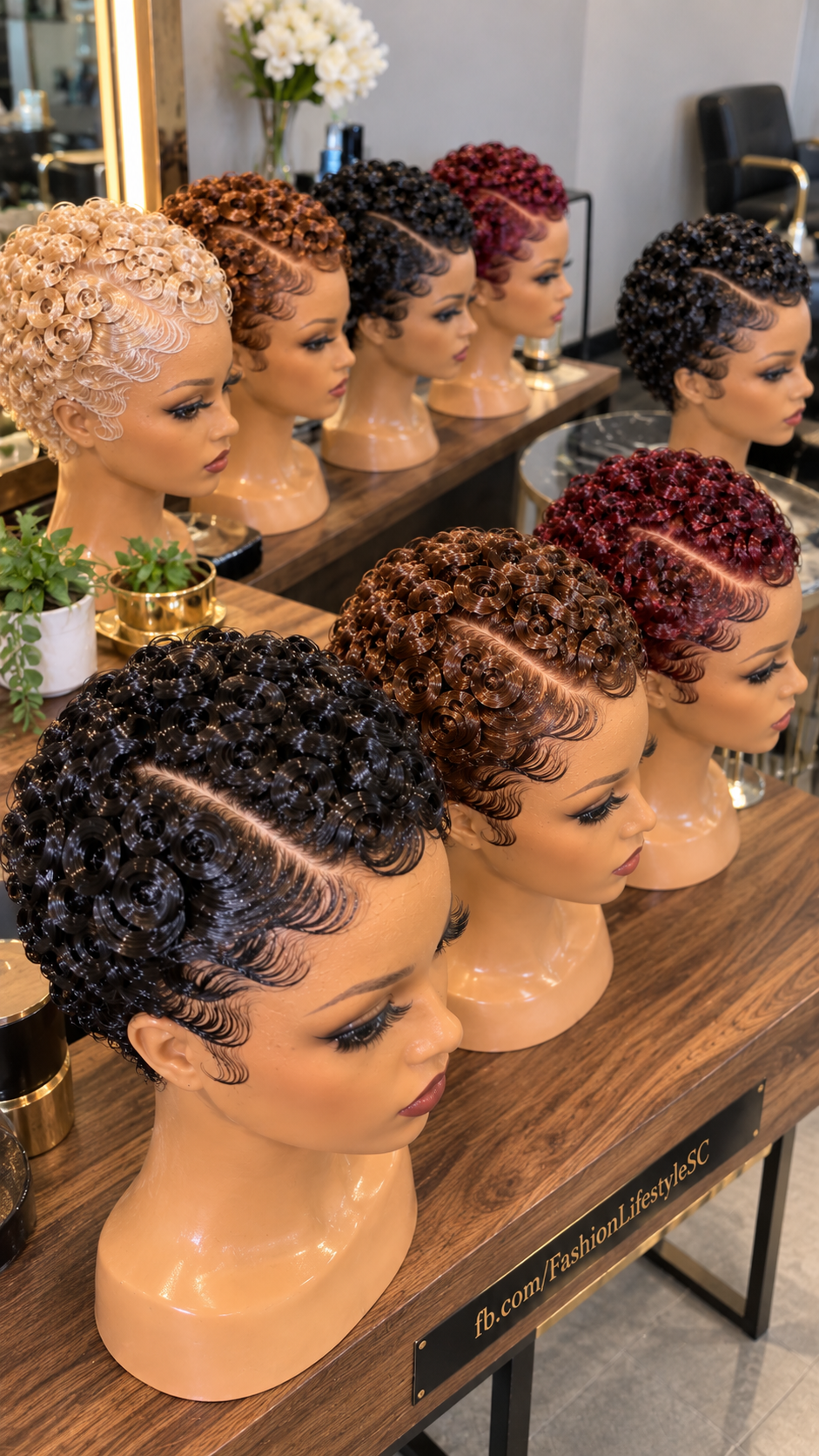
A display like this makes one point immediately clear: wigs from the same finger-coil family can produce very different results without changing the basic compact silhouette. The visible collection moves through glossy natural black, warm bronze-brown, deep burgundy and pale champagne-blonde, but color is only one part of the variation. The size of the circular coils, the density across the crown, the diagonal parting and the long curved strands around the forehead all change from unit to unit. Those differences are what a buyer should study before deciding which version to order.
The foreground black wig provides the clearest view of the construction. Numerous circular coils cover the crown, with larger rings appearing among smaller surrounding sections. A long diagonal part travels through the upper side and becomes the boundary for a sequence of elongated finger-wave arcs. Those arcs sweep toward the forehead and temple rather than repeating the circular shape used above. The neighboring bronze-brown and burgundy wigs follow the same broad styling family but create noticeably different visual weight because their color and curl placement interact differently with the light.
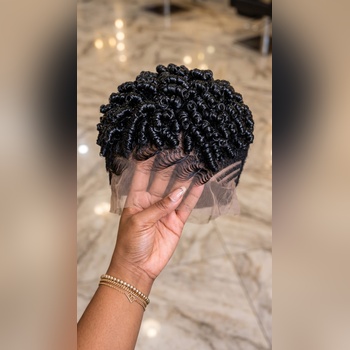
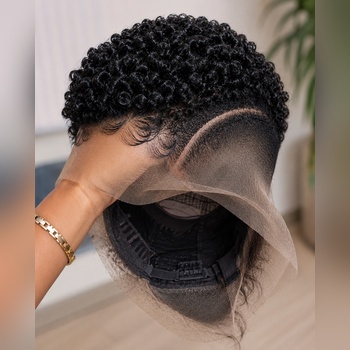
The mannequins show the finished appearance rather than the underside of the wigs. Cap construction and lace specifications cannot be reliably identified from this photograph, so terms such as HD lace should not be attached to the collection without separate confirmation. A customer interested in a particular unit should ask the seller for photographs of that exact wig away from the mannequin before making construction-based assumptions.
Curl Density Determines Whether the Crown Feels Airy or Elaborate
The foreground black crown contains a high number of individual rings packed into a relatively compact area. Even with that density, many circular openings remain visible. This balance is important. If the coils were pushed much closer together, their individual shapes could disappear into a continuous mass. If they were spread too widely, the crown might lose the richness that gives this unit its salon-finished appearance.
Several other wigs in the display use slightly different density. The bronze-brown foreground unit contains large visible rings but allows the warm surface color to do more of the visual work. The burgundy version also has a substantial coil field, although its wine-red reflections make the individual sections appear more separated.
For a buyer, density should therefore be discussed independently from color. Asking for “the bronze version” is not enough if the desired crown actually comes from the black reference. A custom maker needs to know whether the customer wants tightly populated rings, a more open arrangement or a mixture of large and small coils.
The Black Foreground Crown Is Built From Multiple Ring Sizes
The black wig closest to the camera is particularly useful for studying coil scale. Several larger rings occupy prominent positions across the upper crown. Around them are smaller rolled sections that fill gaps and help the pattern follow the rounded shape of the head.
This prevents the crown from looking mechanically repetitive. The circles share a common styling language, but they do not look as though one identical curl has simply been stamped across the entire surface. Variation creates depth and allows the crown to transition naturally toward the sides.
When requesting a recreation, an elevated reference photograph should accompany the order. A frontal portrait can show the overall effect but may conceal the differences in diameter that make the crown interesting.
A Diagonal Part Creates the Structural Spine
The exposed diagonal path is one of the most important elements in several wigs shown here. On the foreground black unit, it begins toward the upper crown and travels diagonally toward the forward side. Circular coils occupy one side of this route while flatter directional strands follow the other.
This division gives the hairstyle an internal structure. Without it, the ring coils could simply continue toward the forehead and produce an all-over curled appearance. The part creates an intentional break and provides space for the long side waves to become visible.
The bronze and burgundy units also demonstrate directional parting, although the apparent contrast changes with color. Warm brown reflections soften the transition slightly, while burgundy creates a stronger color boundary around the exposed path.
A customer should therefore choose the parting deliberately. Changing its angle or moving it closer to the center can alter the distribution of the entire crown even if every individual coil remains beautifully formed.
The Long Front Arcs Are Not Baby Hairs
One detail worth distinguishing carefully is the elongated wave work around the forehead. These are substantial styled sections rather than a few tiny strands added as an afterthought. Multiple parallel arcs follow the diagonal part and sweep toward the face, creating a broad decorative transition between the crown and perimeter.
Closer to the temple, the strands become smaller and turn downward. This produces a gradual change in scale: circular rings on the crown, long sweeping arcs near the part and tighter curved accents near the side.
That hierarchy should be preserved during maintenance. If the long arcs are repeatedly shortened or rolled into small curls, the wig loses an important portion of its original face-framing construction.
Natural Black Makes Every Gap Between the Coils Valuable
On the deepest black units, dimensional contrast comes largely from reflected light and shadow. Raised strands shine strongly, while the centers of the rings and the spaces between them remain dark. Those gaps allow the viewer to understand where one coil ends and another begins.
This means that adding more hair is not automatically an improvement. Overfilling the crown can close the negative spaces and make the surface appear heavier. The successful black versions preserve enough separation for each ring to retain its identity.
The same consideration applies to styling products. Excess oil, wax or gel can make neighboring sections adhere to one another. A glossy result should still allow the coils to remain visually independent.
Bronze Brown Turns Reflection Into Warm Color Variation
The bronze-brown wigs create dimension differently. Raised sections reflect golden and chestnut tones, while the interiors of the coils appear considerably deeper. This produces several brown intensities without requiring a clearly separate highlight color.
The foreground bronze unit makes this effect particularly easy to see. Large circular rolls catch warm light along their outer edges, while darker brown remains around the roots and within recessed areas.
Customers requesting this palette should use photographs rather than relying on a shade name. Bronze, caramel, chestnut, honey brown and copper can overlap considerably across different suppliers. The reference image communicates the target more reliably than terminology alone.
Burgundy Creates Its Own Highlight System
The burgundy wigs offer another approach to tonal depth. Deep areas appear wine-red, while raised curls reflect brighter ruby or cherry notes. Because the variation happens naturally across the curved surface, the hair does not need blonde streaks to make the rings visible.
The color can change substantially under different lighting. Salon illumination may intensify the red, while daylight may reveal a deeper wine base. Before approving a custom burgundy unit, ask for a neutral-light photograph of the actual hair whenever possible.
Buyers should also confirm whether the shade is uniform or contains intentionally darker roots. That difference affects the final crown considerably and should not be left to assumption.
Champagne Blonde Places the Construction in Full View
The pale wig at the upper left behaves differently from every dark unit in the display. Its light champagne-blonde tone minimizes deep shadow, causing the eye to focus directly on the shape of the rings and the sweeping front strands.
The long perimeter arcs are especially visible because each pale strand can be followed across the forehead. Smaller curls around the side also stand out rather than disappearing into a dark background.
This increased visibility means placement needs to be precise. It also makes care information important. If the unit is human hair, the buyer should ask about the processing used to achieve the pale shade. If it is synthetic, the fiber and permitted styling methods should be confirmed. The photograph itself cannot determine which material is present.
The Rear Row Shows Why One Color Can Support Several Constructions
Multiple dark units appear toward the back of the display, but their styling does not look perfectly interchangeable. The number of visible coils, the direction of the part and the balance between crown curls and side waves vary.
This is useful for customers who want black but are unsure which construction suits their preference. Instead of treating black as one product, the salon can present several crown maps within the same color family.
The same concept can be extended to other shades. A burgundy customer may prefer one coil distribution while a bronze customer prefers another. Custom ordering becomes clearer when construction and color are separated into individual decisions.
Choose the Crown First When Ordering Online
When browsing a seller’s catalog, begin by identifying the exact crown arrangement you want. Ignore the color temporarily. Look at ring diameter, density, placement of the largest coils and how the curls transition toward the side.
Next, choose the parting. Determine whether you want the strong diagonal path visible in this collection or a different arrangement. After that, evaluate the front and temple work. Only then select the final color.
This order reduces the chance of buying a beautiful shade attached to a construction that was not actually the customer’s favorite. It also gives a custom maker a much clearer production brief.
Ask for Four Approval Angles Before a Custom Unit Ships
A useful approval set should include a direct front image, a side profile, an elevated crown view and a rear three-quarter view. Each angle answers a different question.
The front reveals face-framing balance. The side shows how the long waves move toward the temple. The elevated image exposes the full diagonal part and coil distribution. The rear view confirms whether the circular pattern continues consistently around the back.
If the seller claims a particular lace or cap construction, request an additional underside photograph with the wig removed from the mannequin. Construction claims should be supported separately from the finished styling photographs.
Customization Works Better When the Salon Has a Visual Checklist
A customer can bring the reference to a wig stylist and identify specific priorities: large ring coils across the upper crown, smaller transition curls, diagonal parting, elongated front arcs and compact temple curves. The desired color can then be added to that list.
If a barber or another specialist is involved in perimeter refinement, everyone should work from the same reference. This prevents one professional from simplifying an area that another intended to preserve.
For a ready-made unit, customization should be conservative. If the wig already contains the desired curl map, unnecessary restyling creates more opportunities to lose the original arrangement.
Price Depends on How Much of the Coil Map Is Handmade
Compact length does not necessarily mean minimal labor. A crown containing dozens of individually arranged rings can require significant styling time. Directional parting, front wave work, color processing and custom cap preparation can add further cost.
| Category | Estimated Price Range | Typical Scope |
|---|---|---|
| Premium Custom | $330–$590+ | Higher-grade hair, personalized sizing, hand-planned coil density, individualized parting, custom color and detailed perimeter work. |
| Standard Custom | $200–$350 | Prepared ring-coil crown, selected color and directional front styling with more standardized sizing options. |
| Basic Human Hair | $120–$220 | A restylable human-hair foundation that may require separate crown setting, part creation and perimeter work. |
| Premium Synthetic | $80–$155 | A higher-quality pre-set option intended to retain its circular coil arrangement with less frequent professional resetting. |
| Basic Synthetic | $35–$90 | A lower-cost interpretation where ring variation, color depth or detailed front styling may be simplified. |
These ranges are broad budgeting guides rather than confirmed prices for the wigs in this display. Hair source, fiber, color work, cap construction, seller location, labor and shipping can change the total. Fitting and later maintenance may also be billed separately.
When comparing quotations, ask whether the circular crown arrives fully arranged. A cheaper base requiring several hours of local styling is not equivalent to a finished custom unit even if both use similar hair.
Book According to the Amount of Work Remaining
A finished display wig may require little more than fitting and minor perimeter adjustment. A basic unit intended to become one of these sculpted designs requires a very different appointment.
Tell the salon whether the ring crown has already been created, whether the diagonal part exists and whether the front arcs are already set. The stylist can then reserve enough time and advise whether more than one session is needed.
For an online purchase, wait until the unit arrives before scheduling irreversible work. Inspect the color and coil arrangement first. If the product differs substantially from the agreed reference, contact the seller before restyling or cutting anything.
Human Hair Offers Flexibility but May Require More Professional Resetting
A human-hair unit can be valuable for buyers who want future styling flexibility. If several coils eventually loosen, an experienced stylist can potentially reconstruct them according to the original map. The hair can also offer more options if the customer later wants controlled changes.
That flexibility comes with responsibility. Heat limits should reflect the hair’s processing history, especially on burgundy, bronze and pale blonde units. Repeated high temperatures can reduce longevity.
A premium synthetic version may retain its pre-set ring pattern with less intervention. However, it offers less freedom for major reshaping. Fiber specifications should be checked before heat is applied.
Wash the Wig Without Turning the Rings Into One Curl Mass
Before washing, take several clear photographs of the crown. They should show the diagonal part, largest rings and the transition into the front waves. These images become a reconstruction guide.
During cleansing, avoid scrubbing the circular sections together. Work gently according to the confirmed material and allow the wig to dry without crushing the crown. Once dry, address displaced sections individually.
The objective is not to restyle the entire wig after every wash. Good maintenance preserves as much of the original construction as possible and repairs only what has changed.
Keep the Long Front Waves Out of the Ring-Curl Maintenance Routine
The perimeter arcs need different handling from the crown. They are flatter, longer and deliberately directional. Treating them like small ring curls can gradually change the face-framing design.
If an arc lifts or loses its route, guide it back according to the reference image. Avoid trimming it simply because the end has moved. Removing hair should be the last option because repeated cutting eventually reduces the length available for those sweeping curves.
This separation of maintenance routines—rings above, elongated waves below—helps preserve the original contrast between the two zones.
Color Refresh Should Respect the Original Tonal Logic
For human-hair burgundy and bronze wigs, eventual color refreshing should preserve the depth visible inside the coils. Applying one flat shade indiscriminately can remove some of the tonal variation that gives the crown dimension.
The pale blonde unit requires its own assessment before chemical work. Highly processed hair may not tolerate repeated lightening. A professional colorist should inspect the unit rather than assuming that wig hair can undergo the same process indefinitely.
Synthetic units should only be altered using methods appropriate for their confirmed fiber. Standard permanent hair color is not automatically suitable.
Storage Is Part of the Styling Routine
A circular crown can be damaged simply by being stored badly. Place the wig on a suitable stand or mannequin head where the rings have room to remain open. Avoid pressing the side against a wall because that can flatten the long perimeter waves.
Do not stack other wigs or clothing on top. Make sure the unit is fully dry before storage, and keep pale hair away from surfaces that could transfer color.
When traveling, use a container with enough depth for the crown. Protecting the coil map physically reduces the amount of professional repair required later.
The Best Purchase Is the One Whose Curl Map Matches the Customer
This collection demonstrates why two wigs with the same general finger-coil description can feel completely different. One may use a dense field of black rings with dramatic side waves. Another may rely on bronze reflections to reveal larger curls. Burgundy adds rich tonal depth, while pale blonde makes every strand direction visible.
The buyer’s most useful comparison is therefore structural. Examine crown density, ring diameter, diagonal parting and perimeter flow first. Once those decisions are made, choose the color that gives the construction the desired personality.
For wig businesses, presenting products this way can make customization easier to understand. Photograph every unit from useful angles, separate color options from construction options, confirm material information instead of guessing and explain what the quoted price actually includes. Customers then have a much better chance of receiving the wig they selected for its craftsmanship rather than merely a similar color.
Search Terms
dense black finger coil wig · bronze circular crown wig · burgundy ring coil part wig · champagne blonde finger wave wig · diagonal coil part wig · sculpted forehead wave wig · mixed diameter coil crown · glossy salon finger curl wig