
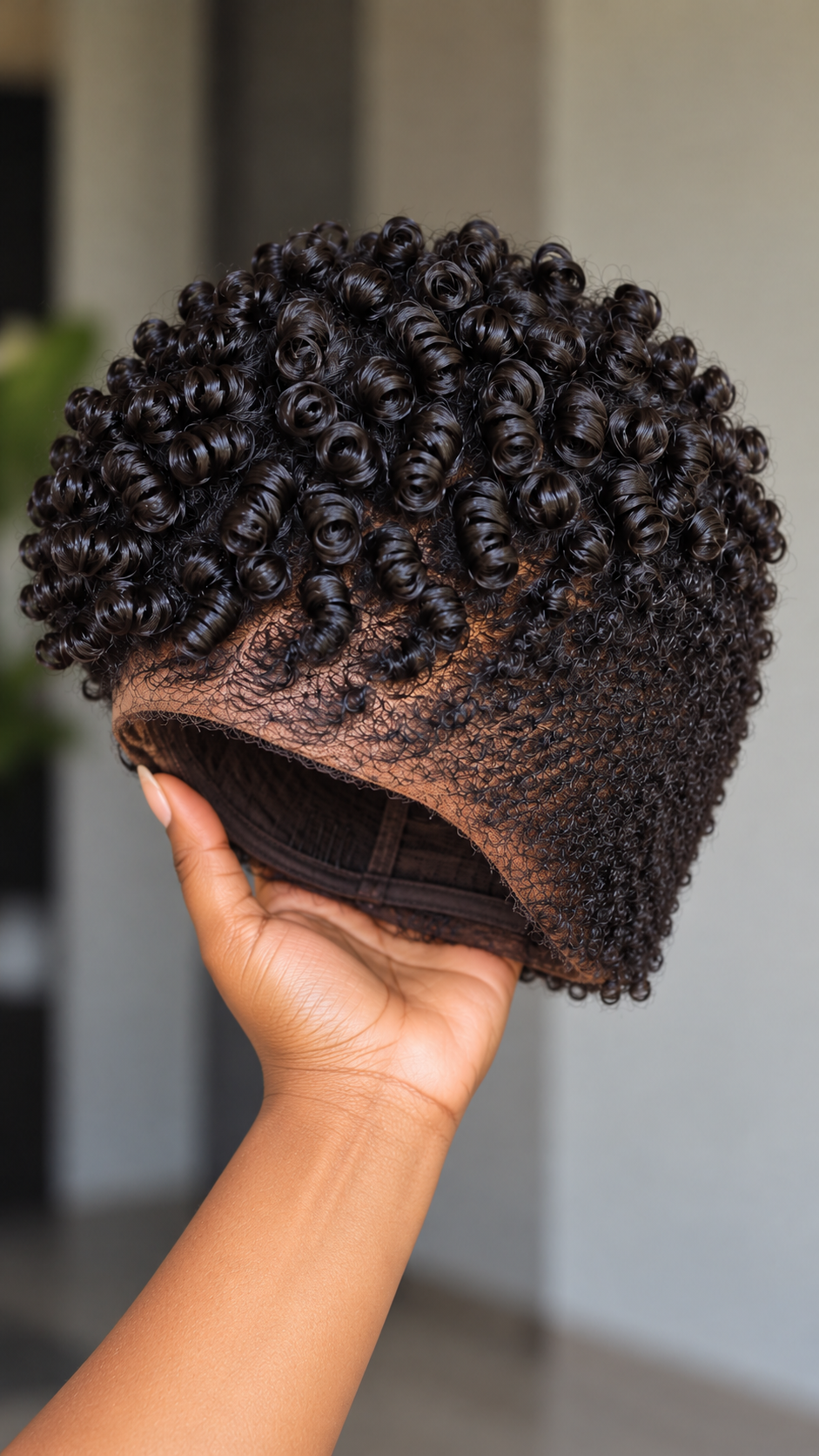
A compact curly wig can look remarkably different depending on how its upper coils transition into the hair around the sides. The black hairpiece photographed here demonstrates an especially interesting contrast: substantial, glossy barrel-shaped curls occupy the upper section, while much smaller, tightly gathered curls cover the lower side. Rather than introducing carved lines or elaborate finger-wave patterns, the hairstyle draws attention through a gradual change in curl diameter, density, and projection.
Held in one hand against a softly blurred indoor background, this wig reveals its rounded upper silhouette, finely curled lower section, part of the supporting lace, and a dark fabric cap beneath the hair. The photograph is particularly useful because it captures the hairstyle without a mannequin face or elaborate salon display competing for attention.
The color appears predominantly black, with subtle dark-brown reflections where light reaches the rounded upper curls. Some of the larger coils resemble compact hollow cylinders, while others form tightly wound spirals with visible openings. Beneath them, very small curls follow the side of the wig, producing a close-fitting profile that contrasts with the fuller upper hairstyle.


This combination makes the design relevant to women who appreciate curly pixie wigs, sculpted barrel-coil hairstyles, and compact hairpieces inspired by natural tapered cuts. However, the photograph alone cannot establish whether the hair is human or synthetic, how the curls were permanently or temporarily arranged, or whether the cap was specifically constructed for adhesive-free wear.
The Upper Barrel Coils Create a Rounded Silhouette
The upper hairstyle contains numerous tightly rolled curls arranged across the visible crown. Several form compact cylindrical shapes, with individual strands wrapping around a central opening.
The curls vary in size and orientation. Some face outward, displaying their hollow centers, while others sit at diagonal angles or overlap neighboring formations.
Near the central upper area, a number of larger barrel coils stand out against the smaller surrounding curls. Their rounded surfaces reflect light, making individual strand groups easier to distinguish.
The hairstyle has noticeable upper fullness without excessive height. The coils rise above the lower side, creating a rounded shape that remains relatively close to the head.
Several smaller spirals occupy the spaces between the prominent barrel curls, preventing the upper surface from appearing sparse.
This balance between larger and smaller coils is an important part of the wig’s appearance. A reproduction created entirely from identical curls could have similar overall volume but a noticeably different character.
Why Barrel Curl Diameter Matters
Barrel coils differ from loose spiral curls because the strands are gathered into relatively compact rolled formations. Their openings can remain visible, giving the hairstyle a sculptural appearance.
If the coils are made significantly larger, the crown may become bulky or uneven. If they are made too small, the upper section may resemble the tightly curled lower side instead of providing a distinct contrast.
The reference maintains a recognizable difference between its upper cylinders and the much finer curls beneath them.
When commissioning a custom wig, ask the maker to preserve a mixture of compact barrel coils and slightly smaller surrounding spirals.
The exact setting technique is not visible. A supplier should explain how the coils are formed and whether they are intended to retain their shape after washing.
The Lower Side Uses Much Finer Curls
The most distinctive aspect of this design is the transition from larger barrel coils to extremely small curls along the visible lower side.
Rather than lying completely flat, the lower hair contains numerous tiny spiral formations that sit close to the wig base.
These curls create an intricate surface with visible strand detail. Their diameter is considerably smaller than that of the upper barrels, helping establish a gradual reduction in apparent volume.
The lower section follows the contour of the wig and narrows toward the bottom edge.
This gives the hairstyle a tapered-looking appearance without demonstrating that the hair was cut using clippers or shaved down to bare skin.
The side retains substantial curl coverage. It does not display a clearly exposed skin fade, geometric barber lines, or a broad decorative separation channel.
For customers who prefer natural-looking compact curls rather than elaborate carved patterns, this side arrangement may be particularly appealing.
The Transition Should Not Become an Abrupt Step
One potential problem during reproduction is making the division between upper and lower curls too severe.
The photograph shows larger barrel coils gradually giving way to finer spirals, with smaller curls occupying the transitional area.
A maker who creates an abrupt boundary between large curls and a completely flat side could produce a noticeably different silhouette.
The relationship between curl size and hair density should therefore be established before any additional cutting or styling.
Ask for close side photographs showing the transition rather than relying solely on a front-facing product image.
A Dark Color That Emphasizes Curl Construction
The hair appears predominantly black, with deep brown undertones and subtle reflective highlights across some upper curls.
The brighter areas are concentrated where the rounded strands catch the light. Within the coils, darker spaces help emphasize the circular openings.
There are no clearly established blonde, copper, burgundy, or other contrasting color sections.
The relatively uniform dark shade allows the change in curl diameter to remain the strongest visual characteristic.
The photograph does not confirm whether the fibers are naturally black, dyed after production, or manufactured in this color.
For buyers who want a specific shade, it is worth distinguishing natural black, jet black, and very dark brown.
A seller should provide an additional photograph under neutral daylight if the color difference matters.
How the Curl Arrangement Changes Toward the Front
Near the visible front-side region, several upper coils extend slightly downward toward the transition area.
These curls create an irregular border between the larger upper formations and the finer hair beneath them.
The arrangement does not resemble a straight fringe or a broad finger-wave panel. Instead, individual coils descend from the upper crown and gradually blend into the smaller curls.
Some of the visible strands near the edge appear more loosely arranged, with fine hairs extending between neighboring sections.
This variation gives the hairstyle a less rigid appearance than a wig whose curls have been positioned in identical rows.
However, the photograph does not provide a complete frontal view. The exact hairline shape and distribution across the forehead remain uncertain.
Buyers should request a direct front photograph before assuming that the same curl arrangement extends symmetrically across the entire hairline.
The Wig Has No Clearly Visible Decorative Side Lines
An important distinction is the absence of a prominent carved side pattern.
Many sculpted pixie wigs incorporate diagonal stripes, curved razor-like channels, or nested geometric divisions. None of those elements is clearly established in this photograph.
Instead, the side is covered with numerous tiny curls that produce a close-fitting surface.
This means the hairstyle should not be advertised as a triple-line or double-curve pixie without additional evidence.
For a custom order, explain that the design relies on the gradual change in curl size rather than decorative shaved-looking lines.
Adding such lines could alter the hairstyle’s identity and potentially expose the cap if the supporting construction is not suitable for cutting.
What the Visible Cap Can Tell a Buyer
The photograph shows part of a dark fabric cap beneath the hair. A reinforced-looking lower edge and stitched interior sections are visible through the opening.
The exposed construction confirms that the hairstyle is being displayed as an uninstalled hairpiece.
However, the complete underside is not shown, so the photograph cannot establish the total number of comb attachments, the presence of adjustable straps, or the complete cap design.
It also does not prove that the wig is suitable for adhesive-free wear.
Before purchasing, ask the seller for a complete inside-out photograph.
Cap circumference, front-to-back length, and ear-to-ear measurements should be confirmed.
The buyer should also ask whether the cap includes adjustable hardware and whether alternative sizes are available.
Why Cap Fit Can Affect the Curl Silhouette
A wig that looks compact while being held may sit differently when placed on a head.
If the cap is too large, the lower curls may bunch or shift. If the cap is too small, the hairstyle may sit higher than intended and create discomfort.
The rounded upper section should remain balanced relative to the wearer’s forehead and temples.
For this reason, fitting should be treated as part of hairstyle preservation rather than a separate finishing step.
A professional installer can assess the cap position before any irreversible adjustments are made.
The Visible Lace Should Be Evaluated Before Trimming
A narrow section of lace or fine mesh is visible along portions of the hairline and cap edge. The material appears untrimmed in the photographed area.
However, the photograph does not establish the full extent of the lace coverage or its commercial classification.
It would be inappropriate to identify the material as HD lace based only on the visible mesh.
Ask the seller whether the wig has a lace front, closure construction, frontal coverage, or another cap configuration.
These options can influence the available hairline customization and installation methods.
If lace trimming is necessary, it should be performed only after the wig has been positioned correctly on the intended wearer.
Removing too much material could reduce fitting flexibility or disturb the fine curls near the edge.
Finding a Supplier Who Can Reproduce Two Curl Scales
This hairstyle requires more than the ability to create attractive barrel curls.
The maker must also understand how the upper coils transition into the much finer lower curls.
Specialized wig boutiques, custom wig makers, and salons experienced in compact curly pixie hairstyles are appropriate places to begin searching.
Useful search descriptions include black barrel curl pixie wig, compact spiral crown wig, micro-coil side hairpiece, and tapered curly pixie lace wig.
When reviewing product photographs, pay attention to the lower side. Many wigs marketed as curly pixies have uniform curls throughout the head.
A unit with the correct upper barrels but oversized lower curls may not reproduce the reference accurately.
Ask prospective suppliers for photographs of comparable completed work showing both curl scales.
Where To Buy This Wig
Ready-made versions may be available through wig boutiques, specialist hair vendors, or online sellers offering compact curly hairstyles.
However, the exact combination of barrel coils and tiny lower spirals may require a custom order.
When contacting a seller, send the reference photograph and identify the upper curl diameter, lower curl scale, and rounded silhouette as the principal requirements.
Request confirmation of the fiber material, cap construction, available sizes, and whether the hairstyle can be restored after washing.
For ready-made products, ask whether the images show the exact unit that will be shipped.
For custom production, request progress photographs before final styling is completed.
A written description of the agreed hairstyle can help reduce misunderstandings about curl size and side coverage.
Ready-Made Convenience Versus Custom Curl Placement
A ready-made wig may offer faster delivery and a lower initial cost.
It can be suitable if the buyer finds a unit with comparable curl diameter, density, and cap measurements.
However, the distinctive change from large upper barrels to very fine lower spirals may not be available in every catalog.
Custom production offers greater control over those proportions.
The trade-off may involve additional labor, higher cost, and more detailed communication with the maker.
Buyers should compare photographs of completed work rather than assuming that custom construction automatically guarantees better results.
The most important consideration is whether the finished hairstyle accurately preserves the curl-size transition.
Illustrative Pricing for a Black Barrel Coil Pixie Wig
The cost of reproducing this hairstyle may depend on hair material, cap construction, lace coverage, curl-setting labor, and the amount of customization needed to create two distinct curl scales.
The photograph does not establish the manufacturer, fiber composition, or actual selling price.
The following US dollar figures are illustrative planning estimates rather than verified current retail prices.
| Wig Category | Illustrative USD Range | Potential Purchase Scope |
|---|---|---|
| Premium Custom | $315–$760+ | Individual cap sizing, carefully arranged barrel coils, fine lower-side spirals, and specialist hairline preparation. |
| Standard Custom | $165–$395 | Selected adjustments to upper curl diameter, lower curl density, cap sizing, and overall silhouette. |
| Basic Human Hair | $100–$265 | A human-hair base unit that may require additional professional coil setting and side customization. |
| Premium Synthetic | $65–$195 | A higher-grade synthetic option with potentially prearranged barrel curls and compact lower spirals. |
| Basic Synthetic | $25–$105 | A budget alternative where curl variation and customization flexibility may be limited. |
These categories represent possible purchasing approaches rather than confirmed versions of the photographed wig.
Installation, shipping, lace preparation, cap adjustments, and future curl restoration may be charged separately.
Ask for an itemized quotation and confirm which services are included before making payment.
Planning an Installation That Preserves the Curl Transition
Once the wig arrives, inspect the upper barrels and lower spirals before making adjustments.
Check whether the curl-size difference is consistent across the visible sides.
At the salon, the stylist should position the cap and assess how the rounded upper hairstyle sits relative to the forehead.
The lower curls should follow the head without bunching or creating an uneven outline.
If lace trimming is required, it should follow the fitting assessment.
Any cutting near the lower side should be approached cautiously because cap material may lie immediately beneath the curls.
When booking, ask whether the stylist has experience working with compact curly wigs and different coil diameters.
Maintaining the Barrel Coils Without Flattening Them
The upper curls depend on retaining their cylindrical shape and visible openings.
Aggressive brushing may separate the strands and reduce the distinctive barrel appearance.
Before washing, ask the supplier whether the coils are intended to retain their shape or require professional resetting afterward.
If the wig contains synthetic fibers, avoid heat tools unless the manufacturer confirms the permitted temperature.
If the unit contains human hair, professional restyling may be possible, but the appropriate method depends on previous processing and the original setting technique.
The larger upper curls should be handled separately from the much finer lower spirals.
Applying the same brushing or styling method to both areas may disturb the transition between them.
Ask whether the supplier recommends specific products or a professional maintenance schedule.
Protecting the Fine Lower Curls
The lower side contains numerous small spirals that may be vulnerable to excessive friction.
Repeated rubbing against clothing, aggressive brushing, or pressure during storage could alter their arrangement, depending on the material and styling method.
The compact lower curls should not be treated as ordinary loose hair intended for daily combing.
Ask the manufacturer how the finer curls should be refreshed and whether they can be restored individually.
When storing the wig, avoid compressing the upper barrels or distorting the lower side.
A suitable support method should preserve the rounded silhouette while allowing the hair to retain its intended shape.
Additional Photographs Worth Requesting
The photograph provides a clear view of the upper coils, one lower side, and part of the interior cap.
However, it does not reveal the complete front hairline, opposite side, or rear construction.
A direct front photograph would help establish how the barrel curls frame the forehead.
An opposite-side view would reveal whether the fine lower curls continue consistently.
A rear photograph would show how the upper coils transition toward the nape.
A complete underside image would help verify the cap construction and securing components.
A brief video under neutral lighting could also provide a more reliable impression of the black shade and rounded silhouette.
A Pixie Wig Defined by Two Distinct Curl Sizes
The strongest characteristic of this wig is the relationship between its compact barrel-coil crown and its extremely fine lower-side spirals.
The upper curls create a rounded, sculptural silhouette, while the lower hair follows the cap in a close-fitting arrangement.
Its predominantly black color emphasizes the curl construction without relying on contrasting highlights or decorative shaved-looking lines.
The partially exposed lace and dark interior cap provide useful pre-installation information, although they do not establish the complete specifications or fiber composition.
For buyers seeking a comparable hairstyle, the most reliable approach is to prioritize curl diameter, density, cap fit, and the transition between upper and lower sections.
A successful reproduction should preserve the barrel-shaped upper curls and fine lower spirals without introducing unrelated decorative lines, excessive height, or unnecessary color changes.
With accurate supplier communication, appropriate professional fitting, and maintenance suited to the confirmed material, this design can provide a distinctive alternative to ordinary curly pixie wigs.
Search Terms
Black barrel coil pixie wig · Compact cylindrical curl crown hairpiece · Tiny spiral side curly pixie · Natural black tapered coil wig · Dense barrel curls lace hairpiece · Fine lower curl black pixie wig · Rounded black coil crown hairstyle · Dark fabric cap curly pixie unit