
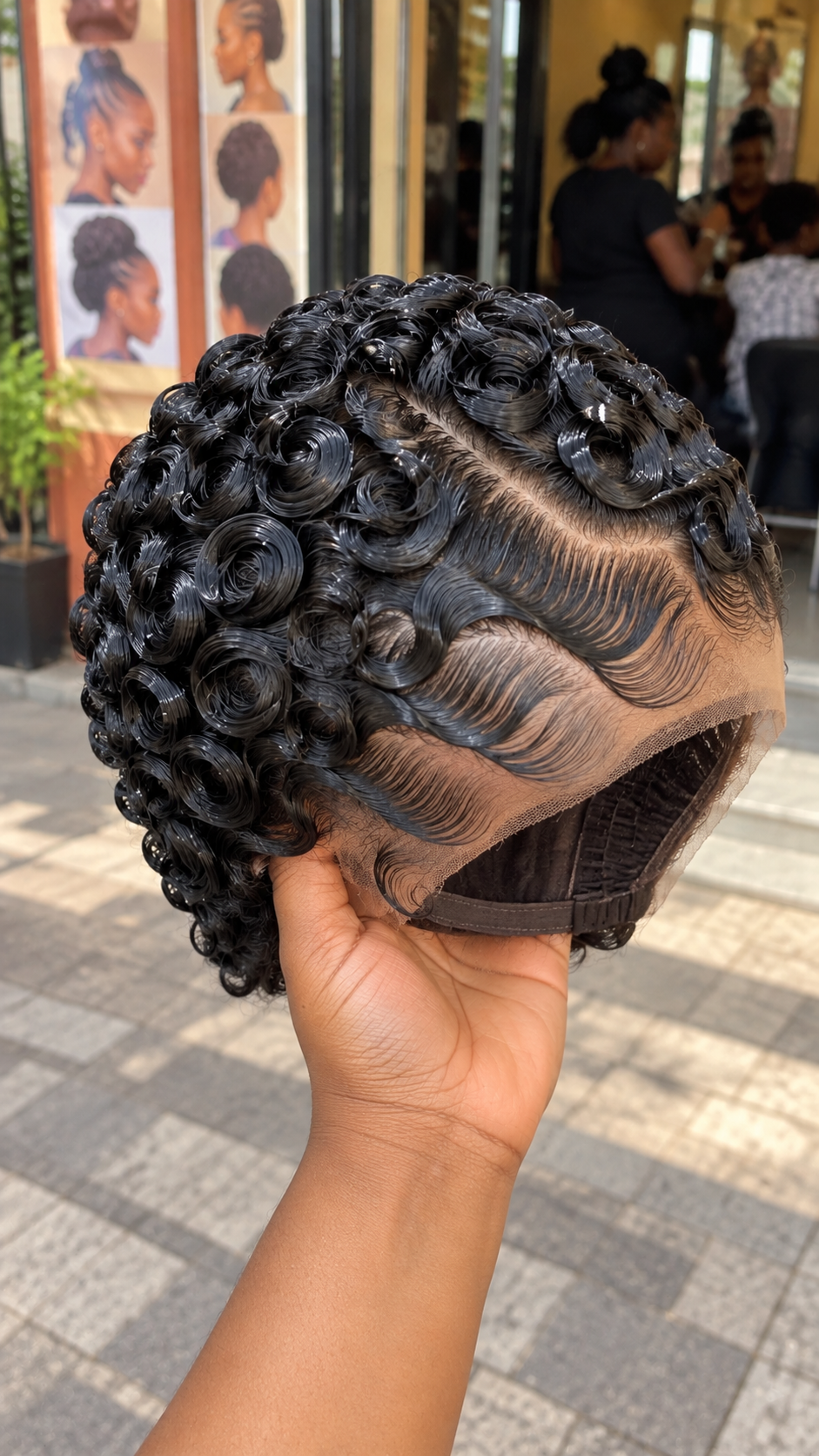
The wig is held in one hand, revealing excess front lace and part of the dark interior cap. That view makes the styling easy to study before installation. You can see how the waves overlap, where the curls begin, and how the outline continues toward the lower edge. For someone considering a similar black finger wave pixie wig, these details provide a useful starting point. The next step is translating the photograph into clear decisions about fit, curl placement, construction, and the amount of upkeep you want.
The Front Waves Deserve Their Own Consultation
The front section is more substantial than a few small edge swoops. Several broad curves travel across the visible lace area, with strands arranged in parallel paths. Their size makes them an essential part of the hairstyle. When ordering a recreation, show the maker which waves you want preserved and how prominent you want them to remain. A unit with tiny front curls may share the same general haircut, but it will not create the same strong framing effect.


Placement matters as much as shape. The upper wave follows the curved part, while the lower sections move toward the outer edge. On a wearer, these elements need to sit appropriately against the forehead and temples. A wave that looks balanced on a stand can appear too low if the cap is positioned differently. Discuss the intended hairline position during fitting, then assess the waves together. Avoid treating front customization as a final decorative step after every other decision has already been made.
You can retain the main design while adapting its intensity. Someone who enjoys an expressive front may want the broad curves close to the reference. Another wearer may prefer slightly shorter or less extended sections. Explain that preference before the final setting is completed. The stylist can then consider how the front connects to the crown curls. Reducing one section without reviewing the neighboring hair can leave the arrangement looking disconnected, especially in a short style where every transition is visible.
Rolled Curls Give the Crown Its Rounded Outline
The curls behind the front waves form open loops, with some resembling small rosettes and others appearing more elongated. They do not all face in the same direction. That variation creates depth across the surface and keeps the crown from looking like repeated identical circles. The hair remains black throughout the visible styling, with light tracing the curved strands. Those reflections reveal the arrangement without establishing a second color or confirming which finishing products were used.
The upper curls have enough lift to create fullness, but the overall outline remains short. Along the visible side, the curls continue downward and become more compact near the lower edge. This helps the body of the wig connect with the front rather than forming an isolated mound on top. Ask a maker to show the side and back of their proposed unit. A convincing front photograph cannot establish whether the crown is proportionate or whether the back has the fullness you expect.
For this look, describe the silhouette instead of asking automatically for maximum density. Extra hair can crowd the curl centers, widen the sides, or make the front harder to position. You want sufficient coverage between the arranged sections while preserving the open circular shapes. Ask how the supplier plans to achieve that balance. A density percentage can be part of the product description, but photographs of the finished unit are more useful for judging its actual shape.
Decide What You Want to Wear Every Day
Before choosing a construction or placing an order, consider how this wig will fit into your routine. Its cropped length keeps hair away from the shoulders and reduces the amount of loose length to manage. However, the sculpted front and rolled curls still need careful handling. If you prefer to put on a wig and make only small adjustments, ask for a unit and care plan designed around that expectation. If you enjoy styling, you may be comfortable with more frequent touch-ups.
Think about whether this will be a regular workday option, an occasion hairstyle, or part of a rotation. That affects how much convenience you need from the fit and how often you are willing to book professional maintenance. A short wig can be practical without being maintenance-free. The useful question is whether the specific arrangement suits your available time. Ask the seller what the unit normally needs between wears and what happens when the set is washed.
The design also leaves room for visible earrings and an open neckline, but accessories should be considered during fitting. Glasses may sit near the temple waves, while a snug hat or scarf can press against the crown curls. Bring the frames you normally wear to your appointment. If you regularly cover your wig during travel, ask how to do so without flattening the set. These ordinary details help determine whether the finished style will be comfortable beyond the initial salon presentation.
How To Order This Style
Look for wig makers, boutiques, and salon specialists who already show molded finger waves and short pin curls in their portfolios. Search terms such as “black finger wave pixie wig,” “short sculpted curl wig,” and “pin curl wig with waved front” can help locate suitable examples. Study the photographs carefully. Loose curls, small coils, and flat finger waves can all appear under similar product names, even though they require different styling and produce different silhouettes.
Send the reference with a short explanation of your priorities. Identify the broad front waves, the curved side part, the rolled crown curls, and the rounded short outline. Ask whether the supplier has a ready-made unit close to the image or would need to create one. Request examples of comparable work from several angles. A maker who understands the design should be able to discuss where the curls change direction and how the front arrangement will be adapted to fit.
Confirm whether you are purchasing a finished wig, a base unit, or a separate styling service. The quote should identify the hair material, cap size, construction, color, cut, and included preparation. Ask whether lace trimming and fitting are part of the price or require another appointment. For a custom order, agree on which details will be reviewed before dispatch. For a stock purchase, request a video of the actual item so you can compare it with the advertised photograph.
Read the return and alteration terms before paying, particularly if the unit will be cut or styled specifically for you. Keep the reference, written specification, and supplier responses together. If the finished wig differs from the agreement, those details make the discussion clearer. Rather than saying only that it looks wrong, you can identify a narrower wave, a different part position, or a crown that is fuller than requested. Specific communication helps both the original order and any later adjustment.
Choose Between a Closure and a Frontal With Purpose
The photograph shows front lace, but it does not establish the exact lace dimensions or the full construction. Ask the seller to describe those details and provide an interior photograph. A closure-based unit may suit a style with a limited parting area, while a frontal can offer a broader front area for customization. The appropriate option depends on where the waves and part need to sit. Do not select a construction solely because its name sounds more elaborate.
If you want this visible curved part reproduced accurately, ask whether the proposed base supports its location. A fixed or limited parting area may restrict later changes. A wider lace area may allow additional placement options, but the finished curls would still need to be rearranged when the part moves. Construction and styling are related decisions. A unit can provide parting space without arriving prepared for every possible hairstyle, so agree on the actual finished arrangement.
Also ask which parts of the cap are wefted, lace-based, or otherwise constructed. The dark interior visible here cannot establish every component. An inside-cap video can show adjustment features and help the seller explain how the unit is fitted. If you have specific comfort preferences, discuss them before ordering. The goal is a cap that supports the styling and sits correctly, with a front that can be customized to your needs.
Fiber Choice Changes the Care Conversation
Neither the shine nor the visible strands can confirm whether the wig is human hair, synthetic, or a blend. Request that information in writing. Then ask how the supplier created the curls and waves. Some arrangements depend on a temporary set, while others may combine a manufactured texture with additional styling. This distinction matters after cleaning. You need to know whether the hair retains its general curl pattern and which finishing steps are required to restore the photographed shape.
If the unit is synthetic, obtain the specific care directions and any manufacturer-approved heat limits. Do not assume that a sculpted appearance means heated tools are suitable. If it is human hair, ask about processing and the recommended method for resetting the short curls. Your choice should reflect how you intend to use the wig. Someone who wants a consistent style may prioritize different qualities from someone who regularly changes the part, curl size, or overall finish.
Ask the supplier to explain the practical advantages and limitations of the material they offer. A lower-cost option may suit occasional wear, while another may better support repeated restyling. However, material labels alone do not establish workmanship, comfort, or how closely the unit matches the reference. Compare the complete product and its care needs. A well-described wig with a realistic maintenance plan is easier to assess than one promoted only through broad claims about quality.
A Comfortable Fit Comes Before Cutting Lace
Use the maker’s measurement instructions when choosing the cap size. Circumference is useful, and some suppliers also request measurements across the head or from front to nape. Provide the information they need rather than guessing from a previous purchase. Cap shapes can differ. With a short wig, positioning around the temples and ears is particularly noticeable because longer hair is not available to conceal an edge that sits somewhere unintended.
Try the unit over the preparation you plan to use regularly. An uneven base beneath the cap can change the crown height or push one side outward. Once positioned, check the front waves, part, sides, and nape together. Turn your head and look down to assess stability. Adjustment straps may help within the cap’s intended range, but they cannot correct every size mismatch. If the fit remains uncomfortable, discuss another size or a professional adjustment before altering the lace.
The lace in this photograph extends beyond the styled front and remains untrimmed. Its final shape should be established after the cap placement is settled. If you are new to lace customization, book a wig stylist who can preserve the front arrangement while fitting the edge. Ask about lace shade and any preparation needed for your preferred finish. The mesh color shown against a hand-held background does not establish how it will appear on a particular wearer.
Five Budget Levels for a Finished Purchase
The following table uses illustrative budget bands in US dollars. These are planning examples, not verified prices for the photographed wig or a current market price list. Actual quotations depend on the documented material, cap, styling, fitting, and included services. A higher amount does not automatically prove a better match. Use the tiers to organize your options, then compare the complete specifications and the work each supplier can demonstrate.
| Price Tier | Illustrative Budget | Purchase Option | What Needs Confirmation |
|---|---|---|---|
| Budget Base | Under $75 | A stock short unit or basic wig for further customization | Whether the front waves and rolled curls are included or require separate styling |
| Ready-Styled Selection | $75–$150 | A completed stock wig in a standard size and color | The actual finished appearance, material, cap measurements, and care instructions |
| Salon-Finished Purchase | $150–$300 | A suitable base combined with cutting, setting, or fitting | Which services are covered and whether lace preparation is additional |
| Custom Specification | $300–$500 | An order with agreed fit, part placement, and front-wave details | The construction, review process, alteration terms, and delivery condition |
| Premium Custom Package | Above $500 | A bespoke project or package with additional appointments and aftercare | The materials, workmanship, and specific services supporting the total |
Compare the total required to reach the same wearable result. One offer may cover only an unstyled base, while another includes the cut, curl setting, fitting, and lace preparation. Delivery, taxes, installation, and later resets may be separate. Ask for a written breakdown when several services are involved. If you need to simplify the order, prioritize correct fit and accurate styling. Optional packaging and accessories will not improve a misplaced front or a cap that does not sit comfortably.
Keep some room in your personal budget for maintenance if you cannot recreate the set yourself. Ask whether the original supplier offers resetting or whether a local stylist can maintain the unit. You do not need to commit to a fixed service schedule before trying it, but you should understand who can help and what work may be needed. The initial purchase is only one part of owning a hairstyle whose appearance depends on deliberate curl and wave placement.
Book a Stylist Who Understands the Whole Arrangement
When making an appointment, ask for experience with short wig styling, molded waves, or pin curl sets. Send the image in advance and explain whether you need a new unit, fitting, installation, or a restyle of an existing wig. If you already own the base, provide its material information and current photographs. This helps the stylist assess the request and reserve enough time. A general booking for curls may not communicate the work required for the broad front sections.
During consultation, review the overall outline before focusing on individual loops. Agree on crown height, side fullness, and the lower edge. Then discuss the curved part and front-wave placement. Ask whether you can check the fit before the final set is completed. A clear sequence helps prevent attractive details from being arranged on a shape you do not want. Also decide how the unseen side and back should look, since the reference does not provide a complete view of every section.
For daily removal, discuss a suitable glueless fit and ask how its stability is achieved. The image does not verify that this unit is designed for glueless wear. If you prefer a secured installation, have the stylist explain the method and follow the relevant product directions. In either case, request removal guidance that protects the lace and styled front. Convenience comes from a routine you can manage comfortably, including taking the wig off and storing it correctly.
Build a Care Schedule Around Its Condition
Before each wear, inspect the front waves and crown for sections that have shifted. Make only the touch-ups recommended for the verified fiber and setting method. After wearing, check for residue, tangling at the lower edge, or compression before storing the unit. Washing and professional resetting should follow the supplier’s instructions and the condition of the wig rather than an arbitrary daily routine. More frequent wear or product use may require different care from occasional use.
Avoid brushing through the finished curls as though they were loose waves. The open loops can separate, and the broad front sections can lose their shape. Support the cap when lifting the wig, and ask your stylist to demonstrate a small correction for a displaced curl. If a large area has flattened, professional resetting may be more effective than repeatedly manipulating neighboring sections. The aim is to preserve the arrangement with the least unnecessary handling.
Before the first wash, clarify what the unit should look like afterward. Follow its specific instructions for products, temperature, and drying. A temporary set may change even when the hair itself remains in good condition. Plan cleaning with that possibility in mind, particularly before an occasion. Do not assume that adding more gel or shine spray will restore a disrupted pattern. Ask which products were used and whether any are appropriate for maintenance between services.
Store the wig on a suitable support that leaves space around the raised curls. Avoid stretching the cap over an oversized form or pressing the front against another object. For travel, choose a protective container that does not crush the crown. Allow the unit to dry fully according to its directions before enclosed storage. These practical habits help protect both the cap and the set, reducing the amount of corrective styling needed before the next wear.
Balance the Benefits With the Styling Commitment
The cropped length, visible curl work, and expressive front make this an appealing option for someone who wants a complete short hairstyle with a clear identity. There are fewer long ends to manage, and the silhouette can remain consistent when the set is protected. The main commitment is preserving the arrangement. Washing, compression, or unsuitable handling may create a need for resetting. Whether that tradeoff suits you depends on your styling confidence and access to a trusted wig professional.
Before accepting the finished unit, inspect it in ordinary light from the front, sides, and back. Compare the waves, part, curl sizes, cap fit, and included components with the agreed specification. For a delivered purchase, do this before alterations that could affect return terms. A carefully chosen unit should preserve the strongest relationship in the reference: broad, close front waves leading into a rounded body of rolled black curls. Accurate fitting and an understood care routine make that look easier to wear well.
Search Terms
black finger wave pixie wig · short rolled curl wig · curved side part wig · sculpted black curls · lace front pin curl wig · broad front waves · short rosette curl hairstyle · black wig with untrimmed lace