
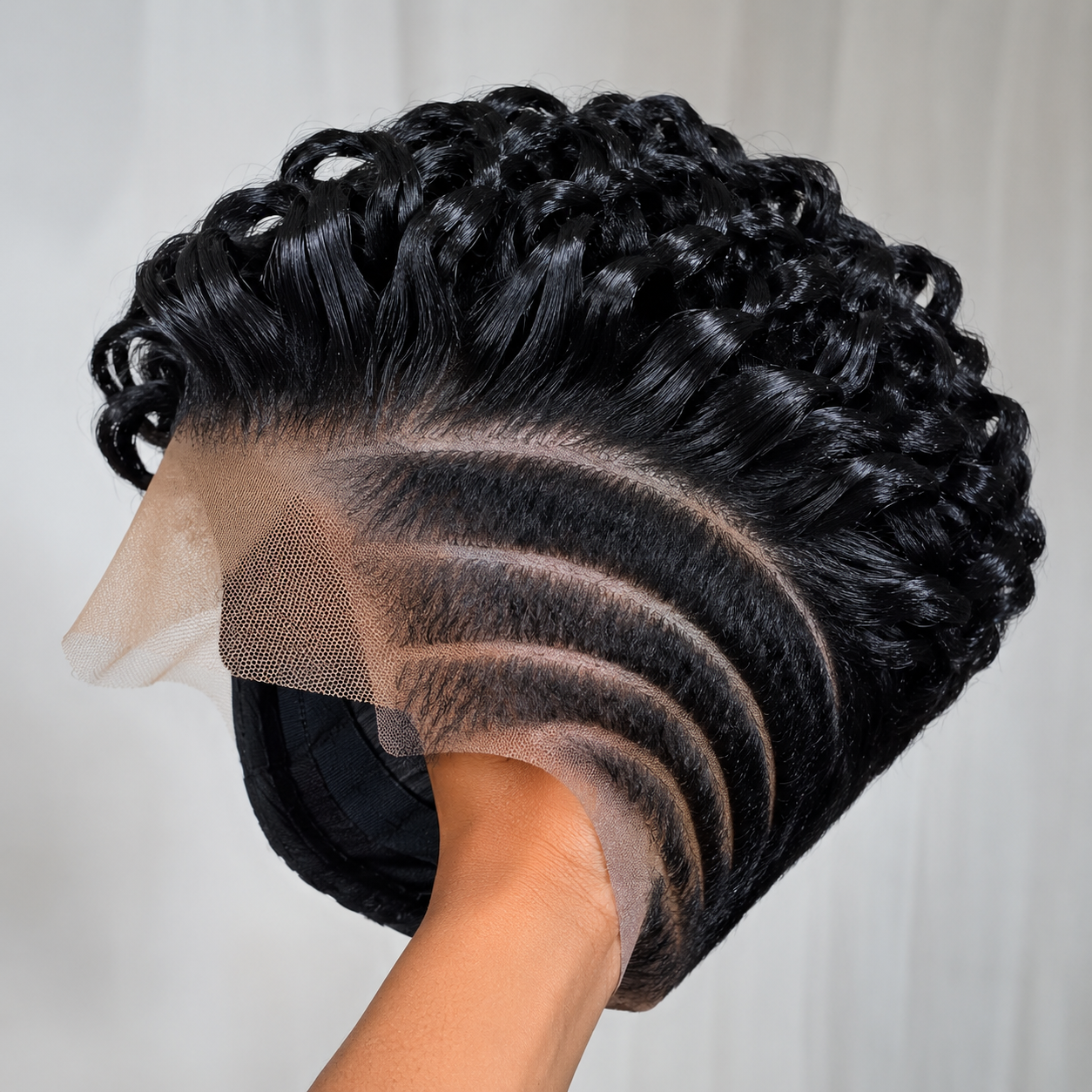
Every hair in that fade was tied into the lace by hand, each one finer than the last, or it was not, and that difference is the whole thing. The tapered side on this unit, where the curl thins down and melts into bare lace, is the make-or-break detail of a short faded style, and there are only two ways to build it. A knotted fade is made by knotting individual hairs into the lace, progressively finer and sparser toward the edge, so it fades to nothing the way a real barbered fade blends into skin. A cut fade is just hair cut short, which can look neat but stays blunter and cannot taper down to true skin. On a faded pixie wig, which one you have decides whether the side looks barbered and real or dropped-off and obvious.
The knotted fade is the harder, costlier, more skilled build, and it is exactly the part cheap units fake or skip. Knotting a convincing fade takes time and a steady hand, tying finer hairs into a sparser and sparser pattern until the lace shows skin through it. A shortcut version cuts the hair short and calls it a fade, or prints a shadow on the cap, and it reads wrong up close because it never melts away. So the fade is where the money and the craft sit on a short unit, far more than in the curls on top.
That is why the fade, not the curl, is the thing to inspect before you buy. The curls are easy to make look good in a photo. A fade that truly melts to skin is not, and knowing whether it is knotted or cut tells you what you are actually paying for.
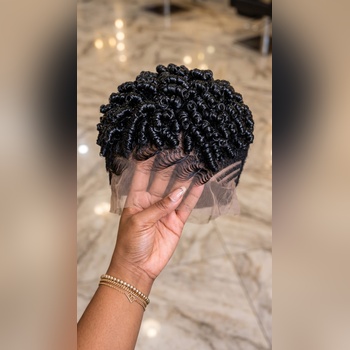
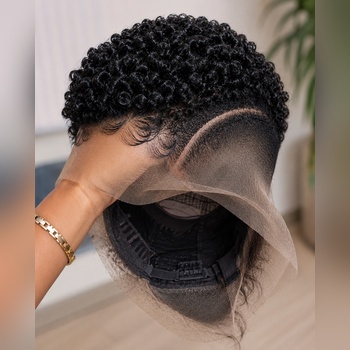
Where To Buy A Faded Pixie Wig With A Real Fade
Custom makers who knot their own fades are the right source, because a melted fade is hand-knotting skill, not a default. Ask directly whether the fade is knotted into the lace or cut short, and to see it close up. A maker who knots fades will show you the taper melting to skin; one who cuts will change the subject to the curls.
Instagram and TikTok sellers show fades from flattering angles, so ask for a close video of the taper where it meets the lace. A faded pixie wig lives or dies at that edge, and a knotted fade melts on camera while a cut one shows a blunt line, which a still photo can hide.
Etsy works with makers who show the fade up close and have reviews mentioning how real the taper looked. The risk is a listing that sells the curls and shows the fade only from a distance. Read reviews for anyone describing the side melting to skin or, tellingly, not.
Marketplaces like Amazon, AliExpress, and Temu mostly ship cut or faked fades, since a knotted fade is costly to build and rare at low prices. That is fine if you want a simple short cut, but do not expect a melted barbered fade. Judge by close-up photos of the taper, not by the overall look.
Local beauty supply shops and salons let you look at the fade up close and see whether it melts or drops off. You pay a premium in-store, but the fade is exactly the detail a distant photo flatters, so seeing it in person helps.
Vendors and wholesalers direct rarely knot fine fades in bulk, so most stock fades are cut. For a genuinely knotted fade, a specialist maker beats general stock.
Regionally, knotted fades on short units come strongly out of Lagos, Accra, Atlanta, London, and across South Africa, where knotters who build melted fades by hand are easy to find on video.
Vet the seller on the fade: check the account age, look for real buyer photos, time a plain question for a genuine reply, and ask outright whether the fade is knotted or cut, and to see the taper close up. A seller who cannot show the fade melting is likely selling a cut one.
Red flags: a fade shown only from a distance, a blunt line where the hair stops, a printed shadow standing in for a fade, and no answer on whether it is knotted or cut.
When you order, send your measurements and ask for a knotted fade that melts to the lace, and say you want to see the taper before it ships. That tells the maker you know the difference.
On payment, thirty to fifty percent down with the balance before shipping is standard for custom work. Use a method you can dispute, and ask for a close photo of the finished fade before releasing the last part.
How Much It Costs
On a faded pixie wig, the fade is the most skilled part, so it is where the price is honestly earned, and a knotted fade costs meaningfully more than a cut one for good reason.
Human hair, full build with a hand-knotted melting fade, bleached knots, and a fine lace: roughly $210 to $450, with the knotted fade a real part of that cost. Human hair, mid build with a simpler fade: about $160 to $320. Human hair, basic cap with a cut, blunter fade: around $80 to $190. Good synthetic with a modest fade: $60 to $140. Basic synthetic: $20 to $55, where fades are usually cut or faked.
The gap between a knotted and a cut fade is real money, and it buys the one thing that makes a short faded style look barbered: a taper that melts to skin. Paying for a knotted fade is paying for the hardest handwork on the unit; paying a knotted-fade price and receiving a cut one is the mislabel to watch for. On this style, the fade is worth more than the curls, so that is where your money should go.
Shipping and any customs charge sit outside the price and change with where you live, so plan a realistic band and confirm your own country’s import rate rather than trusting a single quoted figure.
Then the later costs, which the fade shapes. A knotted fade’s finest hairs are delicate, so gentle handling keeps them intact, and a canvas block plus curl product cover the rest. A cut fade needs occasional trimming to stay sharp. First-year math, honestly: a knotted-fade human unit plus shipping plus any customs plus a small kit plus gentle upkeep tends to land between a low three-figure total and somewhat above the sticker, with the fade being the part to protect rather than a running cost.
Per wear, a good knotted fade is what makes a short unit worth wearing, since the barbered look is the whole appeal. A very low price on a faded style almost always means a cut or printed fade, so read the bargain fade as the shortcut it usually is.
Deposits follow the custom pattern: thirty to fifty percent to start, balance before shipping, and a close photo of the finished fade before the last payment clears.
Shipping, Delivery, And What To Expect After Ordering
A knotted fade can arrive looking crisp, and protecting its fine edge hairs from the first day keeps it that way. Ask that it ship so the fade is not crushed or rubbed, choose a tracked service for custom work, and confirm your country’s import charge before it lands. When it arrives, look closely at the taper: a knotted fade melts to bare lace with skin showing through, while a cut one stops at a blunter line. Handle the faded edge gently, since its finest hairs are the most delicate on the unit. What you unbox should show a taper that fades to nothing, and if it stops abruptly, the fade was cut, not knotted.
A Knotted Fade Melts, A Cut Fade Stops
The clearest way to tell the two apart is to look at where the hair ends. A knotted fade thins gradually into sparser and sparser knots until the lace shows bare, mimicking how a barbered fade blends into skin. A cut fade keeps a fuller density and simply ends shorter, so there is a visible line where the hair stops. Melting to nothing is the mark of the knotted build; a stopping line is the mark of the cut one. Look for the melt.
The Fade Is The Fragile Part
Because a knotted fade is built from the finest hairs tied in the sparsest pattern, it is the most delicate zone on the unit, and rough handling thins it fastest. The same fineness that makes it melt convincingly makes it easy to wear away. Treat the faded edge gently, keep friction off it, and it holds its barbered look; neglect it and the fade goes patchy before anything else does.
The Carved Lines Sit Within The Fade
The parallel arcs shaved into the side here are cut into the faded section, so they depend on the fade being clean to read well. A carved design over a melted knotted fade looks sharp and intentional; the same design over a blunt cut fade looks less crisp. So the fade quality carries the carving too. Judge the fade first, because the design only looks as good as the taper it sits in.
Before You Pay
- Is the fade knotted into the lace, or is it cut short?
- Does the taper melt to bare lace, or stop at a blunt line?
- Can I see the fade close up, not just from a flattering distance?
- Am I paying a knotted-fade price for what is actually a cut fade?
- Do any carved lines sit within a clean fade, or over a blunt one?
Trimming The Lace
The lace comes off the front the usual way, but take special care near a knotted fade, because its fine hairs sit right where the lace meets the taper and a careless cut thins them. Trim in small offset steps and leave a shallow margin rather than cutting flush, and keep the blade clear of the faded edge entirely. If this is your first faded unit, let a stylist make the first pass, since preserving a melted fade while cutting the lace takes a careful hand, and a nicked fade cannot be knotted back at home.
Search Terms
faded pixie wig · knotted fade pixie wig · tapered curly pixie unit · melted fade short wig · barbered fade lace pixie · glueless faded curly wig · short curl fade wig · knotted taper pixie lace
Final Thoughts
This unit is a short faded style, and the fade is the part that decides whether it looks barbered and real or blunt and obvious. There are two ways to build it: knotted, where fine hairs are tied into the lace to melt down to skin, and cut, where the hair is simply shortened. The knotted fade is the harder, costlier, more skilled build, and it is the one that makes a short unit look like a fresh fade rather than a wig with short sides.
Buy it by inspecting the fade before the curls, asking whether it is knotted or cut, and looking for a taper that melts to bare lace rather than stopping at a line. Pay for the knotted build if you want the barbered look, because that handwork is where the realism lives, and protect its fine edge once you have it. A faded pixie wig with a real knotted fade is one of the most convincing short styles there is; one with a cut or faked fade gives itself away at the side. The curls draw the eye first. The fade is what proves the unit.