
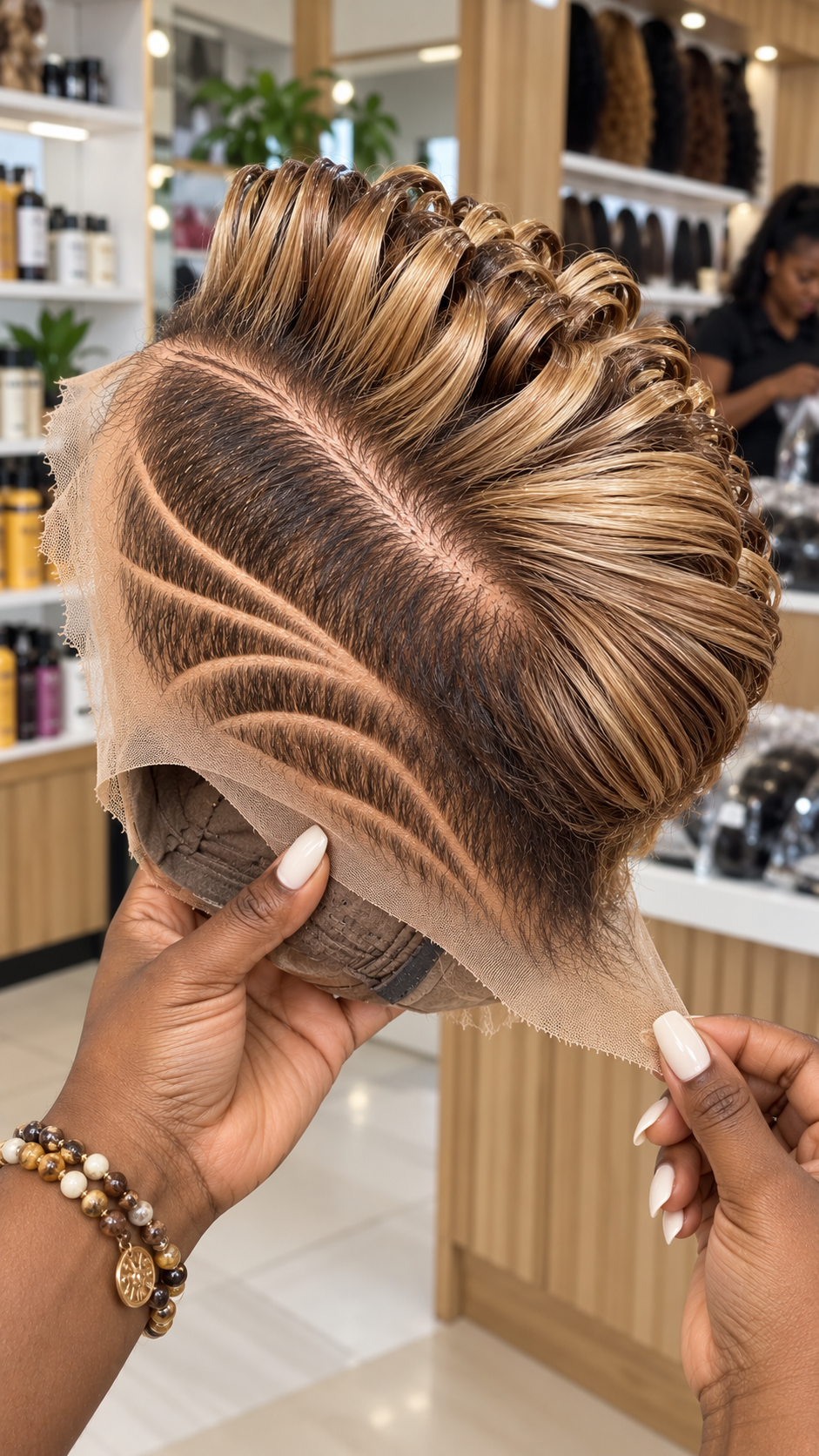
A beautifully lifted crown and precision-styled sides can transform a short hairstyle into something truly memorable. This golden blonde pixie wig combines sweeping, sculpted loops with dark roots and artistic curved side details. Its striking combination of warm blonde hair, dramatic upward movement, and closely arranged side sections makes it an attractive choice for women who appreciate short hairstyles with personality.
The most noticeable element is the voluminous upper section. Golden blonde strands rise from the front hairline and travel backward in broad, carefully shaped loops. Darker brown and black roots remain visible beneath the lighter hair, creating a beautiful contrast that emphasizes the direction of the styling.
Along the visible side, the hair becomes significantly shorter and darker. Narrow curved channels create decorative arcs that follow the contour of the head. These details introduce a barber-inspired character while preserving the elegant appearance of the raised blonde crown.
The photograph shows the wig being held inside a professional beauty supply store. Its untrimmed beige lace extends around the hairline, while part of the interior cap is visible beneath the hairstyle. This view reveals useful construction details for women interested in purchasing or commissioning a similar unit.
The Beauty of a Golden Blonde Quiff
The hairstyle’s defining characteristic is its elevated quiff. Instead of falling toward the forehead, the longer strands rise upward before curving backward across the crown.
Several broad loops occupy the upper front, creating height and movement. Their carefully arranged positions give the hairstyle an expressive appearance without requiring long hair around the shoulders.
The strands are grouped into distinct sections, allowing each loop to remain visible. Some rise almost vertically, while others lean backward and gradually blend into the rear.
This arrangement creates a flattering contrast between the fuller top and closely styled lower sides. It also allows the golden color to catch the light from several directions.
For a similar result, the upward movement of the front sections should be preserved. Replacing these broad loops with ordinary ringlets would noticeably change the hairstyle’s character.
Golden Blonde Highlights and Dark Roots
Color plays an essential role in the overall appearance. The crown contains warm golden blonde strands mixed with deeper honey and light brown tones.
The roots remain considerably darker, creating contrast between the foundation and the elevated blonde sections.
As the strands rise from the hairline, the warmer blonde coloring becomes more prominent. This transition gives the hairstyle depth and makes the individual sections easier to distinguish.
The darker base also connects the blonde crown with the closely styled side hair, creating a coordinated appearance.
Women searching for a similar shade may encounter descriptions such as golden blonde, honey blonde, caramel blonde, and dark-root blonde.
Because these color names vary between suppliers, request photographs in natural daylight before purchasing. The distribution of the blonde and darker strands matters just as much as the overall shade.
Broad Loops Give the Crown Its Distinctive Shape
The upper hair features elongated loops rather than conventional tight spiral curls. These sections resemble flowing ribbons, with fine strands running in the same direction.
Some loops form prominent openings near the highest part of the crown. Others gradually curve downward toward the rear.
This combination creates a layered appearance without making the hairstyle excessively wide.
The front loops contribute the greatest height, while those toward the back become smaller and more closely arranged.
For custom styling, the size and orientation of these loops should be discussed before construction begins. Their shape determines much of the finished silhouette.
A professional wig maker may use suitable setting and sculpting techniques to reproduce the appearance, depending on the fiber composition.
The Swept-Back Crown Creates Natural Direction
Although the upper sections are carefully sculpted, their overall movement follows a consistent direction from front to back.
The hair rises from its darker foundation, bends across the crown, and gradually settles toward the rear.
This gives the hairstyle a flowing appearance despite its structured construction.
Unlike a conventional rounded curly pixie, the crown has an obvious directional pattern. The longer upper strands create a lifted shape that resembles a short pompadour.
When commissioning a reproduction, emphasize that the hair should be swept backward rather than arranged into a uniform collection of circular curls.
Maintaining this direction is essential to preserving the photographed hairstyle.
Layered Side Arcs Add Artistic Detail
The visible side contains carefully arranged curved channels that create one of the hairstyle’s most distinctive features.
These channels follow sweeping paths through the closely styled dark hair. Their shapes resemble nested arcs, with the upper separation extending diagonally and the lower sections bending around the side.
The surrounding hair remains dark and comparatively flat, allowing the lighter-looking separation lines to stand out.
The arcs complement the direction of the upper blonde strands without duplicating their shape.
Because the photograph shows a wig, the precise method used to form the channels cannot be determined. The appearance may involve careful trimming, directional styling, or specialized wig construction.
For a faithful reproduction, the original placement, spacing, and curvature should be maintained rather than introducing additional decorative markings.
Why the Dark Side Balances the Blonde Crown
The hairstyle brings together two distinct areas of styling. The crown contains longer blonde strands with elevated volume, while the lower side remains dark and closely arranged.
This contrast gives the design its recognizable pixie proportions.
If the lower side contained the same amount of hair as the crown, the hairstyle would appear considerably fuller and the curved channels might become hidden.
The dark side also creates a strong visual foundation beneath the golden upper section.
For women considering custom construction, the difference between upper and lower density should be discussed with the wig maker.
The goal is to preserve a pronounced but balanced transition between the raised crown and the precision-styled side.
A Beautifully Sculpted Front Hairline
At the front, shorter dark strands emerge from the root area and continue into the longer blonde sections.
The hairline follows a coordinated upward direction, helping create the lifted appearance of the quiff.
Instead of a heavy fringe, the front remains comparatively open. Fine strands are arranged close to the foundation before joining the raised styling above.
This transition is particularly important when preparing the wig for installation.
Excessive brushing, pulling, or trimming could disturb the intended hairline shape.
A professional stylist should assess the front foundation carefully before completing any installation adjustments.
Understanding the Visible Lace Foundation
The photograph clearly shows beige lace extending beyond the styled front and side hairline.
The material remains untrimmed, indicating that the wig is being displayed before final installation preparation.
The mesh supports the carefully arranged front strands and surrounding side styling.
However, its exact grade, thickness, transparency, and complete dimensions cannot be reliably established from the photograph.
Buyers should not assume that the unit contains HD lace without confirmation from the manufacturer.
Before ordering a similar wig, request detailed photographs showing the complete lace area and ask about available lace shades.
Correct preparation and positioning can help the hairline sit naturally while preserving the sculpted design.
The Interior Cap and Wig Construction
Part of the interior cap is visible beneath the hairstyle. The foundation appears to contain brown fabric sections and internal stitching.
These components support the hair and contribute to the overall structure of the wig.
The photograph does not reveal every attachment feature or the complete adjustment system.
Before purchasing, ask the seller whether the cap includes adjustable straps, combs, clips, or other securing components.
Measurements should include head circumference, ear-to-ear width, and front-to-nape length.
Correct sizing is especially important for hairstyles with detailed side patterns because the placement of the arcs should remain consistent when the wig is worn.
Choosing Between Lace Front and Frontal Construction
Similar short hairstyles may be available with lace-front, frontal, closure, or other adjustable-cap constructions.
Each offers different possibilities for hairline styling and installation.
A frontal generally provides a broader lace area across the front than a closure, which may be helpful for certain detailed temple styles.
However, the most appropriate foundation depends on how the hairstyle is constructed.
The photograph does not establish a specific frontal measurement or closure type.
Ask the wig maker which construction can reproduce the lifted crown and decorative side channels while providing a comfortable fit.
Getting the Right Hair Length
When choosing a sculpted quiff, finished height is often more important than the advertised length of the individual strands.
Hair that is shaped into raised loops appears considerably shorter than it would when stretched straight.
The photographed hairstyle contains enough length to form prominent upper arches without allowing the hair to hang down the sides.
For custom orders, discuss the desired crown height, loop width, and finished rear length.
Ask whether the supplier measures hair before or after styling.
The objective should be to recreate the compact swept-back silhouette rather than simply choosing the longest available option.
Choosing the Appropriate Hair Density
The upper crown requires enough hair to produce full, sculpted loops. However, excessive density can crowd the individual sections and make the styling appear bulky.
The photograph shows noticeable volume with clear separation between the raised blonde strands.
The lower side requires a different approach because the hair sits much closer to the foundation.
This allows the decorative channels to remain visible without being covered by excess hair.
When ordering, discuss the intended density of the crown and sides separately.
An exact density percentage cannot be established from the image, so the stylist should recommend suitable specifications according to the desired finished appearance.
Where to Buy Similar Blonde Pixie Wigs
Women interested in this hairstyle can explore specialized wig boutiques, local beauty supply stores, online hair retailers, and independent wig makers.
Professional salons offering custom short wigs may also provide similar styling services.
However, many products advertised as blonde pixie wigs contain loose curls, ordinary short layers, or uniformly blonde hair.
This particular design is distinguished by its golden lifted loops, darker roots, and curved side details.
When comparing products, examine photographs of the actual styling instead of relying exclusively on product descriptions.
Custom construction may be preferable when an exact match to the crown shape and side pattern is required.
Get The Details On This Wig
The photograph does not establish a verified manufacturer or seller of the exact unit.
To find a similar hairstyle, contact wig makers experienced in sculpted pixies and precision side detailing.
Send the reference photograph and explain that the blonde swept-back crown and darker curved side sections are essential.
Ask whether the hairstyle is available ready-made or requires custom production.
Request photographs of previous work showing similar elevated crowns.
Confirm fiber composition, lace construction, cap measurements, color placement, and maintenance requirements.
Contact can generally be arranged through telephone, WhatsApp, direct messages, or the supplier’s ordering platform.
Before payment, verify the final price, shipping arrangements, production schedule, and return conditions.
Finding a Professional Stylist for Installation
A stylist experienced in lace wigs, short pompadours, and precision hairline work is a suitable professional for installing this hairstyle.
During consultation, emphasize the need to maintain the upward direction of the blonde loops.
The stylist should inspect the lace foundation and cap fit before trimming or making adjustments.
If the loops have become compressed during transportation, restoration methods should be selected according to the actual hair material.
The lower side should remain closely arranged so the curved pattern stays visible.
Correct installation helps preserve the hairstyle’s intended proportions and can improve comfort during wear.
Glueless and Adhesive Installation Options
Some women prefer glueless wigs because they can be removed without applying adhesive around the hairline.
Others choose adhesive-based installations depending on their preferences and the wig’s construction.
The photograph alone does not confirm whether this particular unit is designed for secure glueless use.
Suitable securing features and correct cap measurements are important for adhesive-free installation.
For adhesive installation, products should be compatible with the lace and appropriate for the wearer’s skin.
Whichever method is selected, the front hairline and curved side design should remain correctly positioned.
Illustrative Prices for Sculpted Blonde Pixie Wigs
The cost of a similar hairstyle depends on the fiber composition, cap construction, color preparation, and complexity of the sculpted styling.
The following USD amounts are illustrative budgeting estimates rather than verified current retail prices for the photographed wig.
| Wig Tier | Illustrative Price Range | Potential Features and Services |
|---|---|---|
| Budget | $40–$110 | Basic synthetic blonde pixie wigs with simplified lifted styling and standard caps. |
| Value | $90–$215 | More consistent blonde loops, darker root coloring, and selected adjustable cap features. |
| Mid | $165–$380 | Selected higher-quality or human-hair bases with additional sculpted styling and side preparation. |
| Premium | $310–$680 | Custom blonde quiff styling, dark-root blending, decorative side arcs, and lace preparation. |
| Salon-Grade | $540–$1,350+ | Bespoke construction, personal measurements, specialist sculpted styling, color customization, and professional fitting. |
Actual costs vary according to the seller, country, materials, and included services.
Custom color blending and precision side work may increase the final quotation compared with a conventional short blonde wig.
Ask whether the quoted price includes the completed wig, styling, lace preparation, installation, and shipping.
Evaluating Quality Before Purchasing
Begin by examining the direction and shape of the blonde upper sections. They should rise from the front and sweep backward in broad loops.
Next, inspect the darker root transition and verify that the color placement resembles the reference.
Check the curved side channels for appropriate spacing and placement.
Request photographs of the actual wig from the front, both sides, rear, and underside.
Ask how the sculpted loops are maintained and whether they can be restored after cleaning.
Cap comfort, seller reliability, and construction quality should also influence the purchasing decision.
Maintaining the Raised Blonde Loops
The upper hairstyle requires careful handling because its shape depends on the arrangement of individual sculpted sections.
Repeated brushing can separate the strands and disturb the raised loops.
Excessive pressure may flatten the crown and reduce its characteristic height.
Ask the supplier how the original styling was created and which maintenance products are compatible with the fiber.
Synthetic hair should not be exposed to heated styling tools unless the manufacturer specifically approves them.
Human hair may permit additional styling techniques, but previous coloring and strand condition should be considered.
Professional resetting may be beneficial when the loops lose their original shape.
Protecting the Golden Blonde Color
Care requirements depend on whether the wig contains human hair, synthetic fibers, or a combination.
Color-treated human hair may benefit from suitable products designed for processed strands.
Synthetic fibers have different limitations and should not automatically be treated with conventional hair dyes or toners.
Excessive heat and unsuitable products can affect the appearance of some wig materials.
Before using any treatment, confirm the fiber composition and follow the manufacturer’s instructions.
Because warm indoor lighting can intensify golden tones, evaluate the color in daylight when determining whether additional color work is necessary.
Preserving the Decorative Side Arcs
The curved channels depend on the surrounding dark strands remaining correctly positioned.
Excessive product buildup or repeated combing across the side may reduce their clarity.
Inspect the arcs regularly and avoid widening or reshaping them without professional guidance.
The correct restoration technique depends on how the original pattern was constructed.
If the lines become difficult to maintain, consult a stylist experienced in precision wig work.
Maintaining the original curves will help preserve the hairstyle’s recognizable appearance.
A Practical Maintenance Routine
After each wear, inspect the crown for flattened loops and the side for displaced strands.
During regular use, examine the hairstyle weekly for tangling, product buildup, or changes in its shape.
Cleaning frequency depends on the fiber, wearing conditions, and amount of styling product used.
A wig worn occasionally may require less frequent washing than one used daily.
Professional maintenance may become necessary when several loops lose their structure or the side detailing becomes difficult to preserve.
These recommendations are general starting points rather than a fixed schedule for every wig.
Manufacturer-specific instructions should always take priority.
Storing the Wig Without Flattening the Crown
A supportive wig stand can help protect the elevated styling between uses.
Avoid placing heavy objects on the crown or storing the wig inside a tightly packed bag for extended periods.
The sculpted loops need sufficient space to retain their curved structure.
Protect the lace foundation from stretching and unnecessary pressure.
After cleaning, allow the wig to dry fully according to the supplier’s instructions.
For travel, use suitable packaging that reduces compression around the upper sections.
Styling Golden Blonde Hair for Different Occasions
The warm blonde coloring pairs beautifully with chocolate brown, cream, black, olive green, and neutral clothing.
Gold jewelry can complement the honey-toned strands, while understated silver accessories introduce a cooler contrast.
Colorful Ankara fabrics can also work well, especially when their patterns contain warm earthy shades.
For formal occasions, the lifted crown provides enough decorative interest without requiring additional hair ornaments.
Small earrings may be particularly suitable when the curved side details are intended to remain visible.
The hairstyle can also complement casual outfits when the wearer prefers an expressive short look.
Advantages of This Short Blonde Hairstyle
One significant advantage is its combination of dramatic crown volume and compact overall length.
The golden blonde loops create movement without long strands hanging around the shoulders.
The darker roots add depth, while the precisely styled side introduces an artistic element.
A wig allows women to experiment with a short blonde hairstyle without permanently coloring or cutting their natural hair in the same way.
The design also provides an opportunity to enjoy elaborate styling while maintaining the recognizable silhouette of a pixie.
Possible Limitations to Consider
The raised loops may require more careful maintenance than ordinary loose curls.
Compression during storage or transportation can affect their shape.
The decorative side channels may require professional attention if their arrangement becomes displaced.
Custom coloring and precision styling can also increase production costs.
Correct cap sizing is particularly important because the side pattern should sit in the intended position.
Women seeking extremely low-maintenance wigs should consider these factors before purchasing.
A Beautiful Combination of Blonde Volume and Precision Styling
This hairstyle celebrates the artistry of short hair through its elevated golden blonde loops, darker root transition, and carefully arranged curved side accents.
The raised crown provides dramatic movement, while the closely styled lower section introduces balance and structure. Together, these details create a distinctive pixie that combines warm color with precision-inspired styling.
For women considering a similar wig, the most important factors are the finished crown height, loop direction, color distribution, side-pattern placement, cap construction, and maintenance requirements.
Before ordering, request photographs of the actual product and verify its materials, measurements, and customization options.
With suitable construction, comfortable installation, and thoughtful care, a similar blonde quiff can offer a striking short hairstyle that showcases beautiful color and carefully sculpted hair.
Search Terms
Golden blonde quiff pixie wig · Honey blonde swept back crown wig · Blonde pixie with curved side arcs · Dark root blonde pompadour hairstyle · Sculpted golden blonde loop wig · Short blonde quiff with dark sides · Blonde lace front pixie with side design · Golden blonde swept crown with carved curves