
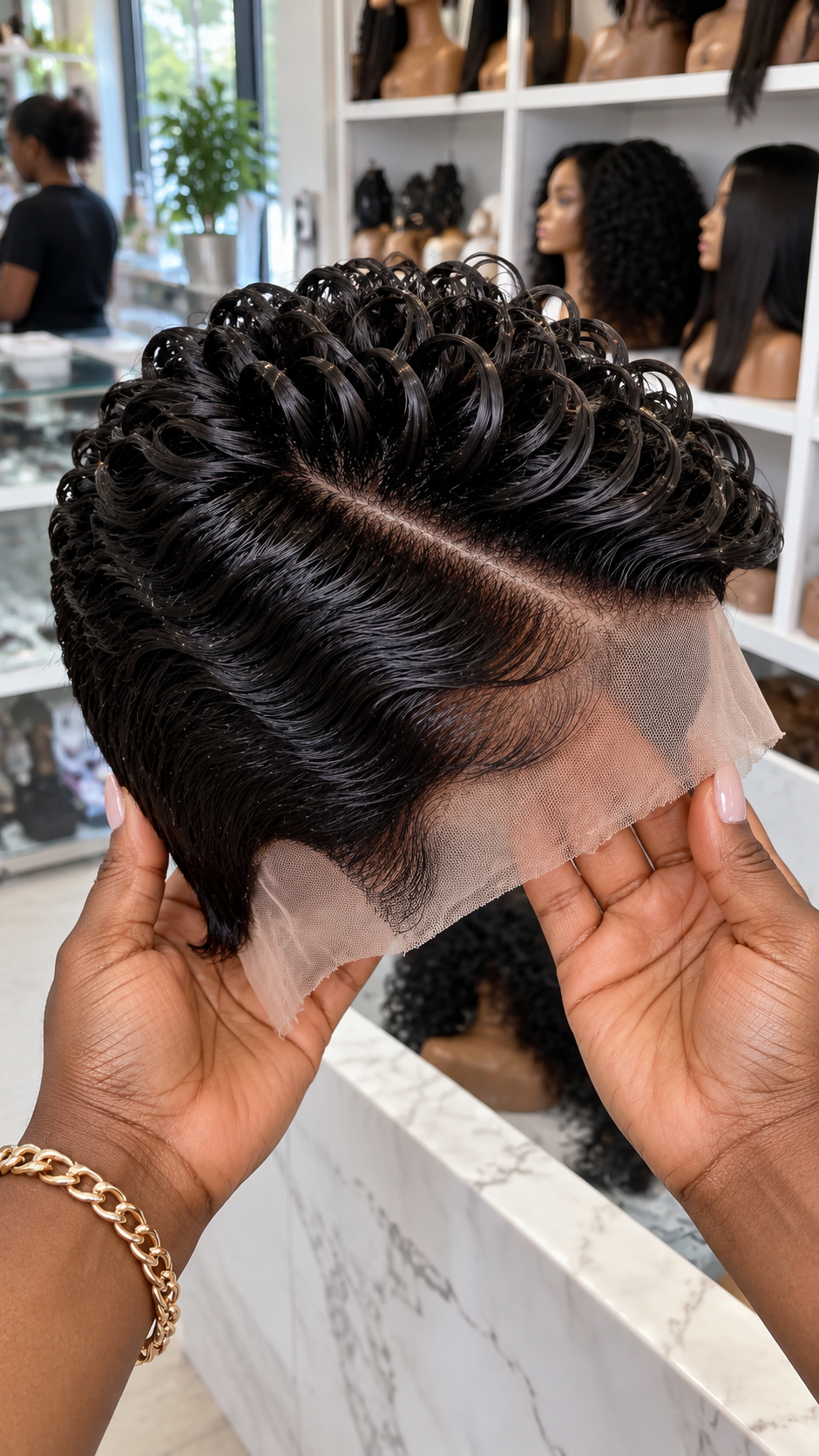
Short black hairstyles can achieve remarkable beauty when their shape is created through carefully arranged strands rather than excessive length. This striking pixie wig combines elevated looped curls across the crown with smooth, backward-sweeping side layers. Its glossy black coloring, visible diagonal parting, and compact lower silhouette create an attractive balance between volume and precision.
The photograph presents a beautifully styled black lace wig being held by two hands inside a bright hair salon. The upper section contains elongated loops that rise from the crown and bend into curved shapes. Below these lifted curls, the hair follows a smoother direction, traveling backward along the visible side. A diagonal parting separates the two areas, giving the hairstyle a distinctive structure.
Unlike pixie wigs covered with small circular rosettes, this design uses broader, more open loops. Several strands rise into upright arches, while others turn backward and blend into the surrounding hair. The curls are arranged closely enough to create fullness but remain separate enough for their individual shapes to be appreciated.


The lower side has a considerably flatter appearance. Long, aligned strands form sweeping layers that follow the contour of the wig. Near the lower edge, the hair becomes more compact, maintaining the short silhouette associated with pixie styling.
Another noticeable element is the beige lace extending beyond the front and temple. Its visibility reveals the wig before installation and allows a closer examination of the hairline arrangement. Although the lace appears fine, the exact grade and construction cannot be determined from the photograph alone.
For women who appreciate black pixie wigs with beautiful crown volume and carefully arranged sides, this hairstyle provides an attractive alternative to conventional curly units. Its identity comes from the relationship between the lifted loops, diagonal separation, and flowing lower hair.
The Raised Crown Gives This Pixie Its Personality
The most prominent part of the hairstyle is the elevated crown. Numerous black loops rise from the upper hair, creating an airy arrangement that looks full without appearing excessively heavy.
Some loops bend into broad circular shapes, while others resemble narrow arches. The strands remain closely aligned within each formation, creating smooth surfaces that reflect light.
The varying orientation of the loops makes the upper section particularly interesting. Several rise almost vertically before turning backward. Others curve sideways, creating a layered effect across the crown.
Rather than falling over the forehead as long bangs, the lifted sections remain close to the overall pixie shape. This allows the upper hair to appear voluminous while keeping the finished hairstyle compact.
The arrangement also introduces noticeable depth. Light catches the outer surfaces of the loops, while their interiors remain darker. These differences in brightness emphasize the direction and movement of individual strands.
When purchasing a comparable wig, customers should examine the crown carefully. Ordinary loose curls may provide fullness, but they do not necessarily reproduce this elevated, backward-flowing structure.
Open Loops Versus Traditional Spiral Curls
There is an important visual difference between the curls in this hairstyle and conventional spiral ringlets.
Traditional ringlets often form compact circular coils with recognizable centers. Some resemble tightly wound springs, while others create small rounded rosettes.
The photographed hairstyle uses more elongated formations. Its loops rise from the crown and bend backward, producing an arrangement that appears lighter and more directional.
Several loops remain open rather than winding into tightly packed circular centers. This gives the upper section additional movement and creates a distinctive silhouette.
A custom stylist should preserve the loop width, direction, and height rather than replacing them with small, densely arranged curls.
The photograph does not establish which tools or techniques were used to form the loops. The maker should explain whether the selected hair material can retain the intended shapes and how they can be restored after washing.
A Diagonal Parting Separates the Styling Sections
A prominent diagonal separation travels through the visible upper side of the wig. It creates a boundary between the raised crown and the flatter hair beneath it.
The parting begins near the upper front region and continues backward across the head-shaped foundation.
Above the channel, the hair rises into elongated loops. Below it, the strands follow a smoother, backward-sweeping arrangement.
This division is especially important because it establishes two different styling directions within a single compact hairstyle.
The exposed channel appears lighter than the surrounding black hair, making the separation clearly visible. Its shape is relatively straight with a gentle diagonal direction rather than an elaborate geometric pattern.
No prominent shaved temple artwork or multiple carved side lines are visible in the photograph. Adding those elements would change the original appearance.
For a faithful reproduction, the wig maker should maintain the diagonal parting and arrange the surrounding hair so it remains recognizable.
The Swept Side Layers Create a Beautiful Flow
Below the diagonal parting, the hair follows a smooth, flowing direction. The strands lie close together and travel backward across the visible side.
Instead of forming separate circular curls, the lower hair creates broad, gentle waves that overlap in a coordinated arrangement.
Several layers follow similar paths, producing subtle movement without excessive height.
The side appears glossy because the strands are aligned and reflect light along their direction.
This smooth section balances the more elevated crown. Without it, the hairstyle might appear uniformly curly and lose the contrast that makes the design attractive.
Near the lower edge, the strands become shorter-looking and more closely arranged. The overall effect is a tapered-looking silhouette that keeps the style compact.
Customers seeking a similar wig should specify that the sides are swept backward rather than curled into small rings.
Why the Contrast Between Crown and Sides Matters
The hairstyle’s beauty depends on two different forms of movement.
The upper loops move upward and backward, creating visible height. The lower strands travel across the side in broad, relatively flat waves.
These directions complement each other because both ultimately lead toward the rear of the hairstyle.
The diagonal parting provides a visual boundary without making the sections feel disconnected.
If the lower hair were made excessively voluminous, the raised crown might lose its prominence. If the upper loops were flattened, the hairstyle would become more like an ordinary swept pixie.
Maintaining the difference in height is therefore essential.
When working with a custom stylist, customers should discuss both crown fullness and lower side density. These characteristics should be evaluated together rather than independently.
The Deep Black Color Emphasizes Every Strand
The wig appears consistently black across the crown, side, and lower sections.
Natural light creates narrow charcoal reflections along the looped strands, making their individual shapes visible.
The lower swept layers also display subtle reflections that follow the backward direction of the hair.
No clearly separate blonde, burgundy, copper, or silver highlights are visible. The hairstyle relies on its arrangement rather than contrasting colors.
This makes the black shade particularly important. A uniform dark foundation allows the raised loops, parting, and smooth side layers to remain the primary visual details.
The photograph cannot confirm whether the hair is naturally black human hair, processed human hair, synthetic fiber, or a blend.
Gloss alone is not reliable evidence of material quality. Buyers should request written specifications before purchasing.
Natural Black and Jet Black Are Worth Comparing
Wig sellers often distinguish between natural black and jet black shades.
Natural black may contain subtle warm or brown undertones, while jet black usually describes a deeper and more uniform dark appearance.
The photographed hairstyle appears very dark, with reflections caused primarily by lighting rather than obvious color variation.
Customers who want to reproduce its appearance should compare actual hair samples under daylight.
The exact shade code cannot be established from the photograph, and commercial naming conventions vary between suppliers.
Requesting photographs of the actual product is more useful than relying exclusively on a written color description.
The Front Hairline Has a Soft Directional Finish
The front hairline contains fine black strands that follow the direction of the surrounding hairstyle.
Near the transition from the raised loops to the swept side, the hair gradually becomes flatter and more closely aligned.
This creates a smooth connection between the upper volume and the lower layers.
The visible hairline does not contain an elaborate arrangement of multiple decorative finger waves. Its principal characteristic is the controlled direction of the strands.
Beige lace extends beyond the front, revealing the pre-installation state of the wig.
When the wig is fitted to a wearer, the stylist should preserve the front hair direction while ensuring that the lace sits appropriately against the forehead.
Permanent lace trimming should take place only after the correct position has been established.
The Lower Edge Keeps the Hairstyle Compact
Although the crown contains generous volume, the lower visible section follows the contour of the wig closely.
The strands gradually narrow toward the bottom, producing a short, tapered-looking finish.
This arrangement helps maintain the pixie silhouette and prevents the hairstyle from becoming excessively wide.
The lower side also provides a smooth transition toward the rearward portion of the hair.
The photograph does not reveal the complete back or nape, so the exact finished length in those areas cannot be confirmed.
Women commissioning a custom version should request rear photographs from the stylist before approving the design.
The finished silhouette should be judged from multiple angles, not solely from the side view.
Understanding the Visible Beige Lace
A broad section of beige lace is visible along the front and temple.
The lace remains untrimmed, making its perimeter easy to examine before installation.
Individual strands appear close to the lace foundation, particularly around the front and side hairline.
The mesh extends beyond the styled hair, allowing the wearer or stylist to determine the final trimming position during fitting.
However, the exact lace grade cannot be established from appearance alone.
The photograph does not prove that the unit contains HD lace or any particular commercial lace classification.
Customers should ask the seller to identify the lace material, dimensions, and intended installation method.
Why Lace Color and Fit Deserve Attention
Lace should be evaluated against the wearer’s complexion and installation preferences.
A beige mesh may appear different against various skin tones, depending on its transparency and the density of the material.
Some installations may require professional preparation to achieve a natural-looking hairline.
Customers should avoid assuming that a lace color shown in a product photograph will automatically match their own complexion.
The final appearance also depends on cap placement, hairline positioning, and the trimming method.
A consultation with an experienced wig stylist can help identify suitable preparation options without unnecessarily altering the original hair arrangement.
Cap Construction Influences Comfort and Styling
The exterior photograph provides detailed information about the hairstyle but does not reveal the complete underside.
Therefore, the exact cap design, attachment hardware, and adjustment system remain unconfirmed.
A cap should fit securely and comfortably while allowing the lifted crown and diagonal parting to sit in their intended positions.
Customers should provide accurate measurements when ordering a custom unit.
Head circumference, front-to-nape distance, and ear-to-ear measurements are commonly requested by wig makers.
If the cap is too large, the hairline may shift during wear. If it is too small, the wearer may experience discomfort or difficulty positioning the lace.
The seller should explain which sizes are available and whether the construction supports the preferred installation method.
Where to Find a Similar Sculpted Black Pixie
Women interested in this hairstyle can begin with specialist wig salons, independent wig makers, established beauty supply stores, and online retailers offering short sculpted pixie wigs.
Useful search descriptions include black loop curl pixie wigs, swept side black lace wigs, and short black hairstyles with elevated crown curls.
However, ordinary curly pixie wigs may not reproduce the elongated upper loops or smooth backward-sweeping side layers.
When comparing products, examine photographs showing the hairstyle from the front, side, and rear.
Look for an elevated crown, a visible diagonal parting, and compact lower hair.
The photograph does not identify a verified manufacturer, current stock listing, or confirmed retail price.
Customers should therefore contact individual sellers for accurate product information.
How To Order This Style
Begin by sending the reference photograph to a wig maker who specializes in short, sculpted hairstyles.
Explain that the upper hair should form elongated open loops rather than compact circular rosettes.
The stylist should preserve the diagonal parting and arrange the lower hair into broad backward-sweeping layers.
Specify the desired deep black shade and compact lower silhouette.
Ask whether the maker has previously created similar lifted crown arrangements.
Photographs of completed work can help establish whether the stylist has experience maintaining smooth strand alignment and directional curls.
Before making a deposit, confirm the hair material, cap specifications, total price, production terms, and any additional installation costs.
Choosing a Professional Wig Stylist
This hairstyle requires more than simply curling short hair.
The upper loops must be arranged to create height, while the lower layers need to follow a coordinated backward direction.
The diagonal parting must also remain clearly visible.
A stylist experienced in structured pixie hairstyles may be better suited to the work than someone who specializes exclusively in loose curly wigs.
When examining portfolios, look for examples of swept-back hair, elevated crown curls, and carefully prepared lace hairlines.
Close-up photographs are useful because they reveal the consistency of strand placement and styling direction.
Customers should also ask whether the stylist offers maintenance or restyling services after the original installation.
Ready-Made Versus Custom Construction
A ready-made black curly pixie may provide a similar color and short silhouette at a lower initial cost.
However, the upper loops and directional side arrangement may differ significantly from the photographed design.
Some ready-made units contain loose curls, while others have tightly packed circular coils.
Neither automatically reproduces the broad, elevated loops and swept lower layers visible here.
Custom styling offers greater control over the shape of the crown, the position of the diagonal parting, and the density of the lower sections.
Before purchasing an unstyled base wig, ask whether its material and length can support the intended arrangement.
Not every fiber can be extensively reshaped using conventional heat tools or styling products.
Selecting an Appropriate Hair Density
Density has a direct influence on the finished silhouette.
The photographed wig contains enough hair to create a full upper section, but the individual loops remain distinguishable.
Excessive density could make the crown appear crowded and conceal the curved openings.
Insufficient density might reduce the visual impact of the lifted sections.
Some suppliers offer advertised densities such as 130%, 150%, and 180%. These numbers cannot be reliably established from the photograph.
The most suitable density depends on hair length, fiber type, cap construction, and styling method.
Customers should ask the wig maker to recommend a density based on the finished hairstyle rather than simply choosing the highest available percentage.
Understanding Hair Length in a Lifted Pixie
The hairstyle appears short, but the actual strands may be longer than their finished arrangement suggests.
Hair formed into loops occupies less visible length than the same strands when straightened.
The crown also requires enough length to rise before bending backward.
Choosing strands that are too short may make it difficult to create the desired open loops.
Conversely, excessively long hair may require additional shaping to maintain the compact pixie silhouette.
The exact inch measurement cannot be determined from the photograph.
Customers should discuss the desired finished crown height and side length with the stylist before selecting a base wig.
Closure and Frontal Construction Options
Different lace constructions offer different levels of hairline coverage and styling flexibility.
A closure generally covers a smaller area, while a frontal may provide wider coverage across the front and temples.
The appropriate option depends on the desired installation method and the location of the styled hairline.
The photograph shows an extended lace perimeter but does not establish the complete construction.
Customers should ask whether the proposed cap can support the diagonal parting and front strand arrangement.
Those seeking glueless wear should confirm that the cap includes suitable retention components and fits their measurements.
Adhesive-free installation should not be assumed solely because a wig contains lace.
Estimated Prices for Sculpted Black Pixie Wigs
The cost of a comparable wig may depend on hair material, cap construction, length, density, lace preparation, and the amount of labor required to arrange the upper loops and swept side layers.
The following USD amounts are illustrative budget-planning estimates, not verified live retail prices or quotations for the photographed wig.
| Price Tier | Estimated Price Range | Typical Features and Considerations |
|---|---|---|
| Budget | $25–$85 | Basic synthetic black pixie wigs with simpler curls and limited customization. |
| Value | $65–$180 | Pre-styled synthetic options with more elaborate crown curls and potentially improved cap construction. |
| Mid | $110–$285 | Human hair or specialty base units that may require additional crown styling and side preparation. |
| Premium | $190–$460 | Customized looped crown, diagonal parting, swept side layers, and professional fitting adjustments. |
| Salon-Grade | $375–$900+ | Personalized cap fitting, detailed directional styling, professional lace preparation, and extensive custom finishing. |
These figures describe possible purchasing categories rather than verified characteristics of the displayed unit.
Additional expenses may include shipping, professional installation, cap adjustments, lace trimming, and future styling restoration.
Customers should request a complete quotation before placing an order.
Maintaining the Elevated Crown Loops
The raised loops are among the most delicate styling elements because their appearance depends on retaining both height and curvature.
Repeated brushing or unnecessary manipulation may disturb their arrangement.
Customers should avoid pulling the loops apart simply to increase volume.
Ask the wig maker whether the hairstyle can be refreshed at home or requires professional restyling after washing.
If the wig contains human hair, its care routine should account for any setting products or previous processing.
If synthetic fiber is used, follow the manufacturer’s instructions and confirm heat compatibility before attempting to reshape the loops.
The goal is to preserve the original direction without flattening the crown or separating the carefully aligned strands.
Keeping the Swept Side Layers in Position
The lower hair depends on smooth, backward-directed strands.
Repeated combing against the original direction could disturb the layered appearance.
The diagonal parting should remain visible, with the neighboring sections staying on their intended sides.
Excessive product application may create buildup and affect the appearance of the hair.
Rather than selecting styling products based only on shine, customers should follow the maker’s recommendations for their specific material.
A professional stylist can explain how to refresh the swept layers without changing the parting or flattening the upper loops.
A Practical Maintenance Schedule
Maintenance frequency depends on how often the wig is worn, the fiber composition, and the conditions in which it is used.
After each use, visually inspect the upper loops and lower layers for displaced strands.
Check the lace perimeter for damage and ensure the cap remains in good condition.
For frequent wear, discuss a suitable cleansing routine with the seller or stylist.
Washing should follow product-specific instructions rather than an arbitrary fixed interval.
After cleaning, allow the wig to dry using a method appropriate for its material and styling technique.
If the upper loops lose their shape, professional restoration may be preferable to repeated home heat styling.
Storing the Wig Without Flattening Its Shape
Proper storage is particularly important for hairstyles with elevated crown sections.
The loops should not be compressed beneath heavy objects or tightly folded materials.
A suitable wig stand or storage form may help maintain the overall silhouette.
The unit should be clean and completely dry before extended storage.
Care should also be taken around the lace perimeter, which can become damaged through repeated pulling or friction.
Customers should follow any storage instructions supplied by the maker, especially if the curls were formed using a specialized setting process.
Advantages of This Swept Black Pixie
The hairstyle offers a beautiful combination of upper volume and compact lower proportions.
Its deep black color can coordinate with a wide variety of clothing and accessories.
The raised loops provide a distinctive appearance without requiring long hair.
The diagonal parting creates a clear division between the crown and the smooth lower layers.
The backward-sweeping sides contribute to an elegant silhouette that can complement different personal styles.
This design may appeal to women seeking an attractive hairstyle for celebrations, portrait photography, special occasions, or everyday wear.
The short overall shape can also be appealing to those who prefer less visible hair length around the neck and shoulders.
Limitations Worth Considering
The carefully arranged upper loops may require more maintenance than ordinary loose curls.
Restoring their original height and curvature after washing could involve professional styling, depending on the material.
The swept side layers may also need occasional attention to preserve their direction.
Custom styling and lace preparation can increase the total price compared with a basic ready-made pixie.
Customers should consider cap comfort, maintenance expectations, and access to professional restyling before choosing the design for frequent wear.
These factors are especially relevant when comparing a sculpted custom unit with a simpler everyday wig.
Inspecting the Finished Wig Before Installation
When the completed wig arrives, compare the upper loops with the approved reference photograph.
The crown should retain its elevated shape, with individual loop formations remaining clearly recognizable.
Check that the diagonal parting follows the intended direction.
The lower side should contain smooth backward-sweeping layers rather than unrelated small curls.
Inspect the lace and interior cap for visible damage.
Confirm the fit before trimming the lace or making permanent alterations.
If the wig was custom-made, significant differences should be discussed with the seller before installation.
The Appeal of Beautifully Arranged Short Black Hair
This hairstyle demonstrates how careful strand direction can transform a compact black pixie into an expressive salon design.
The elevated crown contains open loops that create fullness and movement, while the diagonal parting introduces structure.
Beneath it, smooth side layers travel backward and gradually become more compact toward the lower edge.
The consistent black color allows the individual strands, curves, and styling directions to provide the main visual interest.
The exposed beige lace also highlights the importance of accurate fitting and construction verification before installation.
For women seeking a similar appearance, the key priorities are the raised looped crown, visible diagonal parting, deep black shade, and coordinated sweeping side layers.
With careful customization and appropriate maintenance, this pixie wig can provide a beautiful combination of sculpted volume, graceful movement, and refined short-hair styling.
Search Terms
Black pixie wig with lifted loops · Swept side black pixie hairstyle · Jet black open loop crown wig · Diagonal part black lace pixie · Glossy black backward swept layers · Short black sculpted curl wig · Raised crown black pixie lace front · Black loop curls with smooth side layers