
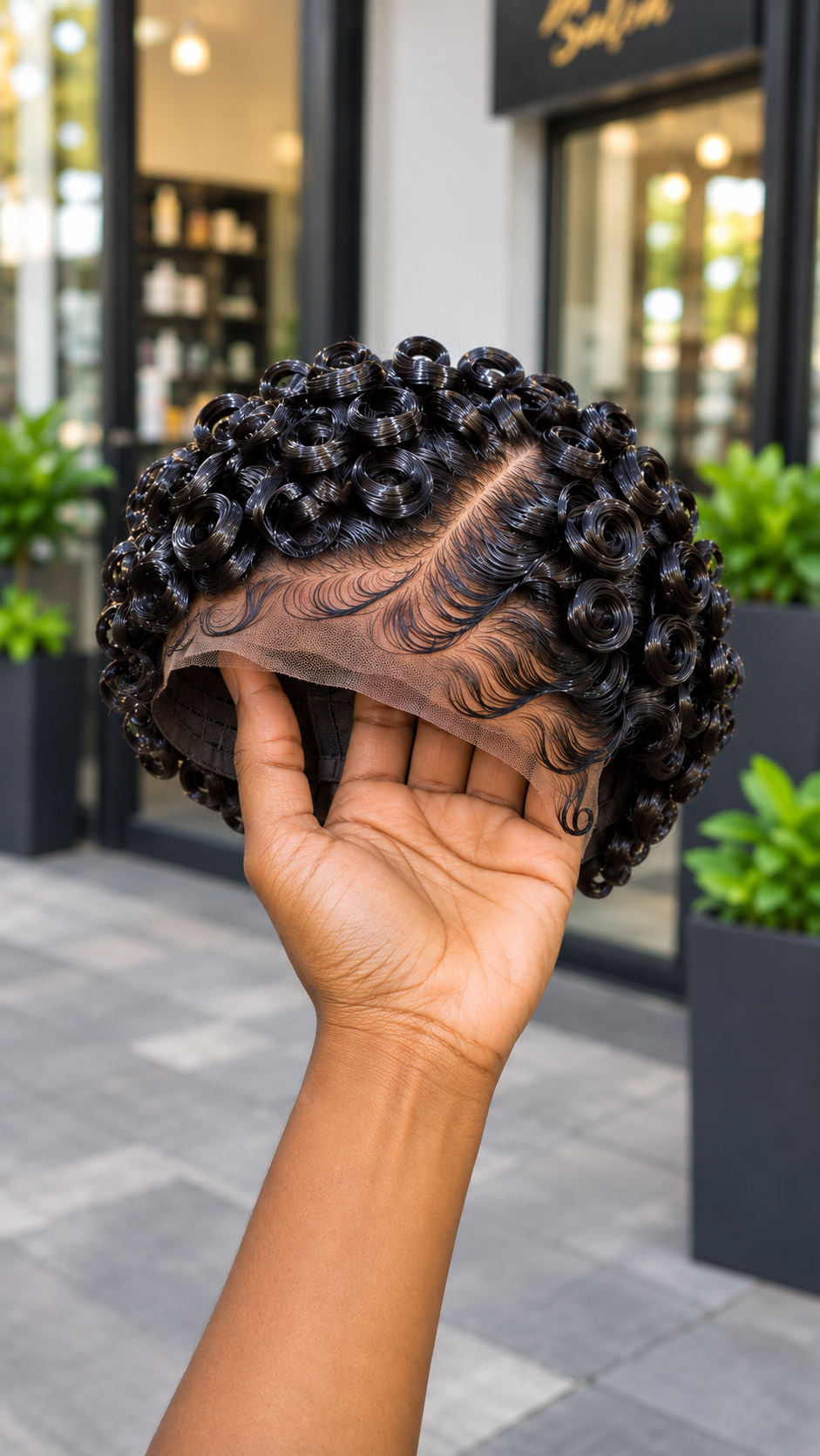
There is something captivating about a hairstyle that combines tightly arranged circular curls with long, flowing waves across the forehead. In this photograph, a deep black pixie wig creates that contrast beautifully. Its upper section contains numerous glossy spiral rosettes, while a prominent diagonal parting leads into sweeping hairline waves that extend across the front and visible temple. The result is a decorative hairstyle that draws attention through its arrangement rather than additional colors or exaggerated length.
The wig is photographed outdoors in front of a beauty salon, supported by one hand beneath its exposed lace and dark interior cap. The angle reveals how the raised curls transition into precisely directed hairline strands. Several circular loops frame the upper front, while the sides remain filled with smaller spirals that preserve the compact rounded silhouette.
What makes this design particularly interesting is the different scale of its styling elements. The upper rosettes form thick circular loops with recognizable openings, while the front waves consist of much finer strands arranged into elongated curves. The diagonal parting organizes these sections, creating an elegant asymmetrical appearance without introducing shaved geometric artwork.


For customers considering a similar wig, understanding these details is more important than simply selecting a black curly pixie. The placement of the rosettes, the direction of the parting, the length of the forehead waves, and the cap fit all influence how faithfully the finished hairstyle resembles the reference.
The Circular Rosettes Give the Crown Its Distinctive Character
The upper section contains numerous circular curls arranged closely across the crown. Several loops form nearly complete circles with visible openings, while others resemble tightly wound rosettes with smaller spiral centers.
The curls vary in apparent diameter. Larger circular loops sit near the upper front and center, while smaller ringlets fill the surrounding areas. This variation creates a densely arranged but visually layered crown.
Rather than hanging freely, most curls remain concentrated close to the head. Their placement creates a rounded silhouette with enough height to emphasize the circular shapes without making the hairstyle excessively bulky.
Several prominent rosettes sit near the diagonal parting, where their curved strands contrast with the flatter hair beneath them. Others continue toward the sides, producing a gradual transition into smaller curls near the lower edge.
The glossy black strands reflect daylight along their circular paths, making individual loops noticeable even though the color remains predominantly dark.
Why the Spiral Openings Matter
The visible openings within the curls contribute significantly to the hairstyle’s appearance. They create depth and allow each rosette to remain distinguishable from neighboring sections.
If the curls are compressed too closely, their openings may disappear, creating a dense mass of dark hair. If they are spaced too widely, the crown may appear sparse.
A custom wig maker should therefore consider curl diameter, density, and orientation together.
For a close reproduction, request circular spiral curls with recognizable openings and a mixture of larger and smaller loops.
A photograph taken slightly above the crown can help establish whether the finished curl arrangement matches the reference.
The Diagonal Parting Creates a Beautiful Flow
A clearly visible diagonal parting travels through the upper front of the wig. The pale channel contrasts with the surrounding black strands, creating a distinctive division between the circular crown and the directional hairline styling.
On one side of the parting, raised rosettes gather across the upper head. On the other, fine strands travel toward the forehead, where they form elaborate sweeping waves.
The parting is not a straight center division. Its angled direction contributes to the asymmetrical appearance and gives the front styling a sense of movement.
Several curls sit close to the exposed channel, while other strands follow its curve before bending into the lower waves.
The photograph does not establish the exact construction method used to create the scalp-like parting. Different wig-making techniques can produce similar visual results, and the appearance alone does not confirm a particular lace technology.
Confirming the Direction Before Ordering
The direction of the parting can influence how the hairstyle frames the face. A reversed parting may produce an attractive result but will not necessarily match the reference.
When ordering, specify the desired orientation from the wearer’s perspective rather than relying only on the left or right side of the photograph.
Ask the seller for a frontal photograph of the actual wig before shipping. This can help confirm whether the parting and surrounding curls follow the intended direction.
If the unit is custom-made, the parting should ideally be approved before the final rosette styling is completed.
Flowing Forehead Waves Add a Delicate Contrast
The front hairline contains a series of carefully arranged waves formed from fine black strands. These sections follow elongated curves that travel across the exposed lace and toward the visible temple.
The waves sit considerably flatter than the raised circular curls above them. Their direction creates a decorative transition between the rosette crown and the front hairline.
Several fine sections begin near the diagonal parting and curve downward before turning back toward the side. Others form shorter arcs that complement the longer waves.
This arrangement is more elaborate than a few ordinary baby hairs. The strands create recognizable, continuous patterns that contribute directly to the hairstyle’s identity.
The lower temple includes a longer curved section with a delicate curled end, completing the flowing appearance.
There are no clearly identifiable shaved geometric channels, zigzag artwork, or razor-carved side designs in the visible area. The decoration comes from the direction of the hair itself.
Why These Waves Need Precise Placement
The front waves must remain visible beneath the upper curls without occupying too much of the forehead.
If the rosettes extend too far forward, they may cover the delicate strands. If the waves are arranged too low, they may sit unnaturally when the wig is worn.
The correct position depends on the cap measurements and the wearer’s forehead and temple proportions.
During installation, the stylist should establish the intended hairline position before trimming the lace.
Customers commissioning a similar wig should request a close frontal photograph showing the full wave arrangement.
Deep Black Hair With Reflective Charcoal Highlights
The hair appears predominantly deep raven black, with subtle charcoal reflections visible along the curved strands.
The brightest reflections follow the circular surfaces of the rosettes, creating narrow bands of light that emphasize their spiral construction.
The front waves produce longer reflective lines because the strands lie closer together and follow elongated paths.
There are no clearly visible blonde, copper, burgundy, or silver color sections. The lighter areas appear primarily to be reflections rather than intentional highlights.
This gives the hairstyle depth without requiring multiple colors.
Customers seeking a similar appearance should ask for a rich black shade and confirm whether the actual product contains any warm brown undertones.
A daylight photograph can help distinguish natural black from deeper jet black alternatives.
The glossy appearance does not establish whether the wig contains human hair or synthetic fibers. The material must be confirmed separately.
The Side Curls Preserve a Rounded Silhouette
Numerous circular curls continue along the visible side, creating a full yet controlled outline.
Several larger loops sit near the upper temple, while smaller spirals gather toward the lower edge.
This progression maintains the compact pixie shape without creating a completely shaved or flat side.
The curls also frame the sweeping forehead waves, providing a decorative border around the front styling.
Near the lower side, the hair becomes more closely arranged, but several small loops remain visible.
The photograph does not reveal the complete rear, so its exact curl density and construction should be confirmed through additional product images.
Customers should ask the maker to preserve the visible side fullness rather than introducing an aggressive taper or carved artwork not present in the reference.
The Exposed Lace Shows the Wig Before Installation
A broad section of beige-brown lace extends beyond the front hairline and visible temple. The mesh remains untrimmed, indicating that the wig is being displayed before fitting.
Fine black strands emerge near the lace boundary, where the forehead waves begin.
The mesh provides material that can be evaluated during installation, but its exact classification cannot be established visually.
It would be inaccurate to describe the lace as HD lace without reliable product specifications.
The photograph also does not prove that the wig is suitable for adhesive-free wear.
Before purchasing, ask the seller to confirm the lace type, cap dimensions, available securing components, and recommended installation method.
What the Visible Interior Cap Reveals
Part of the dark interior cap is visible beneath the lace opening. The cap appears black to dark brown, with stitched fabric sections supporting the styled hair.
However, the photograph does not provide a complete underside view. The presence and position of all combs, clips, adjustable straps, or other securing components cannot be confirmed.
Ask the supplier for a photograph showing the entire interior, including the cap perimeter and attachment hardware.
Cap sizing is especially important because the diagonal parting and flowing forehead waves need to align with the wearer’s face.
Common measurements requested by wig makers include head circumference, front-to-nape distance, ear-to-ear distance, and temple placement.
A poorly fitted cap can shift the front styling and change how the hairstyle appears after installation.
Where To Buy This Wig Style
Similar hairstyles may be available through specialized pixie wig makers, local salons, online wig boutiques, and retailers offering sculpted curly lace wigs.
Useful search phrases include black rosette curl pixie wig, circular spiral lace wig, diagonal part finger-wave pixie, and sculpted black ringlet hairstyle.
A custom wig maker may be particularly useful when the exact rosette arrangement and front-wave placement are essential.
Ready-made alternatives may provide a similar rounded crown but differ in curl diameter or hairline styling.
Review previous examples of the maker’s work, especially hairstyles containing circular ringlets and detailed finger waves.
No verified supplier, live inventory, or current product price can be established from the photograph alone.
How To Order This Style
Begin by sending the reference photograph to the selected wig maker.
Explain that the hairstyle requires a compact rounded crown of glossy black circular rosettes, a diagonal parting, and long sweeping waves across the forehead.
Discuss the desired curl diameter and crown density. The rosettes should remain recognizable without creating excessive volume.
Confirm the parting direction from the wearer’s perspective.
Ask whether the maker can reproduce the front waves using methods compatible with the proposed hair material and cap construction.
Provide accurate head measurements and confirm the available cap size.
For custom production, request photographs of the parting and front waves before final approval.
After styling is complete, ask for front, side, and rear images, along with a complete underside photograph.
Finally, confirm whether the quotation includes styling, installation, lace preparation, shipping, and future adjustments.
Ready-Made, Closure, Frontal, and Glueless Options
The appropriate construction depends on the desired hairline coverage, cap fit, and installation preferences.
A ready-made curly pixie may offer a general resemblance, but the diagonal parting and front-wave arrangement may differ from the reference.
A closure-based unit may be suitable for some compact hairstyles, although the available lace area and parting flexibility should be evaluated carefully.
A frontal construction may provide additional front hairline coverage, depending on its dimensions and design.
However, the photographed wig’s exact construction category cannot be established solely from the visible lace.
Glueless installation should also be considered separately. A secure fit and suitable attachment components are necessary for adhesive-free wear.
Ask the seller to confirm which installation methods the actual cap supports.
Estimated Prices for Sculpted Black Rosette Pixie Wigs
The cost of a similar wig may depend on the hair material, cap construction, curl density, and labor required to create the circular rosettes and flowing forehead waves.
The following USD amounts are illustrative planning ranges rather than verified live product prices or quotations for the photographed unit.
| Wig Category | Illustrative USD Range | Possible Purchase Scope |
|---|---|---|
| Premium Custom | $330–$790+ | Individual measurements, detailed rosette curl styling, customized diagonal parting, and personalized hairline preparation. |
| Standard Custom | $170–$385 | Custom black pixie styling with organized circular curls and professionally arranged forehead waves. |
| Basic Human Hair | $105–$265 | A human-hair pixie base that may require additional rosette formation, parting customization, and installation. |
| Premium Synthetic | $70–$195 | Higher-priced synthetic alternatives with prearranged circular curls and decorative hairline styling, depending on specifications. |
| Basic Synthetic | $25–$100 | Budget black curly pixie options that may resemble the silhouette without reproducing the detailed rosette arrangement. |
Styling labor may be a significant cost factor because the circular rosettes require careful strand placement.
The front waves may also involve additional work, particularly when they extend across a substantial portion of the lace hairline.
Ask whether installation, lace preparation, shipping, cap adjustments, and future restyling are included in the quotation.
The photograph does not establish whether the displayed wig contains human hair, synthetic fibers, or a blend. The table describes possible purchasing categories rather than confirmed product characteristics.
Installing the Wig Without Disturbing the Waves
When the wig arrives, inspect the rosette curls, diagonal parting, front waves, and lace condition before making permanent alterations.
The installer should position the cap correctly on the wearer’s head and evaluate how the forehead waves align with the face.
Only after confirming the fit should the lace be assessed for trimming.
Removing too much material near the decorative strands could interfere with their arrangement.
The securing method should be selected according to the actual cap construction and the wearer’s needs.
During fitting, avoid flattening the circular curls or pulling the front waves into different directions.
Any minor adjustments should use methods compatible with the confirmed fiber.
Maintaining the Circular Rosette Curls
The upper curls require careful handling because their appearance depends on strands remaining arranged in circular paths.
Aggressive brushing may separate the loops, increase frizz, or cause neighboring rosettes to merge.
Before washing, confirm the actual hair material and obtain the maker’s recommended care instructions.
If the wig is human hair, washing may loosen the original rosette arrangement and require resetting.
If the wig is synthetic, heat compatibility must be confirmed before using heated styling tools.
Heavy products can accumulate inside the circular openings and reduce strand separation.
Handle the wig by supporting the cap rather than pulling on individual curls.
Keeping the Front Waves in Their Original Direction
The decorative forehead waves require a different maintenance approach from the raised rosettes.
Their appearance depends on fine strands remaining aligned along sweeping curves.
Repeated rubbing, aggressive combing, or careless handling may disturb their direction.
If the waves begin losing their shape, consult a stylist familiar with finger-wave techniques.
Do not automatically use strong heat or unfamiliar products without confirming the material and recommended methods.
For storage, use an appropriately sized wig stand that supports the cap without compressing the upper curls or rubbing against the front hairline.
The Advantages and Tradeoffs of This Pixie Design
One advantage is its strong visual identity without additional colors. The deep black strands allow the circular rosettes and flowing forehead waves to remain the main attraction.
The compact silhouette provides decorative volume without requiring long hair.
The diagonal parting adds asymmetry, while the smaller side curls maintain a rounded outline.
However, the intricate curl arrangement may require more careful handling than ordinary loose curls.
Customers should ask whether the rosettes need periodic professional resetting and how the front waves should be maintained.
The suitability of the wig for frequent wear depends on cap fit, actual fiber, construction quality, and the wearer’s maintenance routine.
A Beautiful Balance of Circular Curls and Flowing Waves
The strongest quality of this hairstyle is the relationship between the rounded rosette crown and the delicate front-wave arrangement.
The circular curls provide volume and decorative detail, while the diagonal parting introduces direction and movement.
The flowing forehead waves complete the design without requiring shaved lines or contrasting highlights.
For buyers seeking a close reproduction, the most important considerations are curl placement, parting direction, front-wave styling, and accurate cap measurements.
Before purchasing, confirm the actual material, construction, sizing, and installation requirements.
With appropriate fitting and material-specific maintenance, a similar black rosette pixie can offer a distinctive combination of glossy circular curls, graceful forehead waves, and a beautifully controlled silhouette.
Search Terms
Black spiral rosette pixie wig · Flowing forehead finger waves · Diagonal part black circular curls · Glossy black ringlet crown hairstyle · Sculpted black front wave lace wig · Untrimmed beige lace rosette curls · Compact black pixie with side sweeps · Raven black circular spiral wig