
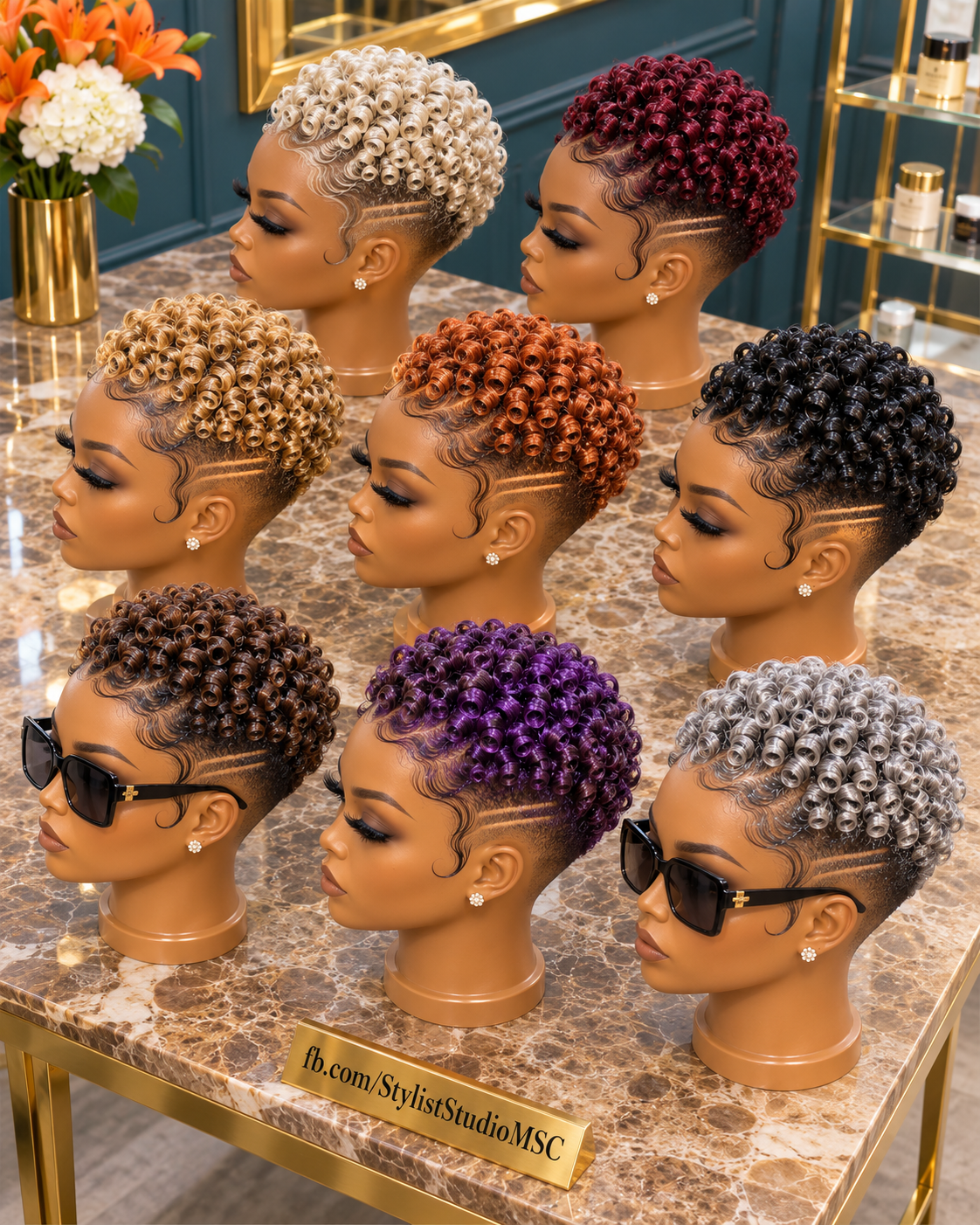
The display brings together pale blonde, burgundy, golden blonde, copper, black, brown, purple, and silver interpretations of the same general cut. Color changes the mood, but the silhouette remains the main attraction. For anyone interested in a spiral curl pixie wig, this reference is useful because it shows how the crown, temple, and ear area relate to one another. A good purchase should preserve that relationship while providing the fit and maintenance routine that suit the wearer.
A Profile Worth Studying Before You Order
From the side, the curls create a gentle rise over the forehead and a rounded shape through the crown. The hair then becomes progressively closer to the head near the lower side and back. This graduation prevents the top from appearing disconnected from the rest of the wig. When discussing a recreation, ask the stylist to consider the complete outline. Attractive curls alone will not reproduce the reference if the rear section is flat or the lower sides remain too bulky.


The ears are largely exposed, and the close section sits above and behind them. That openness gives the cut a compact character and leaves room for visible earrings. It also makes fit important. A cap positioned too far forward or too low can change the appearance around the ear even when the curls are accurate. Request photographs showing the unit correctly positioned on a stand, then confirm the final placement during a fitting wherever possible.
The photograph presents similar profiles across the collection, but it does not show every opposite side or a complete rear view. Ask the supplier for those angles before approving an order. You need to know how the line detail ends, how the nape is shaped, and whether the crown remains balanced from behind. A short hairstyle should make sense as a complete form rather than depend on one preferred camera angle.
Small Spirals Give the Top Its Spring
The curls have visible openings and rounded tubular shapes. Some point forward, while others turn outward or sit above neighboring sections. Their direction varies enough to give the crown depth without creating a loose, sprawling arrangement. This is different from flat rosette curls or a soft brushed-out texture. When searching for comparable wigs, use photographs to distinguish among small ringlets, finger coils, molded pin curls, and looser curls, even when sellers use those names interchangeably.
The front curls remain short enough to keep the forehead open. They do not form a long fringe or hang over the eyes. That detail is worth specifying if you want a close match. A supplier may offer a curly pixie with longer front pieces, which could be attractive but would change the proportions. Explain whether you want the crown lifted away from the forehead or prefer a little more forward fall. The finished direction should be agreed before setting.
Curl size also affects the apparent fullness. Small spirals can create considerable dimension without excessive hair throughout the cap. Ask the maker to preserve the visible spaces between curls instead of filling every gap with additional strands. Those spaces allow the individual shapes to remain readable. A dense, uniform surface may hide the movement that makes this cut appealing, particularly in black or another dark shade.
The Temple Wave Connects the Crown to the Face
A fine wave follows the front hairline before descending into a curved temple strand. Near the ear, the strand turns into a small rounded end. This detail softens the transition between the curled crown and the closely cropped side. It is more than a decorative extra because it gives direction to the front. If you want it included, identify the shape in your reference rather than asking generally for baby hairs.
There is room to personalize the amount of front detail. Some wearers may prefer the long temple curve shown here, while others may want a shorter, quieter finish. Discuss that before the wig is fully styled. Reducing a completed wave can require neighboring sections to be rearranged, especially when the crown has been carefully set. The stylist should understand which parts of the reference you want copied and which can be adapted for your preferences.
Placement should be judged on the wearer. The curve needs to sit comfortably near the temple without extending farther down than intended. Bring glasses to the fitting if you wear them regularly, since their arms may occupy a similar area. The display includes sunglasses on two mannequins, but those are presentation accessories. Your own frames, head shape, and cap position determine whether the same arrangement feels practical in everyday use.
Side Lines Need Balance With the Shorter Hair
Parallel exposed lines cross the closely shaped side beneath the curls. They create contrast against the darker foundation and add interest without increasing length or volume. Their narrow spacing helps them read as a coordinated pair. Ask the maker to confirm the line width, angle, and location rather than treating side detailing as one interchangeable feature. Small changes can affect the appearance substantially when the surrounding hair is cropped so close.
Because the image shows wigs on mannequins, it does not establish how the line effect was produced. Ask whether it depends on the base construction, cutting, setting, or another method. You should also know whether the detail remains visible after cleaning and how it is restored if necessary. This helps you choose a suitable unit and gives a future stylist the information needed to maintain the design.
If the lines are especially important to you, request a fitted side photograph before final approval on a custom order. They should remain visible beneath the crown without being crowded against the ear. A cap that changes position can move the entire pattern, so line placement cannot be separated from fit. Agree on the overall side outline first, then refine the exposed detail within that shape.
A Practical Budget Before Choosing the Finish
The following table provides illustrative planning bands in US dollars. These are examples for organizing a purchase, not verified prices for the displayed wigs or a current market price list. Actual quotations depend on documented materials, construction, color work, cutting, setting, and included services. Offers may fall outside these bands. Use the tiers to compare complete proposals and ask what additional work is covered as the total increases.
| Price Tier | Illustrative Budget | Purchase Route | Question to Resolve |
|---|---|---|---|
| Budget Starting Point | Under $75 | A stock cropped unit or basic wig for further preparation | Are the spiral set, close sides, and line details already included? |
| Ready-Styled Stock | $75–$150 | A preset finished style in a standard shade and cap size | Can the seller show the exact unit and provide its material and fit details? |
| Salon-Finished Option | $150–$300 | A suitable base combined with cutting, setting, or fitting | Which styling and front preparation services are included in the total? |
| Individual Custom Order | $300–$500 | A project with agreed color, measurements, crown height, and side layout | What review stage and alteration terms apply before delivery? |
| Premium Bespoke Package | Above $500 | An individually specified unit or package with additional appointments | What construction, workmanship, fitting, and aftercare support the price? |
Compare the amount required to achieve the same wearable result. One quote may include the base, cut, set, and fitting, while another covers only the wig before customization. Delivery, taxes, lace preparation, installation, and later resetting may be additional. Ask for a written breakdown where needed. If you must simplify the purchase, prioritize fit and accurate shaping before optional extras. Packaging and accessories do not correct a crown that is too wide or a temple detail placed incorrectly.
Maintenance also belongs in the budget. If you plan to have a professional restore the curls after cleaning, find out who can do that work and what it involves. Ask whether the original maker offers aftercare or whether a local stylist can maintain the verified material. A detailed style is more practical when its upkeep fits your routine. You do not need a rigid schedule immediately, but you should understand the likely process before purchasing.
Get The Details On This Wig
The plaque in the photograph identifies a page address within the display, but it does not independently verify the maker, current stock, or sales terms. To find similar units, look for wig boutiques, independent makers, and salons whose portfolios include short spiral curl cuts. Search phrases such as “tapered ringlet wig,” “curly crop with temple waves,” and “short wig with side lines” can help identify relevant examples.
Examine the portfolio rather than choosing by a familiar product name. Look for a proportionate crown, close shaping around the ear, and a deliberate finish through the back. Ask whether the business creates the complete unit, customizes a sourced base, or provides only styling. Each route can work, but the responsibilities should be clear. If you need to buy a base separately, consult the person doing the final cut and set before placing that order.
Send a concise specification with the reference. Identify your chosen color, small open spirals, exposed ear area, parallel side lines, and curved temple wave. Request the verified fiber, cap measurements, construction, included services, and complete price. Ask whether the supplier has a stock match or needs to create a custom version. Clear questions allow the maker to explain what they can reproduce and where their proposed unit differs from the photograph.
For a stock purchase, ask for a rotating video of the actual item being supplied. For custom work, agree on the color reference, completion estimate, and any review photographs before dispatch. Read the return and alteration terms before payment. Keep the specification and seller’s responses together. If an adjustment becomes necessary, those records help you discuss the particular feature involved rather than relying on a general impression that the result is different.
Choosing Between Warm, Dark, and Pale Shades
Black and brown place much of the attention on the silhouette. The black version shows strong contrast between reflective curl edges and darker centers, while brown gives a warmer impression across the crown. Ask to see both in ordinary daylight if you are deciding between them. Color names such as chocolate, coffee, and chestnut can describe different results, so request a specific reference and confirm whether the shade is consistent throughout.
Golden blonde and copper make the individual spirals particularly noticeable. Golden blonde appears lighter and more yellow-gold, while copper carries orange-brown warmth. Burgundy provides a deeper red alternative with a darker overall impression. If you choose one of these shades, clarify the balance you want. A copper leaning strongly orange will not look the same as a redder copper, and a bright red is different from a deep wine shade.
The pale blonde and silver versions offer separate light-color directions. The pale blonde appears creamy, while the silver reads cooler and grayer. Purple creates a more saturated variation of the same haircut. The photograph cannot establish exact commercial color codes, so request daylight samples of the proposed shade. Also ask how the color continues into the close sides and nape. The darker lower sections contribute to the contrast and should not be left to assumption.
Choose according to how you expect to wear the wig rather than the appeal of the entire display. A collection looks interesting because several shades appear together, but your unit needs to work independently. Consider your regular clothing, accessories, and intended occasions. You may prefer a familiar shade for frequent wear or a more noticeable option for a rotation. Either choice is useful when it reflects your own plans rather than an undefined idea of what should suit everyone.
Construction Comes Before Claims About Convenience
The outside view cannot verify the cap design. Ask for an interior photograph and a written description of lace and wefted areas. A closure-based unit provides a different working area from a frontal, and either may be appropriate depending on how the front and sides are created. The supplier should explain why the proposed construction supports this cut. A broad product label is not enough to establish how the temple wave or side detail will be fitted.
If you expect to change the front arrangement, discuss the available options before ordering. Some units support a fixed finish, while others provide more flexibility. Additional lace space does not mean that the set can be changed without restyling. Decide whether you want a consistent ready-styled look or the ability to alter direction later. Construction should serve that preference while still supporting the compact shape that attracted you to the reference.
The material also needs confirmation. The visible curls do not prove human hair, synthetic fiber, or a blend. Obtain the description and care instructions in writing. Ask whether the spiral pattern is built into the fiber, created by a temporary set, or produced through both. This determines what happens after washing and how the finish is restored. Choose the complete ownership experience, including care and styling support, rather than relying on a material name alone.
Fit the Wig Over Your Normal Preparation
Measure according to the supplier’s directions before selecting a cap size. They may request circumference together with front-to-nape or ear-to-ear measurements. These details are especially relevant when the side design must sit above the ear. Do not assume that a familiar size label from another purchase guarantees the same fit. A cap should provide stable, even positioning rather than need excessive tightening to compensate for a mismatch.
Try the unit over the hair preparation you intend to use regularly. An uneven base can raise the crown or push the short sides outward. During fitting, check the front, temples, ear-area edges, and nape together. Turn your head and look down to assess stability. If the wig has excess lace, settle the placement before trimming. A professional fitting can help preserve the workable edge while adapting the front to your chosen position.
For daily removal, ask whether an appropriate glueless option is available and how the actual cap stays secure. That cannot be established from the display. If you prefer an installed finish, discuss the method with a wig stylist and follow the relevant product instructions. Either route should include removal and handling guidance. The securing system should suit your routine while keeping the temple waves and line detail consistently positioned.
Book the Right Styling Appointment
Look for a wig stylist with examples of small ringlets, tapered cuts, and close side shaping. Send the reference before booking and explain whether you need a complete unit, fitting, installation, or a restyle. If you already own the base, provide its material information and current photographs. The stylist needs enough detail to assess feasibility and reserve the right amount of time. A general curl appointment may not cover the full cut and finishing work.
During consultation, establish the outline before refining individual details. Agree on crown height, side closeness, and nape shape, then review the lines and temple curl. Ask whether the fit can be checked before the final set is completed. Bring your regular glasses so their position can be considered. Also confirm whether cutting, coloring, lace customization, setting, and fitting are separate services or included together. Clear scope helps avoid an appointment that ends before the intended result is wearable.
A Maintenance Rhythm for a Cropped Curl Set
Before each wear, inspect the crown for compressed spirals and check that the temple wave remains arranged. After wearing, look for residue and displaced sections before storage. Cleaning frequency should follow the product’s instructions and its condition, considering wear and product use. Ask what the wig is expected to look like after washing and which steps restore the finish. A temporary set may need professional renewal even when the underlying hair remains in good condition.
Support the cap when lifting the wig rather than pulling individual curls. Avoid brushing the entire crown into one mass, since that can separate the spirals and change the outline. Ask your stylist to demonstrate a small correction for one displaced section. Use products only as directed for the verified material. If heat is permitted, follow the specific manufacturer’s limits. Do not assume that the curled appearance establishes heat compatibility or that additional shine product is needed before every outing.
Store the unit on a suitable support with room around the crown and front. Avoid stretching the cap over an oversized form or pressing the curls against nearby objects. For travel, protect the top from compression and keep delicate sections from folding beneath other items. Follow drying directions fully before enclosed storage. Once the fit and set are right, take front, side, and back photographs as a clear reference for future maintenance.
A Short Cut With Detail Worth Preserving
The advantages are the open neckline, limited loose length, and an expressive silhouette that remains recognizably cropped. The spiral crown creates movement, while the close sides and sweeping temple wave give it direction. The commitment is preserving those proportions. Compression, unsuitable brushing, or a shifted cap can alter both the curls and the side detail. This style works best when you understand the approved touch-ups or have access to a professional who can maintain the set.
Before accepting the finished unit, inspect the color, curl size, crown height, side lines, and fit in ordinary light. Request the unseen angles and compare the result with the written specification. For delivered purchases, do this before alterations that could affect return terms. A successful version should preserve the relationship that makes the reference appealing: small open spirals above a close lower section, with a fine wave connecting the hairstyle to the temple.
Search Terms
spiral curl pixie wig · tapered ringlet crop · short wig with temple waves · double side line wig · copper spiral curls · golden blonde curly crop · silver cropped wig · black curls with close sides