
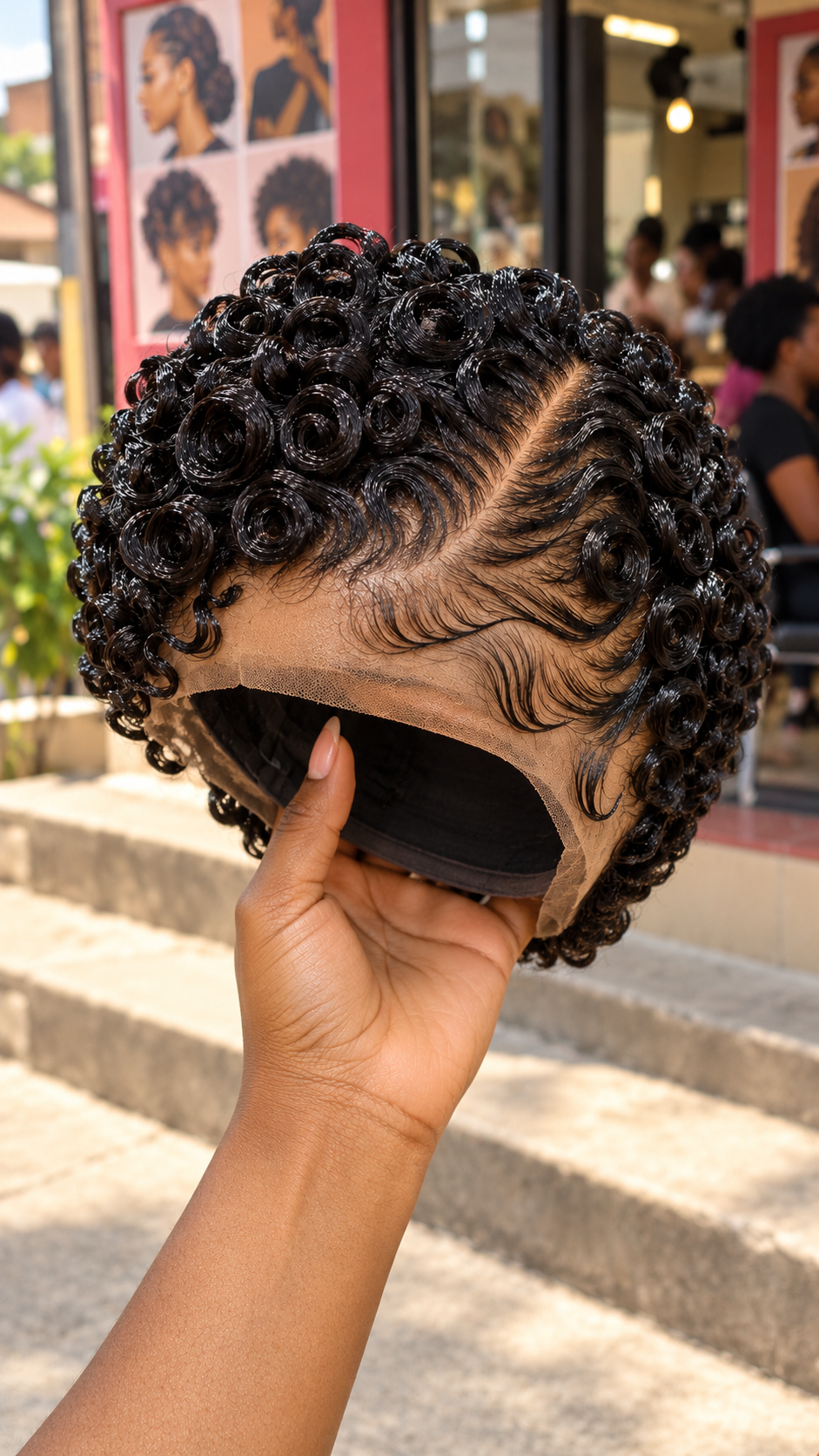
A beautifully arranged hairline can turn a compact curly wig into a distinctive piece of salon craftsmanship. The black spiral wig in this photograph demonstrates that idea through a striking combination of tightly arranged circular curls, an exposed diagonal parting, and long finger-wave sections that sweep across the front and visible temple. The hairstyle has an elaborate appearance, but its impact comes from controlled hair direction rather than bright coloring or shaved geometric artwork.
Displayed outside a neighborhood hair salon, the wig is supported by one hand with its unfinished lace and dark interior cap visible. The upper section contains numerous glossy black ringlets, several of which form clearly recognizable circular openings. Across the front, the curls give way to flatter, precisely arranged strands that follow a series of overlapping curves. A pale diagonal parting separates portions of the raised curls from the lower styling, creating an elegant transition between the two.
The photograph is especially useful for anyone researching a custom pixie wig because it reveals details that may be difficult to appreciate after installation. The untrimmed mesh, front hairline, directional parting, compact curl arrangement, and visible cap opening can all be examined before discussing a purchase.


Rather than concentrating on decorative side lines or contrasting highlights, this design demonstrates how black hair can create an elaborate hairstyle through differences in curl diameter, strand direction, and the placement of finger waves.
A Hairline Arrangement That Deserves a Closer Look
The most distinctive portion of the hairstyle is the sweeping front and temple section. Fine black strands emerge from the front styling area and follow several curved directions across the exposed lace. Some sections form broad arcs, while others turn more sharply before joining the neighboring waves.
The front arrangement is not composed of ordinary loose baby hairs placed randomly along the forehead. Instead, the strands are grouped into deliberate curved sections, creating a decorative finger-wave appearance.
Near the visible temple, one prominent wave travels downward before turning back toward the side. Additional curves sit above it, creating a layered pattern with a sense of movement.
This detail is especially noticeable because the surrounding hair is deep black. Reflected daylight highlights the individual strands, making the wave direction visible without introducing another color.
The photograph does not show carved barber lines within this section. The lighter areas primarily come from exposed parting and lace beneath the arranged strands, rather than an obvious shaved geometric pattern.
For customers requesting a similar wig, the front wave arrangement should be treated as a central design requirement. Replacing it with a few simple baby hairs would produce a considerably different hairstyle.
Why the Long Temple Sweep Matters
The lower temple wave contributes to the shape of the hairline by extending farther downward than the smaller curves above it. Its elongated movement creates a decorative point of interest beneath the raised ringlets.
When the wig is installed, this section needs to align with the wearer’s forehead and temple. A wave that appears balanced on an unworn unit may sit differently depending on the person’s head measurements and natural hairline.
Before trimming the lace, the installer should establish the correct cap position and determine where the lowest curve will fall.
The wave should not be repositioned aggressively merely to compensate for an unsuitable cap fit. Disturbing the arrangement can separate the fine strands and change the intended design.
A custom wig maker should be asked whether the front waves are intended to remain arranged during ordinary wear or whether periodic professional resetting will be necessary.
Dark Circular Ringlets Build a Rounded Crown
Above the decorative hairline, numerous circular curls occupy the upper section. Several larger ringlets are especially noticeable near the center and front, while smaller loops fill the spaces between them.
The ringlets appear glossy, with bright reflections following their curved surfaces. Some form nearly complete circles with dark openings inside, while others overlap or angle toward neighboring curls.
The upper arrangement is dense without becoming an entirely solid mass. Individual circular openings remain visible, allowing the viewer to appreciate the separate curl shapes.
Near the visible side, several curls sit slightly lower and frame the front wave section. Toward the upper center, the curls become more closely gathered, creating a rounded silhouette.
The photographed crown appears compact rather than excessively tall. Its fullness comes from the number and arrangement of the ringlets rather than from long, loosely expanding hair.
This distinction is important when buying a similar wig. A conventional curly pixie may have an approximately matching length but contain smaller spring coils or loose waves instead of the pronounced circular ringlets shown here.
Matching the Curl Arrangement During a Custom Order
Customers should ask the maker to reproduce the recognizable circular openings rather than simply requesting curly black hair.
The approximate diameter of the ringlets, the direction of the curls, and their distribution across the upper head all contribute to the finished appearance.
If the curls are too small, the upper section may resemble a tightly coiled natural hairstyle rather than a sculpted circular-ringlet pixie. If they are too large, the crown may become bulky and lose its compact proportions.
Request an approval photograph taken from slightly above the front. This angle can reveal whether the ringlets are distributed consistently and whether large gaps interrupt the intended shape.
A second image from the side can demonstrate how the upper curls relate to the sweeping hairline beneath them.
The Diagonal Parting Gives the Curls Their Direction
A visible diagonal parting runs through the upper front section, separating groups of dark hair that follow different directions.
On one side of the parting, raised ringlets gather toward the upper crown. On the other, the strands form smaller curls and directional waves that lead toward the forehead and temple.
The parting appears as a pale channel against the surrounding black hair. Fine strands remain visible along its edges, helping establish a gradual transition between the adjoining sections.
This parting is particularly important because it organizes the hairstyle without relying on an obvious central division. The diagonal direction adds asymmetry and supports the flowing movement of the front waves.
When ordering, customers should specify the desired parting direction from the wearer’s perspective. Photographs can sometimes create confusion because the unit may be photographed from different sides or displayed in a mirrored orientation.
A reversed parting could still produce an attractive wig, but it would not precisely reproduce the reference.
Why the Black Color Is More Interesting Than It First Appears
The visible hair is predominantly deep black, with subtle brown-black reflections appearing in some areas under daylight.
The curls do not show a clear pattern of copper, blonde, burgundy, or silver highlights. The lighter streaks along the strands are mainly reflections caused by the direction of the glossy hair and the available light.
This gives the hairstyle a cohesive appearance while allowing individual ringlets to remain visible.
The upper curls reflect light in narrow curved bands, whereas the finger-wave section produces finer, elongated highlights that follow the sweep of the strands.
The contrast between these reflective patterns creates a sense of depth within the same dark color family.
Customers searching for this appearance should ask for a deep natural black or raven-black shade and confirm whether the supplier includes any intentional brown tones.
A daylight photograph of the actual wig is more reliable than a heavily illuminated promotional image when comparing black shades.
The glossy appearance should not be treated as evidence of a particular fiber or quality grade. Human hair and synthetic materials can both appear reflective under favorable lighting, and the actual material must be confirmed separately.
What the Exposed Lace Reveals About This Wig
The wig is displayed with a broad section of beige-brown lace extending beyond the front hairline and visible temple. The mesh remains untrimmed, indicating that the unit is being presented before final installation.
The lace is clearly visible against the hand holding the wig and the darker interior cap. Its outer edge follows an irregular contour beyond the styled hairline.
Fine dark strands appear attached near the mesh boundary, particularly where the finger waves extend across the forehead area.
This presentation gives a prospective buyer an opportunity to evaluate the approximate placement of the hairline before the lace is altered.
However, the photograph does not establish the exact lace classification, its durability, or how naturally it will blend with an individual wearer’s skin.
The visible mesh should not be identified as HD lace without reliable product specifications.
Likewise, the photograph does not prove that the wig can be worn securely without adhesive. The suitable installation method depends on the actual cap construction, available attachments, and fit.
Assessing the Dark Interior Cap
A portion of the black interior cap is visible beneath the open front of the wig. The dark structure appears relatively compact, with part of its fabric and perimeter exposed.
Because the photograph does not show the complete underside, it cannot confirm all adjustment components, securing attachments, or construction materials.
Before purchasing, request a clear underside photograph showing the cap perimeter, any adjustable straps, and all combs or clips included with the actual unit.
Cap measurements should also be established before ordering.
Depending on the supplier, these may include head circumference, front-to-nape distance, ear-to-ear measurements, and temple placement.
The detailed front wave arrangement makes accurate sizing particularly important. If the cap is too large or too small, the waves may sit incorrectly on the forehead even if the upper curls are beautifully arranged.
A professional fitting can help determine whether adjustments are necessary before the lace is trimmed.
Finding a Stylist Who Can Reproduce the Finger Waves
This hairstyle requires experience with both compact spiral curls and elaborate front-wave styling.
A wig maker who specializes exclusively in loose curly wigs may not be familiar with arranging narrow strands into controlled finger-wave patterns.
When searching for a professional, look for salons offering sculpted pixie wigs, finger-wave lace styling, spiral curl customization, and detailed wig hairline work.
Review photographs of previous projects. Examples showing circular ringlets and carefully directed forehead waves are more relevant than general portfolios of long wigs.
When contacting a stylist, send the reference image and explain that the front waves and diagonal parting are essential to the design.
Ask whether the stylist can reproduce the arrangement on a cap suitable for the wearer’s measurements.
For online custom orders, request photographs of the actual completed unit before shipping.
Images of the front, both sides, and rear will help determine whether the finished hairstyle matches the approved reference.
Get the Details on This Wig Before Ordering
For a buyer seeking a close reproduction, the most useful first step is preparing a concise list of requirements.
The wig should have a compact rounded crown filled with recognizable circular black ringlets. A diagonal upper parting should organize the curls, while the front hairline should contain several carefully arranged sweeping waves.
The lower temple wave should remain visible rather than being hidden beneath the surrounding curls.
Ask the seller to confirm the actual hair material, available cap sizes, lace specifications, and recommended installation method.
Also establish whether the unit will arrive fully styled or require additional salon work.
Ready-made options may be available in similar silhouettes, but their curl size and front wave arrangements can vary significantly.
A custom order may be more appropriate when the exact hairline and parting direction are essential.
No particular seller, current stock level, or product price can be verified from the photograph alone. The salon background provides context but does not identify a confirmed supplier for the displayed unit.
Planning the Installation Around the Front Waves
After delivery, the wig should be inspected before any lace is removed.
Check whether the upper curls have maintained their circular arrangement during transport and whether the finger waves remain intact.
Next, position the wig on the wearer’s head and evaluate the relationship between the diagonal parting, front hairline, and temple sweep.
The installer should determine whether the cap sits comfortably and whether the visible waves fall in the intended positions.
Once the fit is established, the untrimmed lace can be prepared for careful cutting.
Because several decorative strands extend close to the mesh boundary, aggressive trimming could interfere with the hairline design.
Any securing method should be selected according to the confirmed cap construction and the wearer’s needs.
After fitting, the stylist may need to make minor adjustments to curls disturbed during handling. These corrections should use techniques compatible with the actual fiber.
Booking a stylist experienced in finger-wave lace wigs can help reduce the risk of losing the original front arrangement during installation.
Estimated Prices for Black Spiral and Finger-Wave Pixie Wigs
The cost of a similar wig will depend on the base material, cap construction, lace specifications, and the labor required to arrange the circular curls and decorative hairline.
The following USD ranges are illustrative planning estimates rather than verified current product prices or quotations for the photographed wig.
| Wig Category | Illustrative USD Range | Possible Purchase Scope |
|---|---|---|
| Premium Custom | $300–$720+ | Individual sizing, carefully arranged circular ringlets, advanced finger-wave hairline work, and personalized lace preparation. |
| Standard Custom | $155–$350 | Custom black pixie styling with sculpted curls, diagonal parting, and decorative front waves. |
| Basic Human Hair | $95–$240 | A human-hair pixie base that may require additional spiral curl setting and professional hairline styling. |
| Premium Synthetic | $65–$180 | Higher-priced synthetic alternatives with prearranged ringlets and possible finger-wave styling, depending on specifications. |
| Basic Synthetic | $25–$90 | Budget black curly pixie options that may resemble the silhouette without reproducing every circular curl and hairline wave. |
One of the most significant cost factors is likely to be the detailed finger-wave styling.
Arranging multiple fine strands into continuous curved patterns can require additional labor, especially when the waves need to align with the lace hairline.
The circular ringlets may also require individual setting to maintain their recognizable openings.
Although the wig does not show elaborate color processing, the styling work can still make a custom version more expensive than a conventional black curly pixie.
Ask whether the quoted amount includes installation, lace preparation, shipping, cap alterations, and future restyling.
The photograph does not establish whether the displayed wig is human hair, synthetic, or a blend. The table represents possible purchasing categories rather than confirmed product characteristics.
Protecting the Circular Curls During Daily Handling
The upper ringlets depend on the arrangement of individual strands into recognizable circular shapes. Aggressive brushing may separate these loops or cause neighboring curls to merge.
Before washing, confirm the wig’s material and obtain the maker’s recommended maintenance procedure.
If the wig is human hair, repeated washing may loosen the original styling and require the curls to be reset.
If the wig is synthetic, heat compatibility must be confirmed before using heated tools. Some fibers can be permanently damaged by unsuitable temperatures.
Avoid excessive heavy styling products. Product buildup can reduce strand separation and make the ringlets appear less distinct.
When handling the wig, support the cap rather than pulling on individual curls.
For storage, use an appropriately sized wig stand that does not compress the raised crown.
Caring for the Sweeping Hairline
The finger-wave section should be treated differently from the upper ringlets.
Its appearance depends on fine strands remaining aligned along curved paths. Repeated rubbing or uncontrolled combing can disturb the pattern.
If the waves begin losing their arrangement, consult a stylist familiar with finger-wave techniques rather than attempting aggressive restyling.
The lace beneath the waves should also be handled gently during installation and removal.
Pulling directly on the hairline may place unnecessary stress on the fine mesh and attached strands.
Any trimming near the decorative waves should be approached cautiously because removing lace or hair from the wrong area may be difficult to reverse.
A Black Pixie That Stands Out Through Hair Craftsmanship
This hairstyle demonstrates how an entirely dark wig can achieve a highly elaborate appearance without additional colors or carved geometric designs.
The glossy circular ringlets create a rounded upper silhouette, while the diagonal parting and layered finger waves introduce direction and movement across the front.
The sweeping temple section is particularly important because it provides a decorative transition between the raised curls and the unfinished lace hairline.
For buyers seeking a similar design, the most important considerations are accurate curl placement, careful finger-wave styling, appropriate cap measurements, and professional installation.
The hairstyle may require more attentive maintenance than a conventional loose curly pixie, particularly if the wearer wants to preserve the original front-wave arrangement.
However, its distinctive appearance comes from a clear combination of styling techniques rather than excessive decoration.
A carefully prepared version can offer a compact black pixie with impressive visual detail, allowing the circular curls and flowing hairline waves to remain the main attraction.
Search Terms
Glossy black circular spiral pixie wig · Sweeping finger wave lace front hairstyle · Diagonal part black ringlet crown · Sculpted black temple swoop wig · Untrimmed beige lace curly pixie · Black circular coil wig with front waves · Deep black side parted spiral curls · Compact finger wave ringlet lace wig