
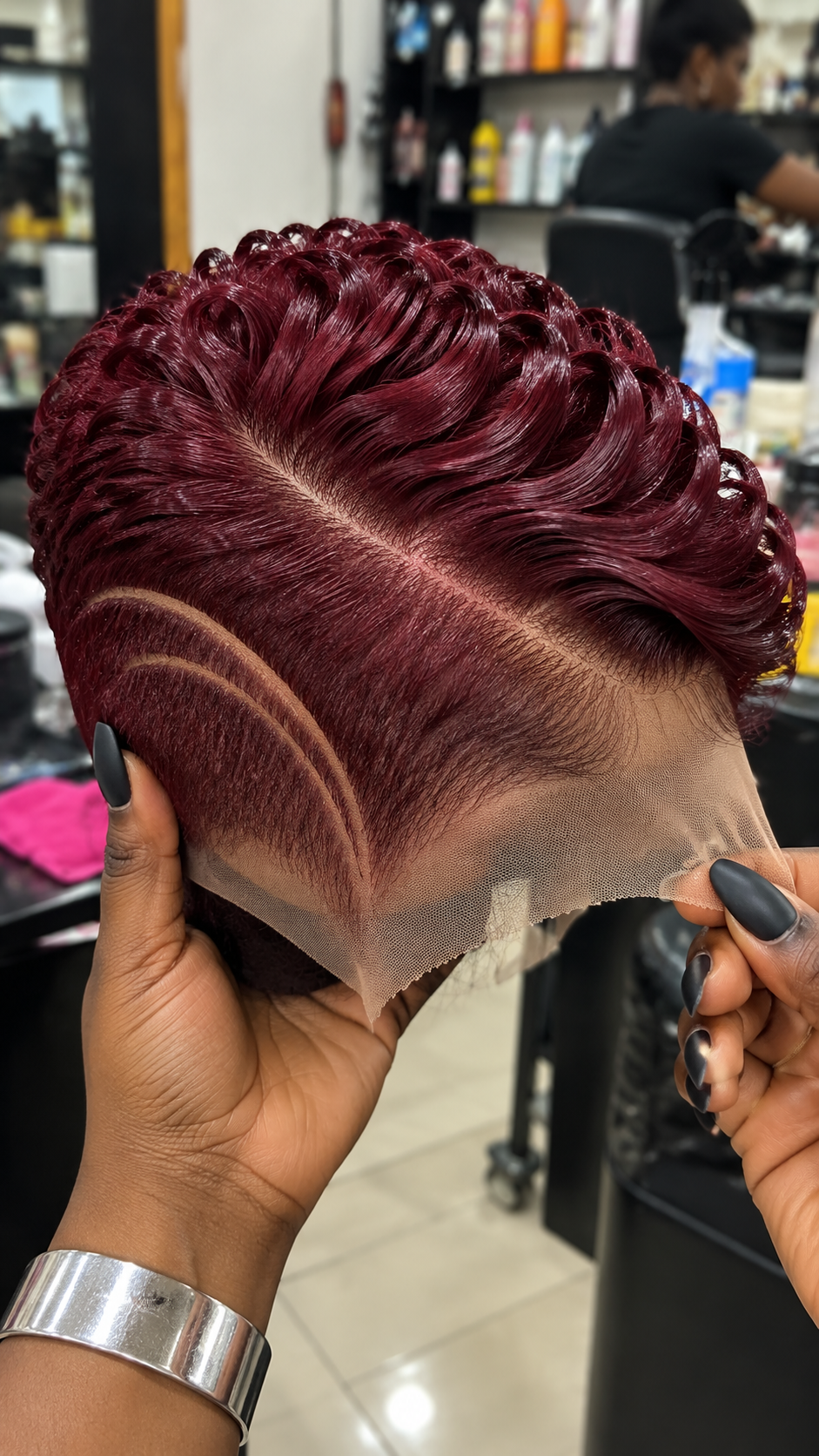
A rich burgundy color can make a pixie wig attractive, but the arrangement of its curls determines whether the hairstyle looks ordinary or genuinely distinctive. This particular lace wig combines broad, backward-sweeping ribbon curls with a closely arranged side and two curved decorative channels. The result is a compact hairstyle that uses movement, color, and carefully controlled proportions to create a striking appearance.
The photograph shows the wig being held between two hands inside a hair salon. One hand supports the body of the hairpiece while the other gently extends the untrimmed frontal lace. This provides a particularly useful view of the hairstyle before installation, revealing the large diagonal crown parting, the burgundy styling, the carefully arranged side, and the excess lace around the frontal edge.
The color appears predominantly deep burgundy with wine-red and subtle plum reflections. Unlike styles that combine black roots with bright copper or blonde highlights, this wig maintains a relatively consistent burgundy appearance across the visible hair. Its decorative character comes primarily from the different directions of the strands and the contrasting shapes of the upper and lower sections.


For customers searching for a burgundy pixie wig, a sculpted lace-front hairstyle, or an elegant ribbon-curl hairpiece, this design offers a useful reference. However, reproducing it accurately requires more than choosing the correct color. The crown direction, curved side channels, frontal hairline, and lace fit all deserve consideration before purchasing.
The Crown Is Built Around Flowing Burgundy Ribbons
The upper section contains broad, glossy strands that rise from the diagonal parting and sweep backward into overlapping curls. Several sections form elongated loops, while others curve across the upper head in a coordinated direction.
These formations differ from compact circular ringlets with open centers facing the viewer. The curls here are longer and more ribbon-like, with broad surfaces that reflect the salon lighting.
Near the upper portion of the crown, several strands curl back into rounded arches. Moving toward the side, the formations become more elongated, creating a continuous sweeping movement.
The arrangement gives the hairstyle noticeable height without producing an excessively bulky silhouette. Its shape depends on the strands being carefully grouped rather than separated into numerous independent spirals.
A wig maker attempting to reproduce the hairstyle should understand that the upper hair needs to move in a coordinated direction. Simply curling a burgundy pixie wig with ordinary rollers may not produce the same result.
Why the Width of the Ribbon Sections Matters
The visible curls contain relatively broad groups of strands. Their width creates reflective surfaces that make the burgundy color particularly noticeable.
If the sections are made too narrow, the hairstyle may resemble a collection of small spirals. If they are excessively wide, the individual bends may become less recognizable.
The desired result is a layered crown containing several elongated curls with distinct curved edges.
Customers commissioning a similar wig should request a close-up photograph from above and another from the side. These views help establish whether the ribbon formations retain their intended size and direction.
The photograph does not establish the exact styling method used to create the curls. Buyers should ask whether the formations are factory-set, manually styled, or maintained through specialized products.
The Deep Burgundy Color Adds Richness Without Highlights
The hairstyle displays a saturated burgundy shade with wine-red and dark reddish-purple reflections. Some strands appear brighter where the overhead salon lighting strikes their curved surfaces.
Other sections remain darker, creating depth within the same general color family.
The roots and lower side appear largely consistent with the burgundy styling, although lighting and strand direction produce variations in apparent brightness.
There is no clear evidence of separate blonde, copper, silver, or bright orange highlighting.
This makes the hairstyle an appealing reference for customers who prefer a single dominant color rather than a pronounced multicolored design.
Choosing Between Burgundy, Wine Red, and Plum
Wig suppliers frequently use the terms burgundy, wine red, dark cherry, and plum to describe similar-looking colors. However, these shades can differ considerably.
The photographed hair appears closer to a rich wine-burgundy than a bright cherry red. It contains noticeable reddish-purple depth without becoming a distinctly violet hairstyle.
Customers should request photographs under daylight and neutral indoor lighting before approving the color.
A warm salon environment can make burgundy hair appear more red or reflective than it would outdoors.
If the seller offers physical color samples, comparing the proposed shade with the reference can help prevent misunderstandings.
A Diagonal Crown Part Creates the Hairstyle’s Direction
One of the most prominent structural details is the exposed diagonal parting that travels across the upper side of the wig.
The channel separates the raised ribbon-curl section from the closely arranged hair beneath it. Its direction helps establish the sweeping movement of the crown.
The parting appears scalp-toned and relatively narrow. It follows a diagonal path rather than a conventional center or horizontal separation.
Above the channel, the strands rise into the decorative curls. Below it, the hair remains closer to the underlying surface.
This difference in orientation creates a strong visual boundary between the two styling zones.
Why the Parting Must Be Positioned Before Styling
The position of the diagonal separation affects the proportion of the upper curls and the lower side.
If the parting moves too far upward, the lower section could occupy more space than intended. If it moves too far downward, the crown may become disproportionately large.
For custom production, the stylist should establish the parting position before completing the ribbon curls.
A photograph from the same angle as the reference can help confirm the alignment.
The exposed channel resembles a scalp part, but the image does not establish the exact construction technique beneath it.
Two Curved Side Channels Add a Decorative Finish
Beneath the diagonal crown parting, the closely arranged side contains two prominent curved channels.
The upper channel forms a broad sweeping arc along the side, while a second, shorter separation follows beneath it. The channels approach one another toward the frontal lower area, creating a layered appearance.
The surrounding burgundy hair remains closely directed, giving the exposed separations clear boundaries.
These curves resemble decorative barber-inspired styling, but the photograph shows a removable wig rather than hair growing from a person’s scalp.
The exact method used to create the channels cannot be confirmed from the image. They may involve selective hair placement, cutting, or another specialist technique.
Maintaining the Shape of the Curves
The two channels are not identical straight lines. Their sweeping direction contributes to the overall movement of the hairstyle.
If they are replaced with ordinary parallel stripes, the side may appear more rigid than the reference.
Customers should request two curved separations with proportions appropriate to the compact side panel.
The dark reddish-burgundy hair between the channels should remain sufficiently dense to preserve the decorative pattern.
Any thinning or cutting should be approached carefully because removing hair from a wig may be irreversible.
The Frontal Hairline Remains Carefully Arranged
Near the frontal lace, the burgundy strands become finer and lie closer to the underlying surface.
The hairline follows a curved direction toward the temple, creating a transition between the exposed mesh and the sculpted side.
Unlike hairstyles dominated by large decorative forehead swirls, this design keeps the frontal hairline comparatively restrained.
The photograph shows fine strands near the lace boundary, but it does not establish whether the area has been customized through plucking, ventilation, or another technique.
Customers should request a close frontal photograph before purchasing, particularly when ordering a wig that requires professional lace fitting.
The Untrimmed Lace Is an Important Buying Detail
The photograph clearly shows beige lace extending beyond the frontal hairline. One hand gently pulls the mesh outward, revealing the amount of material remaining before installation.
The lace extends across the front and toward the visible temple, where it may later be adjusted according to the wearer’s hairline.
The mesh appears relatively fine, but its exact grade cannot be established visually.
It should not automatically be described as HD lace without reliable product information from the manufacturer or seller.
Likewise, the presence of lace does not establish whether the wig is intended for adhesive-free installation.
Attachment requirements depend on the cap construction, fit, and the wearer’s preferences.
Why Lace Trimming Should Follow a Proper Fitting
The decorative side channels and diagonal crown parting need to align naturally with the wearer’s face.
If the wig is positioned too far forward or backward, these details may appear misplaced.
A professional installer should begin by checking the cap fit and frontal position.
Only after confirming the placement should the excess lace be trimmed.
Removing too much mesh can compromise the frontal edge and may be difficult to correct.
The lace color should also be assessed against the wearer’s complexion in suitable lighting.
What the Photograph Does Not Reveal About the Cap
Although the wig is being held from underneath, the photograph does not provide a complete view of its interior construction.
Some dark cap material is visible behind the lace, but the full attachment arrangement remains concealed.
The exact cap circumference, number of combs, adjustable straps, and other fastening components cannot be confirmed from this angle.
Buyers should request a complete underside photograph before purchasing.
This allows the seller to demonstrate the actual cap construction and explain how the wig is intended to be secured.
Cap measurements should be compared with the customer’s head measurements rather than relying exclusively on general size descriptions.
Where To Buy a Similar Burgundy Pixie Wig
Customers searching for this hairstyle can explore independent wig boutiques, custom hairpiece makers, and salons experienced in sculpted pixie styling.
Online wig retailers may offer burgundy pixie units, but their curl arrangements can vary considerably.
Some products contain small spiral curls, while others feature loose waves or ordinary side-swept hair. These alternatives may share the same burgundy color without reproducing the photographed design.
A buyer should therefore send the reference image and explain that the desired wig contains broad ribbon curls, a diagonal crown part, and two decorative side curves.
Ask the seller whether the style is available ready-made or requires a custom commission.
Do not assume that a particular supplier has the exact wig in stock unless availability has been confirmed directly.
Questions to Ask Before Ordering
Begin by confirming the fiber composition. Ask whether the wig contains human hair, synthetic material, or a blend.
Request the exact burgundy color designation and photographs under neutral lighting.
Ask for the cap circumference, lace dimensions, and available attachment options.
Confirm whether the ribbon curls and side channels arrive fully styled.
Find out whether installation, shipping, and future adjustments are included in the quoted price.
For custom production, establish the expected completion time, payment terms, and revision policy before making a deposit.
Ready-Made or Custom: Which Is the Better Choice?
A ready-made burgundy pixie wig may be convenient when its color, crown direction, and side arrangement already resemble the reference.
However, a generic burgundy curly wig may not contain the elongated ribbon formations or decorative curved channels.
Custom production offers more control over the curl size, parting position, side pattern, and cap measurements.
This can be particularly valuable when a customer wants to reproduce the hairstyle closely rather than purchase a broadly similar alternative.
Before buying a basic wig for later customization, consult an experienced stylist to determine whether the material and density can support the intended work.
Extensive restyling or cutting may not be suitable for every wig construction.
Estimated Prices for Burgundy Ribbon-Curl Wigs
The cost of a similar wig may depend on the hair material, burgundy color preparation, ribbon-curl styling, decorative side channels, and lace construction.
Producing broad, coordinated ribbon formations may require more specialist attention than preparing ordinary loose curls.
The following USD figures are illustrative planning ranges rather than verified current retail prices or quotations for the photographed wig.
| Wig Category | Illustrative USD Range | What Buyers Should Consider |
|---|---|---|
| Premium Custom | $290–$690+ | Individually arranged ribbon curls, personalized burgundy coloring, decorative side channels, and possible custom lace fitting. |
| Standard Custom | $160–$360 | Customized crown styling and side detailing with selected cap and frontal adjustments. |
| Basic Human Hair | $95–$230 | A potential human-hair foundation that may require separate coloring and specialist ribbon styling. |
| Premium Synthetic | $65–$165 | A possible pre-styled alternative if the manufacturer offers comparable burgundy ribbon curls. |
| Basic Synthetic | $25–$85 | A lower-cost pixie option that may capture the general burgundy silhouette without reproducing the detailed styling. |
These categories describe possible purchasing options. The photograph does not establish the actual fiber composition of the wig.
Actual prices can differ significantly depending on supplier, country, material quality, and included services.
Before accepting a quotation, confirm whether the price covers the completed crown, side styling, cap adjustments, and lace preparation.
Shipping, professional installation, and subsequent maintenance may be separate expenses.
Planning the Installation Appointment
Once the wig arrives, inspect its styling before attempting modifications.
Compare the burgundy color, ribbon-curl arrangement, diagonal parting, and two side channels with the approved reference.
A professional installer should then check the cap fit and determine how the lace should be positioned.
The upper curls should be handled carefully because pulling or brushing them unnecessarily may disturb the arrangement.
Any correction to the decorative side channels should be discussed before cutting or thinning begins.
After fitting, photographs from the front and visible side can help confirm that the hairstyle retains its intended proportions.
Maintaining the Sweeping Burgundy Curls
The main maintenance concern is preserving the direction of the ribbon curls.
Unlike ordinary loose curls, these formations depend on broad groups of strands retaining their curved positions.
Repeated brushing, pulling, or compression may disturb the arches and reduce their individual definition.
Before washing or applying styling products, confirm the fiber composition and follow the manufacturer’s care instructions.
If the wig is synthetic, heat styling should only be attempted when the manufacturer confirms suitable temperature limits.
If the wig contains human hair, previous color processing may influence its response to additional heat or chemical treatments.
Protecting the Burgundy Color
Burgundy shades may change in appearance depending on the material, previous processing, and products used.
Customers should avoid attempting to recolor the wig without first confirming the fiber type.
Conventional hair dyes may be unsuitable for synthetic materials, while color-treated human hair may require additional care.
Ask the supplier which products are appropriate for maintaining the wine-red appearance.
When storing the wig, support its cap without compressing the elevated curls or stretching the frontal lace.
Why This Burgundy Pixie Is Worth Considering
The most appealing characteristic of this hairstyle is its coordinated direction. The upper hair rises into warm burgundy ribbon curls, while the lower sections follow a diagonal sweep beneath a prominent parting.
Two curved side channels add decorative detail without overwhelming the design.
The rich burgundy color provides depth, but the hairstyle’s identity comes primarily from its arrangement rather than its shade alone.
For customers seeking a similar wig, accurate crown styling and careful frontal fitting should be the main priorities.
Request photographs of the actual product, confirm the material and cap specifications, and discuss the intended ribbon arrangement with the seller before purchasing.
A well-executed version should preserve the deep burgundy color, broad sweeping curls, visible diagonal parting, and paired curved side channels while maintaining a compact, proportional pixie silhouette.
Search Terms
Burgundy ribbon curl pixie wig · Wine red sculpted lace hairpiece · Deep burgundy swept crown wig · Diagonal part burgundy pixie · Double curved side channel hairstyle · Untrimmed beige lace burgundy wig · Glossy plum red ribbon curls · Burgundy tapered side pixie wig