
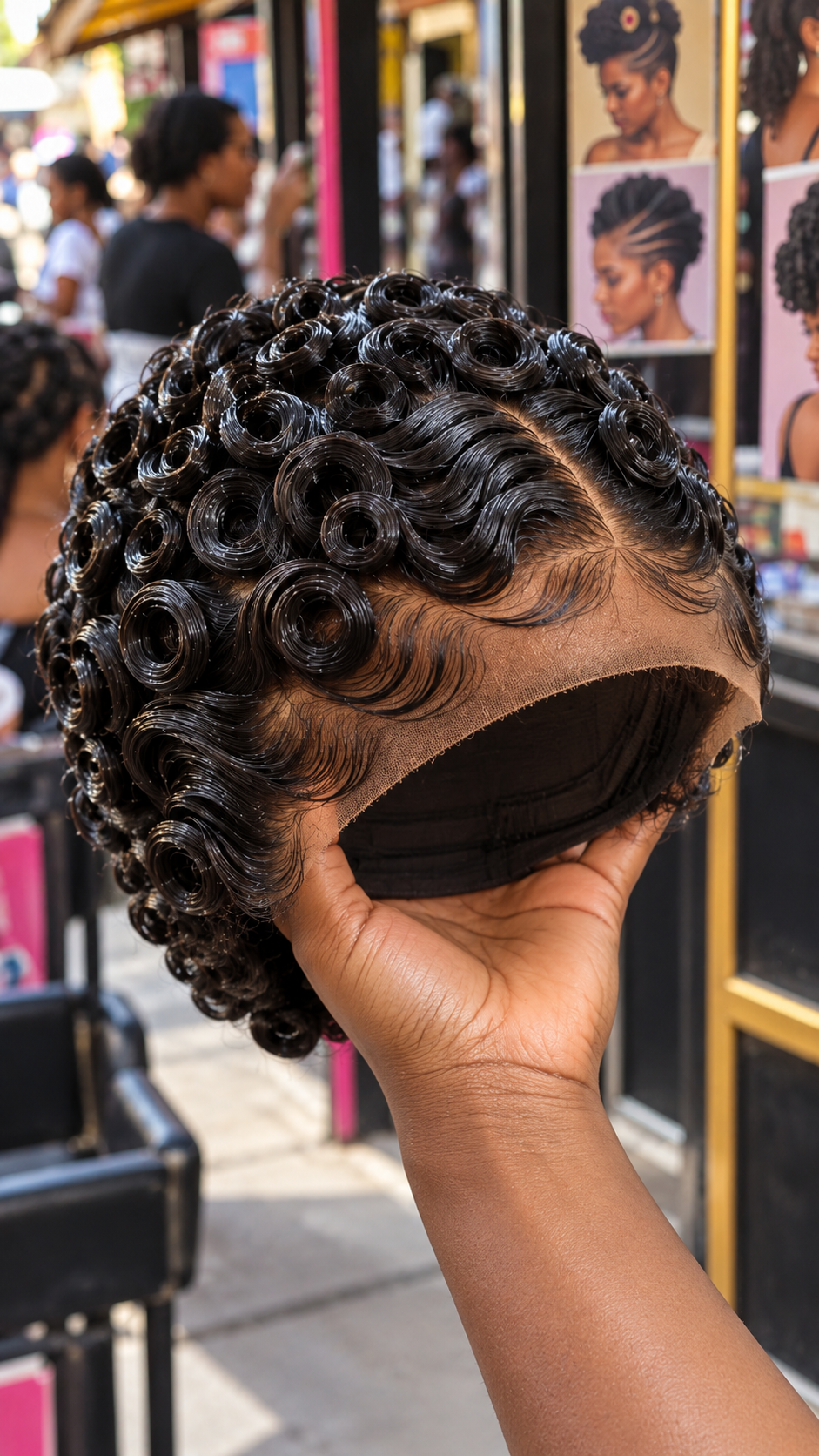
Some hairstyles make their strongest impression through the smallest details. This glossy black pixie wig brings together beautifully rolled circular curls and sweeping finger waves, creating a hairstyle that looks intricate without relying on long hair or contrasting colors. The most interesting feature is the way the curls gradually transform into flowing waves near the front hairline, giving the wig a distinctive appearance from its visible three-quarter angle.
Photographed outside a neighborhood hair salon, the wig is held from underneath with its front lace and interior cap exposed. Numerous circular curls cover the upper and visible side sections, while carefully arranged strands follow broad curves near the forehead. A diagonal parting begins near the upper front and travels backward between the curled sections, helping organize the direction of the hairstyle.
The color appears predominantly glossy black, with subtle warm reflections where daylight reaches the curved strands. Several curls have clearly visible circular openings, while others form overlapping rolls. The front lace remains untrimmed, and the dark interior cap is visible beneath the hairline.


For women considering a similar pixie wig, this design offers an opportunity to explore the difference between ordinary curly hairpieces and carefully sculpted styles. The most important buying considerations are the circular curl arrangement, the direction of the front waves, the cap fit, and the amount of customization required to achieve the desired appearance.
The Front Waves Are the Real Attraction
Although the rounded curls immediately catch the eye, the front styling gives this wig much of its personality. Instead of allowing the upper curls to continue directly to the lace edge, the hair is arranged into broad sweeping waves that follow the forehead.
Near the center-front area, several strands rise from a visible parting and bend into an elongated wave. The hair then flows toward the side, where additional curves continue beneath the circular curls.
These waves are noticeably flatter than the rolled spirals above them. Their strands remain grouped, allowing the individual lines of the hair to create a flowing pattern.
On the visible side, one prominent wave curves downward before turning backward. Smaller sections continue toward the lower edge, creating a layered arrangement without exposing a shaved side panel.
This styling is especially important when ordering a comparable wig. A generic curly pixie may contain similar circular curls but lack the decorative front arrangement that makes this hairstyle recognizable.
Large Circular Curls Give the Crown Its Shape
The upper hairstyle contains numerous rolled curls with visible circular openings. Several larger formations sit near the central crown and visible side, while smaller curls fill the spaces between them.
The curls are arranged close together, creating a rounded silhouette. However, the individual loops remain distinguishable rather than blending into one continuous mass.
Some curls face outward, revealing their hollow centers. Others sit at diagonal angles, overlapping neighboring formations and creating additional depth.
The visible curl arrangement is not completely uniform. Larger rolls appear near the upper side, while smaller spirals occupy portions of the rearward and lower sections.
This variation gives the hairstyle an organic appearance despite the carefully controlled styling.
The curls are also relatively compact. They do not hang into long ringlets or extend far beyond the rounded shape of the wig.
Why Curl Size Matters When Shopping
Two wigs can both be advertised as curly pixies while having substantially different appearances. One may contain small, tightly packed coils, while another uses larger circular rolls with open centers.
The photographed wig belongs closer to the second category, although smaller spirals are also present.
For a custom order, ask the maker to preserve the prominent circular openings and the mixture of curl sizes.
Oversized curls could increase the apparent height and width of the hairstyle. Extremely small coils could make the upper surface appear denser and conceal the individual circular shapes.
A close photograph of the completed crown is useful for evaluating whether the curl proportions match the intended design.
A Diagonal Parting Gives the Hairstyle Direction
Near the upper front, a narrow diagonal parting separates two sections of the hairstyle. The channel is visible where the strands change direction and move into neighboring curls.
Rather than creating a conventional center-parted appearance, the separation contributes to the asymmetrical styling.
Hair on one side of the parting flows into broad waves, while nearby sections rise into circular curls.
The parting appears relatively narrow and follows a natural-looking path through the upper front area.
It does not continue as a large exposed stripe across the entire visible side.
For custom production, the parting should be discussed alongside the front waves because its position influences how the surrounding hair is arranged.
The photograph does not establish the exact technique used to create the separation.
The Side Curls Continue Toward the Lower Edge
The visible side contains numerous circular curls extending from the upper crown toward the lower portion of the wig.
Several larger rolled formations sit near the middle, while smaller spirals appear closer to the bottom.
This arrangement creates a gradual reduction in apparent curl size without exposing a conventional shaved fade.
The lower side remains dark and visibly curled, providing coverage beneath the more prominent upper rosettes.
Near the front, the circular curls transition into broad finger waves. Farther backward, the rolled curls remain the dominant styling element.
The photograph does not show the complete opposite side or rear. Additional views would be necessary to confirm whether the same curl arrangement continues around the entire head.
Glossy Black Hair Creates Beautiful Depth
The wig appears predominantly black, with strong reflections along the outer surfaces of the curls.
Daylight creates subtle gray and warm highlights where the strands bend toward the camera. These reflections should not automatically be interpreted as separately colored hair.
There are no clearly visible blonde, copper, burgundy, or other contrasting color panels.
The dark shade makes the circular openings especially noticeable because the interiors of the curls remain shadowed.
The flatter front waves reflect light in elongated lines, emphasizing their sweeping direction.
This contrast between circular reflections and flowing highlights helps distinguish the two styling sections.
The photograph cannot establish whether the wig contains human hair, synthetic fibers, or a blend.
The Untrimmed Lace Needs Careful Preparation
A broad beige-toned lace section extends beyond the visible front hairline. The mesh remains untrimmed and hangs freely over the opening of the wig.
The lace is particularly noticeable beneath the decorative waves, where the fine black strands sit above the mesh.
Its visible appearance does not establish whether the material is HD lace, Swiss lace, transparent lace, or another commercial type.
Those specifications require confirmation from the manufacturer or seller.
Before purchasing, ask about the lace shade, coverage area, and recommended installation method.
Because the front waves extend close to the lace, trimming should be approached carefully. Removing supporting material too aggressively could affect the appearance or placement of the hairline.
What the Dark Interior Cap Reveals
The wig is supported from underneath, making part of its dark interior cap visible.
The photograph shows dark fabric and stitching around the opening. However, the complete attachment system is not visible.
The number of combs, adjustable straps, or other securing components cannot be established from this angle.
The image also does not prove that the wig is designed for adhesive-free installation.
Before ordering, request an inside-out photograph showing the complete cap, including the front, sides, and rear.
Confirm the cap circumference, front-to-back measurement, and ear-to-ear dimensions.
A correctly sized cap is important because the decorative front waves must sit in the intended position without excessive tension.
Finding a Similar Black Curly Pixie Wig
Specialist wig boutiques, beauty supply stores, online wig retailers, and custom wig makers are suitable starting points for finding a comparable hairstyle.
Useful product descriptions include black rosette curl pixie wig, sculpted finger-wave hairpiece, circular curl lace wig, and glossy black spiral pixie.
When comparing listings, look beyond the general hairstyle category. Examine the size of the circular curls and the arrangement of the front waves.
A wig with loose hanging ringlets may not provide the same rounded silhouette. Similarly, a product with ordinary baby hairs may not reproduce the broad sweeping sections visible in the reference.
Ask the seller for photographs of the exact unit being offered rather than relying entirely on promotional images.
How to Order This Style from a Wig Maker
When commissioning a custom version, begin with the upper curl structure. Explain that the hairstyle should contain glossy circular rolls with visible openings and varied diameters.
Next, describe the diagonal front parting and the broad finger waves that sweep across the hairline.
Ask the maker to retain the compact rounded silhouette and avoid adding unnecessary height.
Specify a predominantly black appearance without contrasting color sections.
The front waves should be treated as an essential part of the hairstyle rather than an optional finishing detail.
Confirm the intended hair material, cap size, lace specifications, production time, and included customization services.
If possible, request a photograph before the final styling is approved. This allows significant differences in curl placement or wave direction to be discussed before delivery.
Ready-Made Wigs and Custom Styling Costs
A ready-made wig may offer a convenient option if the desired curl arrangement and cap dimensions are already available.
However, the combination of prominent circular curls and elaborate front waves may require additional styling.
Custom production can provide greater control over curl diameter, parting position, hairline arrangement, and overall proportions.
It may also involve higher costs and longer production times.
When comparing options, ask whether the displayed curls and waves are included in the quoted price or require separate salon work.
The following US dollar figures are illustrative planning estimates, not verified current retail prices for the photographed wig.
Estimated Prices for Black Finger Wave Pixie Wigs
| Wig Category | Illustrative USD Range | Possible Inclusions |
|---|---|---|
| Premium Custom | $365–$850+ | Personalized cap sizing, carefully arranged circular curls, detailed front waves, and specialist hairline preparation. |
| Standard Custom | $190–$440 | Selected adjustments to curl diameter, parting placement, cap sizing, and wave arrangement. |
| Basic Human Hair | $110–$295 | A human-hair base unit that may require additional professional curl setting and front styling. |
| Premium Synthetic | $75–$220 | A higher-grade synthetic option with potentially prearranged circular curls and decorative waves. |
| Basic Synthetic | $30–$115 | A budget alternative with potentially fewer options for detailed customization. |
These categories describe possible purchasing options and do not establish the fiber composition of the photographed wig.
Installation, shipping, lace preparation, cap adjustments, and future styling restoration may be charged separately.
Request an itemized quotation before placing an order, particularly if the front wave arrangement requires specialized work.
Preparing for a Professional Wig Installation
Once the wig arrives, inspect the curls, lace, interior cap, and front waves before making any adjustments.
During a salon consultation, explain that the hairstyle contains carefully arranged circular curls and broad finger waves positioned close to the lace edge.
The stylist should check the cap fit and position the wig before trimming any lace.
Because the front waves form a visible part of the design, their placement should be evaluated against the wearer’s forehead.
If the waves require adjustment, the stylist should first identify the fiber type and original setting method.
Any trimming or cutting near the lace should be approached cautiously because the process may be irreversible.
Ask whether the salon offers future maintenance appointments for restoring individual curls or front waves.
Keeping the Circular Curls Intact
The most important maintenance concern is preserving the rounded openings of the upper curls.
Aggressive brushing can separate the strands and alter the appearance of individual rosettes.
Before washing, ask the supplier whether the curls are intended to retain their shape or require professional resetting afterward.
For synthetic fibers, heat tools should only be used when the manufacturer confirms compatibility and provides an appropriate temperature range.
For human-hair wigs, the correct styling method depends on previous processing and the technique used to form the curls.
The front finger waves require equally careful handling. Their appearance depends on the strands remaining grouped along the intended curved paths.
When storing the wig, avoid compressing the crown beneath heavy objects or folding the front lace against the curls.
Additional Views That Would Help Before Buying
The photograph provides a detailed view of the upper curls, front parting, decorative waves, and a portion of the interior cap.
However, the complete rear and opposite side remain unseen.
A direct front photograph would help establish how the waves frame the forehead.
A rear photograph would reveal whether the circular curls continue toward the nape or transition into a different arrangement.
An opposite-side view would clarify whether the diagonal parting and decorative waves are repeated.
A complete underside photograph would help verify the attachment system and cap construction.
These additional views are especially useful when ordering a customized wig from a supplier who cannot provide an in-person fitting.
A Black Pixie with Beautifully Sculpted Movement
This hairstyle brings together compact circular rosette curls, a diagonal front parting, and graceful finger waves that sweep across the visible hairline.
The rounded upper curls create fullness without excessive length, while the flatter front styling introduces a flowing contrast.
The untrimmed beige lace and partially visible dark cap confirm that the wig is being displayed before installation, although the complete construction and fiber composition remain unverified.
For buyers seeking a comparable design, the most important details are the circular curl openings, the direction of the front waves, and the overall compact silhouette.
Careful supplier selection, accurate cap measurements, and professional installation can help preserve these characteristics while adapting the wig to the intended wearer.
Search Terms
Glossy black rosette pixie wig · Sweeping finger wave lace hairpiece · Circular barrel curl black wig · Diagonal front part sculpted pixie · Raven black open ringlet crown · Beige lace S wave hairline wig · Compact black curled side hairstyle · Black pixie wig with flowing forehead waves