
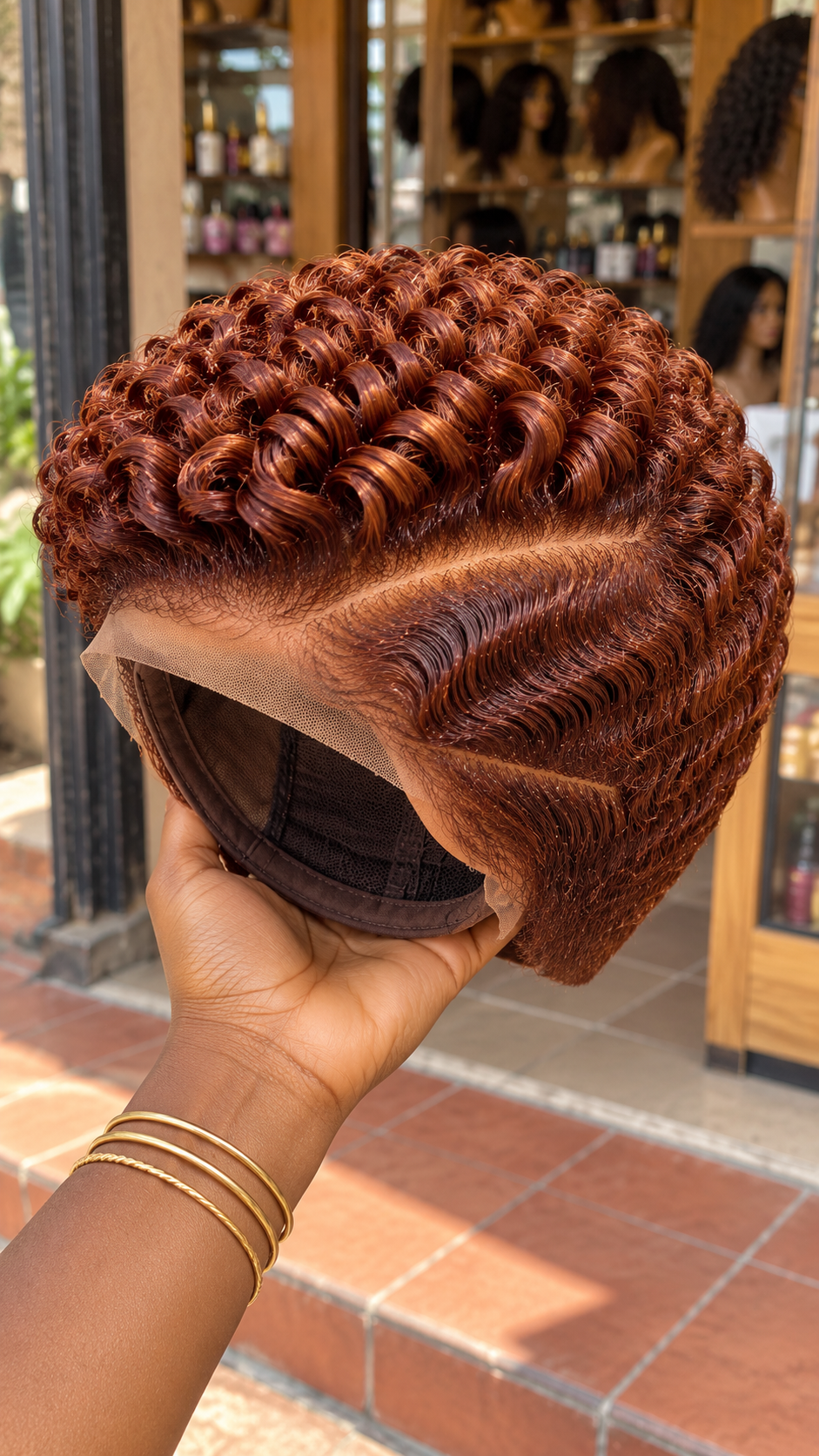
Warm copper hair has a way of making even the smallest curl look remarkable. In this beautifully arranged pixie wig, the reddish-brown color draws attention to a crown packed with springy spiral loops, while an elaborate side-wave arrangement introduces a completely different kind of movement. The result is a hairstyle that combines the lively appearance of copper curls with the precision of carefully laid salon waves.
The wig is photographed outside a beauty salon, held in one hand with its untrimmed beige lace and dark interior cap clearly visible. Behind it, wooden display cabinets contain additional wigs and hair products. Natural daylight illuminates the copper strands, making the individual curls, darker spaces between them, and flowing temple waves especially noticeable.
Unlike pixie hairstyles that rely on contrasting highlights or geometric side patterns, this design uses a predominantly copper-auburn color throughout the visible hair. Its most recognizable characteristics are the rounded crown, closely arranged spiral curls, diagonal parting, and a broad finger-wave panel above the temple.


The hairstyle offers an appealing reference for customers who want a compact copper pixie without sacrificing decorative detail. It also raises several practical questions worth considering before purchase: how the curls are maintained, whether the side waves require professional restyling, and how the lace should be fitted without disturbing the carefully arranged hairline.
The Copper Shade Gives Every Curl More Personality
The visible hair displays a rich copper-auburn color with warm reddish-brown and amber reflections. Some sections appear brighter where daylight strikes the strands, while the inner portions of the curls look deeper and darker.
The color is relatively consistent across the crown and side, although natural variations in reflection create an impression of multiple warm tones.
There is no clearly identifiable platinum, blonde, silver, or contrasting black highlight pattern. The deeper areas near the roots and within the curls appear to belong to the same warm brown-red color family.
This distinction matters when ordering a similar wig. Requesting a dramatic black-to-copper transition could produce a different appearance from the photograph.
A more suitable color description would be rich copper auburn with deeper reddish-brown shading and bright amber reflections.
How Copper Auburn Differs From Bright Orange
Copper auburn combines reddish and brown tones, while bright orange copper generally has a more intense orange appearance.
The wig shown here leans toward a warm reddish-brown foundation rather than a uniformly bright orange shade.
Its darker curl interiors help balance the brighter outer strands.
Customers should request daylight photographs or actual color samples before choosing a commercial shade number. Color names vary between suppliers, and warm indoor lighting can make copper hair appear more golden than it does outdoors.
A Crown Filled With Springy Spiral Loops
The upper section contains numerous compact spiral curls arranged closely together. Several prominent loops sit near the front, while smaller curls fill the surrounding spaces and continue toward the visible rearward section.
Many curls form rounded openings, but their shapes are not completely identical. Some are wider and more circular, while others appear slightly elongated or tilted.
This variation creates a lively crown with noticeable depth.
The curls rise from the foundation before bending into compact loops. They are closely arranged enough to create fullness without producing an excessively tall silhouette.
Near the outer edges, smaller spirals follow the rounded contour of the wig, helping the upper hair transition toward the closely arranged lower section.
The complete rear is not visible, so the exact continuation of the curls around the nape cannot be established.
Why the Curl Openings Should Remain Visible
The spaces inside the spirals are an important part of the hairstyle’s appearance.
They create small shadowed areas surrounded by reflective copper strands, making individual curls recognizable even when the crown is densely arranged.
If a stylist compresses the curls too tightly, the openings may disappear. If the curls are placed too far apart, the crown could look uneven.
A faithful reproduction should balance curl diameter, placement, and density rather than simply adding more hair.
The photograph does not establish whether the spirals were created with rollers, finger setting, heat tools, or another technique. The maker should explain how the selected hair material will retain the intended shapes.
The Side Waves Are the Real Signature of This Pixie
Below the circular crown, the visible temple contains a broad arrangement of closely aligned finger waves.
The upper wave begins beneath the diagonal parting and curves toward the front before bending backward along the side.
Its strands follow a coordinated direction, creating a raised ridge that catches light across the copper surface.
Below this prominent wave, additional curved sections continue toward the lower temple. These smaller waves have tighter bends and gradually become more compact.
The arrangement creates an attractive contrast with the circular spirals above.
While the crown emphasizes rounded loops, the temple emphasizes flowing lines and directional movement.
Why This Side Is Different From a Razor-Line Design
The photograph shows a visible diagonal separation and closely arranged waves, but it does not display an elaborate series of shaved geometric channels.
The decorative effect comes primarily from the placement of the strands.
A narrow lighter separation is visible beneath the upper wave arrangement, but its construction cannot be established from the image alone.
Customers should avoid asking a stylist to add multiple carved lines when the goal is to reproduce this particular hairstyle.
The broad flowing wave panel is already a distinctive decorative element.
The Diagonal Parting Gives the Hairstyle Direction
A visible parting separates the circular crown from the lower finger-wave section.
The channel begins near the front-side region and travels backward along a gently curved diagonal path.
The exposed foundation appears lighter than the surrounding copper hair, making the separation noticeable.
Above the parting, the curls rise into rounded loops. Beneath it, the strands remain closer to the cap and follow sweeping wave patterns.
This difference in direction creates a clear division while allowing the hairstyle to appear coordinated.
The parting also influences the proportions of the crown. Its placement determines how much space is available for the raised curls and how much is reserved for the temple waves.
Getting the Parting Position Right
A custom stylist should establish the intended parting before arranging the curls or setting the waves.
Moving the channel too high could reduce the apparent width of the crown. Placing it too low could make the temple section disproportionately large.
The customer should also confirm which side of the head should display the parting when the wig is worn.
Because the photograph shows a handheld unit, the exact wearing orientation should be discussed rather than assumed.
Why the Lower Side Remains Compact
The lower section follows the contour of the wig, with closely arranged copper strands forming a tapered-looking side.
Its relatively compact shape provides balance beneath the full spiral crown.
If the lower hair were made substantially fuller, the wave arrangement could become less prominent and the hairstyle might appear wider.
The reference instead concentrates most of the volume above the diagonal parting.
This makes the relationship between crown fullness and temple density especially important for a custom reproduction.
The exact cutting or construction method used to achieve the compact side cannot be confirmed from the photograph.
The Lace and Cap Deserve a Closer Inspection
The wig is displayed before installation, with beige lace extending beyond the front and side hairline.
The lace remains untrimmed and is clearly visible against the dark interior cap.
Inside the opening, brown cap fabric, stitching, and darker internal sections can be seen.
However, the photograph does not provide a complete underside view. The exact attachment system, cap dimensions, and lace grade remain unverified.
The presence of fine mesh does not establish that the unit uses HD lace.
Before purchasing, ask the seller for a photograph showing the entire cap interior, including adjustment hardware, any combs, and the extent of the lace.
Choosing a Cap That Fits the Hairline
The finger waves and diagonal parting are positioned carefully relative to the front and side perimeter.
If the cap is too large, the hairline may sit lower than intended. If it is too small, the wig could pull backward and change the apparent placement of the waves.
Measurements such as head circumference, front-to-nape distance, and ear-to-ear width can help determine an appropriate size.
The wearer should confirm the fit before trimming the lace.
Any adjustments should preserve the front strands and the side-wave arrangement.
The photograph does not prove that the wig can be worn without adhesive. The appropriate installation method depends on the actual cap construction and individual fit.
Finding a Stylist Who Understands Copper Finger Waves
Not every stylist who works with curly wigs specializes in sculpted finger waves.
This design requires someone comfortable with both compact spiral setting and precise directional styling.
When searching locally, consider wig customization specialists, experienced finger-wave stylists, and salons that regularly prepare pixie lace wigs.
Review portfolios for examples of circular curls paired with closely arranged temple waves.
A professional who can create beautiful curls but cannot reproduce the broad side-wave panel may not be the best choice for this reference.
How to Describe the Desired Result During Consultation
Explain that the hairstyle should retain a rich copper-auburn shade throughout the visible sections.
Specify a rounded crown of compact spiral loops, with slightly larger curls near the front and smaller curls around the perimeter.
Identify the diagonal parting and the broad temple wave as essential details.
Ask the stylist to preserve the compact lower side rather than increasing its volume.
Request a rear photograph or a proposed rear styling plan, since the reference does not show the complete back.
A clear consultation can prevent the finished wig from drifting toward a different pixie design.
Buying Online Without Relying on Color Alone
Online wig listings often emphasize color names and general curl descriptions. Those details are useful, but they are not enough to establish whether a unit resembles this reference.
A copper curly pixie with loose spirals may look very different from one with compact loops and a broad finger-wave temple.
Ask the seller to provide photographs of the actual wig from the front, both sides, and back.
Request a close-up of the hairline and an underside photograph.
Confirm whether the displayed styling is included in the purchase or represents additional salon customization.
For custom orders, obtain written confirmation of the color, curl arrangement, cap size, delivery schedule, and revision policy.
Should You Choose Ready-Made or Custom?
A ready-made copper pixie may be suitable for customers who prioritize color and a compact curly silhouette.
However, it may not reproduce the particular spiral placement or finger-wave arrangement shown here.
A custom wig allows the buyer to discuss the crown shape, curl density, and temple styling in greater detail.
Another possibility is purchasing a suitable base wig and having it professionally customized.
That approach depends on whether the existing hair length, density, and material can support the desired changes.
Before purchasing a base unit, ask the intended stylist whether the planned customization is realistic.
Planning a Budget for Copper Spiral Pixie Wigs
The price of a similar hairstyle can depend on the hair material, color preparation, cap construction, spiral setting, and labor involved in creating the finger waves.
The following USD amounts are illustrative planning ranges only. They are not verified live retail prices or quotations for the photographed product.
| Wig Category | Illustrative USD Range | Potential Inclusions and Limitations |
|---|---|---|
| Premium Custom | $380–$880+ | Personalized copper shade, individually arranged spiral loops, detailed temple waves, and custom cap measurements. |
| Standard Custom | $185–$450 | Professional curl setting and side-wave customization on a suitable prepared wig foundation. |
| Basic Human Hair | $110–$290 | A possible starting unit that may require separate coloring, spiral setting, and hairline work. |
| Premium Synthetic | $75–$215 | A possible pre-colored alternative if its fiber and construction can retain the intended curl arrangement. |
| Basic Synthetic | $30–$105 | A budget-oriented copper pixie that may not reproduce the elaborate side waves or individual spiral placement. |
The photograph does not establish whether the wig contains human hair, synthetic fiber, or a blend. These categories represent possible purchasing options rather than verified specifications of the displayed unit.
Additional expenses may include professional installation, lace trimming, cap adjustments, shipping, and future styling restoration.
When comparing quotations, confirm whether the finished curls and finger waves are included or charged separately.
Keeping the Copper Color Attractive
The best maintenance routine depends on the confirmed hair material and any previous color processing.
If the wig contains dyed human hair, frequent harsh cleansing or excessive heat may affect its color and condition.
Ask the seller which cleansing products are appropriate and whether the hair has undergone chemical processing.
If the unit contains synthetic fiber, follow the manufacturer’s instructions. Conventional dyeing may not be suitable, and heat tolerance must be confirmed before restyling.
Store the wig away from unnecessary direct sunlight when not in use, especially if the seller advises protecting its color.
Protecting the Spiral Loops
The crown depends on maintaining individual circular openings and closely arranged curls.
Avoid aggressive brushing through the upper hair, as this may disturb the loops and change their shape.
Do not separate the curls merely to increase volume. The compact arrangement is central to the hairstyle.
Ask the stylist whether the loops can be refreshed individually or whether the entire crown requires professional resetting after washing.
Preserving the Broad Temple Wave
The side-wave panel requires a different approach from the circular crown.
Its appearance depends on the strands remaining aligned along their curved paths.
Repeated rubbing near the temple may disturb the arrangement, especially during installation and removal.
Use only styling products recommended for the confirmed hair material.
A stylist may be able to restore displaced strands without rebuilding the entire hairstyle, but the appropriate method depends on how the waves were originally created.
Avoid cutting or permanently altering the side before consulting a professional.
Where This Copper Pixie Fits Best
The warm copper shade can complement cream, beige, brown, black, and other coordinated clothing colors.
Gold accessories may emphasize the amber reflections, while neutral outfits allow the curled crown to become the focal point.
The hairstyle can work well for celebrations, portrait photography, salon fashion displays, or personal everyday styling.
For frequent wear, the buyer should consider the time and professional assistance potentially required to maintain the finger waves.
Its compact silhouette may appeal to women who prefer decorative curls without long hair extending around the shoulders.
A Beautiful Balance of Color and Craftsmanship
This copper pixie stands out because its styling does not depend on one isolated detail. The warm reddish-brown color enhances the circular loops, while the diagonal parting separates the full crown from the flowing temple waves.
The compact lower side prevents the hairstyle from appearing overly wide, and the exposed beige lace shows that final fitting and installation remain important steps.
For customers considering a similar wig, the best purchasing decision begins with understanding the curl structure and wave arrangement rather than choosing a product based on color alone.
A skilled wig maker who can reproduce the rounded spiral crown, broad temple waves, and consistent copper-auburn appearance can create a hairstyle that captures the distinctive character of this reference.
Search Terms
Rich copper auburn spiral pixie · Reddish brown loop curl wig · Copper finger wave temple hairstyle · Rounded auburn coil crown · Diagonal part copper lace wig · Amber copper compact curly hairpiece · Copper pixie with broad side waves · Untrimmed beige lace auburn wig