
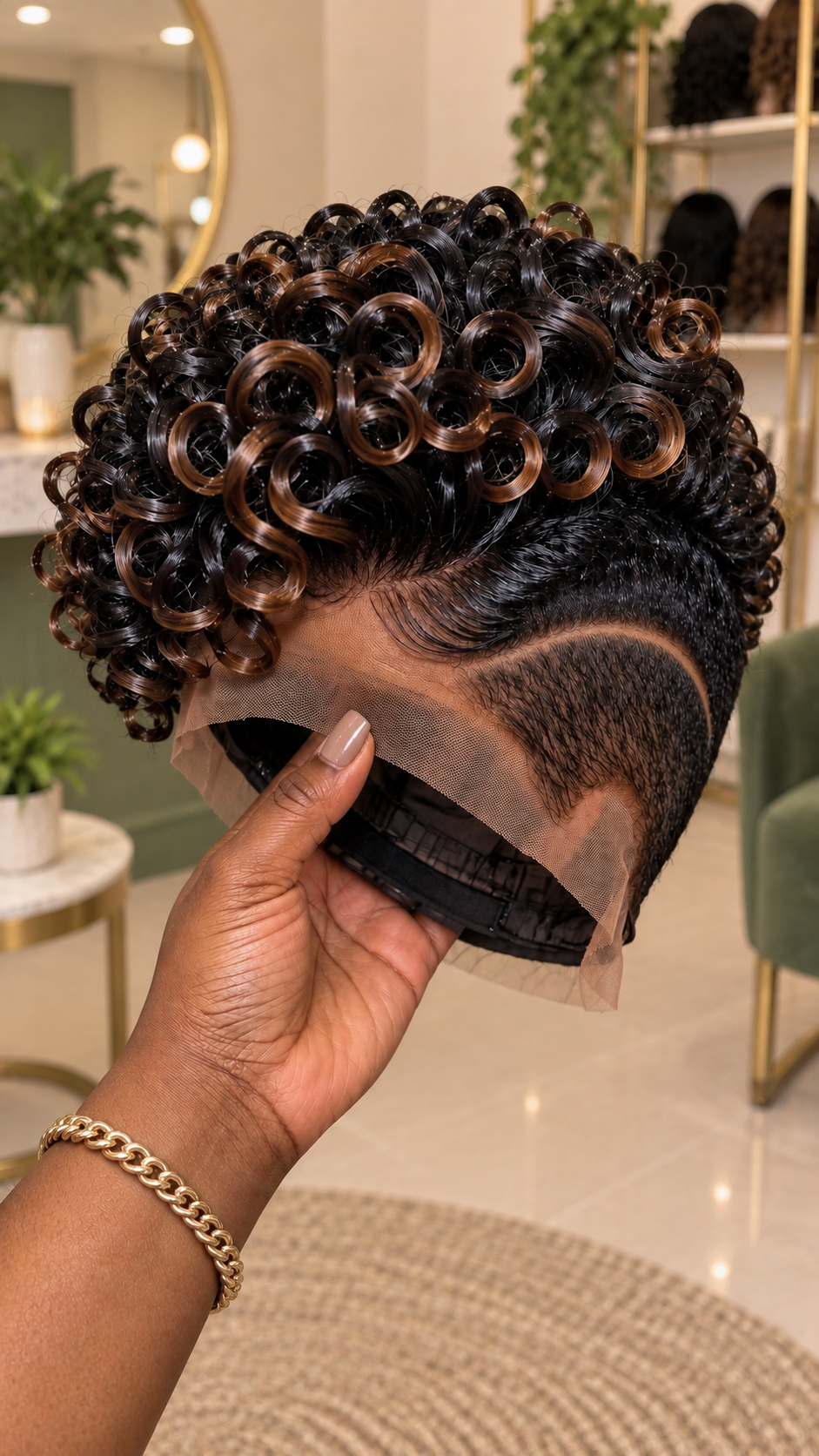
Some wigs are best evaluated by their color, while others demand attention to the way individual strands have been arranged. This espresso-black pixie wig belongs to the second category. Its upper surface contains dozens of circular curls, many accented with warm caramel-brown reflections, while the visible side presents a closely arranged dark section separated by one sweeping curved channel. The result is a striking contrast between rounded, elevated curls and a compact lower profile.
The photograph shows the wig held in one hand in a softly illuminated salon environment. Its front lace remains untrimmed, and part of the dark interior cap construction is visible beneath the opening. This makes the image useful for evaluating not only the hairstyle but also some of the preparation that may be necessary before wearing it.
The most distinctive detail is the distribution of the caramel tones. Instead of covering the entire upper section with blonde, the lighter brown appears along selected circular curls, emphasizing their curved surfaces. The darker strands remain dominant, giving the crown considerable depth.


For women searching for a black and caramel curly pixie wig, the central purchasing question is whether a seller can reproduce the ring-shaped curls and the closely arranged temple section together. A conventional highlighted curly wig may contain similar colors but an entirely different silhouette.
Why the Caramel Rings Stand Out Against the Dark Foundation
The dominant color appears to be deep espresso black, with warm caramel and chestnut-brown accents distributed through the circular curls. Several prominent rings near the front display lighter brown surfaces, while darker loops surround them.
The contrast is particularly noticeable where the curls overlap. The lighter sections catch the salon lighting, making individual circular openings easier to recognize against the black hair beneath.
There is no clearly established uniform blonde tip treatment or continuous light-to-dark gradient. The color appears concentrated in selected curved strands, with variations in brightness also influenced by the direction of the light.
This placement creates a different effect from broad highlights running straight through the hair. The caramel accents follow the circular movement of the curls, making the color and styling appear connected.
When discussing this wig with a supplier, describe the desired shade as an espresso-black base with selective caramel-brown ring accents. Avoid requesting an evenly highlighted crown unless a more uniformly colored appearance is preferred.
Separating Actual Color From Reflected Light
The glossy black strands show numerous bright reflections, particularly around the upper crown. Some reflections appear cool or grayish, but they should not be mistaken for silver-dyed hair.
The warmer brown rings are visually distinct from these cooler reflections. Even so, the photograph cannot establish the exact number of color shades used during manufacture.
Ask the seller for a daylight photograph or a video taken under neutral lighting. This can help determine whether the caramel sections appear as warm brown, golden brown, or a lighter honey shade outside the photographed salon.
For custom coloring, request a sample of the proposed color combination before approving the finished piece. If the hair is synthetic, confirm whether the required shades are available as manufactured fibers rather than assuming that the wig can be dyed afterward.
Examining the Crown as a Collection of Individual Rings
The upper hairstyle contains a dense arrangement of rounded loops with clearly visible openings. Some rings are comparatively broad, while others are smaller and more closely grouped.
Near the front, several large circular curls project forward, creating a prominent edge above the hairline. Behind them, additional loops overlap to form a rounded crown with considerable visual depth.
The curls are not arranged as long, freely hanging ringlets. They remain relatively close to the upper surface, forming a compact but elevated structure.
Several caramel-accented rings are positioned near the front and upper center, where they are particularly visible. Smaller dark curls fill the surrounding areas, preventing the lighter sections from appearing isolated.
This combination gives the crown a sculptural appearance without requiring extreme height. The volume comes from the number and arrangement of the loops rather than from excessive overall length.
Understanding the Difference Between Ring Curls and Spiral Coils
Although the terms are sometimes used interchangeably in product listings, the photographed hairstyle is characterized by open circular rings rather than a uniform mass of tightly compressed coils.
Many of the curls form recognizable loops with openings at their centers. Their surfaces resemble narrow ribbons curving into circular shapes.
A wig maker recreating this design should pay attention to the size of those openings. If the curls become too small, the crown may lose its recognizable ring pattern. If they become too large, the hairstyle may appear disproportionately full.
Ask for a compact crown with varied circular curl sizes and several prominent caramel-accented rings near the front. A reference photograph is essential because descriptions alone may not communicate the intended arrangement.
The photograph does not reveal the entire rear surface, so the precise continuation of the ring pattern should be confirmed through additional images before ordering.
The Curved Temple Channel Gives the Side Its Identity
Beneath the upper curls, the visible side contains a single prominent curved separation channel. It begins near the forward upper side and travels backward in a broad arc, dividing the elevated crown from the closely arranged lower hair.
The channel has a warm, pale appearance because the underlying foundation is visible between the dark strands. Its curved direction follows the contour of the side rather than forming a straight horizontal line.
Above the channel, the hair is directed upward and backward toward the circular crown. Below it, the strands lie much closer to the foundation, creating a compact side section.
The lower hair appears dark and closely arranged, with fine strands following the curve of the temple area. This produces a tapered visual impression without proving that a conventional barber fade technique was used.
It is important not to describe the design as multiple shaved lines. The photograph shows one clearly recognizable curved separation channel on the visible side, and the exact method used to create it cannot be confirmed from the image.
Why the Channel Position Matters During Fitting
The curved separation helps determine where the crown volume begins. If the channel sits too low, the compact side section may appear wider than intended. If it sits too high, the upper curls may lose some of their visual prominence.
Because the wig is being held rather than worn, its final position against an individual’s temple cannot be established from the photograph alone.
A stylist should assess the channel during fitting and confirm that its curve follows the intended facial contour. Any adjustment should preserve the relationship between the lower side and the raised ring curls.
For a custom commission, request a direct side photograph showing the full path of the channel. This will help the wig maker reproduce its curvature more accurately.
The Front Hairline Connects the Rings to the Side
At the front, fine dark strands sweep backward beneath the circular curls. Their direction creates a transition between the raised crown and the exposed lace.
The hairline appears closely arranged, with several curved strands visible near the forehead. These strands do not form the same large rings as the upper section. Instead, they lie flatter and guide the eye toward the temple.
This contrast is essential to the hairstyle’s appearance. If the front strands were styled into large curls, the hairline could become bulky and obscure the separation between the crown and the side.
When ordering a similar wig, ask the stylist to preserve the flatter front transition rather than extending the large circular curls directly onto the lace edge.
The photograph does not establish whether the hairline has been pre-plucked or customized using a particular technique. Such details should be confirmed through product specifications or close-up photographs.
What the Exposed Lace and Interior Construction Reveal
A substantial tan lace section extends beyond the styled front and side perimeter. The lace is visibly untrimmed, indicating that the wig is being displayed before final installation preparation.
The opening also reveals part of the dark interior cap. Black fabric bands and stitched sections are visible beneath the lace, providing a partial view of the construction.
However, the photograph does not show the entire underside. It therefore cannot confirm the complete attachment system, exact cap dimensions, or whether adjustable straps and combs are included.
The lace should not be classified as HD lace solely because it appears fine in the photograph. Its actual grade, transparency, softness, and dimensions require confirmation from the seller.
Questions to Ask About the Cap
Request the cap circumference, front-to-nape length, and ear-to-ear measurement. These dimensions help determine whether the wig is likely to fit comfortably.
Ask for a complete underside photograph showing the cap structure and any attachment hardware. The visible dark bands provide only partial information.
The seller should also confirm the lace color, lace dimensions, and whether the wig arrives with the front mesh untrimmed.
If the product is advertised as glueless, ask what construction elements support that claim. The visible cap opening alone does not establish adhesive-free security.
Finally, confirm the fiber composition. The glossy ring curls may be made from human hair, synthetic fiber, or another material, but the photograph cannot identify the composition reliably.
Choosing Between a Ready-Made Piece and a Custom Recreation
A ready-made black and caramel pixie wig may be suitable if it already contains the correct circular curls and curved side channel. However, many products marketed as highlighted pixies use loose waves, small coils, or conventional side partings.
When browsing online stores, compare the actual product photographs with the reference. Look for recognizable ring openings, selective caramel accents, and a compact dark side beneath the curved channel.
A custom order may offer greater control over the placement of the caramel rings and the size of the upper curls. It may also allow the stylist to adjust the channel position to suit the intended wearer.
However, custom work can involve additional labor and should begin with a clear discussion of what can realistically be reproduced.
Ask the wig maker whether the ring curls are formed individually, whether the color placement can be reviewed before completion, and whether the final piece will be supplied fully styled.
Confirm the material composition, cap size, lace specifications, production schedule, shipping arrangements, and return conditions before paying a deposit.
Booking a Stylist for Ring Curl Customization
The most relevant professional is a wig customization specialist experienced in sculpted pixie hairstyles, circular curl placement, and lace-front preparation.
When contacting a salon, describe the desired hairstyle as an espresso-black pixie wig with selective caramel ring curls, a compact crown, and one curved temple parting.
Provide the reference photograph and ask for examples of previous work involving similarly arranged circular curls. Experience with ordinary loose-curly wigs may not demonstrate the precision required here.
A consultation should address the intended crown height, curl diameter, color placement, side-channel position, and cap fit.
If purchasing the wig from a separate retailer, schedule the fitting after the actual product arrives. The stylist may need to inspect the construction before determining whether further customization is appropriate.
Preparing the Wig for Its First Wear
Before installation, inspect the ring curls for any changes caused by shipping. Check that the caramel-accented sections remain visible and that the darker curls have not been compressed into the lighter rings.
The stylist should then position the wig on the intended wearer and assess how the curved temple channel aligns with the side of the head.
The front lace should remain intact until the correct position has been established. Trimming too much lace can remove material needed for a comfortable and balanced fit.
Any necessary adjustments to the front strands should preserve their backward direction and avoid disturbing the larger circular curls.
The attachment method should be chosen according to the verified cap construction and the wearer’s needs. The photograph does not establish whether adhesive is required.
After installation, examine the hairstyle from the front, side, and three-quarter angle. The crown should retain its rounded shape, the caramel rings should remain recognizable, and the curved channel should follow the intended temple contour.
Illustrative Prices for an Espresso and Caramel Ring Curl Wig
The cost of recreating this hairstyle may depend on the fiber composition, the placement of the caramel accents, the number of individually arranged ring curls, and the lace preparation required for installation.
The following USD ranges are illustrative planning estimates rather than verified live selling prices. The actual material and price of the photographed wig are unknown.
| Wig Category | Illustrative USD Range | Potential Cost Considerations |
|---|---|---|
| Premium Custom | $370–$880+ | Individual cap fitting, specialist ring curl construction, selective caramel placement, and detailed lace customization. |
| Standard Custom | $190–$430 | Selected cap options, customized circular curls, and adjustments to the curved temple channel. |
| Basic Human Hair | $105–$270 | Human-hair base unit that may require separate highlighting, ring curl setting, and lace preparation. |
| Premium Synthetic | $65–$180 | Higher-grade synthetic alternatives with prearranged ring curls and material-dependent styling flexibility. |
| Basic Synthetic | $25–$85 | Budget alternatives that may differ in caramel placement, curl precision, and cap construction. |
These categories describe possible purchasing options rather than confirmed classifications of the photographed product. Actual prices vary by supplier, country, materials, workmanship, and included services.
Selective caramel coloring may increase the cost of a custom order if the desired shades are not available in the chosen base material. The arrangement of numerous circular curls can also require substantial styling time.
Ask whether the quotation includes the completed hairstyle, lace preparation, fitting, installation, shipping, and any future maintenance appointments.
A lower-priced base wig may become more expensive if extensive restyling is necessary to reproduce the reference accurately.
Maintaining the Ring Structure and Color Contrast
The primary maintenance concern is preserving the circular openings of the upper curls. Repeated brushing, aggressive finger separation, or compression can disturb their arrangement.
Ask the supplier how the curls were formed and whether they can be safely repositioned. Some constructions may require professional resetting after significant disturbance.
The curved temple channel needs separate attention. Hair crossing the exposed separation can reduce its visibility, so maintenance should preserve the direction of the closely arranged side strands.
Cleaning instructions must follow the confirmed fiber composition. Synthetic hair should not be exposed to heat unless the manufacturer specifically permits it. Human hair may allow different styling methods, but any previous coloring or chemical processing should be considered.
The caramel accents may require different care depending on whether they are manufactured fiber colors or chemically processed human hair. Do not assume that products intended for bleached human hair are appropriate for synthetic wigs.
When storing the wig, avoid crushing the ring curls or stretching the lace. A suitable support can help preserve the compact silhouette without placing unnecessary tension on the hairline.
If the curls lose their circular shape or the color placement becomes difficult to maintain, professional restyling may be preferable to extensive home adjustments.
Recognizing the Details That Make This Wig Distinctive
The appeal of this espresso-black pixie lies in the relationship between the dark foundation, selective caramel ring accents, and the curved temple separation. The color emphasizes the curls, while the compact side prevents the upper styling from appearing excessively full.
A convincing reproduction should preserve the circular openings, the distribution of the warm brown accents, the rounded crown, and the single curved channel beneath the upper hair.
Before purchasing, request multiple product angles, confirm the cap and material specifications, and determine whether the seller can reproduce the ring arrangement accurately.
By focusing on these specific characteristics rather than relying on a generic highlighted pixie description, buyers can make more informed decisions and communicate their expectations more clearly to a wig maker or salon stylist.
Search Terms
Espresso black caramel ring curl pixie wig · Chestnut brown circular loop crown wig · Single curved temple channel lace hairpiece · Dark black wig with caramel ring accents · Open circular curls on compact pixie · Tan untrimmed lace with dark interior cap · Black sculpted crown with brown ribbon rings · Caramel highlighted ringlet wig with close side