
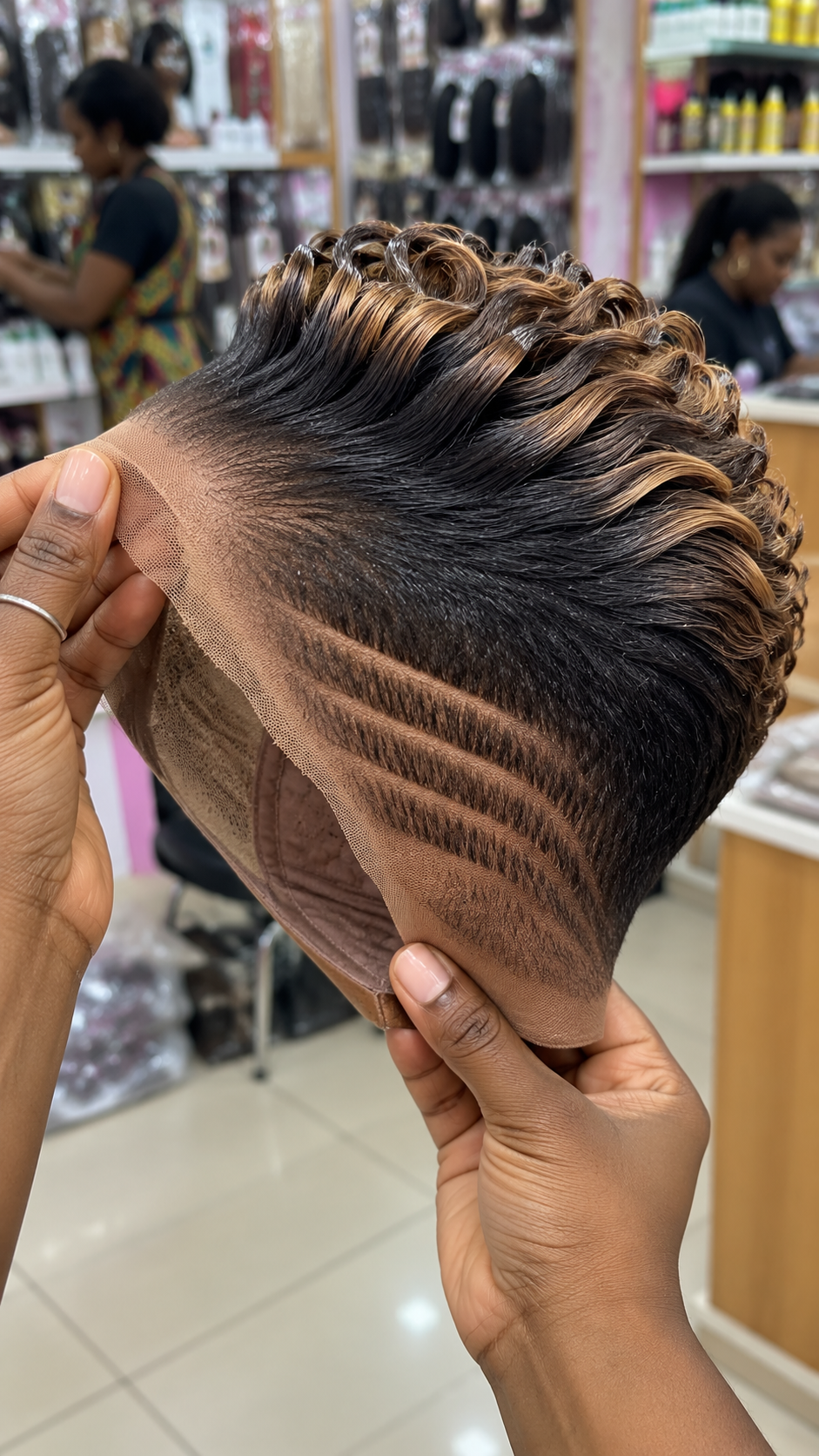
The difference between an ordinary highlighted pixie wig and a carefully constructed salon piece often lies in where the lighter strands begin and how they move. In this photograph, narrow honey blonde ribbons emerge from a predominantly black upper section, travel backward through glossy, elongated curves, and gather into compact loops near the crown. Beneath that movement, a closely fitted side carries two prominent carved channels, introducing a striking contrast between the raised upper hair and the lower panel.
The wig is being held open inside a hair shop, allowing the viewer to examine its unfinished lace perimeter and part of the inner cap. It has not yet been fitted to a wearer. That distinction is valuable because the photograph reveals how the hair is arranged before installation, while also showing why cap measurements, hairline placement, and side-pattern alignment deserve attention during purchasing.
For anyone looking to buy a black and honey blonde pixie lace wig, the important question is whether a supplier can deliver the same distribution of highlights and backward-directed curls. A generic blonde-tipped curly wig may share the colors but produce a substantially different appearance.


Where the Honey Blonde Ribbons Begin
The highlighted strands are concentrated across the upper portion of the hairstyle rather than distributed evenly through the entire unit. Near the front hairline, the hair remains predominantly dark, with black and deep espresso tones establishing the foundation.
Moving backward, selected strands develop into warm honey blonde and caramel-colored ribbons. The lighter sections are particularly visible where the hair bends upward and folds into the raised curls.
This arrangement creates a gradual visual progression without forming a conventional, uniform ombre band. Dark hair remains visible between the blonde sections, and several highlighted ribbons retain darker strands along their length.
At the crown, the color contrast becomes more pronounced because the curls overlap. The blonde portions catch the light along their outer curves, while the darker sections occupy the spaces beneath and between the loops.
The photograph does not show a fully blonde crown or a continuous light-colored fringe. The darker foundation remains an essential part of the design.
Choosing Highlight Placement Instead of Simply Choosing a Shade
When ordering a comparable wig, asking for honey blonde highlights is only the beginning. The supplier also needs to understand their direction, concentration, and relationship to the black hair.
A wig with randomly scattered blonde streaks may look busy rather than coordinated. Likewise, a broad blonde section across the front would alter the darker hairline appearance shown in the reference.
The more accurate approach is to request selected blonde ribbons concentrated along the upper swept sections, with substantial black hair remaining visible beneath them.
Customers should also establish whether the highlights are manufactured into the fiber or created through a coloring process. That information affects future maintenance and whether the color can safely be altered.
The Swept-Back Formation Is More Important Than Curl Quantity
The upper hairstyle begins with elongated strands directed away from the front. These sections lie comparatively close together before lifting into curled formations toward the crown.
Several blonde ribbons travel through this transition, making the direction of the hair particularly easy to observe. The strands do not fall forward over the forehead, nor do they form a uniform arrangement of small upright spirals.
Instead, the hair appears guided backward in overlapping sections that gradually become more curved. Near the upper rear, the styling develops into a series of compact, open loops.
This creates a controlled silhouette with most of the visible elevation concentrated toward the crown rather than the front hairline.
The arrangement is especially relevant for buyers comparing product photographs. Two wigs can contain similar amounts of hair while looking entirely different because their curls are positioned in different directions.
Recognizing the Difference Between Loops and Loose Ringlets
The raised sections in this image are relatively compact. Several form visible circular openings, but the overall styling remains connected to the backward movement of the longer-looking front strands.
Loose hanging ringlets would create more downward movement and a different outline. Very tight finger coils would produce smaller, more numerous circular formations.
Neither alternative would reproduce the particular relationship between the sweeping front and curled crown shown here.
When requesting a custom unit, provide the side photograph and ask for an additional top-view reference during production. This helps establish whether the upper strands continue in the intended direction across the entire crown.
Two Carved Channels Beneath the Highlighted Crown
The lower visible side introduces another design element: two prominent, elongated channels running diagonally backward through closely fitted dark hair.
The upper channel begins near the front side and follows a gently descending path toward the rear. A second channel sits beneath it, creating a narrow strip of hair between the two separations.
The channels are relatively broad and easy to distinguish. Their exposed underlying surface contrasts with the darker hair surrounding them.
Unlike the highlighted upper section, the side panel contains no obvious blonde coloring. Its appearance is dominated by dark hair, the lighter channels, and the closely cropped silhouette.
This division allows the upper color work and lower carving to remain visually separate. The blonde ribbons attract attention above, while the side channels establish the geometric character beneath.
Why the Carved Pattern Must Be Evaluated Before Cutting
A buyer should not assume that any curly pixie wig can be converted into this design with a pair of clippers. The feasibility depends on how the side hair is attached and how much coverage exists over the cap.
If the underlying hair is too sparse, removing additional strands could expose construction materials. If the side is too full, the desired close-fitting appearance may require extensive reshaping.
Ask the wig maker whether the channels are incorporated during construction or created as a finishing step. The photograph establishes their visible appearance but does not reveal the manufacturing technique.
Because cutting is difficult to reverse, the side pattern should be approved before permanent alterations are made. A professional familiar with precision wig styling is preferable to someone experienced only in cutting natural hair.
The Dark Front Hairline Anchors the Entire Color Arrangement
One of the less obvious but important details is the predominantly dark front hairline. Fine black strands emerge near the lace, continuing into the darker upper foundation before the blonde sections become prominent.
This placement prevents the highlights from dominating the entire front edge. It also establishes a visual connection between the upper hairstyle and the closely fitted dark side.
The hairline appears relatively fine compared with the denser upper sections. Individual strands are visible against the beige lace, although the photograph cannot establish the precise knotting method or hair density specification.
For custom orders, buyers should request a front-facing photograph of the completed unit. The current side view provides useful evidence of the hairline’s direction, but it does not show the complete frontal arrangement.
The opposite temple and full rear hairline are also outside the available view.
Reading the Cap Interior Before Making a Purchase
The wig is displayed with its interior partly exposed. A brown fabric cap section is visible beneath the hair, with stitching and a curved internal band along the lower portion.
The beige lace extends beyond the hairline and side, remaining untrimmed. Its color contrasts with the dark hair and the brown interior fabric.
These visible details confirm that the unit is being presented before final fitting, but they do not establish its complete fastening system.
No reliable conclusion can be drawn about all possible combs, clips, elastic straps, or other attachment hardware from this partial view.
The exact lace grade is also unverified. Buyers should request the manufacturer’s specification and avoid relying on appearance alone when comparing lace categories.
Questions About the Interior That Sellers Should Answer
Ask for a photograph of the cap turned completely inside out. This should show the front lace area, internal seams, attachment points, and any adjustment components.
Confirm the available cap circumference and whether the unit can be produced in different sizes. A cap that fits poorly may shift the carved channels away from their intended temple position.
If adhesive-free wear is a priority, ask whether the construction is explicitly designed for that purpose. The presence of lace does not establish that the wig can be worn securely without adhesive.
Also confirm whether the cap is intended to accommodate additional styling or whether the existing hairstyle should remain unchanged.
Finding a Seller Who Can Match Both the Color and Side Pattern
Searching for a highlighted pixie wig will produce many possibilities, but relatively few may combine this particular swept crown with two carved channels.
Begin with sellers specializing in custom pixie units, highlighted lace wigs, and barber-inspired wig styling. Local wig boutiques may be useful when the buyer wants to examine the cap and color before purchase.
Online suppliers can provide additional options, but actual product photographs should take priority over promotional descriptions.
When comparing listings, distinguish between a finished hairstyle and a base wig that requires professional styling after delivery.
A seller may advertise a black and blonde pixie while offering a different curl pattern, a different highlight distribution, or a side without carved channels.
A More Effective Custom Order Description
Describe the hairstyle as a black pixie lace wig with selected honey blonde ribbons running backward through the upper hair, compact curled loops near the crown, and two diagonal carved channels along one closely fitted side.
Specify that the front hairline should remain predominantly dark and that the blonde sections should not cover the entire crown uniformly.
Provide the reference image and request confirmation of which details the maker can reproduce.
Ask for photographs before shipment, including a front view, the decorated side, the opposite side, the crown, and the underside.
Do not assume that the unseen side mirrors the photographed pattern. The seller should explain how the entire unit will be constructed.
Ready-Made Versus Custom Construction for This Color Combination
A ready-made black and honey blonde pixie may offer an economical starting point if the buyer primarily wants the color contrast and compact silhouette.
However, reproducing the carved channels and upper curl arrangement may require additional salon work. The cost and feasibility of that work should be established before buying the base unit.
Custom construction offers more control over the highlight placement, crown direction, and side geometry. It may also allow the maker to account for the desired cap measurements from the beginning.
The best purchasing route depends on which details are essential. Someone satisfied with a similar color may prefer a ready-made option, while a buyer seeking the complete photographed design may benefit from a specialist commission.
Estimated Prices for Honey Blonde Highlighted Pixie Wigs
The following figures are illustrative USD budgeting ranges, not verified live offers for the photographed wig. Actual prices vary according to the supplier, material, cap construction, color processing, and styling labor.
| Wig Category | Illustrative USD Range | Potential Cost Considerations |
|---|---|---|
| Premium Custom | $310–$690+ | Individual cap sizing, selected honey blonde color placement, sculpted upper loops, and precision twin-channel side work. |
| Standard Custom | $165–$345 | Partial customization of the highlighted crown and side pattern, depending on construction options. |
| Basic Human Hair | $95–$235 | A human-hair starting unit that may require additional highlighting, cutting, and curl setting. |
| Premium Synthetic | $70–$160 | A precolored, preformed pixie design where the required curl and side arrangement is available. |
| Basic Synthetic | $28–$78 | A lower-cost highlighted pixie alternative that may not include the carved channels or precise upper styling. |
The photograph does not identify the fiber category of the displayed unit. These classifications describe possible purchasing choices rather than confirmed characteristics.
Highlight placement can increase labor costs when individual strands must be colored or selected carefully. The backward curl arrangement may also require specialist styling, especially if the loops are constructed individually.
Side carving introduces another potential expense because the pattern must be coordinated with the available hair density and cap structure.
Request an itemized quotation covering the wig, customization, shipping, taxes, and any separate installation services. A cheaper base unit may become more expensive after additional salon work.
Planning the First Installation Around the Side Profile
For this hairstyle, the first fitting should begin with the cap position. The carved channels are intended to follow the side of the head at a particular angle, and their appearance can change if the wig is placed incorrectly.
A professional wig stylist should check the cap fit, hairline alignment, and temple position before trimming the lace.
Once the correct position is established, the stylist can determine how much excess lace needs to be removed. Cutting should be conservative because the fine front hairline and nearby side details can be damaged by excessive trimming.
The upper curls should also be inspected after fitting. If the crown has been compressed during shipping, the appropriate restoration method should be confirmed with the supplier.
Do not apply heat automatically. Human hair and synthetic fibers may require different techniques, and the photograph does not establish which material is present.
Preventing the Blonde Ribbons From Losing Their Separation
The highlighted upper sections depend on visible separation between lighter and darker strands. Excessive brushing may blend the ribbons together and disturb their backward arrangement.
Heavy styling products can also collect between the curved sections, making the highlights appear less distinct.
For routine handling, support the wig by its cap and avoid pulling directly on the raised loops. Individual displaced strands should be addressed using methods suitable for the confirmed fiber.
If the wig contains human hair, color maintenance may depend on its processing history and the products used during washing. Previously lightened strands can have different care requirements from untreated hair.
If the wig contains synthetic fibers, conventional recoloring or high-temperature styling may be unsuitable. Manufacturer guidance should determine which products and tools are safe.
Protecting the Two Exposed Side Channels
The carved side requires careful handling because displaced hair can obscure the channels. Brushing across the pattern may change the visual spacing between the dark bands.
If the lines appear less distinct after repeated wear, consult a stylist before attempting additional cutting. Enlarging the channels can permanently alter the hairstyle or expose the underlying cap.
Store the wig on a suitable stand that supports its compact shape without pressing against the decorated side. Avoid compressing the upper loops beneath clothing, packaging, or other objects.
When traveling, use a protective container that provides sufficient room for the raised curls rather than forcing the unit into a tightly packed bag.
Making the Final Decision Based on Construction, Not Advertising
This black and honey blonde pixie offers an appealing combination of color contrast and precise side styling. The dark front foundation gives the highlighted ribbons a strong starting point, while the backward movement leads the eye toward the compact curled crown.
The two carved channels create a separate geometric element beneath the upper hair, giving the side profile an identity that ordinary highlighted pixie wigs may lack.
Its suitability for everyday wear or occasional use will depend on cap comfort, installation requirements, and how much professional maintenance the finished unit needs.
Before ordering, buyers should obtain complete product photographs, confirm the hair material, examine the cap construction, and establish whether the advertised price includes the finished hairstyle.
The most convincing reproduction will retain the dark front hairline, selected honey blonde ribbons, backward-directed upper sections, compact crown loops, and paired diagonal side channels. Those details provide a practical checklist for evaluating a ready-made unit or approving a custom order.
Search Terms
Honey blonde streaked pixie lace wig · Black crown with caramel ribbon curls · Twin diagonal carved side channel wig · Swept back highlighted loop hairstyle · Dark root blonde accent pixie unit · Beige lace front with tapered side lines · Black and golden honey sculpted curl wig · Compact blonde ribbon crown lace wig