
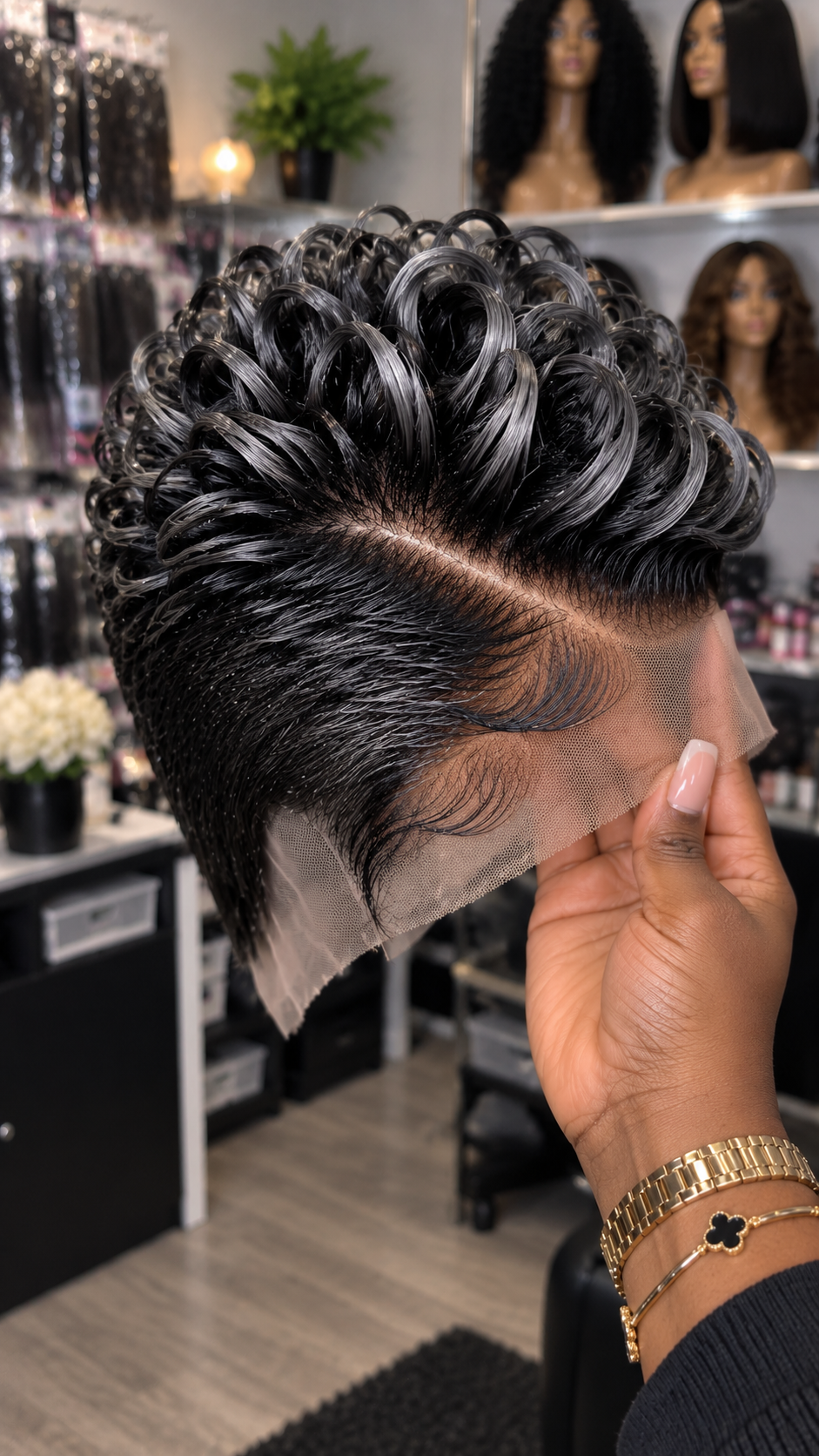
What happens when a wig creates its visual impact without relying on contrasting colors, shaved patterns, or long hair? This raven black lace wig offers an interesting answer through its carefully arranged circular loops, directional side styling, and delicately curved temple hairs. The design uses one dominant dark color, allowing the individual shapes and changes in hair direction to become the main attractions.
The photograph shows the wig being held in a beauty salon, with its front lace extended outward before installation. Across the upper section, glossy black strands rise into numerous open loops of varying sizes. A diagonal parting separates this elevated arrangement from a flatter side panel, while several curved strands sweep across the temple area and onto the visible lace. The combination creates a hairstyle that looks elaborate without depending on additional color processing.
For someone searching for a sculpted pixie wig, the important question is not simply whether the product has curls. It is whether those curls are arranged with the same upward movement, circular openings, and compact proportions. A conventional curly pixie can have similar hair length yet produce an entirely different silhouette.


This image also provides an unusually useful view of the unfinished front edge. The lace has not been trimmed, and the temple styling remains visible against the mesh. These details help buyers understand what they are purchasing and which services may still be required before the wig can be worn.
The Appeal of a Single-Color Sculpted Hairstyle
The hair appears predominantly raven black, with glossy charcoal reflections created by the lighting. Unlike wigs that use copper, blonde, or silver sections to emphasize individual curls, this design relies on the natural contrast between illuminated hair surfaces and the darker spaces inside the loops.
The raised sections reflect light along their curved outer edges. Beneath those reflective strands, the recessed areas appear considerably darker, making the circular openings easier to recognize.
There is no clearly established second hair color in the photograph. The grayish reflections visible on some strands are consistent with light striking glossy black hair, rather than sufficient evidence of deliberate silver highlights.
That distinction matters when communicating with a seller. A buyer asking for black and silver curls could receive a wig with visibly pale strands, changing the appearance considerably. A more faithful description is glossy raven black hair with sculpted open loops.
Why Surface Shine Should Not Be Confused With Fiber Quality
The hair has a noticeable reflective appearance, especially along the upper curves and the closely arranged side section. However, shine alone does not establish whether the wig contains human hair, synthetic fiber, or a blend.
Different fibers, finishing products, and lighting conditions can create similar reflections. A product photograph therefore cannot confirm the material, manufacturing method, or long-term behavior of the hairstyle.
Before purchasing, ask the supplier to identify the fiber and provide appropriate care instructions. This information will become particularly important if the upper loops need to be reshaped after regular wear.
Open Circular Loops Form an Elevated Upper Arrangement
The upper section contains numerous curved hair formations, several of which create nearly complete circular openings. The loops are positioned at different angles, producing a layered arrangement rather than a flat pattern of identical curls.
Near the upper center, larger loops rise prominently above the darker foundation. Some curve forward before returning toward the main body of the hairstyle, while others bend sideways or backward. Smaller loops fill the surrounding spaces, helping the crown retain a relatively continuous outline.
The front-facing sections appear slightly more elongated, while some of the curls farther toward the visible rear form tighter circular shapes. This difference gives the hairstyle movement without requiring loose strands to hang below the main silhouette.
Although the crown contains considerable styling detail, its overall shape remains compact. The loops rise from the foundation but do not create an excessively tall or oversized hairstyle.
That balance is important for a custom reproduction. Increasing the curl diameter or adding too much hair could make the wig significantly fuller than the reference. Reducing the loops too much could eliminate the open circular formations that distinguish the design.
Commissioning the Right Loop Diameter and Density
A custom wig maker should evaluate the relationship between the largest loops and the smaller surrounding curls. The photograph does not provide reliable physical measurements, so exact diameters should not be invented from the image.
Instead, the buyer can ask the maker to reproduce the visible proportions using the reference photograph. The largest loops should remain recognizable, while the smaller sections should support the overall shape rather than conceal the openings.
Request a close photograph of the upper hairstyle before the unit is shipped. A slightly elevated front view can reveal whether the individual loops remain distinct or have become compressed into a dense mass.
It is also worth confirming whether the loop arrangement will arrive fully styled. Some suppliers may provide a base wig that requires additional professional setting, which can affect both the final price and the amount of work needed after delivery.
The Diagonal Parting Introduces a Different Styling Direction
Beneath the raised loops, a visible diagonal parting runs across the side of the wig. The exposed channel begins near the upper side area and travels toward the front, separating the elevated crown from the closely arranged lower hair.
The line is not an elaborate shaved design. It functions primarily as a boundary between two sections styled in different directions.
Above the parting, the hair rises into circular formations. Below it, the strands are directed backward and downward across the side panel. The contrast makes the upper loops appear more prominent while giving the lower section a controlled, tapered appearance.
The dark side hair is arranged in closely aligned strands with visible directional movement. It is not completely shaved, and the photograph does not show additional decorative razor lines crossing the panel.
A buyer should therefore avoid describing this wig as having multiple carved side stripes. Adding such patterns would change the design and introduce details that are not visible in the reference.
Maintaining the Parting During Cap Fitting
The position of the diagonal separation may change slightly when the wig is placed on a head. Cap tension, head circumference, and the position of the front hairline can all influence how the part appears.
For a custom order, the maker should consider the intended wearer’s measurements before finalizing the styling. A parting that looks balanced on a display form may sit differently on a smaller or larger head.
If the line needs adjustment, a qualified wig stylist should evaluate the existing hair coverage before cutting or removing strands. Widening the separation unnecessarily could expose additional foundation material.
The original parting should be treated as a deliberate styling detail rather than an area that automatically requires further barber work.
Temple Waves Give the Front Edge Its Distinctive Character
One of the most interesting details appears near the temple, where several dark strands curve outward from the main side section and extend across the beige lace.
These strands form broad, sweeping arcs rather than tiny decorative spirals. One prominent curve bends toward the front edge, while smaller curved strands appear below it.
The arrangement creates a transition between the densely styled side hair and the exposed lace. It also introduces a softer visual movement that contrasts with the raised circular loops above.
The temple waves should not be confused with the larger crown curls. They are flatter, more elongated, and positioned closer to the foundation.
For buyers interested in realistic hairline styling, this area deserves careful examination. The final appearance will depend on how the lace is positioned, how the strands are secured, and whether the hairline is adjusted during installation.
Keeping the Temple Strands in Their Intended Position
The visible temple hairs appear arranged in deliberate curved directions. Pulling them straight or brushing them into the surrounding side hair could alter the hairstyle’s front profile.
Before attempting to restyle these strands, ask the supplier which products were used and whether the arrangement can be refreshed safely.
A professional installer may need to adjust the placement slightly to suit the wearer’s natural hairline. However, unnecessary reshaping could remove the distinctive curved pattern shown in the photograph.
The safest approach is to assess the wig on the intended wearer before deciding whether any temple customization is required.
The Lace Edge Is Still Awaiting Final Preparation
The photograph clearly shows a broad area of beige lace extending beyond the front hairline. The mesh remains untrimmed, with an irregular outer edge visible near the lower portion of the wig.
Fine strands are present along the hairline, and the larger temple waves extend onto the lace surface. These details indicate that the final installation process may involve careful positioning and trimming around the existing styling.
The lace appears relatively fine in the photograph, but its exact specification cannot be established visually. It should not be advertised as HD lace without reliable confirmation from the seller.
The image also does not reveal the entire underside of the wig. A complete assessment of the cap would require additional photographs showing the interior construction and any attachment components.
Why Lace Trimming Should Follow a Fitting Check
Cutting the lace before confirming the wig’s position can create problems, especially near the temple where the curved strands extend toward the front edge.
The installer should first check the cap fit and identify the intended hairline. Only then should the excess lace be removed using a method appropriate for the construction.
Trimming too close to the temple waves could damage the existing arrangement or remove supporting mesh. Once the lace has been cut away, it cannot simply be restored.
Ask the stylist to explain which areas will be trimmed and whether the temple hairs will remain in their original positions.
Finding a Wig Maker Experienced in Circular Sculpted Styling
Not every wig salon specializes in creating elevated loop arrangements. Some professionals focus primarily on straight lace-front installations, loose curls, or conventional pixie cuts.
For this design, look for a wig maker or stylist with examples of sculpted circular curls, raised loop styling, and precision hairline work.
When making an inquiry, send the photograph and describe the desired unit as a raven black sculpted loop pixie lace wig with a diagonal side part and sweeping temple waves.
Explain that the hairstyle should remain compact and that the circular openings must be visible. These instructions are more useful than simply asking for a black curly wig.
Request examples of previous custom work showing similar curl structures. A stylist who can create loose curls may not necessarily have experience arranging multiple raised loops into a coordinated crown.
Comparing Local Salons With Online Custom Orders
Local wig boutiques and specialist salons may allow buyers to inspect materials and discuss fitting requirements in person. Online custom wig makers may offer additional styling options, but buyers should verify their work before committing to an order.
Ask whether the photographed hairstyle can be reproduced using the seller’s available materials. Confirm the cap measurements, fiber type, styling method, and whether the unit will arrive ready for installation.
For online purchases, request photographs of the exact finished unit rather than relying only on promotional images. A front view, side view, rear view, and underside photograph can reveal important differences.
If the seller cannot provide these details, consider whether the purchase offers enough information to justify the cost.
Budget Considerations for a Black Sculpted Loop Lace Wig
The following amounts are illustrative USD planning ranges rather than verified current prices. They are not quotations for the photographed wig. Actual costs depend on the supplier, hair material, cap construction, styling complexity, and included services.
| Wig Category | Illustrative USD Range | Primary Buying Considerations |
|---|---|---|
| Premium Custom | $310–$760+ | Individual cap construction, detailed circular loop styling, precision temple waves, and possible personalized fitting |
| Standard Custom | $165–$380 | Customized loop arrangement, diagonal part placement, selected cap options, and professional finishing |
| Basic Human Hair | $85–$230 | Base unit quality, hair density, and potential additional charges for sculpted styling |
| Premium Synthetic | $55–$170 | Pre-styled loop appearance, cap specifications, and fiber-dependent styling restrictions |
| Basic Synthetic | $25–$90 | General black pixie resemblance, simpler construction, and potentially less precise circular curls |
The image does not establish whether the wig contains human hair or synthetic fiber. These categories are potential purchasing options rather than confirmed characteristics of the photographed unit.
Because the hairstyle uses one dominant color, the cost may depend more heavily on styling labor than on complex color processing.
Creating numerous open loops, arranging the side hair, and positioning the temple waves can require substantial professional attention. A lower-priced wig may share the general silhouette but lack the detailed upper structure.
Buyers should ask whether the quoted price includes the wig base, styling, lace customization, installation, shipping, and taxes. Additional salon appointments can increase the total expense.
Protecting the Loop Structure During Everyday Use
The most important maintenance concern is preserving the circular openings across the crown. Repeatedly brushing through the upper hair could separate the sculpted strands and change the shape of individual loops.
Before washing or restyling, identify the fiber and obtain material-specific instructions. Synthetic hair may have restrictions involving heat and certain products, while human hair may require a different approach depending on its processing history.
Do not assume that the glossy appearance means the wig requires heavy oils or frequent product application. Excessive residue may collect between the loops and reduce the clarity of the individual formations.
If several loops lose their shape, professional resetting may be preferable to attempting a complete reconstruction without knowing the original styling technique.
Storage That Avoids Flattening the Upper Curls
The wig should be supported in a way that does not compress the raised loops. An appropriately sized wig form may help maintain the silhouette, provided the cap is not stretched.
Avoid placing heavy objects against the crown or pressing the styled hair into a confined space for extended periods.
The temple waves also deserve protection. Their curved arrangement may be disturbed if the front lace is folded sharply or handled roughly.
When removing the wig, use the attachment method recommended for its actual construction. Pulling directly on the delicate lace or the sculpted hair may cause unnecessary damage.
What to Verify Before Accepting a Finished Custom Unit
The most useful final inspection begins with the upper loop arrangement. The circular openings should remain recognizable, with larger raised loops surrounded by smaller supporting sections.
Next, examine the diagonal parting and the direction of the lower side hair. The side should remain closely arranged without unnecessary decorative lines.
The temple waves should retain their broad curved movement across the front lace. Their final position may require adjustment during fitting, but the original styling concept should remain recognizable.
Finally, confirm the cap dimensions, lace specifications, and attachment system before any permanent trimming or installation work.
This raven black wig demonstrates how a single-color hairstyle can achieve considerable visual complexity through shape alone. Its circular crown loops, directional side parting, and sweeping temple waves each contribute a different kind of movement. A faithful reproduction should preserve those relationships rather than introducing additional colors, exaggerated volume, or unrelated side patterns.
Search Terms
raven black circular loop pixie wig · glossy black open ring crown lace unit · diagonal parting sculpted black wig · sweeping temple baby hair lace pixie · black raised ribbon curl hairpiece · untrimmed beige lace loop wig · compact black sculpted crown curls · curved temple wave black lace front