
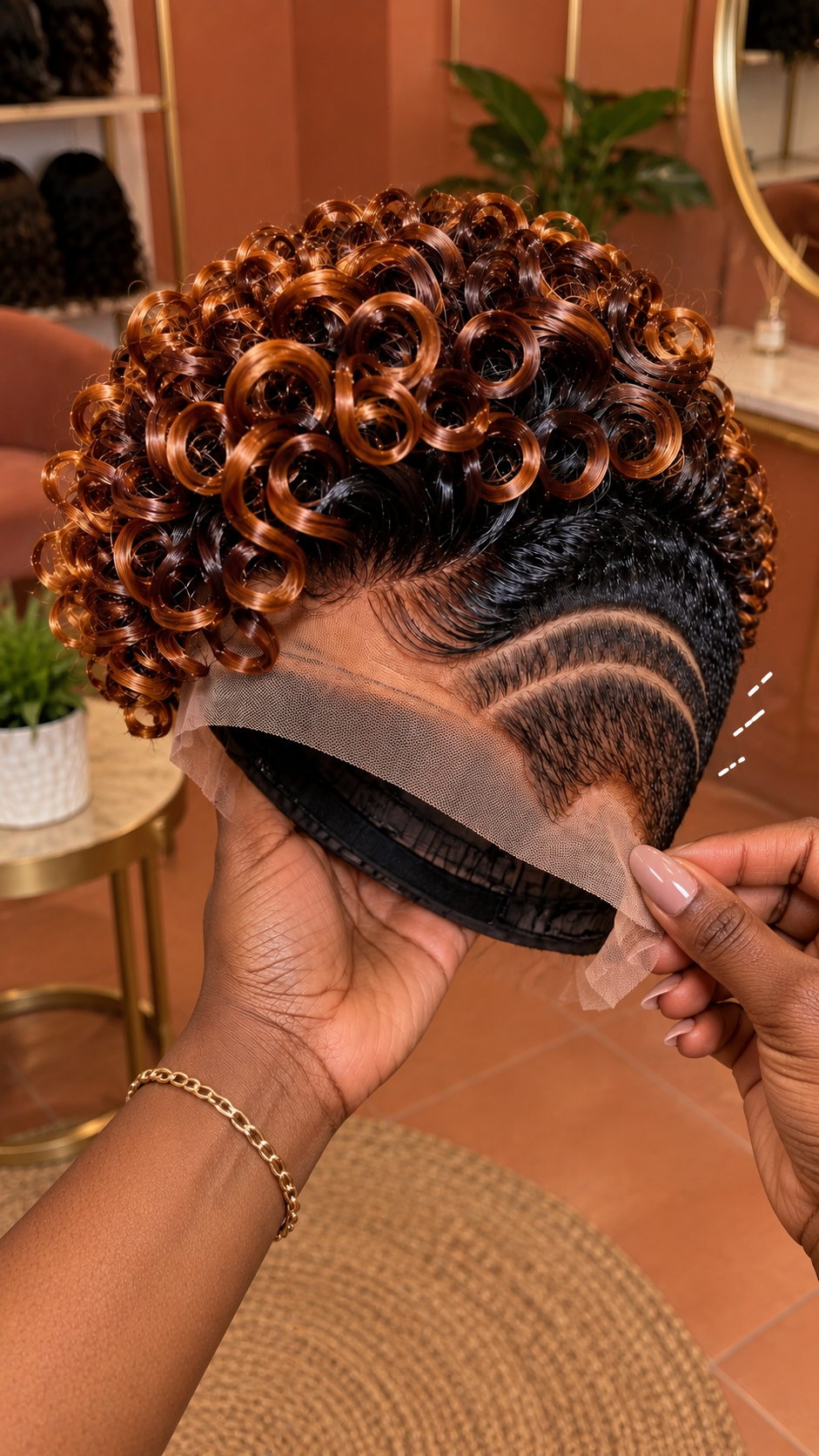
The first thing that distinguishes this wig is the extraordinary number of individually visible spiral rings arranged across its upper surface. Copper-colored curls form an intricate collection of circular openings, overlapping loops, and spring-shaped strands, while a dark espresso foundation creates depth beneath them. On the visible side, two closely spaced curved channels introduce a contrasting barber-inspired element. The combination gives the hairstyle a distinctive identity: abundant circular curls above, carefully directed dark hair below, and a pair of sweeping temple arches separating the decorative side area.
Photographed before installation, the wig is supported in one hand while the other holds a section of its untrimmed beige lace. The image provides a close view of the curl construction, front hairline, side detailing, and part of the black interior cap. Although the finished appearance on a wearer cannot be confirmed from this photograph, the exposed construction offers useful information for anyone considering a comparable purchase or custom commission.
This is not simply a copper curly wig with a decorative side. Its appeal depends on the particular scale of the spiral rings, the concentration of warm color through the upper hair, and the shape of the two curved channels. Understanding those details makes it easier to communicate with a wig maker, compare products, and avoid ordering a hairstyle that shares the general color but looks substantially different.
What Makes These Copper Ringlets Different From Ordinary Curls?
The upper hairstyle consists of numerous compact spiral formations with clearly visible circular openings. Some ringlets face toward the camera, revealing their hollow centers, while others are viewed from an angle and appear as curved ribbons. Their arrangement creates an intricate surface without depending on long, hanging hair.
The most prominent rings appear across the front and central crown. Several form almost complete circles, while others curl inward or overlap adjacent sections. Smaller spirals are visible toward the outer edges, contributing to a rounded silhouette.
The curls are not all identical in diameter. Some are relatively broad and open, while others are tighter and more compact. This variation creates a natural-looking progression between the different sections, even though the overall hairstyle is clearly sculpted.
Unlike conventional loose ringlets that fall downward under their own weight, many of these spirals appear to stand or curl outward from the main body of the wig. The arrangement allows individual circular shapes to remain visible across the upper surface.
For a buyer, the distinction is important. Searching for a copper curly pixie wig may produce units with ordinary corkscrew curls, tightly coiled natural-looking hair, or broad waves. Those alternatives can be attractive, but they do not necessarily reproduce the open circular ringlets shown here.
The Role of Curl Openings in the Overall Silhouette
The empty spaces inside the rings contribute as much to the hairstyle’s appearance as the hair itself. They allow the darker foundation to remain visible through the copper strands, creating contrast within the upper section.
If the ringlets were compressed into tighter coils, those openings would become less noticeable. If they were expanded too far, the hairstyle could appear oversized and lose its compact proportions.
A custom wig maker should therefore consider the relationship between ring diameter, strand thickness, and overall density. The goal is not simply to create the greatest possible number of curls, but to preserve the visible circular formations without making the crown excessively bulky.
The reference photograph can help communicate these proportions. A buyer should request progress photographs from the same general angle to check whether the spiral openings remain recognizable during construction.
The Copper Color Is Concentrated Where the Rings Catch Light
Color is a major part of the design, but it is not distributed as a flat, uniform shade. The visible ringlets contain warm golden copper, reddish auburn, and deeper brown reflections. The brightest areas appear along the outward-facing curves, where the lighting strikes the hair directly.
Inside the loops, the hair looks darker. In some places, nearly black strands are visible beneath the copper sections, emphasizing the depth of the curled arrangement.
The dark foundation is especially noticeable where the upper curls meet the side panel. This produces a pronounced contrast between the warm ringlets and the black-to-espresso hair underneath.
The photograph does not establish whether the color was created through dyeing, pre-colored fibers, or a combination of differently colored strands. It also does not confirm the wig’s material. These details should be obtained from the supplier rather than inferred from the glossy appearance.
Requesting the Right Shade Without Losing the Dark Base
Golden copper, ginger brown, auburn, and cinnamon copper are common descriptions, but sellers may use them for different shades. The photograph is therefore more useful than a color name alone.
When requesting a custom version, specify that the upper ringlets should have a warm copper appearance with visible darker areas beneath them. The side panel should remain substantially darker than the upper curls.
A completely orange or uniformly light copper wig would change the balance of the hairstyle. Similarly, a dark brown unit with only a few copper highlights might not provide enough contrast to reproduce the reference.
Ask for photographs under daylight and ordinary indoor lighting before approving the final color. Warm salon lighting can intensify orange and red reflections, making a shade appear brighter than it will outdoors.
Two Sweeping Temple Arches Create the Side Signature
Beneath the copper ringlets, the visible side contains two curved channels arranged one above the other. Both follow a sweeping path around the temple area, with the upper curve sitting close to the boundary between the darker upper side hair and the lower panel.
The lines appear as narrow, lighter channels where the dark hair has been separated or reduced. The hair between them remains visible, creating a distinct dark band that follows their curvature.
The lower curve runs above the area where an ear would sit when the wig is worn. Its shape reinforces the curved geometry of the upper line rather than introducing a separate angular pattern.
These are two primary carved curves, not three parallel stripes or a collection of intersecting lines. Their placement is one of the most recognizable aspects of the design.
Above the arches, the dark hair is arranged in closely directed sections, including a small sweeping wave near the transition to the copper crown. This area helps connect the elaborate upper curls with the more restrained lower side.
Why the Temple Detail Should Be Planned Before Installation
The curved channels are positioned in an area where cap fit can influence their appearance. If the wig sits too far forward, backward, or above its intended position, the arches may no longer align naturally with the wearer’s temple.
For that reason, a custom maker should consider the intended cap measurements when creating the design. The curves should be evaluated on a correctly sized fitting form rather than cut without reference to the eventual wearer.
If a buyer purchases a wig without the side design and plans to add it later, a stylist should first determine whether enough hair is present in the correct location. Cutting decorative lines into a sparse area could expose too much lace or cap material.
Once a channel has been carved, restoring its original appearance may require significant reconstruction or replacement. Any adjustment should therefore be approached as a potentially permanent modification.
The Transition Between Circular Curls and Dark Side Hair
One of the more interesting aspects of this hairstyle is the way the two styling techniques meet. The upper copper ringlets are three-dimensional, with strands curling outward and upward. The lower dark section lies much closer to the cap, with hair directed into a flatter arrangement.
The boundary is not simply a straight horizontal division. Near the front of the visible side, dark strands curve into a small wave before disappearing beneath the dense copper curls.
This creates a visual connection between the different sections. The dark wave introduces curved movement on a smaller scale, while the copper ringlets continue that movement in larger circular forms.
For a stylist recreating the design, this transition deserves attention. An abrupt, poorly positioned boundary could make the upper curls appear disconnected from the side panel.
The photograph shows the relationship clearly on one side, but it does not reveal the complete opposite side or the entire back. Buyers should request those additional views before assuming the hairstyle is symmetrical.
Inspecting the Beige Lace Before Any Cutting
The wig is presented with a broad section of beige lace extending beyond the front and temple hairline. The excess lace remains attached, indicating that fitting and trimming have not yet been completed.
Fine dark hairs are visible near the front, particularly beneath the copper ringlets and around the transition into the side section. The hairline follows a curved path rather than appearing as a completely straight boundary.
The lace extends over an area that would eventually be positioned near the forehead and temple. Its apparent color is influenced by the lighting and the background beneath the mesh, so the final appearance against skin cannot be determined from this photograph alone.
The visible mesh should not automatically be described as HD lace. The image does not provide enough information to confirm a particular lace grade, thickness, or manufacturing specification.
Examining the Black Interior Cap
Part of the underside is visible beneath the lace. The interior appears black, with a mesh-like cap structure and darker bands or stitched sections.
However, the photograph does not show the entire cap. It cannot establish the full attachment system, whether adjustable straps are included, or whether the unit can be worn without adhesive.
Before purchasing, request a complete underside photograph. Ask the seller to identify the cap construction, available sizes, adjustment hardware, and any combs or clips.
Measurements should include the circumference, front-to-back length, and ear-to-ear distance. An accurate fit is particularly important because the temple arches and upper ringlets have a deliberate position relative to the face.
Lace trimming should take place only after the unit has been fitted and the intended hairline confirmed. Removing too much material may damage the edge or interfere with the placement of the side design.
Commissioning a Spiral Ringlet Wig From the Right Specialist
Reproducing this hairstyle requires more than selecting a copper wig and adding curls. The ringlets must retain their open circular shapes, the darker foundation must remain visible, and the side arches must be positioned accurately.
When contacting a custom wig maker, provide the reference photograph and describe the design as a copper spiral-ringlet pixie lace wig with a dark foundation and two curved temple channels.
Ask whether the stylist has experience creating sculpted circular curls rather than only loose curls or conventional finger waves. Examples of previous work can help determine whether the professional understands the difference.
A barber experienced in precision wig detailing may be needed if the maker does not provide carved side designs. However, it is preferable to establish responsibility for that work before construction begins.
Buying Ready-Made Versus Ordering From a Reference
A ready-made wig may be appropriate if the buyer finds a unit with similar copper ringlets and a suitable cap. However, the side design and curl arrangement may differ considerably from the photograph.
A custom order allows the buyer to specify the ringlet size, color distribution, side pattern, and cap measurements. It may also involve additional costs and a longer preparation period.
Online wig marketplaces, specialist wig boutiques, independent wig makers, and local beauty supply stores are possible places to search. Availability and exact product specifications should be confirmed directly.
Before paying for a custom order, request written confirmation of the hair material, cap dimensions, styling services, and expected completion time. Ask whether the seller will provide photographs for approval before shipping.
A useful approval set should include a close front view, both sides, the rear, and the underside. Those angles help verify the hairstyle beyond the single perspective available in the reference.
Estimated Purchase Budgets for a Copper Spiral Crown
The following USD ranges are illustrative planning estimates, not verified current prices for the photographed wig. Actual quotations can vary substantially according to the supplier, material, cap construction, color processing, styling labor, and location.
| Wig Category | Illustrative USD Range | Relevant Buying Considerations |
|---|---|---|
| Premium Custom | $350–$850+ | Individual cap construction, elaborate copper ringlet styling, dark foundation, precision temple arches, and possible fitting services |
| Standard Custom | $190–$440 | Customized copper coloring, sculpted spiral arrangement, selected cap options, and specified side detailing |
| Basic Human Hair | $100–$270 | Base human-hair unit with possible additional charges for coloring, spiral setting, and decorative cutting |
| Premium Synthetic | $70–$195 | Pre-styled ringlet appearance, color consistency, cap specifications, and fiber-dependent care restrictions |
| Basic Synthetic | $30–$105 | General copper curl resemblance, simpler construction, and potentially less accurate ringlet or temple detailing |
These categories are shopping alternatives rather than evidence of the material used in the photographed wig. The image does not establish whether it contains human hair, synthetic fiber, or a blend.
The most labor-intensive element may be the construction of the numerous open spiral rings. Creating a few ordinary curls is not equivalent to arranging dozens of visible circular formations across a compact crown.
The side arches may also require specialist work, especially if the wig maker and barber are separate professionals. Color customization, lace fitting, installation, shipping, and taxes may add further expenses.
Ask for an itemized quotation that identifies what is included. A lower-priced base unit can become considerably more expensive if the copper coloring, ringlet setting, and carved side pattern are all charged separately.
Keeping the Circular Ringlets Intact During Wear
The most vulnerable visual element of this hairstyle is the open spiral formation. If the curls are repeatedly pulled, brushed apart, or compressed, their circular openings may become distorted.
Maintenance should therefore begin with understanding how the original ringlets were created. Some styles may rely on a setting technique, while others may require particular styling products or professional reshaping.
Do not assume that heat can safely restore the curls. Synthetic fibers may have specific temperature limitations, and some may not tolerate heat styling at all. Human hair may offer different possibilities, but previously colored strands can still be vulnerable to damage.
The supplier should provide material-specific care instructions before the buyer attempts washing, drying, or resetting the hairstyle.
Managing Product Buildup Around the Copper Loops
The many overlapping ringlets create small spaces where styling products may accumulate. Heavy application can cause adjacent strands to stick together and reduce the visibility of individual circular openings.
A professional can recommend an appropriate product type and quantity after confirming the fiber and styling method. The glossy appearance in the photograph is not proof that a particular oil, gel, or finishing spray was used.
When the wig is not being worn, it should be supported without compressing the upper curls. An appropriately sized wig form may help preserve the silhouette, provided it does not stretch the cap.
The temple design requires separate care. Avoid pulling the dark side strands across the carved channels, and do not repeatedly widen the lines to restore visibility. A stylist should evaluate any necessary adjustment before cutting.
Final Checks Before Approving the Finished Wig
The best way to evaluate a completed version is to compare its individual design elements rather than relying on an overall impression of similarity.
Begin with the upper hair. The ringlets should form recognizable circular openings across the crown, with a compact silhouette and visible variation in curl size. The copper coloring should remain prominent while allowing the darker foundation to contribute depth.
Next, examine the side. Two sweeping temple arches should remain distinct, with a narrow dark section between them. The closely arranged black hair should provide contrast without making the channels disappear.
Finally, confirm the cap measurements, lace specifications, and attachment method. The untrimmed lace should be customized only after the wig has been positioned correctly on the intended wearer.
This design succeeds through the relationship between its many copper spiral rings and its comparatively restrained dark side. The circular curls supply intricate movement, while the paired temple arches give the hairstyle a recognizable profile. A faithful reproduction preserves those proportions rather than introducing extra volume, unrelated decorative lines, or a different curl structure.
Search Terms
golden copper spiral ringlet lace wig · espresso root circular curl pixie · twin curved temple arch wig · auburn copper open loop crown · black side double carved curve hairpiece · beige lace copper ringlet wig · dark foundation ginger spiral curls · sculpted copper circle curls with temple lines