
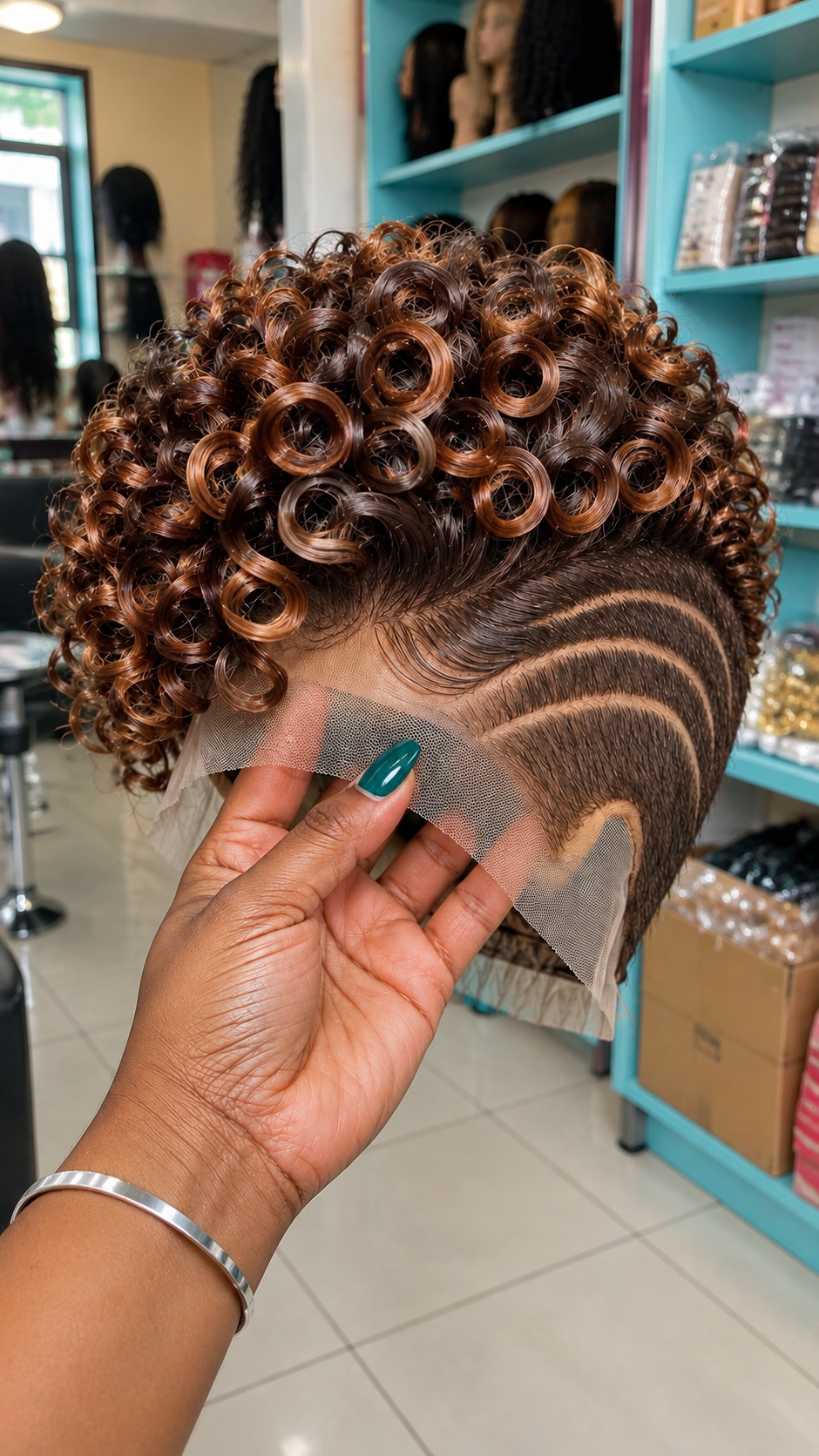
The first thing that catches the eye in this wig is the extraordinary contrast between its copper-colored circular curls and the carefully arranged dark hair beneath them. The upper section is filled with glossy, rounded ringlets in shades of honey copper, amber brown, and deeper chestnut, while the visible temple carries three sweeping separation lines. Together, these elements create a hairstyle that looks elaborate without depending on long hair or an excessively tall silhouette.
Photographed before installation, the wig is held by its untrimmed lace inside a hair salon and wig shop. This viewing angle reveals the front hairline, the tightly arranged temple hair, the direction of the carved-looking side pattern, and the dense collection of circular curls across the upper portion. The photograph is especially useful for anyone considering a similar purchase because it shows the relationship between the hairstyle and the lace that will eventually need fitting.
This is not simply a copper curly pixie wig. Its identity depends on the placement of individual circular loops, the gradual transition from darker roots into brighter copper strands, and the precision of the three arched temple divisions. Buyers who want the same appearance should understand these characteristics before selecting a ready-made unit or commissioning a custom reproduction.
Why the Copper Ringlets Appear Almost Like Small Hair Sculptures
Across the upper portion, numerous curls form rounded openings that resemble miniature circular coils. Many are positioned with their openings facing the camera, making the individual shapes immediately recognizable. Others turn sideways or overlap neighboring curls, producing a lively arrangement rather than a repetitive sequence of identical circles.
The curls are particularly noticeable near the front and center, where several larger loops sit above a darker foundation. Toward the outer edges, smaller curls appear more closely packed, helping the upper hairstyle maintain its rounded silhouette.
Unlike ordinary loose spiral curls, these ringlets appear deliberately positioned. Their curved strands return toward themselves, forming compact loops instead of falling freely downward. The result resembles a salon-set circular curl arrangement in which individual sections contribute to the overall shape.
The photographed loops vary in size, and that variation is part of the hairstyle’s appeal. A reproduction made entirely from identical ringlets might look too uniform. The balance between larger central loops and smaller surrounding curls is worth preserving when communicating with a wig maker.
The Front Edge of the Curl Arrangement
Several copper curls extend slightly forward over the darker hairline region. They create a decorative border above the forehead without completely covering the lace or the fine hair immediately beneath them.
These forward-facing loops also help connect the upper hairstyle to the sweeping hair direction at the temple. Rather than appearing as an unrelated curly section placed on top of a flat wig, the ringlets visually emerge from the darker styled foundation.
For customers who prefer a compact pixie appearance, this detail is important. Increasing the length of the front curls could cause them to hang farther over the forehead, changing the hairstyle’s proportions.
A custom-order request should therefore specify the approximate projection of the front loops and the desired overall height rather than asking for more curls simply to increase fullness.
Amber, Chestnut, and Honey Copper Across the Upper Hair
The photographed color is particularly interesting because it does not appear as a single flat orange or bright red shade. Instead, the upper curls display a mixture of warm copper, honey-brown, amber, and deeper chestnut tones.
The most luminous areas occur where the rounded strands face the light. Some loops have golden copper reflections along their outer surfaces, while the hair inside their circular openings appears considerably darker.
The underlying hair near the roots and temple looks dark brown to nearly black. This creates a noticeable contrast between the bright upper curls and the close-fitting side section.
Although the photograph clearly shows multiple warm tones, it cannot establish the exact coloring process. The appearance may result from deliberate color variation, lighting, the natural reflectivity of the fibers, or a combination of these factors.
Buyers should avoid ordering a generic bright copper wig without examining the seller’s color samples. The reference has a richer, darker foundation than many uniformly orange-colored hairpieces.
Getting the Color Right When Ordering Online
A useful approach is to request photographs under two lighting conditions: ordinary indoor light and indirect natural daylight. This allows the buyer to compare the depth of the darker areas with the brighter copper reflections.
Ask whether the seller offers a dark-rooted copper shade or a blend of warm brown and copper tones. If the wig is being custom-colored, discuss the relationship between the roots and the loops rather than focusing only on the brightest visible strands.
For a human-hair custom unit, any coloring service should account for the hair’s processing history. For a synthetic option, the desired shade generally needs to be selected from available fiber colors unless the manufacturer specifically supports another coloring method.
The photographed wig’s material cannot be determined from its appearance alone, so neither coloring approach should be assumed to apply to the actual unit.
Three Sweeping Temple Channels Create a Distinctive Side Profile
Below the ringlet-covered upper section, the visible temple carries three prominent curved separation channels. They follow the side of the hairstyle in a descending arrangement, with the upper channel tracing a broad arc and the lower channels following related but not perfectly identical paths.
The pale channels contrast sharply against the surrounding dark hair. Between them, the strands are arranged in narrow, closely fitting sections that emphasize the curvature of the design.
The uppermost division separates the copper curl region from the darker temple styling. Beneath it, two additional curved channels create a layered effect that continues toward the lower front-side area.
One especially distinctive detail is the lower channel’s ending. Near the front-lower edge, the separation bends into a pronounced angular curve rather than simply continuing as a straight diagonal stripe.
This shape contributes to the wig’s individuality. A stylist reproducing the design should pay attention to where each channel begins, how it bends, and how much dark hair remains between the divisions.
The photograph does not prove that these lines were produced with a razor or clippers. They appear as exposed channels between arranged hair sections, so it is more accurate to describe their visible geometry than to assume a specific cutting technique.
The Dark Temple Hair Provides More Than Color Contrast
The hair beneath the copper ringlets is styled close to the wig base. Fine strands follow the direction of the curved channels, creating a flatter appearance than the upper curls.
This difference in hair height is essential to the design. If the temple section were equally curly or voluminous, the separation lines would become less noticeable and the compact pixie silhouette would change.
The dark side also acts as a visual foundation for the brighter upper section. Copper ringlets attract attention, while the temple styling introduces structure and gives the hairstyle a carefully composed profile.
Near the front, fine hairs are arranged into a delicate directional pattern. The strands appear to flow backward from the hairline before joining the upper styling.
Because the wig is not installed, the exact position of these hairs against a wearer’s forehead remains uncertain. Their appearance will depend partly on the fit and the way the lace is prepared.
Examining the Lace Before It Is Cut
A substantial section of beige-toned lace extends from the front and visible temple. The mesh is clearly visible against the hand holding the wig, and the edge has not yet been trimmed to match a wearer’s hairline.
The lace extends below the lower decorative side section, making the relationship between the styled hair and the supporting mesh easy to observe.
This is valuable information for buyers because the lace is not merely a background detail. It influences how the wig can be positioned, where the hairline will sit, and how the temple styling aligns with the wearer’s face.
However, the photograph does not establish whether the lace is HD lace, Swiss lace, transparent lace, or another specific type. Such classifications require reliable product information.
The image also does not fully reveal the cap interior or all attachment hardware. Buyers should request a separate underside photograph before making assumptions about comb placement, adjustable straps, or adhesive-free suitability.
Why the Temple Pattern Should Be Checked Before Trimming
On a hairstyle with three visible side channels, installation accuracy matters beyond the front hairline. If the wig is positioned too far forward, the curved pattern may extend into an unintended area of the face. If it sits too far backward, the temple design may lose some of its intended prominence.
The stylist should first place the wig on the head and check the relationship between the upper curls, temple channels, and natural hairline.
Only after confirming the position should the lace be trimmed where necessary. Removing too much lace is difficult to reverse and may affect the available fitting options.
What to Request From a Wig Maker Before Production
The most useful custom-order instructions for this design concern proportions rather than general descriptions. A request for a copper curly pixie may produce many attractive hairstyles, but few will reproduce this particular combination of circular loops and arched side divisions.
Begin by sending the reference photograph and explaining that the upper curls should remain compact, with visible circular openings and varied loop sizes. Specify the warm copper-brown appearance and the dark foundation beneath the curls.
Next, identify the three curved temple channels as a priority. Ask the maker whether they can reproduce the pattern without increasing the side volume or changing the overall direction of the hair.
Finally, discuss the cap measurements and lace specifications. Even a visually accurate hairstyle may be unsuitable if the cap does not fit the intended wearer.
Ask the supplier to provide recent photographs of comparable work. A portfolio showing ordinary curly wigs is not necessarily evidence of experience with carefully arranged circular loops and precision temple patterns.
Ready-Made Availability Versus a Personalized Order
A ready-made wig may be attractive to buyers who want faster delivery or a lower initial price. However, the exact combination of copper ringlets and triple curved temple divisions may be difficult to find in a standard catalog.
When comparing ready-made options, inspect the actual product photographs rather than relying only on listing titles. Some units may have similar colors but completely different curl shapes. Others may reproduce the ringlets while omitting the temple pattern.
A custom order offers more control over these details, although it may require additional production time and a higher budget.
For customers with specific fitting requirements, customization can also provide an opportunity to discuss cap dimensions, lace placement, and the preferred position of the decorative side pattern.
Before paying a deposit, establish which aspects of the design the maker can reproduce accurately and which may vary because of materials or production methods.
Finding a Salon That Understands Circular Curl Styling
Not every wig installation specialist regularly works with tightly arranged circular curls. This hairstyle benefits from someone familiar with sculpted pixie wigs, structured curl setting, and lace hairline preparation.
When searching locally, consider terms such as copper pixie wig stylist, circular curl wig customization, sculpted lace wig installation, and precision temple hairstyle specialist.
Ask whether the salon can install the wig without disturbing the upper ringlets. Also determine whether the stylist can repair individual loops if some lose their position during shipping.
For a remote purchase, the seller may offer styling guidance, but professional installation can be particularly useful when the lace and temple design require careful alignment.
Schedule the appointment after the wig has arrived and been inspected. This allows time to identify any construction issues before irreversible adjustments are made.
Budgeting for a Copper Ringlet Wig With Detailed Side Work
The visual complexity of this hairstyle can influence its cost. Creating numerous circular curls, maintaining their arrangement, and producing the three curved side channels may require more styling labor than a conventional pixie wig.
Color selection or processing may add another expense, depending on the material and whether the desired copper-brown appearance is available as a standard option.
The following amounts are illustrative planning ranges in US dollars. They are not verified current product prices and do not identify the material or actual selling price of the photographed wig.
| Purchase Category | Illustrative USD Range | Potential Purchase Considerations |
|---|---|---|
| Premium Custom | $340–$760+ | Individual cap measurements, intricate circular curl arrangement, personalized copper coloring, and precision temple styling. |
| Standard Custom | $175–$390 | Selected cap and styling adjustments with attention to curl placement and curved side divisions. |
| Basic Human Hair | $105–$260 | A human-hair base unit that may require separate coloring and professional curl setting. |
| Premium Synthetic | $75–$195 | A higher-grade synthetic option with possible prearranged circular curls and detailed side styling. |
| Basic Synthetic | $30–$100 | A budget category where loop arrangement, color variation, and temple accuracy may be more limited. |
These categories represent possible shopping routes, not confirmed versions of the pictured wig. An intricate design may not be available in every material or price category.
Request an itemized quotation that separates the wig cost from shipping, lace preparation, installation, additional coloring, and future restyling.
The most expensive option is not automatically the closest match. The maker’s demonstrated skill with circular curls and side-channel geometry is an important factor in evaluating value.
Protecting the Ringlet Openings During Wear
The upper curls are the most visually delicate part of this hairstyle. Their appearance depends on individual loops retaining their circular shape and remaining separated enough for their openings to be visible.
Brushing through the curls as though they were loose hair could disrupt the arrangement. Before attempting maintenance, ask the supplier how the loops were set and which products are suitable for the material.
If the wig is synthetic, avoid heat tools unless the manufacturer confirms that the fibers can tolerate the intended temperature. If it is human hair, restyling may be possible, but the hair’s processing history and the original setting method still matter.
The copper color also requires appropriate care. For confirmed color-treated human hair, frequent washing, high temperatures, and strong sunlight may contribute to color changes over time.
For synthetic fibers, conventional hair dye should not be assumed suitable. Replacement or professional advice may be preferable to attempting an unverified recoloring process.
The dark temple sections should be maintained without disturbing the narrow separation channels. Heavy manipulation can shift the hair across the pale divisions and reduce their visibility.
Checking the Finished Wig From Every Necessary Angle
The photograph provides a strong view of the upper curls and one temple, but it does not show the entire rear or opposite side.
Before completing an online purchase, request a direct front photograph, an opposite-side view, a rear photograph, and a complete underside image.
The front view should reveal how the copper ringlets frame the hairline. The opposite side should establish whether the decorative channels continue or whether that side has a different arrangement.
A rear photograph can help determine whether the circular curls extend uniformly toward the nape. The underside image should establish the cap construction and visible securing components.
A brief video under ordinary lighting is also useful for evaluating the copper color and the overall proportions.
A Distinctive Choice for Women Who Prefer Detailed Pixie Styling
This wig offers a compelling combination of warm color and deliberate hair placement. The honey copper ringlets provide brightness and dimension, while the dark temple sections create a contrasting foundation for the three curved channels.
Its visual character comes from the interaction between these elements. Removing the side pattern would make the hairstyle considerably simpler, while replacing the circular curls with ordinary loose ringlets would change the upper silhouette.
For buyers who appreciate sculpted hairstyles, the design provides a strong reference for a personalized lace wig. The best results will depend on accurate communication with the supplier, careful fitting, and maintenance suited to the confirmed hair material.
By prioritizing the copper color relationship, the circular loop arrangement, and the precise temple divisions, customers can make more informed decisions about ordering, installation, and long-term care without relying on unsupported product claims.
Search Terms
Honey copper circular ringlet pixie wig · Amber brown loop curl lace wig · Triple arched temple parting wig · Copper ringlet dark root hairpiece · Three curved side channels pixie · Beige untrimmed lace copper wig · Chestnut honey spiral crown wig · Angular lower temple curve wig