
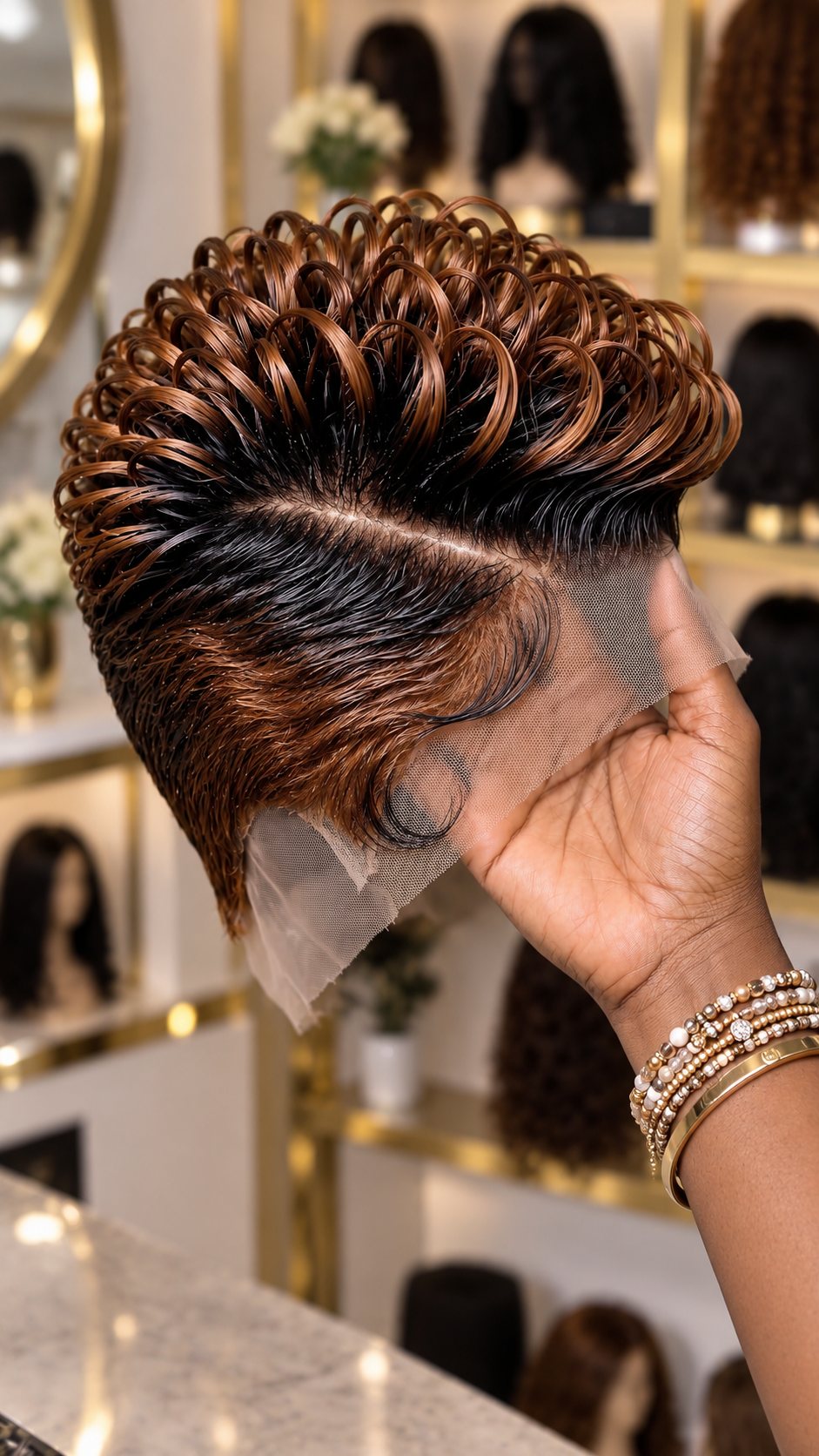
A side-profile photograph can reveal a wig’s construction more effectively than a traditional front portrait. In this cinnamon-bronze piece, the eye first encounters a series of tall, narrow loops rising above a deep espresso foundation. Beneath those arches, a distinct diagonal part separates the crown from a flatter section of dark, backward-directed hair. The lower side introduces warm bronze movement and a single curled perimeter flourish, giving the piece an entirely different identity from a wig decorated with multiple shaved lines.
The unit is being held before installation in a wig salon. Its lace extends around the front and lower edge, and some of the mesh is folded beneath the side. That makes the photograph useful for studying how the finished hairstyle is positioned over an unfinished fitting perimeter. The exact fiber, lace grade and interior attachment arrangement are not established by this view. A buyer should therefore treat those characteristics as specifications to verify with the maker rather than assumptions based on the photograph.
The strongest purchasing question is whether the buyer wants this particular arrangement of loop direction, color depth and sweeping side hair. A generic brown curly wig may share the same warm palette but lack the elevated crown and carefully arranged lower strands. Reproducing the reference requires attention to construction before selecting a color code.
The Side Profile Explains the Height of the Crown
The most prominent sections begin at the top of the head, rising steeply before folding backward into open arches. These arches have a narrow ribbon-like appearance, with many strands traveling in the same direction rather than separating into fluffy curls.
The tallest sections occupy the forward and upper crown. Farther around the head, the loops gradually lean backward and settle into a more compact arrangement. This gives the hair elevation without forcing every section to stand at the same height.
For a custom order, ask the maker to preserve this change in angle. A crown formed from uniformly upright curls would appear much taller around the rear, while ordinary flat waves would eliminate the open arch construction.
It is useful to request a side-profile approval photograph with the wig held in approximately the same orientation as the reference. That allows the buyer to judge the actual crown height rather than relying on a frontal image that conceals much of the loop structure.
Cinnamon and Bronze Are Distributed Across the Raised Hair
The crown color moves through dark cinnamon, bronze-brown and warm caramel reflections. Some strands appear more copper under the salon light, while darker brown remains prominent in the root area and recessed sections.
The lighter tones follow the loops rather than creating one solid blonde block. As a ribbon rises, its reflective surface appears warmer; as it curves inward, the underlying espresso shade becomes more visible.
This relationship is important because the color reveals the physical construction. A uniform medium-brown crown would not display the same contrast between the raised loops and their dark interiors.
The photograph does not confirm how many color formulas were used. For accurate ordering, a neutral-light photograph of the finished hair is more useful than assuming separate highlight shades from reflected light alone.
Dark Espresso Roots Anchor the Warm Crown
The root area appears almost black in several places, especially near the front and beneath the tallest loops. This dark foundation contrasts with the warm outer ribbons and connects the crown to the deeper side strands.
Keeping those roots dark preserves the hairstyle’s dimensional appearance. If the entire wig were colored light bronze, the spaces between the arches would become less distinct.
A colorist recreating the piece should therefore plan the root depth as part of the design rather than treating it as an area that still needs lightening.
When comparing seller photographs, inspect the base of the loops. The reference does not show an even light-brown foundation from root to end; it relies on a darker beginning that gradually gives way to warmer reflective lengths.
The Crown Uses Long Loops Instead of Hollow Ringlets
This construction is noticeably different from the compact circular finger-coil wigs that contain dozens of small, round openings. Here, the upper pieces are longer and more elongated. Several arches rise and bend backward with enough space for the darker hair beneath to remain visible.
The open spaces between the loops are part of the finished appearance. They should not automatically be filled with additional hair.
If a stylist makes the crown excessively dense, the individual ribbons may merge into a continuous mass and the directional movement becomes harder to read.
A good recreation should balance the number of loops with their width and projection. The overall crown can appear full without every small opening being covered.
The Rearward Motion Prevents an Oversized Silhouette
As the ribbons move away from the front, they begin to overlap and settle into the rounded rear. Some sections become narrower, while others form tighter bends than the principal upper loops.
This progression is responsible for much of the silhouette’s balance. The front gains height, but the lower rear avoids the same projection.
Before commissioning an expensive version, ask for a rear three-quarter photograph as well as the side view. The supplied reference demonstrates one side and much of the upper construction, but it does not fully establish the appearance of the opposite side.
A maker should show that the styled hair continues coherently around the entire cap instead of concentrating all the effort on the most photographed area.
The Diagonal Part Divides Two Different Styling Techniques
A scalp-toned part runs across the visible side beneath the crown. Its diagonal route creates a distinct division between long elevated loops and the flatter strands below them.
Unlike a decorative shaved pattern, this separation appears to organize the broader hairstyle. The upper hair rises from one side of the path, while the lower section follows a more horizontal, backward direction.
The parting therefore establishes the structural boundary between crown and side.
Changing its position would alter how large each area appears. A lower division could make the crown visually larger, while a higher division might compress the amount of raised styling.
When ordering, the desired diagonal placement should be approved independently from the color and loop arrangement.
The Lower Side Relies on Strand Direction Rather Than Carved Geometry
Beneath the parting, the dark hair is directed backward in broad, closely arranged sweeps. Warm bronze strands become more visible toward the rear, where the movement bends downward and follows the taper of the foundation.
This creates side interest without prominent parallel shaved channels or lightning-inspired artwork.
For someone commissioning the exact reference, the absence of elaborate carving is important. Adding multiple side lines would produce another hairstyle rather than a more accurate version of this one.
The buyer should ask for directional, layered side styling with dark roots and warm bronze movement, not generic barber stripes.
A Single Curled Perimeter Strand Finishes the Temple
Near the lower front of the visible side, one dark strand forms a small circular flourish against the lace. Its shape contrasts with the long swept movement above it.
This detail creates a more decorative endpoint for the side without requiring a large carved motif. Its modest scale is part of the appeal.
During fitting, the strand should be evaluated in relation to the wearer’s temple and the final lace boundary. Cutting it away automatically would remove a visible design element.
Similarly, making the curl significantly larger could draw attention away from the upper loops. The reference uses the small flourish as an accent, not the main focal point.
The Lace Extends Beyond the Hair-Bearing Area
Untrimmed lace is visible along the front and lower side. The mesh continues beyond the styled hair, giving the installer material to work with during the final fitting.
This is particularly useful for a wig with a fixed diagonal part and sculpted perimeter curl. The cap needs to sit correctly before either detail can be evaluated on the wearer.
The installer should place the unit, check the crown position and side alignment, and then determine where excess lace should be removed.
The photograph cannot verify a specific commercial lace grade. A fine-looking mesh is not automatically HD lace, and the visible construction does not prove adhesive-free wearability.
Those specifications should be requested directly from the seller.
Cap Fit Determines the Position of the Decorative Front
A wig’s crown, parting and front curls are fixed to its foundation. If the cap shifts forward or backward, all of those elements move together.
This is especially important when the side profile contains a precise diagonal separation. An incorrect cap position may make the crown appear too far forward or place the perimeter curl in an unintended location.
For a custom unit, follow the maker’s measurement instructions. Depending on construction, circumference, front-to-nape length and ear-to-ear width may be required.
A professional wig stylist can help collect those measurements before an order is placed, reducing the need for corrective fitting later.
Choosing a Wig Maker With Ribbon-Setting Experience
Not every stylist who offers curly wigs specializes in long folded loop construction. The upper sections require controlled elevation and directional movement, while the lower side needs carefully aligned strands.
When evaluating a maker, look for examples of sculpted ribbon crowns rather than relying solely on photographs of loose curls or conventional spiral wigs.
The most useful portfolio images show the work from the side and above. They reveal whether the loops retain their individual shapes and whether the rear styling is completed consistently.
If the wig will be styled locally, send the reference photograph before booking so the salon can confirm that the necessary techniques are available.
Where to Buy a Similar Cinnamon Bronze Wig
Specialist lace-wig studios, custom wig makers and salons offering sculpted pixie styling are relevant sources for this type of hairpiece.
General wig retailers may carry deep brown or bronze foundations, but reproducing the tall ribbon loops and layered side movement may require additional professional work.
Before buying a base unit, confirm that its hair length and density can support the intended crown construction.
When ordering a finished wig, ask whether the photographed styling is included or whether the seller is providing an unfinished foundation.
That distinction can affect both final cost and the number of salon appointments required.
Build the Order Around Crown Proportions
A useful custom brief should begin with the shape rather than a vague description of the color.
Specify tall, elongated ribbon loops concentrated across the crown, with open spacing and a backward transition toward more compact rear bends.
The color requirement should describe dark espresso roots and warm cinnamon-bronze reflections along the raised sections.
The side specification should identify the diagonal crown part, broad backward-directed strands and small perimeter curl, while excluding elaborate shaved artwork that is not present in the reference.
After these appearance requirements are agreed upon, the buyer can discuss cap size, available lace shades, attachment preferences and the desired installation method.
Approval Images Should Match the Reference’s Viewing Angle
A side-profile approval image is essential because the silhouette depends on crown height and the gradual change from upright loops to backward movement.
An elevated image should reveal the spacing between the ribbons and their color distribution.
A rear three-quarter photograph should confirm that the styling does not become disproportionately bulky or unfinished toward the back.
If the supplier advertises a particular cap construction or lace specification, request a separate underside photograph of the actual unit.
For custom work, these images should be reviewed before the wig is shipped whenever the maker offers final approval.
Price Differences Often Come From Crown Labor
The absence of elaborate barber carving does not automatically make this wig inexpensive. The long upper loops must be arranged individually, and the lower side requires directional setting that differs from the crown technique.
Color placement, cap construction and lace preparation can also contribute to the final quotation.
Estimated Pricing for Cinnamon Bronze Sculpted Loop Wigs
| Category | Illustrative Price Range | What May Be Included |
|---|---|---|
| Premium Custom | $325–$575+ | Higher-grade hair, personalized cap sizing, dark-root bronze coloring, individually arranged ribbon loops, directional side styling and detailed lace preparation. |
| Standard Custom | $195–$345 | Prepared bronze crown, established diagonal parting and coordinated side movement with standardized cap options. |
| Basic Human Hair | $115–$215 | A human-hair foundation requiring additional color work, loop setting, side shaping and professional installation. |
| Premium Synthetic | $80–$155 | A pre-colored and pre-set interpretation that may retain the loop arrangement with less frequent professional reconstruction. |
| Basic Synthetic | $40–$90 | A budget version where loop separation, tonal depth, side-wave precision or cap construction may be simplified. |
These figures are illustrative budgeting estimates, not verified prices for the photographed unit. Actual quotations depend on hair or fiber, labor, location, cap construction, shipping and installation.
Customers should ask whether crown setting and side styling are already included. A lower-priced foundation requiring several professional services may ultimately cost more than a completed custom piece.
Human Hair and Synthetic Fiber Require Different Plans
A human-hair version may offer more freedom for future professional resetting of the loops. If some sections lose their height, a stylist can potentially reconstruct them without rebuilding the entire crown.
The hair’s processing history should guide heat use, particularly if the warm bronze color was achieved through chemical treatment.
A quality synthetic version may retain a pre-set arrangement well but offer fewer options for future heat styling or recoloring.
The photograph does not establish the material, so the seller’s specification should guide the buyer’s maintenance decisions.
Preserve the Narrow Loop Openings During Care
Before washing, photograph the crown from the side and above. These images record where the tallest sections begin and how they transition backward.
During cleansing, avoid vigorous rubbing that can intertwine neighboring ribbons and close the spaces between them.
Use products compatible with the confirmed material and allow the wig to dry without crushing the upper loops.
Afterward, restore only the sections that have shifted. Rebuilding every loop unnecessarily can alter the original spacing over time.
The Bronze Side Should Remain Directional
The lower side uses elongated movement rather than the same raised loops found above. Its strands should continue following their backward paths during future styling.
If a section becomes displaced, guide it back into the existing curve rather than converting it into another upright curl.
The small perimeter flourish also deserves individual attention because it is part of the visible design.
Heavy styling product can cause neighboring strands to adhere together, making the side appear less organized. Product application should therefore remain conservative.
Color Refreshing Should Protect the Espresso Foundation
If the wig is human hair and the bronze tone begins fading, a professional should evaluate which sections require attention.
The darker roots create important shadow beneath the loop crown and should not automatically be lightened during a color refresh.
Applying one medium-brown formula throughout the wig could remove some of the original depth.
Synthetic versions should be maintained according to their fiber specifications rather than treated as ordinary dyeable human hair.
The Lower Side Needs Preservation, Not Frequent Cutting
Because the visible design does not rely on multiple carved channels, routine barber recutting may be unnecessary.
The compact side should be maintained primarily through careful directional styling and density preservation.
Removing hair repeatedly can make the lower section thinner than the reference, and wig hair cannot naturally regenerate.
A stylist should therefore correct displaced strands before considering permanent trimming.
Fit Before Altering the Lace or Temple Curl
When the unit arrives, inspect the crown, side, lace and cap before permanent alterations.
The installer should establish the final wearing position and examine the diagonal parting and small perimeter curl.
Only after that alignment has been approved should excess lace be trimmed or front strands adjusted.
If the styling remains intact after shipping, extensive restyling may not be necessary.
Storage Should Support the Tall Crown Without Compression
The raised ribbon loops need adequate vertical space between wears. A suitable wig stand or mannequin head can help preserve their open construction.
The side should also remain clear of hard surfaces so its directional strands and small perimeter curl are not flattened.
Store the unit only when the cap and lace are fully dry.
For travel, choose packaging deep enough to protect the crown without pressing the loops inward.
The Appeal Lies in the Contrast Between Loops and Flowing Side Hair
This cinnamon-bronze wig gains its identity from two different kinds of movement. The crown rises through long, open ribbons, while the side uses flatter backward-directed strands and a small curled perimeter accent. Deep espresso roots connect both areas and provide the shadow that makes the warmer surfaces stand out.
For buyers, the most important quality checks are crown height, loop spacing, bronze color depth, root placement, diagonal parting, side-wave direction, perimeter curl and untrimmed lace condition.
For wig businesses, a clear side photograph is especially valuable because it reveals how the upper and lower styling zones relate to one another. Additional overhead, rear and underside images can help customers verify details that a single presentation angle cannot establish.
A faithful custom reproduction should preserve the proportions of the original. Extra blonde highlights, decorative carving or exaggerated crown height would create a different hairstyle rather than improve its accuracy. The goal is a coordinated combination of warm bronze loops, dark roots and controlled side movement.
Search Terms
cinnamon bronze ribbon loop wig · espresso root bronze crown · elongated sculpted loop hairpiece · diagonal side part lace wig · bronze finger wave side wig · small temple curl lace front · warm chestnut elevated crown · untrimmed lace bronze wig