
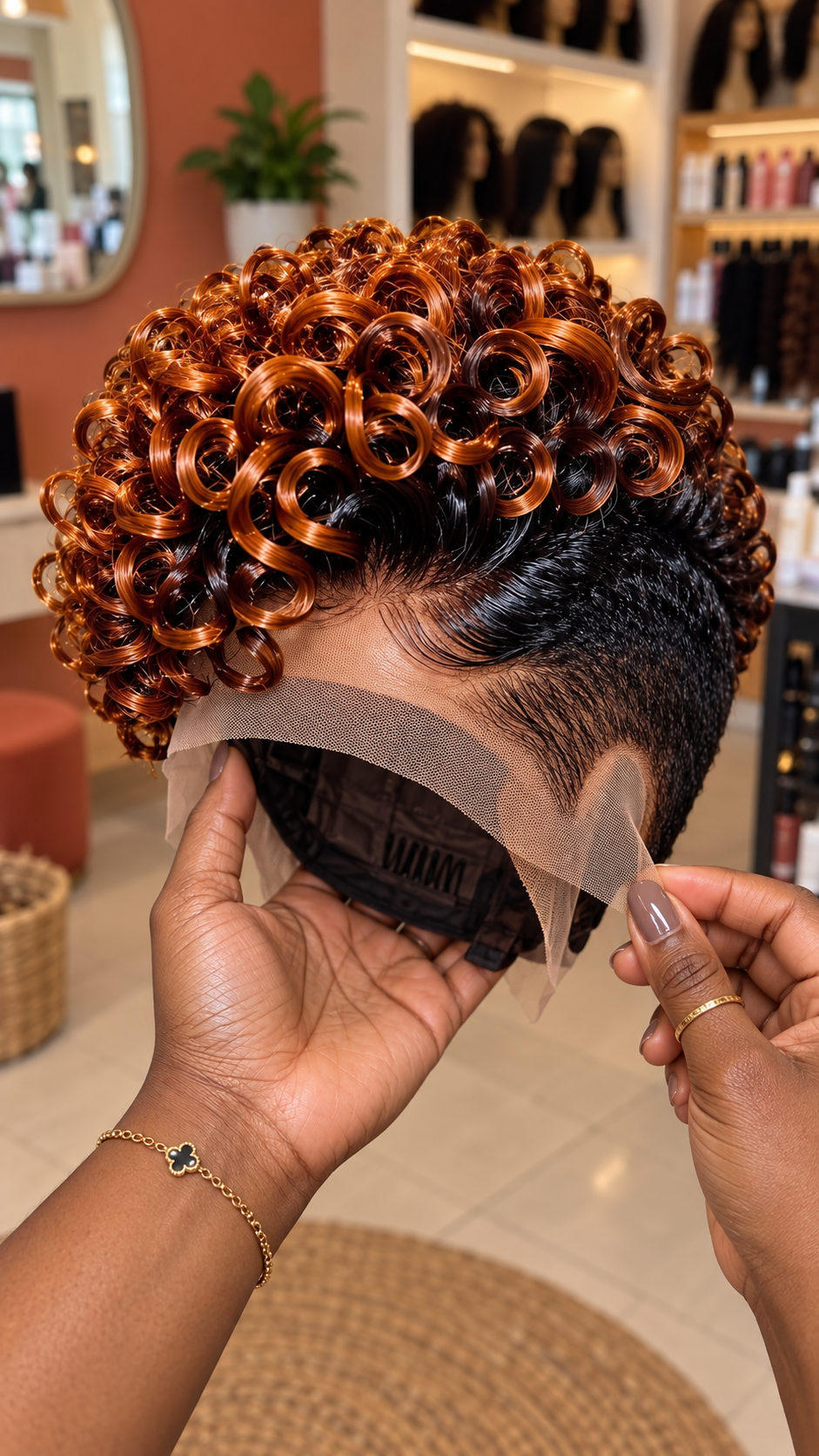
A richly colored ringlet wig can attract attention immediately, but the real test of a custom hairpiece begins when it is lifted from the display and examined before installation. This fiery auburn-copper unit offers that opportunity. Its crown contains prominent hollow spiral curls with reflective copper-orange surfaces, while a deep black foundation forms the front transition and closely arranged side. The lace extends beyond the hair-bearing perimeter, allowing the buyer to inspect a hairstyle that has already been sculpted but has not yet been fitted to a wearer.
The design is particularly interesting because it does not depend on decorative carved side lines. Instead, almost all of its visual complexity is concentrated above the dark perimeter. Large circular curls overlap across the forward crown, smaller spirals continue toward the rear, and fine black strands are directed backward beneath the copper formations. That contrast makes the upper hair appear even more dramatic while allowing the lower side to remain compact.
For buyers, the important distinction is between a wig that has been professionally arranged for display and one that is fully prepared for individual wear. The photograph confirms the appearance of the copper ringlets, dark foundation, visible lace and portions of the cap interior. It cannot establish the hair material, lace grade or whether the wig is suitable for adhesive-free installation. Those specifications should be verified before ordering.
The Crown Makes Copper Color the Center of Attention
The most prominent visual element is the dense collection of copper ringlets across the upper hair. They are arranged into circular formations with open centers, allowing the darker underlying strands to remain visible through many of the curls.
The brightest areas appear fiery copper-orange under the salon lighting. Other sections display deeper auburn, reddish-brown and burnt-copper tones. This variation creates a dimensional appearance rather than one flat orange surface.
The curls themselves contribute to the tonal differences. A strand facing the light appears brighter, while the same strand becomes darker as it curves inward. Consequently, even a relatively consistent copper color can display several intensities within one spiral.
A buyer ordering a similar wig should request rich auburn copper with darker interior depth rather than relying only on the name copper red. Supplier shade terminology varies, and a photograph offers a more reliable reference for the desired result.
Hollow Spiral Openings Are More Important Than Maximum Density
The upper curls have a particularly recognizable construction. Several look like small rolled tubes, with the hair traveling around circular openings instead of hanging downward as conventional ringlets.
The largest formations occupy prominent areas near the front and central crown. Smaller curled sections fill neighboring spaces and help the overall shape remain rounded.
These openings are essential to the style. If additional hair were packed into every gap, the crown might become fuller but lose the individual circular structures that make it distinctive.
For custom production, the maker should concentrate on preserving the diameter and separation of the curls. An elevated approval photograph can help the customer judge whether the ringlets have retained their hollow centers.
The goal is a densely arranged but clearly readable spiral crown, not simply the greatest possible quantity of curled hair.
The Black Foundation Creates a Deliberate Color Boundary
The copper curls rise from a much darker foundation. Black and very deep brown are clearly visible around the roots and front, continuing into the compact side.
This contrast creates the impression of a bright copper crown emerging from a dark base. It also prevents the orange-red hair from covering the entire silhouette.
The root area should therefore be considered part of the color specification. A fully copper foundation would make the wig considerably brighter but would change the visual relationship between its upper and lower sections.
Similarly, adding blonde highlights throughout the dark side could distract from the deliberately restrained lower styling.
Customers requesting this look should specify copper ringlets over a jet-black or near-black foundation, with the transition preserved around the front and side.
Large Front Rings Create a Distinctive Silhouette
Several prominent curls extend toward the front of the crown, creating a rounded outline above the dark hairline. Their openings face slightly different directions, allowing individual copper strands to reflect light at changing angles.
This variation makes the crown look less mechanical than an arrangement of identical circles. Some curls sit almost vertically, while others lean forward or backward.
Although the ringlets are large, the overall hairstyle remains compact. The hair is concentrated around the head rather than hanging into long curls.
A professional recreation should maintain that relationship. Increasing the length too much could produce a hanging curly hairstyle, while flattening the rings would remove the raised construction.
The Side Is Intentionally Free of Elaborate Carving
One of the defining characteristics is the absence of prominent decorative side channels. Unlike wigs with lightning patterns, parallel shaved stripes or geometric temple markings, this unit uses a continuous dark side to support the copper crown.
The black hair is arranged closely against the foundation, creating an even lower profile beneath the raised ringlets.
This simplicity is intentional from a visual perspective. The upper color and circular architecture already provide substantial detail, so additional carving is not necessary to make the wig recognizable.
Buyers commissioning this particular appearance should tell the stylist not to add decorative razor lines. Such additions would produce a different design, even if they were executed skillfully.
The Front Strands Create a Connection Between Two Color Zones
Immediately beneath the copper curls, fine dark strands travel backward in coordinated directions. They appear flatter than the large ringlets and gradually transition into the close side.
This arrangement helps the bright upper hair connect visually with the black foundation. Without it, the copper coils might appear to begin abruptly at the lace edge.
These strands should be treated separately from the circular crown during styling. They are not intended to become additional hollow spirals.
During installation, the stylist should evaluate their placement before removing or shortening them. Preserving the original transition may require only minor adjustment.
Why the Untrimmed Lace Matters Before Installation
The photograph shows a broad lace perimeter extending beyond the visible front and side hairline. The material has not yet been shaped to an individual wearer’s head.
This extra lace provides fitting flexibility. A professional can first establish the cap position, assess where the dark hairline sits and then determine the final trimming route.
The photograph also shows an extended section around the ear-area boundary. This portion should be handled carefully because the final fit depends on the wearer’s anatomy.
Although the mesh appears fine, its exact commercial grade cannot be verified visually. A seller advertising HD lace should provide the corresponding product specification.
Similarly, the photograph does not confirm whether the unit can be installed securely without adhesive. A buyer wanting that option should request explicit confirmation.
The Visible Cap Interior Offers Practical Buying Information
A portion of the dark inner cap can be seen beneath the lace and styled hair. An interior comb-like attachment is visible, but the photograph does not fully reveal every attachment or adjustment component.
That limitation makes additional documentation important. Before purchasing, ask the seller for a complete underside photograph of the actual unit.
The image should reveal the interior foundation, available adjustment system, cap dimensions and attachment placement.
Some customers prefer internal combs, while others want an alternative securing arrangement. These preferences should be discussed before a custom order is completed rather than left until installation.
Accurate Sizing Protects the Copper Crown’s Position
The hairstyle is built onto a structured foundation, so the position of the crown changes when the cap moves.
A unit placed too far forward may cause the prominent front ringlets to project differently over the forehead. A cap sitting too far backward may shift the dark hairline and alter the intended silhouette.
For a custom wig, follow the supplier’s measurement instructions carefully. Depending on the cap design, measurements may include circumference, front-to-nape length and ear-to-ear distance.
Having a wig stylist take the measurements before ordering may be worthwhile when the crown has a highly specific arrangement.
A Salon Demonstration Should Include the Rear
The visible photograph emphasizes the front and one side, making those areas easy to evaluate. However, it does not fully establish how every curl is arranged around the back.
For an expensive custom order, ask the seller to rotate the finished unit slowly while recording a video or taking additional photographs.
The rear should contain an appropriate continuation of the spiral styling, with smaller formations where necessary to maintain the rounded shape.
It should not be assumed that the unseen areas have exactly the same curl diameter or density as the front. The finished product needs to be inspected before the buyer approves it.
Where to Find a Wig Maker for Open Copper Ringlets
Custom lace-wig studios, specialist wig makers and salons offering sculpted finger-coil work are practical places to begin searching for a comparable design.
The important skill is not simply coloring hair copper. The professional must be able to construct numerous hollow curls that remain individually visible.
When examining a maker’s portfolio, look for close crown photographs showing circular openings, controlled density and consistent styling around the front and rear.
General wig retailers may offer copper curly foundations, but a standard loose-curly unit will not necessarily reproduce this crown.
If the exact arrangement is not available as ready-made stock, a custom commission may be the more appropriate purchasing route.
Custom Ordering Should Separate Color From Curl Architecture
A useful production brief should establish the crown first: compact, raised, hollow circular ringlets with varied diameters and substantial coverage.
The color requirement should then describe fiery auburn copper on the visible curls, with darker reddish-brown interiors and a predominantly black foundation.
The side specification should emphasize closely arranged dark hair without decorative carved channels.
Finally, practical details should identify cap sizing, available lace shades, attachment preferences and whether the lace should arrive untrimmed for professional fitting.
These distinctions help prevent a seller from delivering an ordinary copper curly wig that matches the color but not the style.
Choosing Between Ready-Made and Custom Production
A finished wig can be a good purchasing option when its actual curl arrangement, color and cap measurements already match the buyer’s needs.
Custom production offers greater control over the exact ringlet diameter, dark root placement and overall crown shape.
However, custom work may require additional time and labor. Some sellers provide a base wig while expecting the customer to arrange professional styling separately.
Before ordering, confirm whether the quoted price includes completed ringlets, color work and lace preparation.
A lower initial price is not necessarily better value if the hairstyle still requires extensive professional construction after delivery.
Estimated Costs for a Fiery Copper Spiral Crown Wig
Creating this appearance involves more than choosing a compact wig in an auburn shade. The price can reflect individual curl setting, color processing, dark-root preservation, cap construction and fitting preparation.
| Category | Illustrative Price Range | Possible Services or Construction |
|---|---|---|
| Premium Custom | $340–$610+ | Higher-grade hair, individual measurements, planned copper coloring, hand-arranged hollow ringlets, dark root detailing and personalized lace preparation. |
| Standard Custom | $205–$365 | Prepared copper ringlet crown, compact black side construction and more standardized cap fitting options. |
| Basic Human Hair | $120–$225 | A human-hair foundation that may require coloring, spiral setting, crown shaping and professional installation. |
| Premium Synthetic | $80–$165 | A quality pre-colored and pre-set unit that may preserve its spiral arrangement with reduced need for regular professional resetting. |
| Basic Synthetic | $40–$95 | A budget interpretation with potentially simpler curl construction, reduced color depth or more basic cap materials. |
These figures are illustrative budgeting estimates, not verified quotations for the pictured wig. Prices vary by seller, location, material, construction, customization labor, shipping and installation.
Ask for a breakdown of included work. The comparison should consider the cost of reaching the completed appearance, not only the price of the initial hairpiece.
Human Hair Offers Greater Flexibility for Curl Reconstruction
A human-hair version may allow a stylist to reset selected ringlets when they lose their original circular form.
This can be useful for someone who expects regular professional maintenance or wants the possibility of future styling adjustments.
However, fiery copper color may involve chemical processing. The condition of the hair should guide heat use and any later coloring decisions.
Human hair does not automatically tolerate repeated maximum-temperature styling.
Premium Synthetic May Preserve the Circular Shape Longer
A well-made synthetic unit can be useful when the buyer wants to maintain the original crown rather than frequently change it.
Pre-set fibers may retain their spiral formation with relatively limited styling intervention.
The disadvantage is reduced flexibility for major changes. Heat tolerance varies, and conventional human-hair dye should not be assumed compatible.
Always confirm the fiber specification before purchasing products or tools for maintenance.
Preserving the Hollow Centers During Washing
The most important maintenance challenge is protecting the circular openings. When several ringlets become intertwined, the crown can gradually lose its individual sculpted forms.
Before the first wash, photograph the upper hair from above and from the front.
During cleansing, avoid aggressive circular rubbing that mixes neighboring sections. Follow the instructions for the confirmed human-hair or synthetic material.
Once dry, inspect which curls have actually shifted. Reconstruct only those sections instead of automatically resetting the entire crown.
Copper Color Maintenance Should Respect the Black Foundation
The fiery auburn crown and dark side should remain visually separate even after repeated wear.
If the unit is human hair and the copper begins fading, a professional colorist should assess where refreshing is needed.
Applying copper pigment indiscriminately through the entire wig could alter the dark foundation and weaken the original contrast.
The objective is to maintain the rich copper ringlets while retaining the black root and side areas.
Avoid Excessive Shine Products on the Spirals
The ringlets already display strong reflections. Heavy oils, waxes or holding products can cause neighboring strands to adhere together and conceal the circular openings.
Product buildup may also make copper appear darker or less reflective.
Use only what the confirmed material requires. If residue becomes noticeable, suitable cleansing may restore the appearance more effectively than applying additional shine product.
The Dark Side Needs Preservation Rather Than Frequent Cutting
Because the side contains no prominent carved artwork, it does not require routine line maintenance.
The closely arranged black strands should be preserved at their intended density. If a few hairs begin lifting away from the foundation, repositioning may be sufficient.
Repeated trimming can gradually make the lower area thinner than the reference, and the removed hair cannot naturally regenerate.
Professional maintenance should therefore concentrate on retaining the original side silhouette.
Installation Should Begin With Cap Position
Once the wig arrives, inspect the crown, lace, cap and dark root placement before making permanent alterations.
The installer should position the cap and examine how the large ringlets frame the forehead.
Only after approving the placement should the excess lace be trimmed and any optional front adjustment considered.
If the crown and side remain intact after shipping, extensive restyling may not be necessary.
Storage Must Protect the Raised Copper Rings
The hollow ringlets can lose their shape when compressed. A suitable wig stand or mannequin head can help preserve the crown between wears.
Avoid stacking other hairpieces over the copper loops or pressing the side against a hard surface.
Ensure that the cap and lace are completely dry before storage.
For transportation, choose packaging with enough depth to retain the circular openings without forcing the curls inward.
The Right Purchase Depends on More Than Fiery Color
This wig demonstrates how a warm copper crown can become distinctive without relying on carved side artwork. Large hollow spirals provide the main visual detail, while the black root foundation and compact side create the contrast needed to keep those curls readable.
For buyers, the key quality checks are the diameter of the ringlets, their visible openings, the distribution of copper and darker tones, the continuity of the black side, the condition of the untrimmed lace and the suitability of the cap.
For wig businesses, showing the actual product before installation creates an opportunity to communicate both craftsmanship and practical construction. Additional overhead, rear and underside photographs can help customers compare options and understand what remains to be completed during fitting.
The strongest reproduction will preserve the relationship between copper color, open spiral architecture and dark lower density. Making the curls larger, adding more highlights or introducing decorative side lines would not automatically improve the design. Accuracy comes from maintaining the same balanced combination visible in the reference.
Search Terms
fiery auburn copper ringlet wig · black root orange copper wig · hollow copper spiral crown · jet black side curly wig · sculpted copper lace front · reddish copper tubular curls · dark foundation copper hairpiece · untrimmed lace auburn wig