
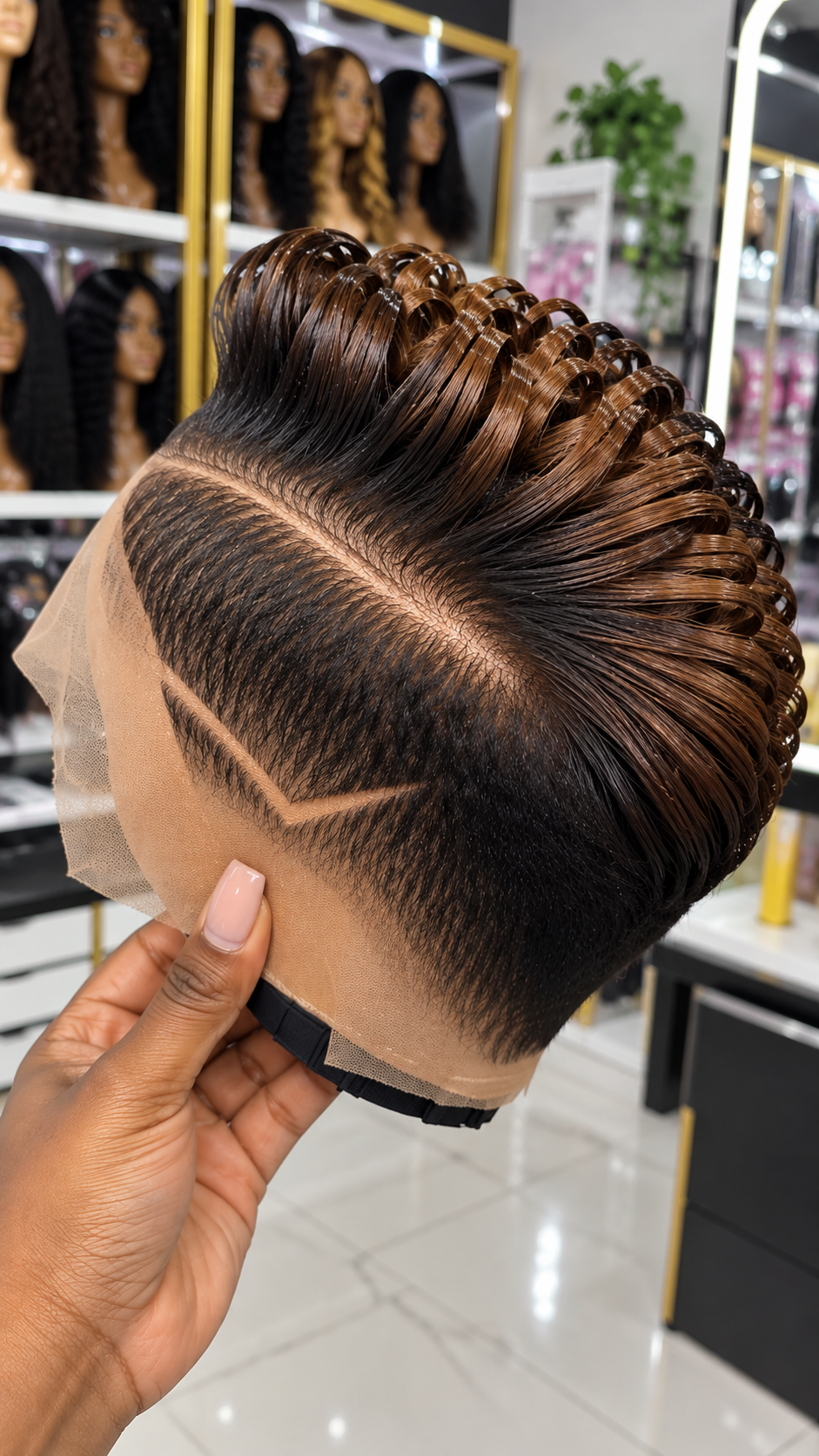
The most distinctive detail in this chestnut-brown wig is the small angular interruption within its otherwise continuous dark side. While the crown contains glossy, backward-folding ribbon loops and warm brown reflections, the lower section remains closely arranged with just one prominent geometric accent. This creates a very different visual balance from wigs covered in multiple carved stripes. The upper hair supplies height and movement, while a single sharp change of direction gives the side its identity.
Shown in hand inside a wig retail salon, the unit has not yet been installed. Beige-toned lace remains visible around the front and lower perimeter, and a black band appears along part of the underside. The photograph provides an excellent view of the crown’s folded construction, the side density and the angular marking, but it does not establish the exact hair material, lace grade or complete internal attachment system. Those specifications should be confirmed with the seller rather than inferred from appearance.
The dark foundation is particularly important. The longer crown reflects chestnut and reddish-brown tones, while the roots and close side appear significantly deeper, approaching espresso and natural black. The color difference helps distinguish the raised ribbons without creating obvious blonde or copper-highlight streaks.
The Side Accent Resembles a Bent Directional Path
The principal distinguishing detail is a narrow exposed line along the compact side. It begins near the forward portion, travels diagonally and then changes direction at a noticeable angle. The result resembles a bent or chevron-like path rather than an ordinary straight barber stripe.
This small angular turn is important. Its visual effect depends on the sudden change in direction, not the number of lines or the width of the exposed area.
A custom maker should preserve the marking’s relatively restrained proportions. Enlarging it into a lightning-shaped pattern or adding several parallel paths would create a substantially different hairstyle.
The dark hair surrounding the accent should also remain intact. Those retained areas provide the contrast needed for the narrow exposed pathway to remain visible.
The Upper Boundary Separates the Crown From the Close Side
A longer scalp-toned division runs beneath the raised crown, following the contour of the wig from the front toward the rear. This line establishes the transition between the longer upper hair and the compact lower section.
The boundary and the smaller angular accent have different purposes. The upper division organizes the hairstyle, while the lower marking contributes a discreet graphic detail.
For professional customization, the main crown boundary should be mapped before the angular marking is finalized. Its position determines how much side hair remains available.
Moving the boundary too low could enlarge the crown visually, while shifting it upward could reduce the amount of raised hair. Matching the reference requires the two areas to remain proportional.
Chestnut Brown Works Through Reflection Rather Than Strong Highlighting
The crown appears within a deep chestnut and chocolate-brown family. Raised sections catch warmer reddish-brown reflections, while the roots and recessed spaces remain dark espresso.
There is no clearly established bright blonde streaking in the photograph. Much of the tonal variation appears to come from how the strands bend and reflect the salon lighting.
A buyer should therefore be cautious about requesting additional highlights simply because some crown sections look lighter. The reference relies on brown tonal depth rather than a heavily contrasted multi-color design.
When ordering, request a rich chestnut-brown crown with darker roots and a near-black side foundation. A neutral-light photograph can help determine whether the actual available shade matches the intended depth.
Large Forward Ribbons Establish the Crown’s Elevation
The front upper sections rise noticeably from the roots before folding backward. Several contain long, aligned strands that create broad reflective surfaces rather than compact circular coils.
These folds give the crown its height and directional character. Their open interiors reveal the darker foundation, creating shadow between neighboring sections.
A successful recreation should preserve those spaces. Adding too much hair between the folds could make the crown appear heavier and reduce the individual ribbon shapes.
The aim is controlled elevation rather than maximum volume. The front should appear sculpted, with distinct sections rising before moving toward the rear.
The Middle Crown Uses Overlapping Folded Strands
As the hair travels backward, several ribbons begin overlapping. Some bend earlier, while others extend farther before turning, producing variation within the same overall direction.
This arrangement prevents the crown from looking like identical loops placed in rigid rows. The different widths and angles create a more natural visual rhythm.
The warm chestnut reflections also follow these curves, making the outer surfaces easier to distinguish from the dark interior sections.
A custom stylist should arrange the hair according to this directional progression rather than simply curling every section in the same way.
The Rear Settles Into Smaller, More Compact Loops
The visible rear portion contains tighter curled sections that follow the rounded foundation. Their projection is lower than that of the upright front ribbons.
This helps the crown settle naturally toward the back and prevents excessive bulk throughout the entire silhouette.
The supplied photograph does not reveal every angle of the rear, so a buyer commissioning the style should request a rear three-quarter approval photograph.
That image can confirm whether the smaller loop work continues consistently and whether the crown remains balanced outside the main side view.
The Close Side Is Deliberately Dense
Beneath the upper division, fine dark strands form a substantial side panel. The hair remains close to the foundation, creating a compact surface that contrasts with the raised crown.
This density is essential to the angular marking. If the side were extremely sparse, the exposed path would have less visual contrast against the surrounding area.
Conversely, leaving the side too long could allow strands to cover the geometric detail.
A professional recreation should therefore maintain a closely arranged but visibly populated lower section rather than treating the entire side as a shaved surface.
The Angular Design Should Remain a Single Accent
This wig demonstrates how a small decorative marking can be sufficient when the crown already contains substantial movement.
The side does not require multiple lightning motifs, extensive parallel stripes or elaborate carved curves. One angled path provides a recognizable detail while allowing the chestnut ribbon crown to remain dominant.
For buyers, the absence of additional markings is part of the desired appearance. A seller accustomed to producing heavily carved wigs should be instructed not to add extra lines automatically.
The design succeeds because the graphic lower section remains restrained.
The Exposed Lace Preserves Fitting Flexibility
A broad lace perimeter remains visible beyond the front and lower hair-bearing sections. This indicates that the unit has not yet been trimmed for a specific wearer.
During professional installation, the stylist can establish the cap position before removing the excess mesh. That sequence is especially important when the side artwork must align with the temple and ear.
The apparent beige lace shade may be influenced by lighting and camera processing. Buyers should ask about the actual available lace colors.
The photograph does not verify a particular commercial lace grade. Terms such as HD lace should only be used when supported by the supplier’s product specifications.
The Partially Visible Underside Needs Additional Inspection
A dark band and portions of the interior foundation can be seen beneath the lace. However, the photograph does not show enough of the underside to establish the complete cap configuration.
Customers who have preferences regarding adjustable straps, combs or attachment methods should request a full interior photograph.
The seller should identify which components are included in the actual unit being purchased rather than relying on generic product descriptions.
Visible lace and a dark interior band alone do not prove that a wig is suitable for adhesive-free installation.
Cap Placement Controls Where the Angular Marking Appears
The geometric side accent is fixed to the wig foundation. If the cap sits too far forward, the marking moves toward the face. If it sits too far backward, the detail shifts away from its intended position.
This makes accurate sizing important even though the side pattern is relatively simple.
For made-to-order wigs, follow the maker’s measurement chart. Depending on the construction, circumference, front-to-nape and ear-to-ear measurements may be requested.
A professional wig stylist can assist with measurements when the wearer wants a particularly accurate fit.
Commission the Crown and Side as Different Tasks
A clear production brief should begin with the crown: elongated backward-folding ribbons, prominent forward elevation, overlapping middle sections and smaller rear loops.
The color should then be established as rich chestnut brown with darker espresso roots.
The side requirement should remain separate: compact dark hair, a long boundary beneath the crown and one narrow angular accent that changes direction near its center.
After those details are agreed upon, confirm cap size, lace shade, interior attachment preferences and whether the lace should arrive untrimmed for local fitting.
This approach gives the maker a more precise target than a generic request for a brown sculpted wig with a line.
Choose a Wig Maker Experienced With Directional Crowns
The upper construction requires more than ordinary curling. The strands need to rise in elongated sections, overlap through the middle and become progressively more compact toward the rear.
Look for makers whose portfolios include sculpted ribbon crowns rather than only loose curls or conventional pixie wigs.
A professional who also understands precision side cutting may be able to complete the entire unit. Otherwise, final refinement of the angular marking can be handled by a local specialist after fitting.
Because wig hair cannot regrow, any additional cutting should remain conservative.
Where to Buy a Comparable Chestnut Wig
Specialist wig studios, custom lace-wig makers and salons offering structured crown styling are practical starting points.
A general wig retailer may offer a dark-brown foundation, but the folded ribbon crown and specific side accent may require additional professional services.
When contacting a seller, send the photograph and ask whether the quoted unit includes the completed crown, dark side and angular marking.
For a custom order, request a production estimate and clarify whether the final piece will arrive fully styled or require local finishing.
Approval Images Should Focus on the Side Proportions
A direct side photograph should show the long crown boundary and the single angular marking below it. The retained dark hair around both exposed areas must remain visible.
An elevated view should reveal the width and spacing of the folded crown sections.
A rear three-quarter photograph should confirm the transition into smaller loops.
If cap construction matters to the buyer, an underside photograph should be requested separately.
Estimated Pricing for a Chestnut Ribbon-Crown Wig
The compact length of this unit does not necessarily make it inexpensive to produce. Its value can lie in directional crown setting, careful brown color selection, cap construction and the precision required for the restrained side accent.
| Category | Illustrative Price Range | Potential Scope |
|---|---|---|
| Premium Custom | $300–$540+ | Higher-grade hair, personalized cap sizing, rich chestnut coloring, hand-arranged ribbon crown, precise angular side detail and lace preparation. |
| Standard Custom | $180–$315 | Prepared brown loop crown, close dark side and established single-line accent with standardized cap options. |
| Basic Human Hair | $110–$200 | A human-hair foundation requiring additional crown setting, side customization and professional fitting. |
| Premium Synthetic | $75–$145 | A quality pre-set alternative that may retain its sculpted crown with less frequent professional resetting. |
| Basic Synthetic | $35–$85 | A budget interpretation where crown separation, brown depth, side precision or cap construction may be simpler. |
These are illustrative budgeting estimates rather than verified prices for the photographed wig. Actual quotations vary by material, seller location, cap construction, labor, shipping and installation.
Ask whether the crown styling and side accent are included before comparing offers. A cheaper foundation requiring additional salon work may ultimately cost more than a finished custom unit.
Human Hair Provides More Flexibility for Future Crown Resetting
A human-hair version may allow individual ribbon sections to be reset if they lose their backward direction.
The hair’s quality and processing history should guide the use of heat. Even dark human hair can be affected by repeated excessive temperatures.
Targeted maintenance is preferable when only several sections have moved, because rebuilding the entire crown unnecessarily can change the original spacing.
Premium Synthetic May Preserve the Pre-Set Shape
A quality synthetic version can be useful when the wearer wants the folded ribbon crown to remain close to its original form.
The tradeoff is reduced flexibility for major restyling. Heat tolerance varies by fiber, and conventional permanent dye should not be assumed suitable.
Confirm the material before choosing a maintenance method.
Preserve the Crown Direction During Washing
Before the first wash, photograph the wig from above and from the side. These images record where the large forward loops sit and how the middle sections overlap.
During cleansing, avoid aggressive rubbing between neighboring ribbons. Excess friction can cause them to intertwine and lose their separate shapes.
After drying, restore only the sections that have moved, using the original photographs as a guide.
The Angular Marking Needs Minimal Cutting
The single side accent should not be enlarged on a routine schedule. If fine strands move across the exposed path, repositioning may restore its visibility without cutting.
When refinement becomes necessary, use the reference photograph to preserve the angle and width.
Because the hair is attached to a wig foundation, repeated cutting can permanently alter the design.
Use Styling Product Without Merging the Ribbons
The crown already reflects light strongly. Heavy oils or waxes may cause neighboring sections to adhere together and reduce the spaces between the loops.
Product buildup can also make the brown color appear darker or less dimensional.
Use only what the confirmed material requires. Appropriate cleansing may be more effective than applying additional shine product when residue becomes noticeable.
Fit the Wig Before Altering the Side
When the unit arrives, inspect the crown, side marking, lace and cap before making permanent changes.
The stylist should establish the final wearing position, evaluate the crown height and check where the angular accent falls relative to the temple.
Only after the fit is approved should the excess lace be trimmed and optional side adjustments considered.
Storage Should Protect the Raised Front Sections
The forward crown contains the tallest folds and therefore needs adequate vertical clearance. A suitable wig stand or mannequin head can help preserve their open shape.
Avoid pressing the crown under other objects or storing the side against a hard surface.
The cap and lace should be completely dry before storage. During transport, use packaging that does not crush the raised sections.
The Single Angular Accent Makes This Wig Distinctive
This chestnut-brown unit demonstrates that a sculpted wig does not need multiple carved patterns or bright contrasting highlights to have a recognizable identity. The crown supplies most of the movement through backward-folding ribbons, while the close dark side supports one restrained angular detail.
For buyers, the main quality checks are the richness of the chestnut shade, the spacing of the folded crown sections, the transition into smaller rear curls, the density of the uninterrupted side and the shape of the angular marking.
For wig businesses, detailed side and crown photographs can communicate the craftsmanship more effectively than a generic brown-wig description. Clear information about lace, cap sizing and included customization makes the purchasing process more transparent.
A successful reproduction should preserve the balance between the raised brown crown and restrained dark side. Adding more highlights, carving or volume would create a different hairstyle rather than a more accurate version of the reference.
Search Terms
chestnut brown ribbon loop wig · espresso root sculpted crown · single angular side accent wig · dark brown tapered lace wig · backward folded brown ribbons · chevron side marking hairpiece · chestnut custom lace front · compact sculpted brown wig