
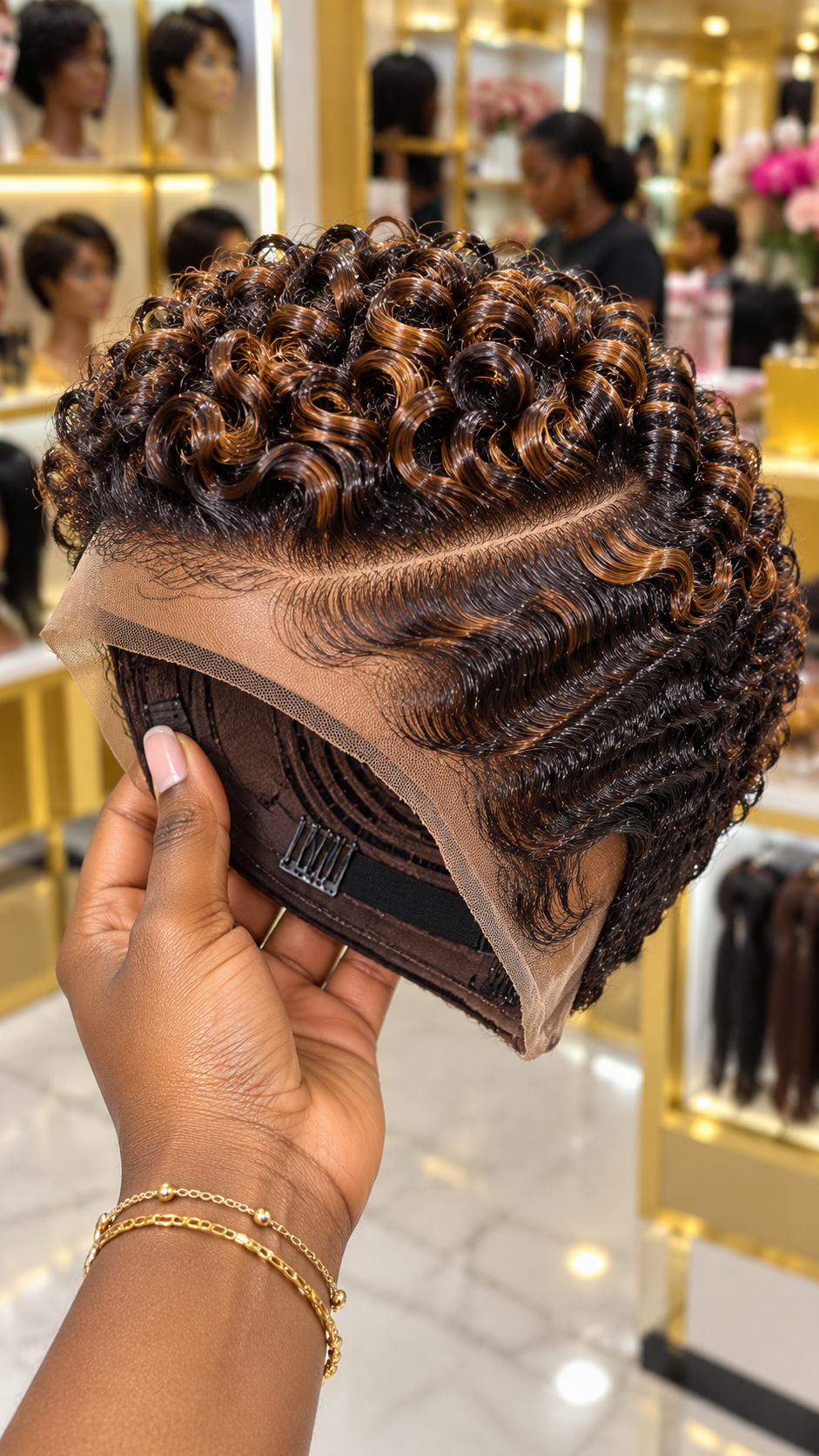
The most distinctive quality of this caramel-copper pixie wig is not simply its color or its compact length. It is the way two completely different styling techniques occupy the same hairpiece. The crown is filled with raised, circular spiral formations, while the front and side are arranged into long, closely aligned S-shaped waves. Deep brown roots connect those sections, creating a continuous foundation beneath the warmer caramel reflections.
The photograph shows the wig being held before installation inside a beauty supply salon. Its lace perimeter remains untrimmed, and a substantial portion of the brown interior cap is visible. A comb-style attachment and dark internal band can also be seen. These construction details make the image useful for evaluating the wig beyond its finished appearance, although the photograph cannot establish the exact hair fiber, lace grade or suitability for adhesive-free installation.
Unlike a wig with decorative razor stripes, the side styling here depends primarily on the arrangement of the hair itself. Broad finger-wave ridges travel across the temple, following one another in a coordinated pattern before transitioning into smaller curls toward the rear. That detail changes how the unit should be ordered, maintained and priced.
A Crown Built for Circular Movement Rather Than Height
The upper hair contains numerous individually formed spirals. Several have open centers, while others overlap and create smaller curled shapes. Their arrangement produces a densely populated crown without requiring long lengths or an exaggerated silhouette.
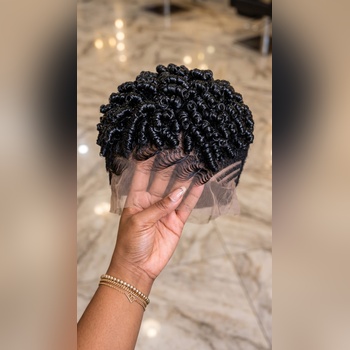
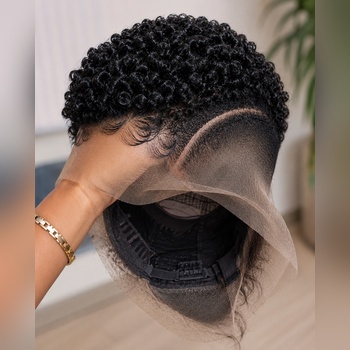
The coils sit relatively close to the head, but their raised surfaces remain visible. This gives the crown a rounded structure that can be appreciated from above and from the side.
A stylist recreating the wig should pay attention to the difference between a conventional tight curl and the rolled spiral construction shown here. Ordinary loose curls would create a softer, less architectural result.
The desired crown should contain individual circular formations that remain recognizable rather than merging into one continuous curly mass.
Caramel and Copper Reflections Follow the Spiral Openings
The warm color appears through the raised sections of the crown, with caramel, amber-brown and copper reflections visible under the salon lighting. Darker espresso and chocolate tones remain within the spiral interiors and around the roots.
This creates contrast without relying on a rigid two-color split. Some curls appear more copper because their outer strands face the light, while recessed sections remain considerably darker.
For color matching, the customer should provide the reference photograph rather than selecting a shade based only on a marketing name. One supplier may describe a similar palette as caramel brown, while another may call it copper chestnut or auburn.
The intended result is a rich dark-brown foundation illuminated by warm caramel-copper strands, not a uniformly orange or pale blonde wig.
The Crown Contains Several Spiral Diameters
The coils across the upper surface are related but not identical. Larger openings appear through the central crown, while smaller formations fill gaps and continue toward the outer edges.
This variation helps the curls follow the rounded shape of the cap. A crown made from one identical curl size might appear mechanical and could lose some of the depth visible in the reference.
For a custom order, an elevated approval photograph is particularly valuable. It allows the buyer to evaluate whether the maker has preserved the variation in curl scale.
The number of curls should not be treated as the only measure of quality. Their distribution and ability to remain individually recognizable matter just as much.
The Front Hairline Uses Directional Strands Beneath the Spirals
Below the circular crown, the hair changes into a flatter directional arrangement. Fine strands sweep from the front toward the side, creating an elongated curve beneath the heavier upper styling.
This front area provides an important transition. Instead of allowing the spiral curls to meet the lace directly, the styling introduces a controlled band of longer directional strands.
The front hairline also contains finer pieces that sit closer to the mesh. Those strands should be evaluated during fitting rather than removed automatically.
A faithful recreation should preserve the distinction between the circular crown and elongated front-wave movement.
The S-Wave Panel Is the Main Side Detail
The most recognizable lower feature is a broad series of S-shaped waves traveling through the temple area. Several raised ridges follow one another, creating a sculpted surface that remains much flatter than the upper spiral crown.
These waves are not simply loose hair combed backward. Their strands are arranged into coordinated curves with visible changes in direction.
The caramel reflections emphasize the wave ridges, while darker brown appears in the recessed areas between them. This produces a layered effect without relying on carved scalp channels.
For customers ordering a similar wig, the S-wave panel should be specified as a major styling component. A generic description of a curly pixie wig would not communicate the precision of this side construction.
The Wave Ridges Create Contrast Without Shaved Artwork
Some sculpted wigs achieve side interest through exposed razor designs. This unit uses a different approach. The waves themselves create the decorative pattern through alternating raised and recessed hair.
The strands remain sufficiently close for the side to appear compact, but the repeated curves make the surface visually active.
This is an important distinction for customization. Asking a barber to add decorative lines would change the design rather than improve its accuracy.
A buyer who wants the same appearance should prioritize the direction and spacing of the waves, not additional carving.
The Lower Side Becomes Progressively More Compact
As the styling approaches the lower perimeter and rear, the strands become smaller and closer to the foundation. The large spiral crown gives way to the wave panel, which then transitions into tighter dark curls.
This change in scale creates a balanced silhouette. The upper portion remains visually dominant, while the lower side supports the crown without adding excessive bulk.
A stylist recreating the unit should not leave the entire side as full as the crown. The original appearance depends on a gradual reduction in projection.
Equally, aggressive cutting could remove too much of the compact curl field. Density should be controlled rather than eliminated.
Dark Roots Connect the Copper Crown to the Lower Side
The underlying espresso-brown foundation is essential to the visual balance. It remains visible between the warm spirals and becomes increasingly prominent through the lower side.
This color continuity makes the crown and wave panel feel related despite their different styling methods.
Lightening the entire lower section to match the brightest caramel highlights would change the reference significantly. The darker hair is not an unfinished portion of the design.
A colorist should therefore preserve root depth and work with the final curl and wave arrangement when placing any lighter strands.
The Photograph Reveals an Untrimmed Lace Perimeter
A broad section of lace extends beyond the front and lower side of the wig. The mesh has not yet been trimmed to fit a specific wearer.
This can be useful for professional installation because the stylist retains material for adjusting the final perimeter.
The wig should first be positioned on the wearer. Once the cap, front hairline and side alignment are correct, the excess lace can be trimmed.
The apparent beige tone of the mesh may be affected by the salon lighting. Buyers should ask about available lace shades and exact material specifications rather than assuming the photographed mesh will match every complexion.
The Interior Cap Deserves Its Own Product Photograph
The image exposes part of the brown cap foundation, including an interior comb attachment and a dark band or strap section. These are useful visual clues about the unit’s construction.
However, the complete interior is not shown. The photograph does not establish the total number of combs, full adjustment system or cap dimensions.
Customers who care about attachment options should request a complete underside photograph of the exact wig before purchasing.
This information can be just as important as the exterior styling for regular wear.
Internal Combs Do Not Guarantee Adhesive-Free Installation
The presence of a comb attachment should not be interpreted as proof that the wig is designed for glueless use.
Whether a unit can be worn securely without adhesive depends on the full construction, cap fit and the wearer’s individual preferences.
If adhesive-free installation is important, ask the seller for explicit confirmation that the actual model is intended for that purpose.
Likewise, a visible lace front does not establish HD lace. Material and installation claims should come from verified product information.
Fitting Determines Where the S-Wave Panel Sits
Unlike natural growing hair, the wig’s sculpted side is fixed to the cap. Moving the entire unit changes where the S-wave panel appears in relation to the temple and ear.
An inaccurate cap size may therefore affect the final appearance even when the styling itself is excellent.
Follow the maker’s measurement instructions before ordering. Circumference, front-to-nape and ear-to-ear measurements may all be relevant depending on the cap construction.
A professional wig stylist can assist with measurements when the customer is unsure.
A Custom Order Should Describe the Curl and Wave Zones Separately
The first requirement should identify the crown: compact circular spirals in several sizes, with visible openings and a rounded profile.
The second should establish the color: deep chocolate or espresso roots with caramel-copper reflections across selected curls.
The third should describe the front and side: elongated directional strands leading into several parallel S-shaped wave ridges, followed by smaller close curls toward the lower perimeter.
Finally, discuss cap sizing, available lace shades, internal attachments and whether the wig should arrive with its lace untrimmed.
This structure provides a much more accurate order specification than simply requesting a caramel curly pixie wig.
Choose a Wig Stylist Experienced With Finger-Wave Construction
The main difficulty in recreating this unit is not the caramel color alone. A maker must arrange a dense spiral crown and then produce a separate wave panel with carefully aligned ridges.
These techniques require different kinds of control. Curl setting needs to preserve circular openings, while the wave panel relies on elongated directional movement.
When evaluating a stylist, examine photographs of previous sculpted wigs from above and from the side.
Look for consistent curl placement, carefully arranged S-waves and transitions that do not appear abrupt.
Where to Buy a Similar Caramel Spiral Pixie Wig
Specialist lace-wig makers, wig customization studios and salons offering sculpted finger curls are practical places to search.
A general wig retailer may carry a suitable foundation, but the exact crown and wave panel could require additional salon work.
Before ordering online, ask whether the listed product includes the completed spiral crown and S-wave side styling or only the underlying base.
If the hairstyle will be completed locally, obtain a quotation for coloring, spiral setting, wave construction and fitting before deciding whether the base is a better value.
Approval Photographs Should Include an Elevated Crown View
The crown photograph should show the circular openings and mixture of spiral sizes. It should also reveal how the caramel reflections are distributed across the dark foundation.
A direct side image should show the complete S-wave panel, including the width and direction of the ridges.
A rear three-quarter photograph can confirm how the crown transitions into smaller curls toward the back.
For a custom unit, the buyer should request images of the actual finished wig before shipment whenever the seller offers approval photography.
Color Approval Should Consider the Effect of Warm Salon Lighting
The reference contains strong copper and caramel reflections, but warm indoor lighting can intensify those tones.
A neutral-light photograph can help the buyer understand the actual shade before approving a custom order.
For human hair, ask whether the warm color was created through processing or supplied in the original hair.
This information helps determine which future maintenance methods may be appropriate.
Pricing Should Reflect the Work Required to Build the Waves
The absence of elaborate razor carving does not mean this wig is simple to produce. The crown contains many individually formed spirals, while the side requires directional wave setting and careful density control.
The warm color placement and lace construction can add further labor.
Estimated Price Guide for Caramel Copper Spiral and Wave Wigs
| Category | Illustrative Price Range | Typical Services Included |
|---|---|---|
| Premium Custom | $340–$605+ | Higher-grade hair, custom measurements, espresso-to-caramel coloring, hand-arranged spiral crown, detailed S-wave side construction and personalized lace preparation. |
| Standard Custom | $205–$360 | Prepared spiral crown, coordinated wave panels, warm brown coloring and more standardized cap options. |
| Basic Human Hair | $120–$220 | A human-hair foundation requiring additional color work, curl setting, side-wave construction and professional fitting. |
| Premium Synthetic | $80–$160 | A quality pre-set interpretation that may retain its spiral and wave arrangement with relatively limited rebuilding. |
| Basic Synthetic | $40–$90 | A budget alternative with potentially simpler curls, less precise wave placement, different color depth or basic cap construction. |
These figures are illustrative planning ranges rather than verified prices for the photographed wig. Actual costs depend on material, seller, location, customization labor, cap construction, shipping and installation.
Ask for an itemized quotation showing which parts of the crown and wave styling are already included. An inexpensive base that requires substantial professional work may not be the lowest-cost option overall.
Human Hair Offers Flexibility for Future Wave Resetting
A human-hair version may be useful for wearers who expect periodic professional restyling. Individual spirals can potentially be reset, while the side-wave ridges can be addressed independently.
However, hair that has undergone copper or caramel coloring may require more conservative heat use than untreated material.
A professional should consider the hair’s condition before performing a complete styling reset.
Selective maintenance can reduce unnecessary handling and help preserve the original shape.
Premium Synthetic Can Help Preserve a Pre-Set Arrangement
A high-quality synthetic version may hold the circular crown and side waves with relatively little daily manipulation.
This can be useful for customers who want to wear the same sculpted hairstyle repeatedly rather than change it frequently.
The limitation is flexibility. Heat tolerance varies, and conventional human-hair dye should not be assumed suitable.
Confirm the exact fiber before attempting hot-tool work or major color changes.
Wash the Crown Without Intertwining the Spirals
Before washing, photograph the wig from above to record the placement of the major curls and smaller supporting sections.
Avoid aggressive rubbing between neighboring spirals. Excessive friction can cause the circular openings to collapse or the strands to become intertwined.
Use products compatible with the confirmed hair or fiber.
After drying, restore only the curls that have moved, using the original photographs as a guide.
The S-Wave Panel Needs Directional Maintenance
The side waves should be handled differently from the circular crown. Their purpose is to remain elongated and follow a coordinated path.
If one ridge becomes displaced, a stylist should guide it back into the existing curve rather than roll it into another spiral.
The original side photograph can help preserve spacing between the wave ridges.
Heavy product can cause neighboring sections to merge, so application should remain controlled.
Warm Brown Color Should Retain Its Darker Root Depth
If the hair is human and the caramel-copper tone eventually fades, a professional colorist should assess the original distribution before refreshing it.
The deeper espresso foundation contributes to the appearance of the crown and should not automatically be lightened.
A blanket copper formula could remove some of the contrast that makes the spirals visible.
For synthetic versions, follow fiber-specific guidance rather than assuming conventional coloring methods are appropriate.
Product Buildup Can Flatten the Wave Ridges
The glossy appearance of this wig may encourage repeated use of oils or holding products, but excessive application can work against the sculpted construction.
Heavy residue can cause neighboring spirals to stick together and make the parallel S-waves less distinct.
Use only what the confirmed material requires. If buildup becomes the problem, suitable cleansing may restore the appearance more effectively than another layer of product.
Protect the Compact Lower Side From Unnecessary Cutting
The lower curls are part of the wig’s finished appearance. Repeated trimming can reduce the density that creates the gradual transition beneath the wave panel.
If some strands lift away from the foundation, controlled repositioning may be sufficient.
Unlike natural growing hair, the wig cannot replace strands that have been removed.
Maintenance should therefore focus on preserving the lower shape rather than treating it as a conventional haircut that requires frequent cutting.
Book the First Appointment for Fitting and Preservation
When the unit arrives, inspect the crown, wave panel, lace and visible cap components before making irreversible changes.
The wig stylist should establish the final cap position and evaluate how the directional side sits around the temple.
Once the fit is correct, the lace can be trimmed according to the wearer’s needs.
If the spiral crown and S-wave panel already match the reference, extensive restyling may not be necessary.
Storage Should Protect Both the Spiral Openings and Side Waves
The crown needs enough room to retain its circular openings. A suitable wig stand or mannequin head can support the style without flattening the upper coils.
The side should also remain clear of hard surfaces that could compress the wave ridges.
Make sure the lace and cap are fully dry before storage.
For travel, use packaging deep enough to protect the crown and prevent the side from being pressed into an unnatural shape.
The Value Comes From Coordinated Styling Rather Than Extra Decoration
This caramel-copper wig demonstrates how a compact sculpted hairstyle can achieve visual complexity without elaborate carved artwork. The crown contains individual spiral formations in warm brown and copper tones, while the side uses a controlled sequence of S-shaped waves and smaller close curls.
For buyers, the important quality checks are the spiral openings, variation in coil size, dark root depth, warm caramel placement, front direction, side-wave consistency, compact lower density and lace condition.
For wig businesses, detailed photographs of the crown, side and interior can communicate the labor involved more effectively than broad descriptions of a curly pixie wig. Accurate construction information and clear customization pricing help customers understand what they are purchasing.
A successful reproduction should preserve the contrast between circular crown movement and elongated side waves. When those styling zones remain distinct and the warm color supports their direction, the finished unit retains the character of the reference rather than becoming an ordinary caramel curly wig.
Search Terms
caramel copper spiral pixie wig · espresso root curl crown · sculpted S wave side wig · warm brown tubular coils · caramel finger wave lace wig · compact copper curly hairpiece · directional side wave crown · untrimmed lace caramel wig