
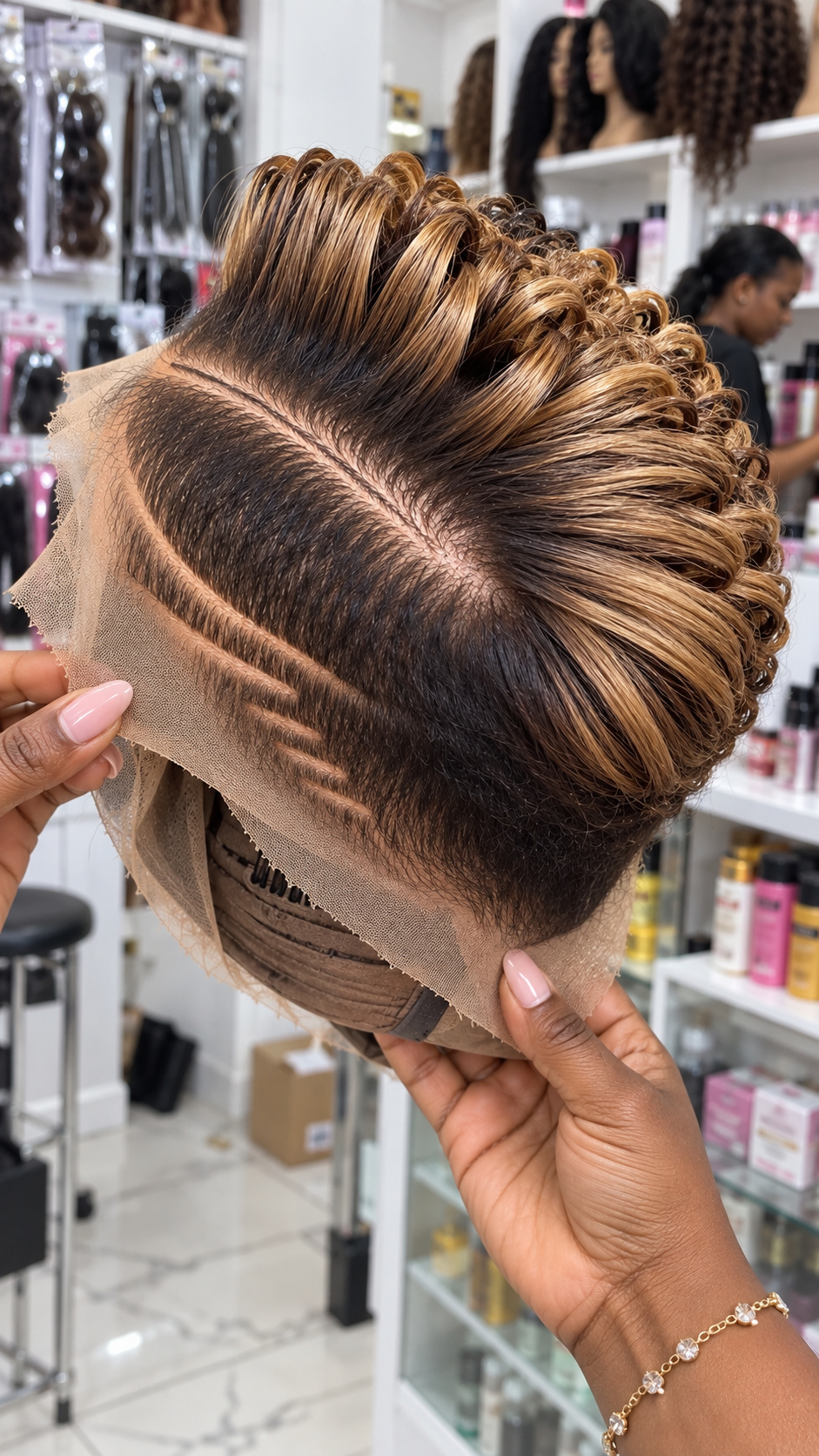
A convincing custom wig is often judged by its color, but this champagne-honey blonde piece makes a stronger case for examining how the color has been placed. The most memorable detail is the dramatic difference between the bright, folded crown and the dark, closely arranged side. Broad blonde ribbons rise from an espresso-black foundation, travel backward through open loops and gradually settle into smaller curled formations near the rear. Beneath them, an elongated curved division and a group of narrow tapered etchings create a precision-cut appearance without taking attention away from the upper construction.
The photograph captures the wig before installation, with excess lace extending around the front and lower perimeter. Portions of the interior cap are visible, while the exterior shows the relationship between the higher crown, dark side panel and carved markings. This makes the image especially helpful for someone commissioning a similar unit. The picture provides evidence of lace construction, but it does not verify the fiber type, exact lace grade or whether the piece can be worn without adhesive. Those specifications should be confirmed with the seller rather than assumed.
A Blonde Placement Strategy Built Around the Crown
The blonde is concentrated across the longer upper strands. It ranges visually from warm champagne and honey blonde to deeper caramel, while the roots remain dark espresso. The lower side retains that dark foundation instead of carrying the blonde throughout the entire unit.
This positioning creates a natural visual boundary between the two areas. The crown appears brighter and more elevated because its outer surfaces catch the light, while the darker roots provide shadow beneath each section.
The image does not show a traditional ombré in which every strand changes uniformly from one shade to another. Instead, the warm blonde appears particularly prominent along selected ribbon surfaces, with darker strands remaining between and beneath them.
When ordering, describe this relationship explicitly. A seller given only the instruction “black and blonde wig” could produce chunky highlights, alternating streaks or a completely different color distribution. The desired result needs honey-blonde ribbons that follow the direction of the sculpted crown.
The Front Crown Has a Distinctive Upright Beginning
The forward crown is dominated by elongated sections that rise steeply before bending backward. Several of these pieces contain long, relatively aligned strands, giving each formation the appearance of a folded hair ribbon rather than a conventional spiral curl.
These upright sections establish the height of the wig. Their open bends reveal glimpses of the darker hair underneath, which makes the blonde appear more dimensional.
The largest folds should not be packed too tightly. If neighboring pieces are combined into a continuous backward sweep, the crown may retain its overall direction but lose the individual forms that make this reference recognizable.
For a custom order, ask the maker to preserve visible spaces between the primary front ribbons. Crown density should be planned around those openings rather than maximized indiscriminately.
The Middle Crown Carries the Strongest Blonde Movement
As the hair travels toward the middle, the longer sections begin leaning farther backward. The individual ribbons become broader and overlap more noticeably, allowing the honey-blonde surfaces to flow across the rounded crown.
The contrast between the light outer strands and deeper root areas is particularly effective here. The eye follows each highlighted curve and then sees the dark recessed section beneath it.
That arrangement gives the hairstyle depth without requiring many separate highlight colors. The same warm blonde can produce several different impressions simply because the strands face the light at different angles.
A maker should therefore complete the directional crown setting before making final judgments about color distribution. Strands that look evenly highlighted while straight may create an entirely different balance after they are folded into loops.
The Rear Transitions Into Smaller Interlocking Curls
Toward the back, the open ribbons become less upright and the styling develops into tighter curled formations. Smaller loops fill the rear while the larger upper sections settle closer to the cap.
This change gives the crown a balanced endpoint. If the largest blonde arches continued all the way around the back, the wig could appear excessively bulky.
The darker underlying hair remains visible in the rear, preventing the blonde from forming one uninterrupted bright surface. This continuation of the espresso foundation also connects the back to the compact lower side.
When inspecting a custom unit, request a rear three-quarter photograph. The supplied reference emphasizes the crown and one side, but a complete order should include confirmation that the back has been constructed with comparable care.
The Dark Side Panel Is Essential to the Color Composition
Below the crown, the visible hair becomes much closer to the foundation. Deep espresso and near-black strands create a substantial dark panel, giving the blonde upper sections a contrasting base.
This area should not be treated as unfinished hair waiting to receive additional blonde coloring. Its darker appearance is part of the design.
Keeping the side compact also makes the carved markings easier to see. Longer strands could fall across the exposed channels, while excessive cutting could reduce the density needed to distinguish the pattern.
The most faithful reproduction will retain substantial dark hair throughout this section instead of automatically creating a very low-density side.
The Long Upper Division Establishes the Color Boundary
A narrow exposed part runs beneath the crown and separates the longer upper construction from the close side. It follows the rounded contour of the wig, beginning near the forward area and traveling diagonally toward the rear.
This division has a structural purpose. It creates a visible boundary at the point where the blonde ribbon construction gives way to the dark compact side.
The line should therefore be considered separately from the smaller decorative etchings underneath it. The upper division organizes the hairstyle; the lower markings provide additional visual detail.
During customization, establishing this primary boundary first can help the stylist position the smaller markings proportionately.
The Side Etchings Form a Descending Angular Arrangement
The lower side contains several narrow exposed marks with distinct angled ends. The upper decorative path is longer and extends farther toward the rear, while shorter paths sit beneath it. Their lengths and pointed trajectories create a graduated arrangement rather than a group of identical straight stripes.
This is one of the details that deserves particular attention when commissioning the wig. A generic request for three lines would not adequately describe the pattern.
The maker should preserve the angles, tapered ends and areas of dark hair that separate the marks. Increasing their width could make the lower side visually heavier than intended.
A close side reference photograph is more useful than a verbal description alone because it communicates the relationship among all the marks simultaneously.
Precision Cutting on a Wig Is Different From Cutting Growing Hair
Barber-inspired etchings can be highly attractive on a wig, but the work needs a conservative approach. Hair removed from the foundation cannot grow back, so every cut affects future maintenance.
The dark panels between the exposed markings are especially important. If those sections become too narrow, the individual paths may merge visually.
For a newly commissioned unit, the side design should be planned before permanent cutting begins. A stylist can mark or photograph the proposed arrangement and compare it with the reference.
When the wig is eventually worn, further refinement should be considered only after its final position on the head has been established.
The Front Lace Provides Room for Individual Fitting
The photograph shows a substantial lace perimeter that has not yet been trimmed. This can be useful for a buyer planning professional installation because the stylist still has material available for positioning and adjustment.
Fine strands are visible near the front transition before the hair becomes denser toward the crown. Their arrangement should be assessed on the wearer rather than removed automatically.
The apparent mesh shade is influenced by salon lighting and camera processing. A customer should ask which lace shades the supplier actually offers.
The image does not establish HD lace, and a visible lace front does not by itself confirm adhesive-free wear. Those claims require separate product information.
Cap Measurements Determine the Final Side Placement
The upper division and decorative etchings are fixed to the wig foundation. If the cap sits too far forward or backward, those details move with it.
This makes accurate cap sizing important for appearance as well as comfort. The buyer should follow the maker’s measurement chart and provide every requested dimension.
Depending on the construction, circumference, front-to-nape and ear-to-ear measurements may all be relevant.
A salon specializing in wig installation can help collect these measurements before a custom order. This is particularly worthwhile when the side artwork must sit at a precise position relative to the temple and ear.
A Useful Ordering Brief Should Separate the Crown From the Carving
Start the commission with the upper hair: deep espresso roots, warm champagne-honey blonde ribbons, elongated upright front loops, overlapping middle folds and smaller rear curls.
Next, describe the lower side independently. Request compact dark hair, a long curved crown boundary and several narrower angled markings with progressively shorter lengths.
Then establish practical details such as cap size, available lace shade, internal attachment preferences and whether the lace should remain untrimmed for local installation.
This separation creates a clear production checklist. The buyer can verify color, crown structure and side geometry as independent requirements rather than relying on an overall impression of similarity.
Finding the Right Professional for This Construction
A custom wig maker experienced with sculpted crowns is a useful starting point. However, experience with lace fitting and coloring does not automatically guarantee precision in barber-inspired side work.
Ask potential suppliers for examples of broad ribbon-loop wigs and close-side detailing. A maker who has completed both types of work may be able to deliver the unit ready for fitting.
Alternatively, the crown and color can be commissioned from a wig specialist while the final side refinement is completed by a local professional familiar with cutting wig hair.
For local bookings, send the reference photograph in advance and explain which parts of the unit are already finished.
Approval Photographs Should Be Taken From Different Directions
A side photograph should clearly show the long crown boundary and smaller carved markings. The dark panels between them need to remain visible.
An elevated image should reveal the honey-blonde ribbon placement and spacing between the major loops.
A rear three-quarter photograph should demonstrate how the larger crown sections transition into tighter curls.
For color approval, request at least one image under neutral illumination. Warm salon lighting can make champagne blonde appear more golden or caramel than it actually is.
Where possible, all approval photographs should show the actual commissioned unit rather than examples from a previous order.
Pricing the Work Rather Than the Visible Hair Length
The compact dimensions of this wig can be misleading when estimating cost. The price may reflect several separate forms of skilled labor: root and ribbon coloring, section-by-section crown setting, side density control, precision etching and lace preparation.
For that reason, comparing wigs solely by length or fiber type may not reveal which is better value. The buyer needs to know how much customization is included in the quoted price.
Estimated Price Guide for Honey Blonde Ribbon Crown Customization
| Category | Indicative Range | What May Be Included |
|---|---|---|
| Premium Custom | $350–$625+ | Higher-grade hair, personalized cap sizing, custom espresso-root coloring, carefully arranged honey-blonde ribbons, precision side etchings and professional lace preparation. |
| Standard Custom | $215–$375 | Prepared blonde loop crown, established side markings and more standardized cap and fitting options. |
| Basic Human Hair | $125–$225 | A human-hair foundation that may still require professional highlighting, loop setting, side cutting and installation. |
| Premium Synthetic | $85–$170 | A pre-colored and pre-set option that may retain the sculpted crown with less frequent resetting but fewer modification options. |
| Basic Synthetic | $40–$95 | A budget interpretation with potentially simpler blonde placement, crown separation, side detailing or lace construction. |
These figures are illustrative planning ranges, not confirmed retail prices for the photographed unit. Actual quotations depend on material, workmanship, location, cap construction, shipping and installation.
Before paying a deposit, ask whether the quoted price includes the crown styling, side etchings and lace fitting. A less expensive unfinished foundation may require enough additional salon work to make its final cost higher than expected.
Human Hair and Synthetic Fiber Require Different Decisions
A human-hair version can provide greater flexibility for future color work and professional crown resetting. Individual ribbon sections may be reconstructed if they lose their original direction.
However, blonde human hair may have undergone processing. Future heat should be selected according to the condition of the strands rather than assuming every human-hair wig tolerates high temperatures.
A premium synthetic version may hold a pre-set loop arrangement well and can offer stable manufactured color. The limitation is reduced flexibility for major restyling or recoloring.
Buyers should choose according to their intended maintenance routine, not simply because one material has a more expensive label.
Preserving the Blonde Ribbons During Washing
Before the first full wash, photograph the crown from above, from the side and from the rear. These images record where the blonde sections rise, how they fold backward and where the smaller curls begin.
During cleansing, avoid rubbing neighboring ribbon sections together. The aim is to remove residue while preserving as much of the original arrangement as possible.
Use products appropriate for the confirmed material. After drying, inspect the crown and restore only the sections that have shifted.
Reconstructing every loop after each wash creates unnecessary manipulation and may gradually change the original spacing.
Color Maintenance Should Protect the Dark Root Contrast
The deep espresso foundation is essential to the wig’s dimensional appearance. If the honey-blonde sections eventually need refreshing, a colorist should preserve the root depth and darker recessed strands.
Applying one light blonde formula throughout the entire crown could reduce the contrast that currently separates the folded ribbons.
For processed human hair, additional coloring should be guided by the condition of the strands. Synthetic fiber should only be treated using methods compatible with its confirmed composition.
The Side Markings Need Preservation, Not Constant Recutting
The angled channels are permanent elements of the wig. They should not be widened automatically during every maintenance appointment.
If fine hairs begin covering an exposed section, careful repositioning may restore the original appearance without cutting.
When refinement becomes necessary, compare the side with the original photograph. Preserve the pointed ends and the dark hair between the paths.
This conservative approach protects the construction and can extend the period before extensive side reconstruction becomes necessary.
Styling Product Should Not Hide the Open Crown Loops
The blonde ribbons already reflect light strongly. Heavy waxes, oils or holding products may cause neighboring sections to adhere together and close the spaces between them.
Product buildup can also alter the apparent shade, making the blonde look darker or less separated from the espresso foundation.
Use only what the material requires. When the crown loses clarity because of residue, appropriate cleansing may be preferable to applying additional shine product.
Installation Should Be Planned Around the Existing Side Artwork
When the wig arrives, inspect the crown, color distribution, carved markings, lace and cap before making permanent alterations.
The first professional appointment should establish the final cap position. The stylist can then assess the lace perimeter and determine whether the side markings sit correctly.
Any optional barber refinement should happen only after fitting. If the design already matches the reference and sits appropriately, further cutting may be unnecessary.
This order of work reduces the risk of altering a completed side design to compensate for an incorrectly positioned cap.
Storage Should Protect Both the Raised Crown and Compact Side
The longest ribbon loops need enough vertical clearance to remain open. A suitable wig stand or mannequin head can support the crown without flattening its largest folds.
The close side should also remain free from pressure. Fine strands pushed across the carved channels may obscure their pattern even when no hair has been damaged.
Store the unit only after the cap and lace are completely dry. During transportation, use packaging deep enough to prevent crown compression.
What Makes This Honey Blonde Design Worth Commissioning
The value of this wig lies in the contrast between its two principal styling languages. The upper crown uses warm honey-blonde ribbons to create open, elevated movement. Beneath that, an espresso-dark foundation carries a curved boundary and smaller angular etchings that make the side immediately recognizable.
For buyers, the important quality checks are the placement of the blonde, the depth of the roots, the width and direction of the major loops, the compact rear curls, the spacing of the side markings and the available lace for final fitting.
For wig businesses, photographing those elements individually offers a stronger sales presentation than relying on a general claim that the unit is a blonde curly wig. The construction can be explained through crown views, side photographs and verified cap information, allowing customers to understand what is included in the customization.
When the color, loop architecture, side geometry and fitting requirements are agreed upon before production, the customer has a much better chance of receiving a wig that reflects the original design rather than merely sharing its warm blonde palette.
Search Terms
champagne honey blonde ribbon wig · espresso root blonde crown · tapered side etching wig · golden loop crown lace wig · angled triple side marks · black root honey ribbon curls · sculpted backward blonde loops · untrimmed lace blonde wig