
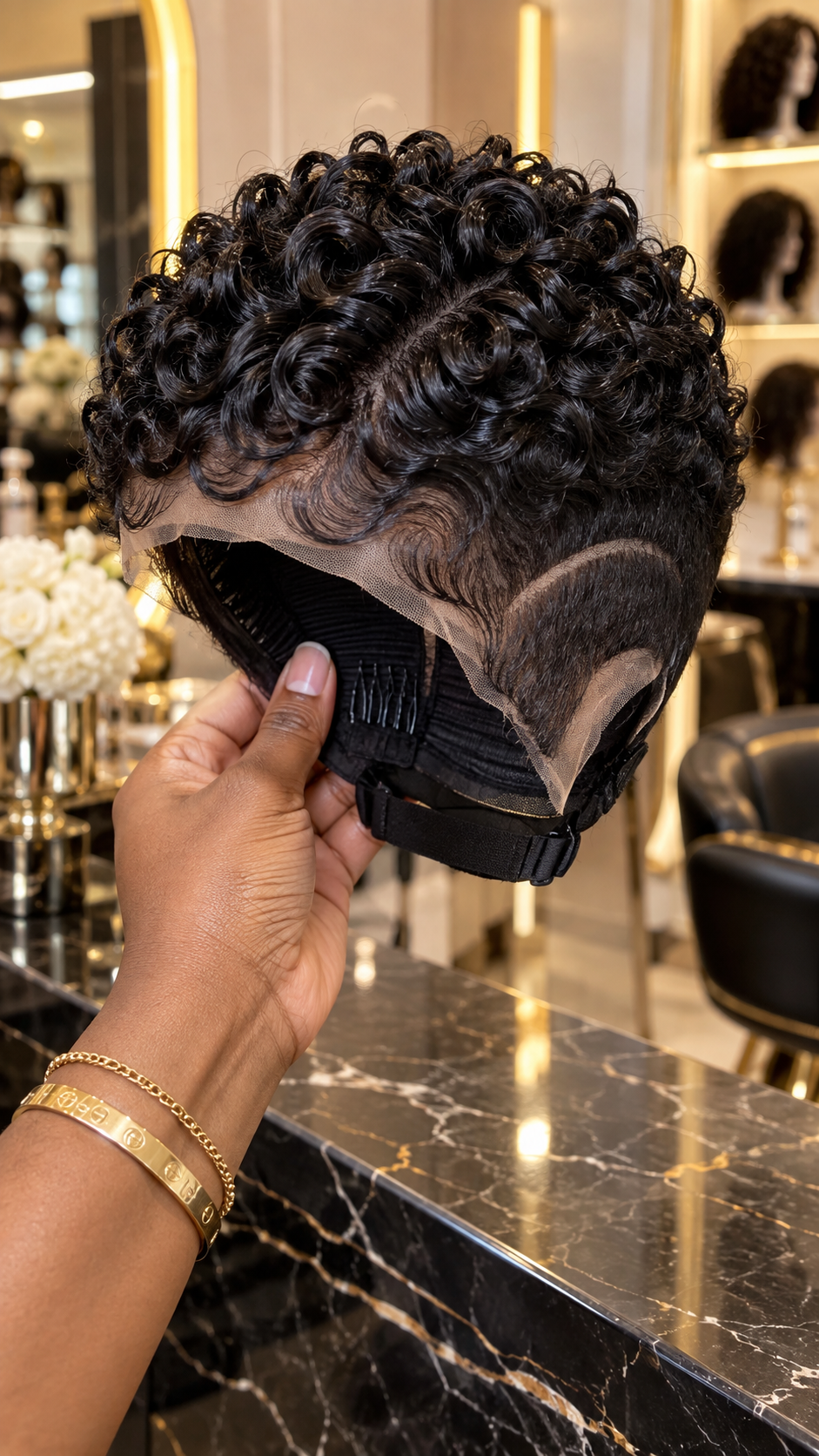
The most revealing detail in this raven-black wig is not the glossy curl crown. It is the exposed interior beneath it. The photograph shows an uninstalled sculpted wig held open by hand, revealing the lace perimeter, internal combs, adjustable strap and a distinctive curved side design. These details create an opportunity to evaluate the relationship between artistic styling and practical construction before the piece reaches a customer’s head.
The upper crown contains tightly arranged spiral loops, several with broad circular openings. A diagonal division separates portions of the curl field, while flatter strands sweep around the front and toward the side. Beneath the curls, a single crescent-shaped exposed channel curves through the close dark hair. Unlike wigs with multiple parallel lines or elaborate geometric patterns, this unit relies on one substantial side accent supported by a densely populated black foundation.
For someone ordering a similar wig, the main consideration is whether all these elements have been constructed to work together. A beautiful spiral crown cannot compensate for uncomfortable cap dimensions, and a well-fitted cap will not reproduce the reference if the curls or crescent design are substantially different. This makes the visible interior particularly valuable when discussing quality, customization and price.
The Open Cap Reveals More Than a Finished Portrait Would
A conventional product photograph usually shows a wig on a mannequin or model. That presentation helps customers judge the hairstyle but often conceals the underside. Here, the lower portion of the unit is exposed enough to reveal several practical components.
The dark interior cap has a structured appearance with visible stitching and mesh areas. A comb attachment is present on the inner side, while an adjustable strap crosses the lower portion. The strap and its adjustment hardware are particularly noticeable.
These components suggest that the wearer has some ability to adjust how the unit is secured, although the photograph alone cannot establish the full adjustment range or guarantee that the wig will fit without adhesive.
For online buyers, this distinction matters. A visible strap does not automatically mean that a wig can be worn securely without additional installation methods. Cap measurements, tension, attachment placement and the wearer’s preferences should all be considered.
The Crown Contains Large Spirals With Smaller Supporting Curls
The upper construction is densely populated with glossy raven-black curls. Several central formations have open circular centers, while smaller spirals surround them and occupy the spaces toward the crown edges.
This mixture creates a rounded silhouette without requiring the curls to hang over the forehead or ears. The largest coils provide the most obvious sculptural detail, while the surrounding smaller sections maintain continuity.
Although the crown appears full, the individual circular openings remain visible. That distinction is essential. Filling every gap with additional hair would increase density but could also reduce the recognizable spiral pattern.
A custom wig maker should therefore work toward controlled placement rather than maximum fullness. The coils need enough separation to remain individual, even when they overlap slightly.
Black Hair Makes Curl Geometry the Primary Attraction
The visible hair belongs to a deep raven-black color family. Narrow reflections travel across the raised surfaces, occasionally giving the curls a blue-black or charcoal appearance under the salon lighting.
These reflections should not be mistaken for separate colored highlights. The photograph does not clearly show an intentional second color.
This monochromatic palette places greater emphasis on construction. The eye follows the circular openings, the direction of the strands and the contrast between raised curls and dark recessed areas.
For customers who prefer a black wig without blonde, copper or burgundy accents, this unit demonstrates how a carefully arranged crown can remain visually striking through form alone.
The Diagonal Division Organizes the Curl Field
A scalp-toned diagonal separation appears through the upper crown, dividing curl groups rather than allowing every spiral to overlap indiscriminately.
The division creates a directional route through the hair. Larger coils occupy the neighboring sections, and smaller curled pieces adapt to the available spaces.
This contributes to the overall arrangement by giving the crown a deliberate internal structure. Without the parting, the curls might appear more randomly distributed.
When commissioning this hairstyle, the customer should indicate the desired parting position. Moving the division toward the center or removing it entirely would change how the crown is visually organized.
An elevated approval photograph is especially useful for evaluating this detail because a frontal image may conceal much of the division.
The Front Hairline Uses Sweeping Fine Strands
Near the lace perimeter, several strands form elongated curves that are noticeably flatter than the spirals above them. These sections travel across the front before turning toward the side.
The change in scale creates a transition from circular crown curls to more directional perimeter styling. It also prevents the heavy upper hair from beginning abruptly at the lace edge.
During installation, these fine sections should be evaluated after the cap is positioned. Their arrangement may contribute to the desired front appearance, and removing them automatically could change the reference design.
A wig stylist should preserve their directional character rather than rolling every visible strand into the same type of spiral.
The Crescent Side Design Is the Main Lower Accent
The lower side contains a curved exposed pathway resembling an elongated crescent or arch. It moves through closely arranged dark hair and creates an open boundary between the surrounding sections.
This is different from a straight razor stripe or multiple parallel carvings. The curve rises, bends and returns toward the lower side, giving the pattern a rounded geometric identity.
The side design works because the exposed channel remains surrounded by dense black strands. Those dark areas create contrast and make the crescent readable.
For a faithful recreation, the customer should supply a side photograph showing the entire path. Describing the design merely as a curved line would leave too much room for interpretation.
The Dark Panel Inside the Crescent Must Be Preserved
The crescent shape depends on the close black hair retained within and around its curve. Removing too much of that hair could convert the design into a broad exposed patch rather than a distinct carved pathway.
This is particularly important for wig customization because cut hair does not naturally regrow. A barber correcting the pattern should therefore use conservative techniques.
When the line becomes less visible because fine strands have shifted, repositioning those strands may restore the appearance without additional cutting.
A photograph of the new wig can serve as a permanent width and curvature reference for future maintenance appointments.
The Crescent Should Be Checked After the Cap Is Positioned
The side design is attached to the wig foundation. If the unit sits too far forward or backward, the crescent moves with it.
That makes fitting especially important. A beautifully formed curve can appear misplaced when the cap does not align correctly with the wearer’s temple and ear.
For a custom unit, cap measurements should be established before the final side design is completed. A local fitting appointment may also help determine whether any adjustment is necessary.
If the wig arrives with the crescent already finished and correctly positioned, additional cutting should be avoided simply for the sake of customization.
The Visible Lace Is Still Untrimmed
The photograph shows lace extending beyond the front and side hair-bearing areas. The mesh follows an irregular perimeter around the visible lower section, leaving room for the final installer to determine its finished boundary.
This is useful for customers who prefer professional fitting. The stylist can place the unit first, evaluate the hairline and side position, and only then trim the excess lace.
The exact grade cannot be confirmed visually. Fine-looking mesh does not automatically prove that it is HD lace, and the photograph does not establish whether the material has been selected for any particular complexion.
Buyers should request the actual lace specification and available shade options directly from the supplier.
The Interior Comb Can Influence Attachment Preferences
A black comb attachment is visible inside the cap. Such hardware can be part of a wig’s securing system, but the photograph alone does not establish how the wearer should use it or whether it is necessary for every installation.
Customers who prefer not to use comb attachments should discuss alternatives with the maker. Someone who relies on internal anchoring should ask where the combs are positioned and whether their configuration can be adjusted.
These questions belong in the ordering conversation alongside color and styling details. A wig is not fully specified simply because its exterior resembles the reference.
The Adjustable Strap Is a Practical Selling Point
The exposed strap is one of the clearest functional elements in the photograph. It crosses the lower interior and includes adjustment hardware.
This may help the wearer fine-tune the cap fit within its intended range. However, it should not be treated as a substitute for correct sizing.
A cap that is substantially too small or too large may remain unsuitable even when the strap is adjusted.
For online ordering, ask the seller for the cap’s measurement range and whether the adjustment system shown is included in the actual unit being purchased.
Cap Construction Should Be Documented Before Purchase
Because the interior is clearly part of this product’s appeal, an online listing should include a dedicated underside photograph.
That image can reveal how the lace connects to the cap, where attachment components sit and whether additional adjustment elements are present.
Without such documentation, customers may assume the interior matches another wig they previously owned.
For custom purchases, it is reasonable to request an approval photograph of the actual cap before shipping, especially when the attachment system influences the customer’s decision.
Ordering This Unit Requires Both Styling and Construction Specifications
A useful custom order begins with the exterior: deep raven-black color, densely arranged open spiral coils, mixed curl diameters, an upper diagonal separation and elongated front hairline waves.
The lower styling should specify a compact dark side with one prominent crescent-shaped carved channel. The maker should understand that the retained hair around the curve is essential to the design.
The interior requirements should then be stated separately. These include cap size, lace shade, adjustable strap preference, internal comb placement and whether the lace should arrive untrimmed.
Keeping exterior and interior requirements separate helps prevent a visually accurate wig from arriving with an unsuitable attachment configuration.
A Specialist Should Have Experience With Compact Spiral Crowns
Not every wig stylist who works with curly hair is experienced in tightly arranged sculptural spirals. This crown contains numerous individual openings that need to remain recognizable.
When selecting a maker, examine portfolio photographs from above as well as from the front. Look for repeated curls with visible centers, controlled density and consistent direction.
If the side crescent is part of the commission, examples of precision wig-side cutting are also useful.
The ideal provider should understand that making a wig resemble a natural haircut requires different techniques from cutting growing hair because removed wig strands cannot regenerate.
Where to Buy a Comparable Wig
Specialist wig makers, custom lace-wig studios and salons offering sculpted hairpieces are practical places to begin. A retailer selling general curly wigs may have a suitable starting foundation, but the crown and carved side could still require professional customization.
For remote purchases, send the reference photograph and ask which elements the seller can actually reproduce. Confirm whether the quoted product includes the completed spiral crown and crescent carving or only the underlying wig.
If the seller offers made-to-order construction, request a production estimate and photographs before final dispatch.
For local work, a wig stylist can handle the cap and crown while a professional experienced with precision cutting may assist with the crescent, ideally after the fit has been established.
Photographs Needed Before Approving a Custom Unit
A direct side photograph should clearly show the crescent and the dark hair remaining within its curve.
An elevated crown image should reveal spiral diameter, spacing and the diagonal division.
A frontal image should show the sweeping fine strands near the hairline, while a rear view can confirm the continuity of the curl construction.
Finally, an underside photograph should document the cap, combs, strap and lace perimeter.
These angles allow the buyer to verify appearance and construction independently rather than relying on one flattering product image.
Material Choice Determines Future Styling Flexibility
If the wig is human hair, a professional may have more freedom to reconstruct individual spiral sections when they loosen, provided the hair is suitable for the intended technique.
A premium synthetic version may offer stronger retention of a pre-set spiral pattern, potentially reducing the need for frequent crown resetting.
Neither option should be chosen based solely on assumptions about quality. Human hair can require careful maintenance, while synthetic fiber may have restrictions on heat and recoloring.
The seller should confirm the actual material before the customer plans a care routine.
Estimated Cost of a Custom Raven Black Spiral Wig
The price of this design should reflect the work involved in creating the spiral crown, preparing the side crescent, constructing the lace perimeter and providing an appropriate interior cap.
The visible attachment hardware is another consideration. A premium quotation should make clear which cap components and customization services are included.
| Category | Illustrative Price Range | Expected Scope |
|---|---|---|
| Premium Custom | $325–$575+ | Higher-grade hair, individualized sizing, carefully placed spiral coils, custom crescent-side work, lace preparation and selected interior attachment options. |
| Standard Custom | $195–$340 | Prepared raven-black spiral crown, planned side design and standardized adjustable cap construction. |
| Basic Human Hair | $115–$210 | A human-hair foundation that may require separate spiral setting, side detailing, cap adjustment and fitting. |
| Premium Synthetic | $75–$150 | A higher-quality pre-set spiral option with potential shape-retention benefits and limited customization flexibility. |
| Basic Synthetic | $35–$85 | A lower-cost interpretation where coil separation, side accuracy, lace quality or interior construction may be simpler. |
These ranges are budgeting illustrations rather than confirmed prices for the photographed wig. Actual costs vary by material, cap construction, seller location, customization labor, shipping and installation.
Ask for an itemized quotation rather than comparing two products by total price alone. The amount of work already completed can make a significant difference to the final cost.
Maintenance Should Begin With the Cap, Not the Curls
Because this photograph reveals an adjustable interior, routine inspection should include the cap as well as the hairstyle.
Check whether the strap remains secure, whether comb attachments are firmly connected and whether the lace perimeter shows signs of damage after repeated wear.
These checks should happen before more styling product is applied to the crown. A wig that no longer fits properly may shift during use, affecting both the hairline and the position of the crescent design.
Interior maintenance should follow the maker’s instructions, particularly around attachment components and stitched areas.
Preserve the Spirals Without Brushing the Entire Crown Apart
The individual spiral openings are a central part of the hairstyle. Broad brushing can combine neighboring sections and remove the circular pattern.
Before washing, photograph the crown from above. This records the original placement and provides a reference for future restoration.
During cleansing, use techniques appropriate for the confirmed hair or fiber and avoid aggressive rubbing between neighboring coils.
Once dry, address displaced sections individually. Rebuilding the entire crown unnecessarily can increase handling and gradually change the intended arrangement.
Keep the Crescent Shape Consistent During Barber Maintenance
The curved side channel should not be widened automatically at every appointment. Unlike growing hair, wig strands do not replenish themselves.
If fine strands move into the exposed pathway, repositioning may restore visibility without cutting.
When refinement is genuinely necessary, the barber should compare the pattern with the original photograph. Particular care should be taken to preserve the dark interior of the crescent and its narrow exposed boundary.
The objective is to maintain the existing shape rather than create a larger design with each visit.
Product Buildup Can Change the Appearance of a Black Spiral Crown
The crown has a glossy surface, but excessive oil, wax or holding product can cause neighboring curls to adhere together.
As buildup increases, the open centers may become less visible and the crown can begin to resemble a continuous curl mass.
Use products sparingly and according to the confirmed material. If the surface becomes dull or sticky, appropriate cleansing may be more useful than adding another layer of shine product.
This preservation approach helps retain the contrast between reflective outer surfaces and dark inner openings.
Installation Should Be Booked Before Optional Side Refinement
When the wig arrives, inspect the curl arrangement, lace, cap hardware and crescent design before making permanent alterations.
The first professional appointment should establish the cap position and assess how the front hairline and side artwork sit on the wearer.
Only after the fit is correct should additional trimming or carving be considered.
If the side design already matches the reference and lands correctly, further cutting may be unnecessary.
Customers should tell the salon that the unit contains pre-arranged sculpted curls and visible attachment hardware so the fitting can be planned appropriately.
Storage Should Protect Both the Crown and the Adjustable Interior
A suitable wig stand or mannequin head can help maintain the rounded crown without crushing its spiral openings.
Before storage, ensure that the lace and cap are completely dry. Avoid placing heavy objects on the wig or allowing the side to press firmly against a hard surface.
The strap and comb attachments should also be positioned so they do not snag the lace or pull on neighboring construction when the wig is handled again.
For travel, use packaging with enough depth to protect the raised curls while keeping the interior components from becoming tangled.
The Best Quality Check Combines Artistic and Practical Details
This wig demonstrates why examining the underside matters. From the outside, the raven-black spiral crown and curved side design create a compact, highly sculpted appearance. Inside, the visible combs, strap and cap structure introduce practical questions about sizing, securing and long-term wear.
For buyers, the essential inspection points are the spiral openings, curl distribution, diagonal crown division, sweeping front strands, crescent-shaped side channel, preserved dark hair, lace perimeter and interior attachment components.
For wig businesses, photographs of both the exterior and interior can make the listing more informative. Customers should be able to distinguish what is visibly confirmed from what requires manufacturer specifications. This supports clearer custom orders, more accurate pricing comparisons and better preparation for salon fitting.
A well-chosen wig should satisfy both sides of that evaluation. Its styling should match the desired reference, and its foundation should be appropriate for the wearer. When those two requirements are addressed together, the result is more likely to remain practical as well as visually distinctive through repeated use.
Search Terms
raven black spiral coil wig · crescent temple design wig · curved side part lace wig · adjustable strap curly wig · open spiral crown hairpiece · black lace front wig · sculpted side crescent wig · internal comb spiral wig