
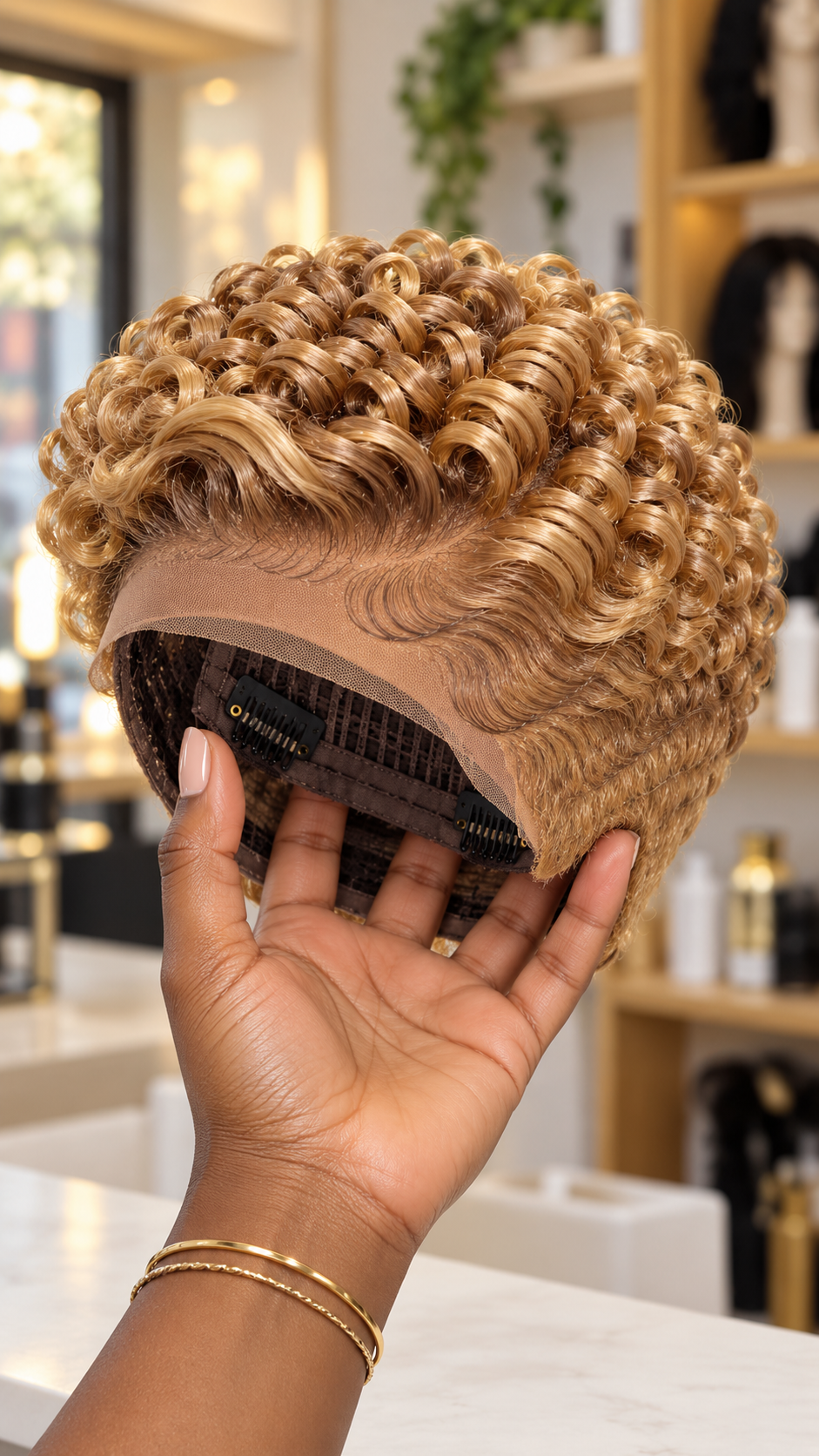
Before purchasing a golden blonde wig, most shoppers concentrate on whether the shade will complement their complexion. This particular hairstyle introduces a more demanding question: can the seller reproduce the arrangement of its curls and the carefully sculpted hair around the forehead? The photograph shows a compact, richly detailed wig held in one hand, with a golden honey blonde color, numerous polished spiral loops, decorative temple waves, and an exposed lace front. Its appeal comes from the relationship between these elements rather than from the blonde shade alone.
The photograph also provides something especially useful for a prospective buyer: a partial view inside the wig. Two black attachment combs, dark interior construction, and a broad section of untrimmed lace are visible. These details make it possible to discuss fitting and preparation without pretending that the photograph proves the fiber composition, exact cap dimensions, or installation method.
For women considering a blonde curly pixie wig, this design offers a distinctive alternative to ordinary loose curls. The hair has been arranged into compact, individually recognizable loops, while the front and temple areas create a different visual rhythm through flatter, sweeping waves. Understanding how those two structures interact is essential when choosing a ready-made piece or commissioning a stylist to recreate the appearance.
The Blonde Color Has More Depth Than a Single Flat Shade
The visible hair belongs to a warm golden blonde family, with honey and amber-like reflections appearing across the curls. Some sections look lighter where the salon lighting strikes their curved surfaces, while recessed areas between the loops appear deeper and more golden. The result is a dimensional blonde appearance rather than an entirely uniform yellow tone.
There is no clearly established dark-root transition in the photograph. Although some areas look darker, the effect may result from shadow, curl overlap, or the direction of the light. A buyer should therefore avoid assuming that the wig includes a deliberately colored root melt or an espresso-to-blonde gradient.
Lighting also matters when evaluating the shade. The photograph was taken in a warmly illuminated salon environment, with bright natural-looking light entering from one side. Such conditions can make honey blonde appear especially luminous. Under cooler indoor lighting, the same hair may appear less amber and slightly more neutral.
When ordering this color, request photographs in indirect daylight and ordinary indoor lighting. If a color code is available, ask the seller to identify it rather than assuming a specific numbered blonde shade from the image. For a custom order, a physical color swatch is preferable whenever precise matching matters.
Choosing the Blonde Tone Without Losing the Original Character
Golden honey blonde can complement a wide range of deeper skin tones, particularly when its warmth is balanced against the wearer’s preferred makeup and clothing colors. However, the photograph does not establish how the wig will look on every complexion. A salon consultation or realistic try-on can help determine whether a slightly deeper honey shade or a lighter golden version is more flattering.
Anyone seeking the photographed appearance should be cautious about requesting platinum, ash blonde, or bright yellow substitutes. Those shades would change the visual identity of the wig even if the curl arrangement remained similar.
Why the Spiral Arrangement Requires Careful Reproduction
The most striking element is the concentration of circular curls across the upper head. These are not casual, freely hanging ringlets. Many resemble rounded ribbon loops or tightly arranged barrel spirals, with curved surfaces that reflect light along their length.
Across the upper crown, the loops overlap closely, producing a rounded silhouette. Their individual openings remain visible in numerous places, giving the hairstyle depth and separation. Toward the rear and outer sides, the spirals become more compact and densely grouped, helping the hairstyle maintain its contained profile.
The front section introduces slightly broader curved strands that sweep backward into the clustered curls. This directional change prevents the entire hairstyle from appearing like a collection of identical rings.
For a wig maker, the challenge is preserving the balance between curl diameter, placement, and volume. If the loops become substantially larger, the hairstyle may appear loose and oversized. If they become too small, the characteristic ribbon-like movement may disappear into a tightly curled surface.
A useful custom-order instruction is to request a rounded, close-fitting spiral crown with visible individual loop openings and controlled height. The stylist should receive the original photograph from the front and three-quarter perspective. A side or rear reference would improve accuracy further.
Reflective Hair Surfaces Are Not Proof of Fiber Quality
The hair appears exceptionally glossy, with strong reflective highlights following the curves. This contributes to the sculptural appearance, but shine alone cannot establish whether the wig contains human hair, heat-resistant synthetic fibers, or another material.
High-quality synthetic fibers can produce substantial shine, while human hair may also appear highly reflective after styling or product application. Buyers should request the material composition, styling-temperature limits, and recommended maintenance instructions directly from the seller.
It is equally important to determine whether the loops have been permanently set, heat styled, or shaped with styling products. These methods can behave differently after cleaning, exposure to humidity, and regular handling.
The Forehead and Temple Work Deserve Their Own Consultation
One of the photograph’s most recognizable characteristics is the contrast between the raised spirals and the flatter wave work along the front hairline.
At the forehead, fine strands are directed into curved sweeps that transition into the larger curls. On the visible temple side, the hair forms several flowing, overlapping S-shaped waves. Their arrangement follows the contour of the head and creates an ornamental effect without requiring shaved decorative lines.
This distinction matters. The visible design is made from styled hair, not a clearly identifiable razor-carved pattern. Advertising it as a shaved-line pixie would misrepresent the photograph.
The temple waves also contribute to the perceived fit. Because they sit close to the head, they create a narrower profile below the fuller crown. If a reproduction makes these waves too thick or projects them outward, the hairstyle can lose the contrast that makes the original composition attractive.
When discussing the hairstyle with a professional, ask whether the temple waves can be adjusted to suit the wearer’s forehead and temple proportions without changing their basic shape. The ideal result should preserve the curved direction while positioning the design comfortably against the head.
What the Exposed Interior Actually Tells a Buyer
Unlike photographs showing only a wig installed on a model, this image reveals part of the interior. The hand holding the piece supports the opening, making the front lace and attachment hardware particularly visible.
A tan-colored mesh lace section extends below the styled front hairline. It has not yet been cut to the final wearing contour. Behind the lace, dark cap material and interior stitching are visible. Two black comb attachments can also be seen along the inner opening.
These are useful observations, but they do not establish that the entire cap is made from lace. Nor do they confirm a specific lace grade, adjustable strap system, or adhesive-free installation.
The lace appears relatively broad in the photographed area, giving a stylist material to work with during fitting. However, its actual width, transparency, softness, and compatibility with the wearer’s skin cannot be measured reliably from this photograph.
Questions Worth Asking Before Paying
Rather than relying on general product descriptions, request practical information that affects whether the wig will be wearable:
- The available cap circumference and recommended head measurements.
- The lace color, front lace dimensions, and whether the lace arrives untrimmed.
- Whether the two visible combs are part of the delivered product.
- Whether additional adjustable straps or attachment points are included.
- The fiber composition and permitted styling methods.
- Whether the spiral arrangement is already completed before shipping.
- Whether the seller can provide an unfiltered side and underside video.
A photograph of the complete underside would be particularly valuable. It could clarify the construction beyond the exposed front area and help the buyer assess whether the cap is suitable for the intended installation.
Commissioning the Style Without Receiving a Different Pixie
Ready-made blonde pixie wigs are available in many curl patterns, but not every curly pixie will resemble this example. A product can have the correct color and approximately the correct length while missing the two details that distinguish this design: its organized spiral crown and sweeping temple waves.
For a ready-made purchase, prioritize photographs showing the actual product from multiple angles. Avoid judging the match from a single heavily styled promotional image. Ask whether the photographed wig is the item being shipped or merely an example of a broader product category.
A custom commission may be more appropriate when the precise curl arrangement is important. A wig stylist can discuss the intended loop size, crown height, temple-wave direction, and lace positioning before beginning the work.
Custom ordering should also account for how much variation is acceptable. Individually arranged loops may not be perfectly identical between pieces, particularly when shaped by hand. Establishing expectations beforehand reduces the likelihood of disappointment.
A Practical Salon Appointment Sequence
Begin with a consultation rather than immediately scheduling a final installation. Show the stylist the photograph and explain that the rounded spiral arrangement must remain compact, with the temple waves lying close to the head.
Next, have the stylist measure the head and assess the natural hair underneath. The underlying hair arrangement can affect how the wig sits, especially around the temples and front hairline.
Once the wig arrives, inspect its color, construction, and curl placement before making permanent changes. A fitting session should establish where the lace will sit and whether the visible combs are comfortable and appropriate for the wearer’s hair.
Only after the position is confirmed should the lace be trimmed if necessary. Cutting too close to the hairline can remove material that cannot be restored. The stylist should also check whether the front waves remain correctly positioned after fitting.
Adhesive may or may not be required, depending on the actual cap design, fit, and desired security. The visible combs alone are not sufficient evidence to market the piece as glueless.
Budgeting for Golden Blonde Spiral Construction
This hairstyle has several possible cost drivers: the golden blonde color, dense loop styling, decorative front waves, lace preparation, and fitting labor. The amount charged will depend heavily on fiber selection, workmanship, location, and whether the wig is purchased finished or commissioned individually.
The following figures are illustrative USD planning ranges, not verified live prices, quotations, or offers for the pictured wig. The photograph does not establish its actual material category.
| Wig Category | Illustrative USD Range | Potential Scope |
|---|---|---|
| Premium Custom | $350–$850+ | Individualized cap fitting, advanced spiral placement, detailed front styling, and possible specialist color work. |
| Standard Custom | $180–$400 | Made-to-order styling with selected cap options and adjustments to the crown and temple arrangement. |
| Basic Human Hair | $100–$260 | Human-hair base wig that may require separate curl shaping, color services, and hairline preparation. |
| Premium Synthetic | $65–$170 | Higher-grade synthetic construction with prearranged curls, depending on the manufacturer’s specifications. |
| Basic Synthetic | $25–$75 | Budget-oriented synthetic alternatives that may differ substantially in loop precision, lace construction, and styling flexibility. |
These categories are purchasing alternatives, not a classification of the wig in the image. A premium synthetic piece may reproduce the sculptural curls more accurately than a poorly styled human-hair alternative, while a skilled custom stylist may be able to achieve closer visual matching at a higher labor cost.
Ask for an itemized quotation that separates the base wig, color processing, curl styling, lace customization, shipping, and installation. This makes it easier to compare offers that initially appear to have similar prices.
For an especially intricate crown, it may be worth paying for a styling consultation before committing to the full order. The time required to create and position the loops can be more important to the final appearance than simply choosing a more expensive fiber category.
Keeping the Loops Intact Between Appointments
The primary maintenance concern for this hairstyle is disturbance of the spiral arrangement. Repeatedly running fingers through the loops, brushing across the crown, or compressing the hair can change their spacing and reduce the carefully arranged appearance.
Instead of treating the crown like ordinary loose curly hair, ask the supplying stylist how each loop should be maintained. Some constructions may permit gentle individual repositioning, while others may require professional resetting.
Cleaning instructions must follow the confirmed fiber composition. Human hair and synthetic fibers can require different products and handling methods. If the wig is synthetic, never assume that heated tools are safe simply because the curls appear polished. Confirm the manufacturer’s temperature guidance before attempting any heat styling.
The front waves deserve separate attention. Their flatter shape can be disrupted by aggressive rubbing, repeated handling, or pressure during storage. Avoid applying heavy products that may accumulate between the closely arranged strands unless the stylist recommends them.
Because the blonde color is an important part of the appearance, use only cleaning products suitable for the verified material and any known color processing. A human-hair piece that has undergone lightening may have different conditioning needs from a factory-colored synthetic alternative.
When the wig is not being worn, support it in a way that preserves its rounded silhouette without stretching the lace or flattening the curls. A properly sized wig stand or suitable form can help, provided it does not place excessive tension on the front mesh.
Evaluating the Finished Result From the Wearer’s Perspective
A successful reproduction should be judged from more than one angle. From the front, the hairline should transition naturally into the sweeping waves. From a three-quarter view, the spiral crown should remain rounded and proportionate. From the side, the temple arrangement should appear intentional rather than bulky.
Comfort matters just as much as appearance. The wearer should be able to move naturally without feeling excessive pressure from the cap or attachment combs. A stylist should address discomfort rather than assuming that tighter attachment automatically means better security.
Before accepting a finished custom order, compare it with the original photograph under ordinary lighting. Examine the golden blonde tone, the relative height of the curls, the visible openings in the loops, and the placement of the front waves. These observations provide more meaningful quality criteria than generic claims about luxury or salon-grade workmanship.
The wig pictured here is memorable because it combines three distinct forms of styling: compact circular loops above, flowing sculpted waves around the forehead and temple, and a close-fitting lower silhouette. Its visible lace and interior combs also offer practical starting points for asking the right purchasing questions.
For someone seeking this particular appearance, the most valuable investment is not necessarily the highest-priced wig. It is finding a seller or stylist who understands the reference, can explain the construction honestly, and can demonstrate how the finished piece will fit, look, and be maintained in everyday use.
Search Terms
Golden honey blonde spiral lace wig · Amber gold ribbon loop pixie wig · Sculpted S wave temple blonde wig · Circular barrel coil crown hairpiece · Untrimmed tan lace curly blonde wig · Honey blonde wig with interior black combs · Compact golden spiral crown wig · Blonde forehead finger wave lace hairpiece