
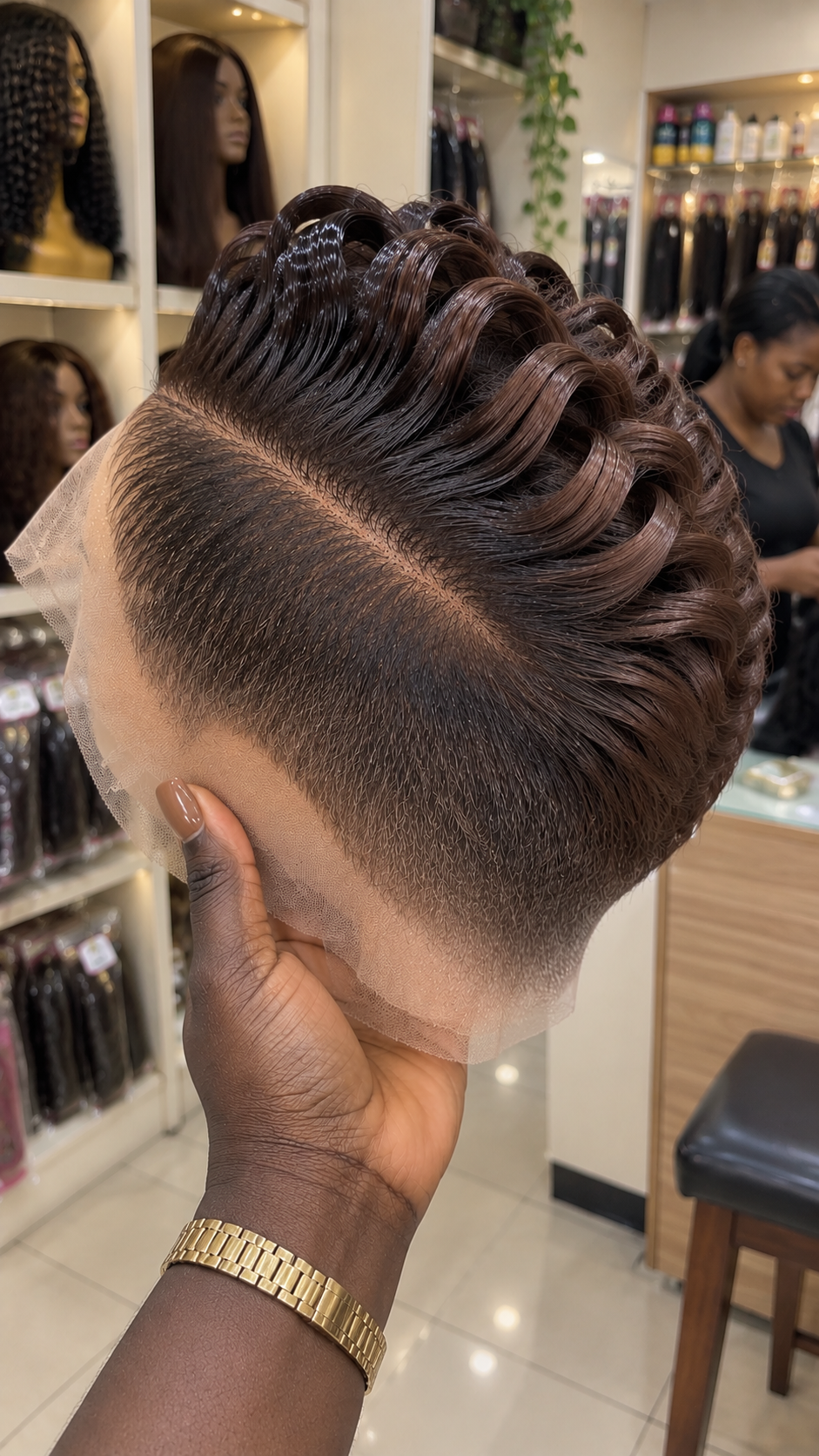
This espresso-brown wig takes a notably different approach from the carved-line pieces in the same sculpted family. There is no prominent razor artwork competing for attention on the visible side. Instead, the lower section is kept close, dark and uninterrupted, allowing the entire visual focus to move upward toward the large folded loops. That restraint gives the wig a sophisticated profile: the crown provides movement, the espresso-to-chocolate reflections provide tonal variation, and the compact side acts as a quiet foundation rather than a second focal point.
The photograph is particularly useful because the wig is shown before installation. A broad lace perimeter remains visible, the close side can be inspected without being concealed against a wearer, and the relationship between the finer lower density and heavier crown is easy to study. The lace is clearly visible, but the photograph does not provide enough evidence to classify it specifically as HD lace. Any such material claim should come directly from the wig maker or supplier.
The Absence of Carved Lines Is an Intentional Design Choice
One of the most important observations about this unit is what it does not contain. The visible side has no obvious decorative stripe, lightning motif, parallel razor lines or sweeping exposed channel. The lower area remains largely continuous from front to rear.
This changes the hierarchy of the wig. On a carved-side unit, the eye often moves back and forth between crown and geometry. Here, the close side provides a broad uninterrupted dark field, so the raised loops become the unquestioned focal point.
For buyers commissioning this exact version, that simplicity should be protected. Asking a barber to “add something” to the side after purchase would create a different design. A clean uninterrupted side can be just as deliberate as elaborate line work.
Espresso Brown Creates Depth Without a Dramatic Color Split
The crown sits within a deep espresso-to-chocolate brown family. The roots and recessed portions appear particularly dark, while raised surfaces reflect warmer brown. This produces tonal movement without obvious blonde, copper or red streaks.
The result is subtle compared with a vivid two-tone wig. Instead of noticing a color transition first, the viewer sees the construction and then notices how the brown changes across each fold.
A customer trying to reproduce this palette should therefore avoid choosing an overly light brown simply because the crown appears warm under salon lighting. The darker foundation is essential. Neutral-light photographs from the seller can help determine whether the actual hair carries the same deep espresso character.
The Forward Loops Establish the Crown’s Maximum Height
Several large sections near the front rise prominently from the foundation. Their strands travel together in broad bands before folding backward, creating open arches rather than tight spiral curls.
These forward sections establish the highest point of the silhouette. Importantly, the height is concentrated rather than distributed equally across the entire wig. That gives the front a sculpted lift without making the rear unnecessarily bulky.
Dark gaps remain visible inside and between the loops. Those negative spaces are essential because they separate one brown ribbon from the next. Filling the gaps with additional hair would make the crown heavier and reduce the architectural quality visible in the reference.
The Middle Crown Is About Overlap, Not Repetition
Moving backward, the large sections begin to overlap more strongly. One loop appears to pass beside or partially over another, creating depth through layering. The shapes belong to the same family, but they are not identical copies.
This controlled variation prevents the crown from resembling a row of matching rollers. Some arches are broader, some lean farther backward and some reveal more of their dark interior.
A stylist recreating this unit should work from the overall directional map rather than using one identical curl size everywhere. The objective is a coherent sequence with subtle variation.
The Rear Resolves Into Tighter Loop Work
The back becomes progressively more compact. Smaller looped ends and curled pieces occupy the rear, following the rounded contour of the cap. This is where the large forward movement is gradually resolved.
The reduction in scale helps maintain a balanced silhouette. If the largest loops continued all the way around the back, the unit would project much farther from the head and lose the controlled profile shown here.
A rear three-quarter photograph is therefore worth requesting when commissioning this wig. It allows the buyer to confirm that the maker has completed the transition rather than concentrating only on the highly visible front sections.
The Close Side Creates a Foundation for the Entire Crown
The lower side consists of fine, compact espresso strands sitting close to the base. The density appears substantial enough to create an even dark surface, but the hair does not project outward like the crown.
This height difference establishes a strong visual boundary even without a carved line. The eye can immediately identify where the compact side ends and the larger loop construction begins because their directions and elevations are so different.
That makes density control especially important. Leaving the side too long could blur the transition into the crown. Removing too much could expose the foundation excessively and weaken the rich dark field.
A Natural Transition Replaces Decorative Geometry
Where some wigs use a pronounced exposed path beneath the crown, this design relies more heavily on the natural directional change between close side strands and the larger upper hair. The transition appears restrained rather than graphic.
This gives the wig broader styling versatility. The side does not impose a particular carved motif, so attention remains on the sculpted brown loops and overall silhouette.
For customers who enjoy precision crown work but do not want prominent barber-inspired lines, this construction can be a particularly useful reference. It retains the dramatic upper architecture while keeping the lower half visually calm.
The Fine Front Density Needs to Be Preserved During Fitting
The front and side perimeter contain finer strands before density increases farther into the wig. This graduation helps avoid an abrupt jump directly from lace into the heavier crown.
During installation, a stylist should assess those strands with the unit positioned on the wearer. Automatically removing them to create a harder edge could eliminate the softer transition visible in the photograph.
The goal should be to adapt the existing density to the wearer’s placement rather than redesign the entire front before seeing how the wig sits.
The Untrimmed Lace Gives the Installer More Control
A generous lace perimeter remains visible around the lower edge. At this stage, that extra material is useful. It allows the stylist to position the cap, evaluate the front and side, and establish the final trimming route only after the wig is sitting correctly.
Customers ordering online should ask whether the wig will arrive with its lace uncut. Someone with a trusted local stylist may prefer to retain as much fitting flexibility as possible.
Lace shade should also be confirmed through the seller’s actual options. The mesh appears warm beige-brown in this photograph, but lighting and camera processing can affect perceived tone.
The Quiet Side Makes Cap Fit Even Easier to Evaluate
Because there are no prominent carved patterns distracting the eye, an incorrect fit may become visible through the overall silhouette. A cap that sits too high, low, forward or backward can change where the close side transitions into the raised crown.
Accurate measurements are therefore worthwhile even though there is no fixed side motif to align. Follow the manufacturer’s own sizing system and provide every requested measurement.
A local wig stylist can assist before ordering if the buyer is uncertain about circumference, ear-to-ear or front-to-nape measurements. Good sizing reduces the amount of correction required during installation.
Ordering This Wig Requires Restraint in the Custom Brief
Some custom requests become inaccurate because too many extra details are added. This reference benefits from a relatively disciplined specification: deep espresso-brown color, dark root depth, broad folded crown loops, progressively tighter rear construction and a continuous close side without prominent carved artwork.
That last point should be stated explicitly if the buyer wants the reference preserved. A maker accustomed to adding decorative side lines may otherwise introduce a feature that was never part of the desired design.
The order should then address cap size, available lace shade, whether the lace remains untrimmed and whether the crown arrives fully set.
Ask Whether the Crown Is Pre-Set Before Comparing Sellers
Two listings can show similar brown wigs while representing very different amounts of completed labor. One seller may provide a base unit that still requires a stylist to build the large crown loops. Another may ship the crown already arranged in the sculpted sequence shown in the reference.
Ask directly whether the folds are part of the delivered product. If they are not, obtain a local styling estimate before comparing prices.
This question can be more financially important than a small difference in hair length or cap specification because rebuilding the crown professionally may require considerable salon time.
A Local Stylist Can Be Valuable Even Without Barber Detailing
This unit does not require elaborate side carving, but professional fitting still matters. A wig stylist can establish the cap position, prepare the lace and preserve the transition between the close side and crown.
The stylist can also refresh any loops that shifted during shipping. Ideally, those repairs should be selective. If only two sections have moved, there is no reason to dismantle every loop.
Bring the reference photograph to the appointment so the stylist can compare height, direction and rear compression before making adjustments.
Approval Photography Should Concentrate on Crown Architecture
For this design, the most useful approval photographs are an elevated side view and a rear three-quarter view. The first should reveal the size and spacing of the forward loops. The second should demonstrate the transition into tighter rear work.
A direct side photograph can also show whether the lower area remains continuous and free from unintended decorative carving.
If the unit is being custom-colored, request a neutral-light image as well. Espresso brown can appear significantly warmer under salon lights, and the buyer should understand the actual shade before shipment.
The Price Should Reflect Crown Labor Rather Than Side Decoration
Unlike carved-side wigs, this design does not concentrate labor in complex razor geometry. Instead, more of its value lies in crown arrangement, density control, color depth, cap preparation and lace work. That changes where the customization budget is being spent.
| Category | Estimated Price Range | Likely Source of Value |
|---|---|---|
| Premium Custom | $290–$510+ | Higher-grade hair, personalized cap sizing, deep espresso color work, hand-arranged crown loops, density refinement and detailed lace preparation. |
| Standard Custom | $175–$300 | Prepared brown crown construction with controlled side density and more standardized cap options. |
| Basic Human Hair | $105–$190 | A human-hair foundation that may require professional crown setting, density adjustment and fitting after purchase. |
| Premium Synthetic | $70–$135 | A pre-set option that can retain broad loop formations with relatively limited daily manipulation. |
| Basic Synthetic | $35–$75 | A budget interpretation where crown separation, tonal depth, lace work or density control may be simpler. |
These figures are broad budgeting references rather than verified prices for the photographed unit. Hair source, fiber, cap construction, seller location, labor, color processing, shipping and installation can all change the final cost.
When requesting a quotation, ask whether the price includes crown setting. That single detail can make two apparently similar offers financially incomparable.
Human Hair Is Useful When the Crown Will Be Professionally Refreshed
A human-hair version can make sense for someone who expects to have the loop sequence reset periodically. It gives a stylist more freedom to rebuild individual sections when the hair is suitable for the required styling technique.
The deep brown shade may still involve processing, so heat should be used according to the hair’s condition rather than automatically at a high temperature. Repeated aggressive heat can reduce longevity even when the wig is genuine human hair.
If the espresso tone eventually fades, professional color refreshing should preserve the dark depth rather than turning the unit into a lighter uniform brown.
Premium Synthetic Can Work Well for a Shape-First Buyer
A customer who primarily wants to preserve the original loop construction may find a quality pre-set synthetic version practical. Synthetic fiber can hold arranged shapes well when manufactured for that purpose and may require less frequent professional rebuilding.
The tradeoff is reduced flexibility. Heat tolerance varies by fiber, and recoloring options can be limited. The material should be confirmed before any hot tool or chemical process is attempted.
The better choice depends on whether future restyling freedom or shape retention is the higher priority.
Maintenance Should Follow the Crown Section by Section
Broad brushing through the entire upper area can destroy the separation between loops. Each large section should be treated as its own styling unit.
If one fold loosens, isolate it and restore its backward direction. If several neighboring sections move, separate them before rebuilding their shape. Avoid combining them simply to speed up maintenance.
The open spaces between the brown loops are part of the design and should remain visible after care.
Photograph the Wig Before Its First Full Wash
An overhead image can record the crown spacing, while a side image captures the height progression and a rear photograph shows where the smaller loop work begins. These images become a practical restoration guide.
During washing, avoid vigorous circular rubbing. Clean according to the confirmed material and handle the lace gently. The close side should also be treated carefully so its fine density remains even.
After drying, reconstruct only what has changed. Preserving the majority of the original styling reduces unnecessary heat and manipulation.
Keep Product Buildup Away From the Recessed Areas
The glossy crown does not require heavy product saturation. Excess oil or holding product can collect where the loops overlap and cause neighboring sections to adhere together.
Use only what is appropriate for the material. If the hair loses its reflective appearance, cleansing buildup may sometimes be more useful than adding another layer of product.
The close side should remain light enough in product that individual fine strands are still visible rather than being pressed into a heavy coated surface.
The Continuous Side Needs Less Cutting but Still Needs Care
The absence of carved channels reduces the need for barber maintenance, but the lower area can still change if it is repeatedly trimmed. Wig hair does not regenerate, so unnecessary cutting should be avoided.
If strands become uneven or begin projecting outward, a stylist can first try repositioning and controlled setting. Actual removal should be conservative and aimed at preserving the original close silhouette.
This gives the design a potential maintenance advantage over highly carved units: there are fewer geometric paths that need to be preserved through repeated precision cutting.
Store the Wig to Protect the Largest Forward Loops
The forward crown contains the tallest sections and is therefore especially vulnerable to compression. A suitable wig stand or mannequin head should provide enough vertical clearance for those loops to remain open.
The rear also needs room so the smaller forms are not flattened. Avoid storing the unit beneath other wigs or pushing it tightly against a hard surface.
Make sure the cap and lace are completely dry before storage. For travel, choose a container deep enough that the crown does not need to be pressed down.
The Strength of This Wig Comes From What It Leaves Out
This espresso-brown unit demonstrates that a sculpted wig does not need vivid color or elaborate carved geometry to have a strong identity. Its design is concentrated where it matters: large open crown loops, gradual rear compression, deep brown tonal variation and an uninterrupted close side that gives the upper construction room to dominate.
For buyers, the quality checklist should therefore focus on proportion. Examine the size and spacing of the loops, the transition toward the rear, the depth of the espresso shade, the consistency of the close side, the visible lace perimeter and the available cap sizing. Do not add side lines simply because similar wigs often contain them; this reference gains much of its character from restraint.
For wig businesses, that also creates a useful selling angle. Detailed photographs can show the craftsmanship in the crown and density work rather than relying on dramatic color or barber patterns. Accurate construction information, transparent customization pricing and realistic maintenance guidance allow customers to understand why a seemingly simple brown wig can still represent substantial skilled work.
Search Terms
espresso brown loop crown wig · seamless close side wig · chocolate folded crown hairpiece · dark root brown lace wig · open ribbon loop wig · compact espresso side wig · backward sculpted brown crown · untrimmed lace chocolate wig