
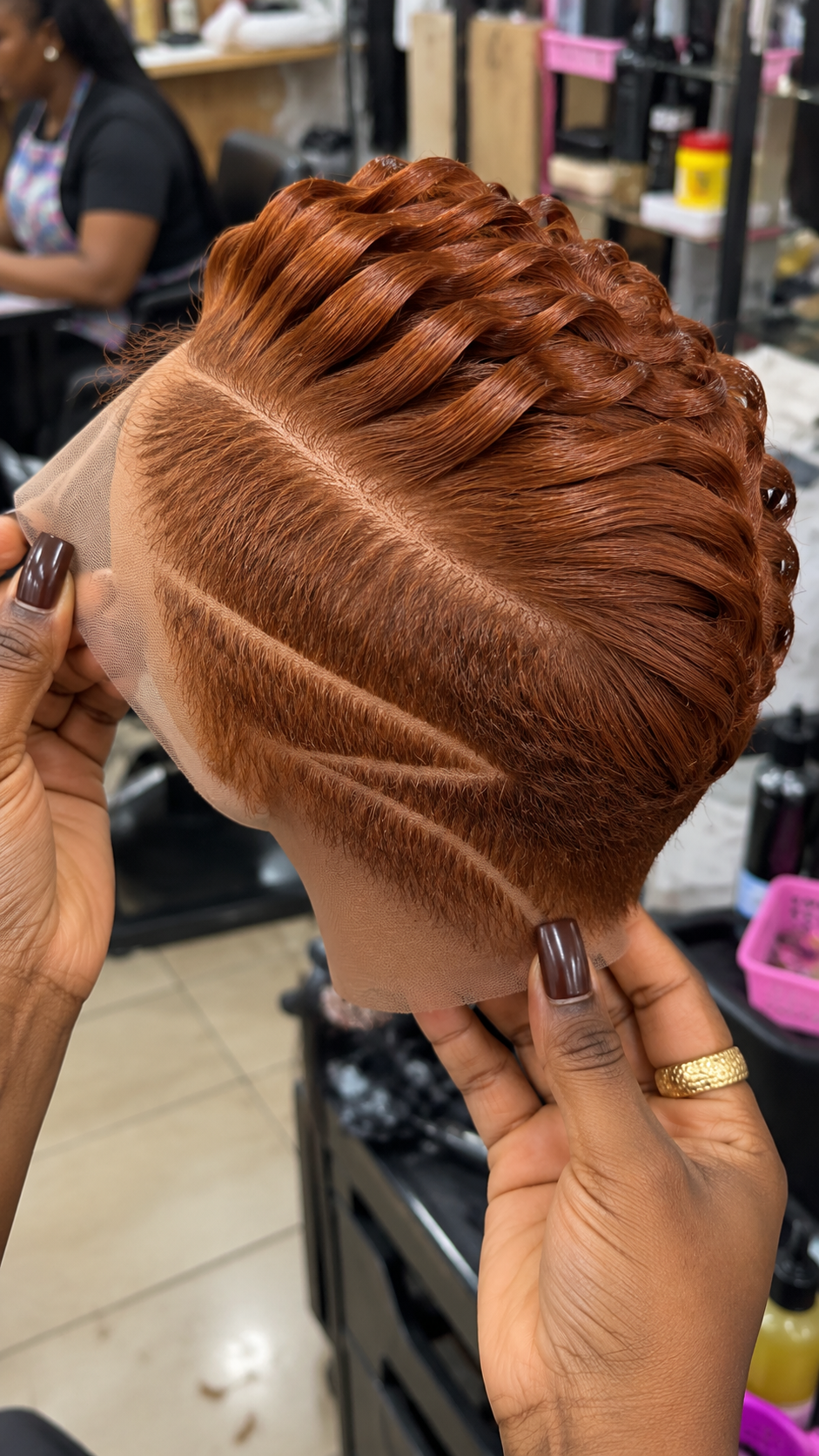
A single-color wig can sometimes reveal more craftsmanship than a heavily highlighted design because there is nowhere for the construction to hide. This fiery copper piece is a strong example. Its impact comes from the relationship between color, directional styling, a closely shaped side panel and sweeping carved lines rather than from multiple contrasting shades. The warm copper tone travels across the entire visible hairstyle, allowing every raised ribbon, bend and change of direction to be read clearly.
The crown has been arranged into broad sculpted sections that rise from the front and travel backward in a connected sequence. These sections are not ordinary loose curls. Each one has been shaped into a wide ribbon-like movement with a polished surface and a controlled bend. Toward the rear, the forms become tighter and begin to overlap more closely. Beneath this upper structure, the side is kept close to the base and decorated with curved line work that follows the contour of the wig.
The photograph is particularly useful for anyone considering a custom unit because it shows the wig before installation. The lace perimeter remains visible, and the relationship between the styled hair, side panel and underlying construction can be inspected without a finished hairstyle hiding those details. Buyers can use this type of reference when discussing a custom order with a wig maker, barber or salon stylist.
Copper From Root to Tip Changes the Entire Character
The most immediate difference between this wig and darker-rooted versions is the continuous copper color. Instead of beginning with black or espresso and transitioning into a brighter shade, the visible hair maintains a warm cinnamon-copper family from the crown through the side panel. Small differences in brightness are created primarily by lighting and the direction of the strands rather than by obvious contrasting color blocks.
This gives the piece a more unified appearance. When a ribbon turns toward the light, the copper becomes brighter and almost amber. Where the strand bends away from the light, the same color appears deeper and closer to auburn. That natural variation gives the crown dimensionality without requiring a separate highlight pattern.
Anyone ordering this color should use the reference image instead of relying only on a shade name. Terms such as copper, cinnamon, auburn and ginger can mean very different things to different manufacturers. Ask the seller to provide a color sample or an unfiltered photograph under neutral lighting whenever possible. A reference image is especially valuable when the desired shade sits between orange copper and deeper reddish brown.
The Front Elevation Sets the Direction for Everything Behind It
The styling begins with elevated sections near the front. These pieces stand higher than the sections farther back, giving the crown a strong starting point. Instead of falling forward, the hair is directed upward and backward. That movement exposes the sculpted side and prevents the upper hair from covering the line work.
Each successive section continues the direction established at the front. The hair bends, overlaps and gradually lowers as it travels toward the rear. This creates a continuous flow rather than a collection of disconnected curls. The effect depends on careful spacing: too much space between the sections would make the crown appear fragmented, while too little would hide the individual ribbon shapes.
The rear area becomes more compact. Smaller bends and tighter turns finish the design without creating unnecessary bulk. This transition from larger front sections to tighter rear movement is one of the reasons the silhouette remains balanced.
The Side Panel Works Like a Second Hairstyle
Below the sculpted crown is a much closer section designed to imitate a precision-cut side. This area is important because it provides visual contrast against the raised upper hair. Without that difference in height, the crown would not appear nearly as pronounced.
The side panel also carries the graphic detail of the wig. A long sweeping line travels through the area and curves toward the rear. Beneath it is another closely following line, while a narrower accent appears between portions of the design. The lines do not run horizontally like simple barber stripes. They follow the shape of the side panel and gradually change direction.
This curved geometry should be specified carefully when ordering. A request for “two lines” or “side lines” is too vague if the objective is to reproduce this exact character. Send the image and point out that the lines should sweep backward and taper naturally with the contour of the side.
The amount of visible side density also matters. The surrounding hair needs enough depth for the carved effect to remain readable. If the area is too sparse, the illusion of a closely cut side can become less convincing. If it is too dense, the line work may lose its contrast.
A Monochrome Color Makes Precision More Important
With no dark root separating the individual sections, the structure itself must create definition. The stylist has to rely on direction, shine, spacing and elevation. This is why the broad ribbon shapes are especially important on a copper unit like this one.
Look closely at the crown and the strands do not all travel in identical arcs. Some sections have a higher lift before turning. Others begin their curve sooner. Toward the rear, several forms interlock more tightly. Those differences give the style rhythm and prevent the surface from looking mechanically repetitive.
A recreation should preserve that controlled variation. Asking a stylist to make every loop identical could produce a very different result. The objective is not perfect duplication of one curl repeated across the head; it is a connected sequence of shapes that share the same overall direction.
What the Visible Lace Tells a Buyer
The photograph clearly shows lace extending around the perimeter. It also shows hair positioned close to the lace edge. This is useful information when discussing installation, but it does not confirm a specific commercial lace grade. The image therefore should not be used as proof that the unit is HD lace or any other named material.
Before purchasing, ask the seller what type of lace is actually used, what color options are available and how far the lace extends. If the wig is being custom made, discuss whether the perimeter can be selected to suit the intended wearer.
The lace should normally be customized during fitting rather than aggressively cut before the position of the wig has been established. A professional wig stylist can assess how the perimeter sits against the wearer’s natural hairline and determine how much material should be removed.
Because this design includes detailed work near the side, fitting deserves extra attention. Shifting the unit significantly can change where the curved lines sit in relation to the temple and ear. A correct cap size therefore affects more than comfort; it affects the visual placement of the design.
Matching the Cap to the Intended Side Placement
A custom wig with sculpted side details should be ordered with accurate measurements. Ask the maker which measurements they require rather than guessing. Common requests may include head circumference, front-to-nape distance and measurements across the head, but individual makers use different construction methods.
The side panel in this reference occupies a specific position beneath the crown. If a cap is significantly too large, the design may sit lower than intended. If it is too small, the lace can be placed under unnecessary tension and the side details may shift.
For customers buying remotely, it can be useful to send both measurements and reference photographs. Confirm the position of the decorative lines before production begins. A custom order should describe not only the color and crown but also which side receives the most visible detailing.
Choosing a Stylist for This Type of Unit
This piece combines wig work with styling that visually borrows from precision barber detailing. That means the best professional may be someone comfortable with both lace installation and sculpted hair designs. When contacting a salon, show the photograph before making the appointment and ask whether the stylist has experience handling units with close side panels and pre-shaped crowns.
The installation should preserve the work already present on the wig. Excessive brushing or combing through the crown can dismantle the ribbon formation. If transportation has disturbed individual sections, they should be corrected selectively rather than automatically restyling the entire unit.
Ask the stylist to inspect the side position before trimming the lace. The curved lines should sit where they can be seen naturally when the wearer turns her head. Once the placement is confirmed, the perimeter can be customized according to the actual construction of the wig.
Who May Enjoy This Copper Direction
This color is suited to someone who wants the hairstyle itself to be immediately noticeable. The copper tone is warmer and more expressive than natural black or deep brown, yet the use of one dominant color keeps the overall design cohesive.
The crown also makes it an interesting choice for women who enjoy sculpted salon looks without relying on long lengths. Most of the visual drama is concentrated in shape and direction. The raised ribbons provide height while the close side panel keeps the silhouette controlled around the lower portion.
For clients who normally wear darker colors, this type of copper can be a significant change. A wig allows the color to be explored without requiring the wearer’s own hair to undergo the same coloring process. The exact result, however, depends on the material used in the unit, so buyers should verify whether the pictured or ordered piece is human hair or synthetic.
Wardrobe Colors That Support a Copper Crown
Warm copper hair can become the focal point of an outfit very quickly. Neutral clothing such as black, cream, chocolate and beige allows the hair color to dominate. Olive and deep forest green can create a rich contrast because green sits opposite the reddish-orange family visually.
Navy can also work well when a cooler clothing color is preferred. Burgundy creates a deeper tonal combination, while ivory can make the copper appear brighter. Gold jewelry naturally complements the warmth of the hair, although minimal accessories may be preferable when the side-line design needs to remain visible.
Large earrings should be considered carefully because the most distinctive detail sits near the side of the wig. An accessory that completely covers this area would hide part of the styling. Smaller hoops, studs or narrow drop earrings can leave more of the curved design visible.
Keeping the Raised Sections Intact Between Wears
This crown should not be treated like loose everyday curls. The broad sections depend on deliberate placement. Repeatedly brushing through them can separate the strands and remove the sculpted direction. Instead, preserve the arrangement whenever possible and correct only areas that have been disturbed.
A wig stand can help keep the crown away from flat surfaces. When storing the unit, make sure nothing presses directly onto the raised front sections. Crushing them for long periods can change their shape and reduce the height that gives the hairstyle its profile.
Product choice must depend on the actual hair material. Human hair and synthetic fibers can respond very differently to heat, styling products and washing. Confirm the fiber before applying heated tools. Even when heat is permitted, excessive temperatures can affect color and alter the carefully formed crown.
Before a major wash or restyle, photograph the wig from the front, both sides, the top and rear. These reference photographs can help a stylist reconstruct the original direction afterward.
Ordering the Look Without Losing Its Identity
Start the order with the color. Request a warm copper or cinnamon-copper shade that remains consistent through the visible side and crown, then provide the photograph to establish the exact target. Avoid requesting additional blonde highlights unless you intentionally want a different result.
Next, describe the upper structure as broad elevated ribbon waves that travel backward and become tighter toward the rear. Mention that you do not want a conventional curly top or a uniform roller set. The directional pattern is one of the defining characteristics.
Then specify the side. Request a close-cut visual effect with sweeping curved lines that follow the contour of the wig. If the maker can send a progress photograph before completing the styling, use that opportunity to check the direction and spacing.
Finally, confirm cap size, lace type, hair or fiber material, density, adjustment features, processing time and shipping terms. Written confirmation is particularly useful for custom work because it creates a clear record of the agreed specifications.
Premium Custom / Standard Custom / Basic Human Hair / Premium Synthetic / Basic Synthetic
| Category | Best Considered For | Details to Confirm |
|---|---|---|
| Premium Custom | Clients seeking close reproduction of the copper tone, crown direction and curved side work | Exact measurements, lace specification, hair source, color matching, sculpting labor and side-line placement |
| Standard Custom | Buyers who want the main silhouette and copper palette with fewer individual modifications | Available cap sizes, crown height, side pattern choices and color consistency |
| Basic Human Hair | Wearers who prioritize future salon restyling possibilities | Hair authenticity, processing history, density, lace coverage and recommended heat range |
| Premium Synthetic | Clients interested in strong retention of a factory or stylist-set shape | Fiber specification, heat resistance, copper shade accuracy and washing instructions |
| Basic Synthetic | Budget-focused buyers seeking a similar general silhouette | Fiber quality, cap construction, shine, comfort and expected durability |
There is no reliable way to determine the price of this exact unit from the photograph alone. Labor, hair material, cap construction, lace, coloring process and the complexity of the sculpted crown can all change the final quote. Custom side detailing may also increase the amount of work required.
Questions Worth Sending Before Paying a Deposit
Ask whether the seller can reproduce the copper shade throughout the entire piece rather than placing it only on the crown. Confirm whether the side pattern is created as part of the wig construction and whether its position can be adjusted for the wearer’s measurements.
Request photographs of the actual unit or a completed sample whenever possible. If the order is custom, ask whether approval photographs will be provided before shipping. A side photograph is especially important because it allows you to inspect the curved line placement.
Ask about maintenance services as well. Some wig makers offer crown refreshing, color maintenance or restyling after several wears. For a sculpted design, access to someone who understands the original construction can be valuable.
When booking the salon separately, tell the installer that the crown and side work should be preserved. Sending the reference image before the appointment gives the stylist time to assess the unit instead of making decisions after you arrive.
What to Inspect When the Wig Arrives
Begin with color consistency. Under neutral light, inspect the front, crown, rear and side. The copper should feel intentional throughout the design rather than appearing noticeably mismatched between sections.
Next, view the crown from above. The large front ribbons should transition into smaller movements toward the back. Check that they have not been flattened during shipping. Minor movement can often be corrected professionally, but major deformation should be documented immediately.
Inspect the side pattern without stretching the lace. The sweeping lines should remain visible and should follow the intended contour. Then examine the interior cap, adjustment system and stitching. If the unit was ordered to specific measurements, perform a careful fitting before making irreversible alterations.
Do not immediately cut the lace simply because the wig has arrived. Confirm the fit and styling first. Once lace is removed, return or adjustment options may become more limited depending on the seller’s policy.
The Detail That Makes This Copper Wig Memorable
The strength of this piece does not come from one isolated feature. Its copper color makes the entire surface visually continuous, the raised ribbon sections provide movement, and the sweeping side lines introduce a contrasting graphic element beneath them. Each area supports the next.
That relationship should remain the priority in any recreation. Making the crown dramatically larger, adding unrelated highlights or replacing the curved side work with straight stripes would change the personality of the design. A closer interpretation keeps the crown controlled, maintains the warm copper family and allows the side detailing to follow the natural direction of the silhouette.
For a wig business, it is also a useful example of why multiple photographs matter. A front view may emphasize the copper crown, while a side angle reveals the line work and an interior view can show construction. Customers making a custom purchase benefit from seeing all three because the beauty of this design is as much about its architecture as its color.
Search Terms
fiery copper sculpted ribbon wig · cinnamon copper lace wig · copper raised ribbon crown · sweeping curved side line wig · auburn copper sculpted waves · copper close side panel wig · warm cinnamon crown waves · copper lace wig with curved lines