
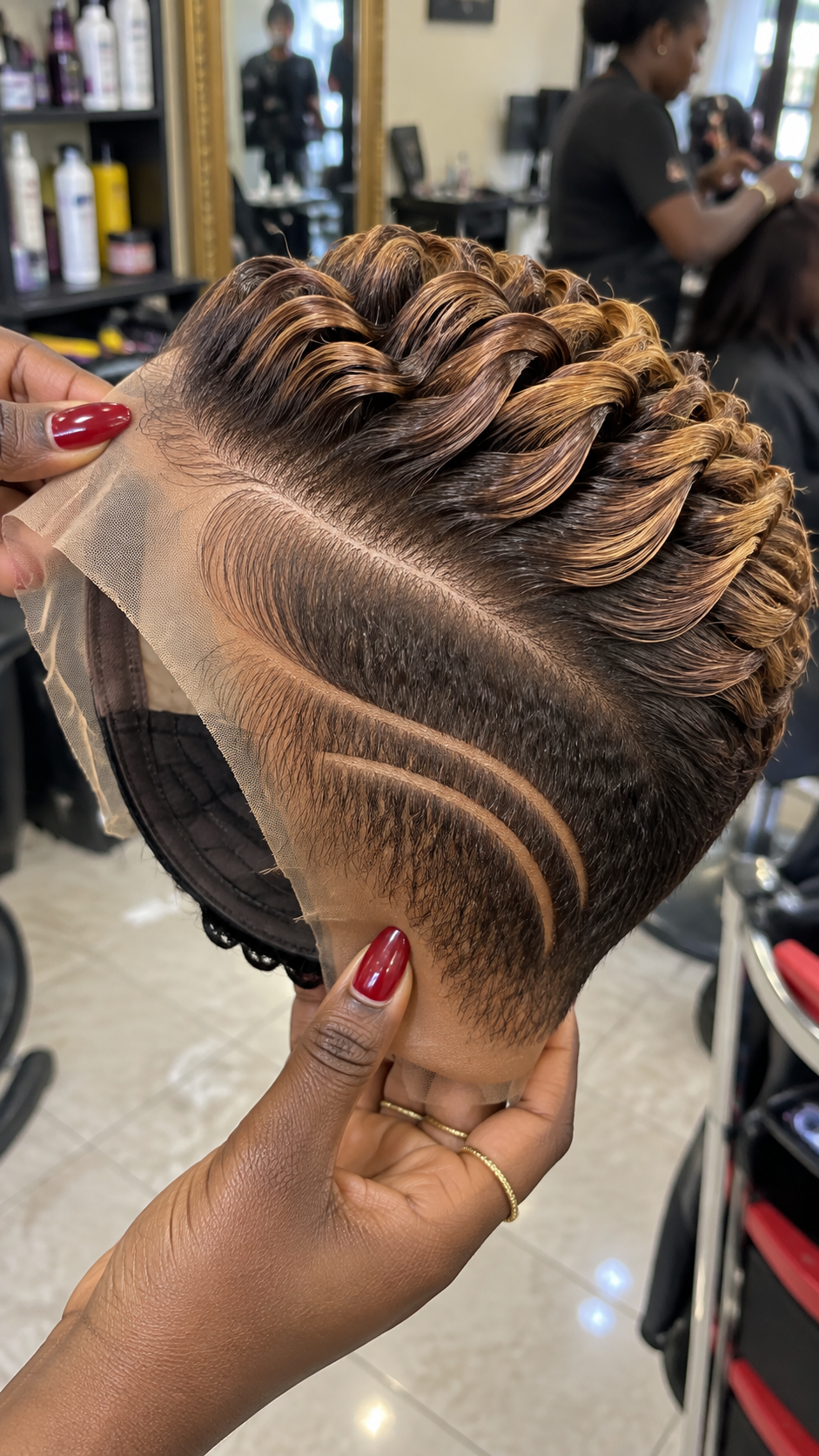
Color placement can completely change the way a sculpted wig is perceived, and this espresso-and-caramel design demonstrates that beautifully. The darker foundation gives the hairstyle visual depth while warm caramel and golden-brown ribbons travel across the raised sections of the crown. Instead of appearing as random highlights, the lighter strands follow the direction of the styling, helping each wave stand apart from the next. The result is a compact salon-inspired wig with a strong profile, visible movement and a color arrangement that becomes more interesting as the viewing angle changes.
The photograph also exposes important construction details that would normally disappear after installation. The lace extends beyond the perimeter, the interior cap is partially visible, and the side section has been created to resemble closely cropped hair. Two curved lines sweep through that darker side panel. Above them, the hair changes dramatically: longer strands rise from the crown, bend into broad ribbon-like sections and continue toward tighter curves near the rear.
Anyone ordering a similar wig should treat these characteristics as one coordinated design rather than separate options. The color placement, crown direction, side-line geometry and lace perimeter all contribute to the final appearance. Changing one element can alter the balance of the entire piece.
Where the Espresso and Caramel Tones Do the Most Work
The color story begins with a deep espresso foundation. It anchors the wig around the side and root areas, creating enough darkness for the lighter sections to become clearly visible. Across the crown, caramel brown develops into warmer golden-honey accents. These lighter strands are concentrated along the raised portions rather than distributed evenly throughout every area.
That placement is important. When the hair curves upward, the caramel sections sit where salon lighting naturally strikes the surface. This makes the upper ridges appear more pronounced. Between those ridges, the deeper brown remains visible and creates separation. The contrast is noticeable without turning the wig into a heavily striped design.
For a custom order, sending the photograph is more useful than requesting generic brown highlights. Explain that the lighter color should follow the movement of the crown. If highlights are scattered randomly, the relationship between color and wave direction can disappear. A stylist should understand that the darker foundation needs to remain visible beneath the caramel sections.
The Ribbon-Shaped Crown Is the Center of the Design
The upper hair is arranged in broad, polished sections that resemble folded ribbons. Near the front, the sections rise almost vertically before bending backward. As the design progresses, the movement becomes more diagonal and then begins to curve toward the rear. The changing direction prevents the crown from looking like identical loops placed in rows.
There is also a deliberate difference in scale. The front sections are wider and more prominent. Moving toward the back, the shapes become tighter and more numerous. This gives the eye a natural route across the hairstyle. It also prevents excessive bulk from collecting at the front while still maintaining enough height to showcase the caramel color.
If this structure needs to be recreated after washing, a stylist should study the direction before dismantling it. Simply curling every section to the same size would not reproduce the photographed result. The larger front movement and gradually tighter rear arrangement are essential parts of the silhouette.
Why the Curved Side Lines Matter
The side panel introduces a completely different visual language from the crown. Instead of large flowing sections, this area is compact and closely shaped. Two curved lines travel through it, creating a graphic accent that follows the contour of the wig rather than cutting across it at a harsh angle.
The upper line is longer and establishes the main direction. A second line follows beneath it, creating a parallel relationship while tapering toward the rear. Because the lines curve with the side profile, they connect naturally with the movement happening above. They are noticeable without overwhelming the caramel crown.
When requesting this detail, specify that the lines should be curved and positioned within the close side panel. Do not assume that asking for “lines” will produce the same result. A barber or wig specialist might otherwise create straight parallel marks, a geometric pattern or a different number of lines.
Placement should also be adapted carefully during fitting. The visual relationship between the lines, temple area and upper crown can change if the wig sits too far forward or backward. This is another reason accurate cap sizing matters.
Reading the Hairline Before the Wig Is Installed
The photograph shows the unit before the excess lace has been trimmed. That makes it easier to inspect how the hair has been positioned near the front and side. Fine strands extend toward the lace perimeter while the denser styling begins farther behind them.
This transitional area should not be ignored during installation. A skilled wig stylist can assess how much lace needs to remain, where the perimeter should sit and whether any additional customization is appropriate for the wearer. Removing too much material too quickly can make later adjustments difficult.
Although lace is clearly visible in the photograph, the image alone does not prove a particular commercial lace grade. Buyers should therefore ask the seller directly about lace type, color and coverage. If a listing claims a specific material, request product specifications rather than relying solely on photographs.
Skin tone should also be considered. The objective is not merely to hide the lace but to create a believable transition around the perimeter. Depending on the actual material, tinting or other professional customization may be recommended.
Balancing Height With a Compact Side Profile
One of the strongest contrasts in this design is the difference between the crown and the side. The upper sections have height and visible movement, while the lower side remains close and controlled. That difference creates the impression of a precision salon cut even though the piece is presented as a wig.
If the crown becomes too large, the hairstyle can lose its compact character. If it is pressed too flat, the caramel ribbons no longer have enough separation to show their direction. The target is controlled elevation: enough height for the individual sections to remain visible without turning the wig into an oversized silhouette.
The side density is equally important. It needs enough coverage to create the appearance seen in the photograph while still allowing the curved lines to remain legible. Excessive density around this area could make those lines disappear. Too little could expose the underlying construction in places where it should not be noticeable after installation.
What to Tell a Wig Maker Before Ordering
A strong custom-order brief should begin with the overall silhouette. Explain that you want a compact sculpted wig with an elevated ribbon-wave crown and a close side profile. Then describe the color distribution: deep espresso or chocolate through the foundation, with caramel-to-golden-brown sections concentrated through the raised crown.
Next, address the side design separately. Request two curved parallel lines following the contour of the side rather than straight marks. Provide the reference photograph so the maker can see their approximate width, spacing and direction.
Ask how the unit will be constructed and what measurements are required. Circumference alone may not be enough for a custom cap. Depending on the maker, measurements such as front-to-nape, ear-to-ear and temple-to-temple may also be requested. Follow the seller’s measurement instructions exactly.
Finally, confirm the actual hair material. The photograph cannot establish whether the piece is human hair, synthetic fiber or another construction. That distinction affects future styling, heat use, washing and maintenance. Never assume that a photographed hairstyle can automatically be restyled with heated tools.
Salon Appointment Questions That Can Prevent Mistakes
Before booking an installation, ask whether the stylist regularly works with sculpted wigs. This design requires more than attaching a unit. The crown may need careful handling during fitting, and the side-line placement must remain visually balanced once the wig is positioned on the wearer.
Show the stylist the reference before the appointment rather than waiting until the unit is already being installed. Discuss where the front should sit, how much lace customization may be needed and whether the crown requires any refreshing after transportation.
If the stylist plans to reshape the waves, ask how closely the original direction can be preserved. The caramel ribbons are tied visually to the movement of the hair. Changing the direction of individual sections can also change where the lighter color appears.
After fitting, examine the unit from several angles. The side view is particularly important because it reveals whether the two curved lines are positioned correctly and whether the crown begins at a flattering point above them.
Protecting the Caramel Sections From Becoming Blended Together
The lighter ribbons should remain visually separated from the darker base. Heavy manipulation can cause strands from neighboring sections to mix, reducing the contrast that makes the color placement effective. Avoid repeatedly running a brush through the sculpted crown unless the intention is to dismantle the existing arrangement.
Storage should support the overall shape without crushing the elevated front. A suitable wig stand can help keep the crown away from flat surfaces. Avoid stacking other wigs or objects on top of the unit, especially around the broad front sections.
Product buildup is another consideration. Excessive oils and heavy finishing products can weigh down the crown and make the individual ribbons collapse into one another. Use only products appropriate for the confirmed hair material and begin with small quantities.
If the wig is human hair and eventually needs restyling, consider photographing the crown from several angles before washing. Those images can provide a useful map for rebuilding the direction later. If it is synthetic, follow the manufacturer’s care instructions because heat and product compatibility can vary significantly between fibers.
Choosing Clothing Around Warm Caramel Hair
The combination of espresso and caramel works particularly well with earthy wardrobe colors. Cream, beige, chocolate, olive, rust and deep green can complement the warmth without competing with it. Black clothing can create stronger separation and allow the caramel ribbons to become the brightest part of the overall look.
For a more colorful combination, teal, burgundy or rich blue can work well against the warm brown palette. Gold jewelry is another natural pairing because it echoes the warmer sections of the crown.
Because the hairstyle already contains strong directional detail, accessories do not need to be excessive. The curved side lines and sculpted crown can provide enough visual interest on their own. Earrings that leave the side profile visible can be especially useful when the goal is to showcase the line design.
Checking a Finished Custom Unit Before Accepting It
When a seller sends completion photographs, compare more than the color. Begin with the crown silhouette. The front should have noticeable elevation, while the sections behind it should travel backward in a connected sequence. Look for separation between the broad ribbon forms rather than one continuous mass of hair.
Then inspect the color. The espresso foundation should remain visible. Caramel should appear along selected sections and become brighter in areas where the design calls for stronger contrast. If nearly the entire crown has been lightened, the result may no longer resemble the reference.
Move to the side panel next. Confirm the number of curved lines and their orientation. If the unit is being shipped, ask for photographs from both sides when possible because the construction may not be identical on each side.
Finally, request an interior photograph. This can help verify cap construction, adjustment features and other details that exterior beauty shots may hide. If something differs from the agreed custom specification, address it before the unit is shipped.
Premium Custom / Standard Custom / Basic Human Hair / Premium Synthetic / Basic Synthetic
| Option | What It May Offer | Important Questions Before Purchase |
|---|---|---|
| Premium Custom | Individual sizing, detailed color placement and extensive crown shaping | Ask about measurements, hair source, lace specification, side-line customization and maintenance service |
| Standard Custom | Personalized color and styling with fewer construction changes | Confirm available cap sizes, caramel placement, crown height and side detailing |
| Basic Human Hair | Potential flexibility for future salon restyling | Verify authenticity, processing history, density, heat recommendations and lace construction |
| Premium Synthetic | Potentially stronger retention of a pre-shaped crown | Ask about fiber type, heat tolerance, shine level, color availability and washing instructions |
| Basic Synthetic | A more economical interpretation of the general silhouette | Check fiber appearance, cap comfort, perimeter construction and expected lifespan |
These categories should be treated as comparison points rather than fixed price promises. The final cost depends on the actual hair or fiber, cap construction, lace, color processing, density, styling labor and level of customization. A highly detailed crown and custom side work can require substantially more labor than a basic ready-made unit.
Building a Useful Price Quote Instead of Asking Only for a Total
When contacting a seller, request a breakdown of what the quoted amount includes. Ask whether the price covers color work, crown styling, side detailing, lace preparation and final customization. This makes it easier to compare offers from different wig makers.
For salon installation, find out whether the appointment price includes lace trimming, fitting, perimeter customization and adjustments to the sculpted crown. Some salons price these services separately. Knowing that before the appointment prevents surprises.
If the wig will be shipped internationally, calculate delivery charges and possible import costs separately. A lower initial unit price does not always produce the lowest final cost once customization and shipping are included.
Why This Color Pattern Photographs So Well
This hairstyle is particularly effective in photographs because its lighter sections follow physical curves. Every caramel ribbon has both a bright surface and a darker underside. That creates depth without requiring dozens of different shades.
The side panel adds another focal point. Its curved lines echo the direction of the crown, so the upper and lower portions feel connected rather than designed independently. When photographed from a three-quarter angle, both the highlighted waves and side detailing can be visible at the same time.
For wig businesses, that makes the design useful for product photography and social media. One unit can produce substantially different views depending on whether the camera emphasizes the front elevation, caramel crown, side lines or rear curl arrangement. Showing several angles also gives customers more information before they order.
The Details Worth Preserving in a Recreation
The strongest recreation will preserve the relationship between dark and light rather than merely copying a general brown palette. Keep the espresso foundation visible beneath caramel and golden-brown ribbons. Maintain the broad elevated sections at the front, allow the movement to tighten toward the rear and retain the compact side profile beneath the crown.
The two curved side lines should remain part of the design instead of being replaced with unrelated geometric carving. The lace perimeter should be fitted by someone who understands wig customization, and the crown should be handled carefully during installation so the large sections retain their shape.
This combination is what separates the wig from an ordinary highlighted hairstyle. Its personality comes from coordinated color direction, sculpted elevation and side geometry. When those elements are preserved together, the result can retain the distinctive salon-built character visible in the reference.
Search Terms
espresso caramel ribbon wave wig · chocolate golden honey crown wig · caramel sculpted wave lace wig · curved double side line wig · espresso raised crown hairstyle · golden brown ribbon curl wig · caramel directional crown wig · chocolate lace wig with side lines