
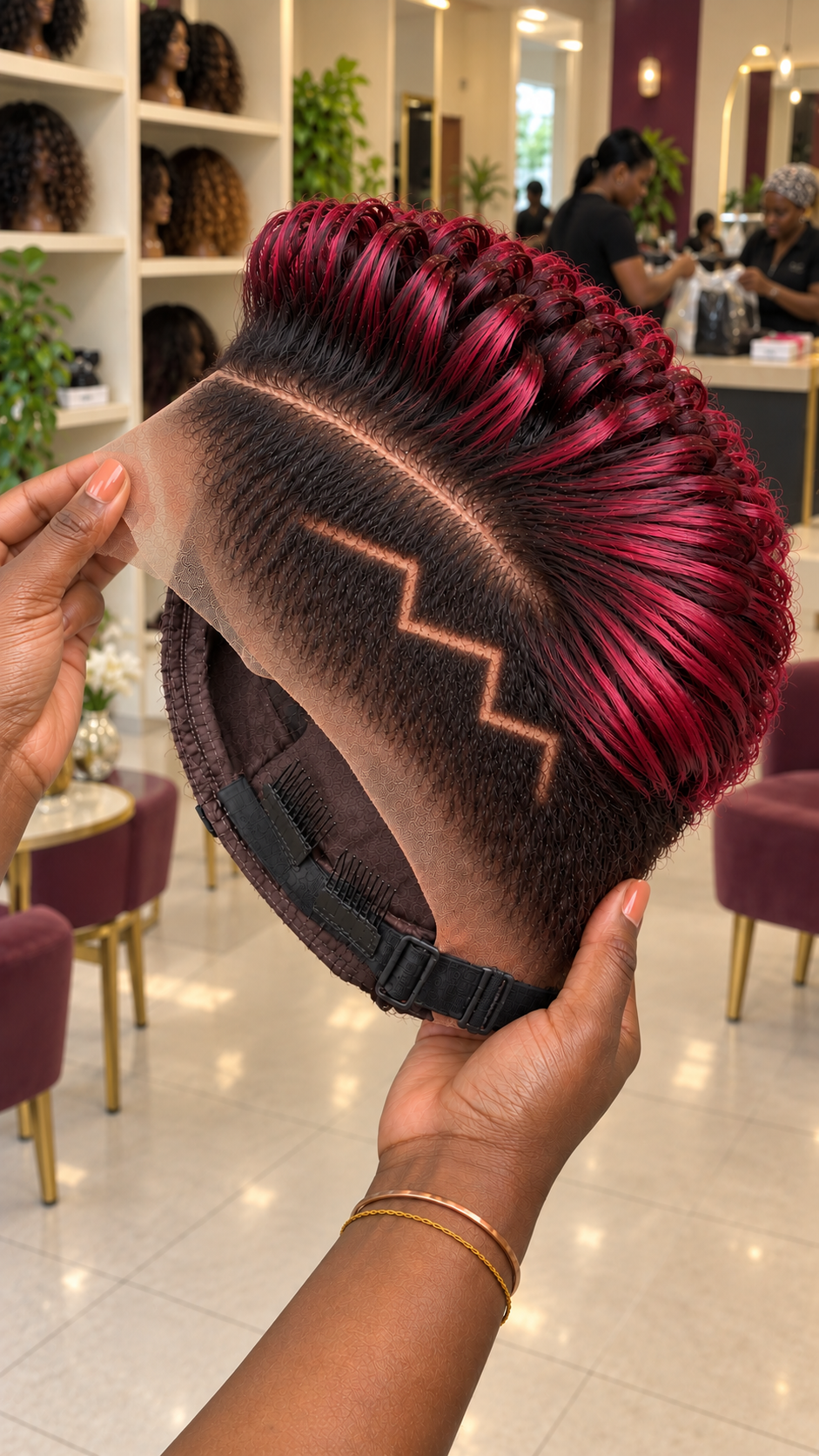
This sculpted pixie wig combines a dark black base with vivid magenta-red accent strands, a raised looped crown, a long diagonal part and a dramatic zigzag design through the close side section. The photograph gives an unusually useful view of the unit because the wig is being held open, allowing the exterior hairstyle, lace perimeter and several internal cap components to be seen at the same time. For a buyer who wants to commission a similar wig, this image can therefore serve as both a styling reference and a starting point for discussing construction with a wig maker.
The upper section is the dominant feature. Broad strands rise from the diagonal part and bend backward into repeated sculpted loops. Instead of covering the entire crown in one solid color, narrow magenta-red sections travel through the darker hair. The placement of these accents follows the direction of the loops, which makes the color appear integrated into the hairstyle rather than randomly scattered across it.
The lower side creates a completely different visual effect. It remains dark and close to the base, allowing a large angular zigzag line to stand out clearly. This contrast between the colorful elevated crown and the restrained black side gives the wig its strongest identity.
Magenta Accents Follow The Direction Of The Crown
The color placement is important because the brighter strands are not distributed evenly from root to tip across every section. The visible base around the part remains predominantly dark, while the magenta-red accents become stronger as the strands rise and sweep backward. This creates depth near the roots and brighter movement across the outer curves.
Under the salon lighting, some sections appear vivid magenta while others lean toward cherry red or raspberry. The deepest areas remain almost black. A buyer should therefore use the photograph itself as the primary color reference rather than relying entirely on a commercial shade name.
When contacting a wig maker, explain that you want a dark foundation with strategically placed magenta-red ribbons through the sculpted upper sections. If the stylist simply mixes red and black hair evenly, the result may look streaky rather than directional. The brighter strands should reinforce the movement of the loops.
The Crown Is Built From Broad Backward-Sweeping Loops
The crown does not use small conventional ringlets. Each visible section contains a broader ribbon of hair that rises, bends and travels backward. These sections overlap in a controlled sequence, creating a raised ridge across the upper portion of the wig.
Near the front, the loops have greater vertical lift. As they continue toward the rear, they gradually lean farther backward and follow the rounded contour of the head. This progression creates movement without making the wig excessively tall.
If you are ordering remotely, use terms such as “broad sculpted loops” and “backward-sweeping crown sections” when describing the shape. Include the photograph so the stylist can see the approximate width of each loop. Asking only for curls is too general for this design.
The Main Part Establishes The Entire Styling Direction
A long diagonal part separates the elevated crown from the close side. It begins near the front and travels backward across the wig, creating a strong visual boundary. The dark roots around this line make the part particularly easy to see.
Above the part, the strands immediately rise toward the looped crown. Below it, the hair stays close and compact. Because these two areas move in very different directions, the part becomes an architectural element rather than simply a place where the hair separates.
Tell the wig maker which side you want this feature placed on before construction or detailed styling begins. Reversing the part changes the orientation of the crown, the placement of the color accents and the position of the geometric side design.
The Lightning-Shaped Side Detail Sets This Unit Apart
The most distinctive side feature is the large angular line cut through the close dark section. It begins as a relatively straight line and then changes direction several times, producing a stepped zigzag or lightning-like pattern.
The surrounding hair remains dark, so the exposed line creates a strong light-against-dark contrast. Unlike simple parallel barber lines, this pattern occupies a substantial portion of the side and becomes a major part of the hairstyle.
For an accurate custom order, send a separate close crop of this section. Specify that you want one continuous angular zigzag rather than multiple parallel lines. The stylist should also know approximately where the first bend begins and how far the pattern should extend toward the back.
Dark Roots Keep The Bright Color From Overwhelming The Design
The black foundation performs an important visual role. It separates the bright magenta strands and provides contrast around the part, crown and side pattern. Without the darker base, the colored upper section would have a very different character.
The transition is especially noticeable near the roots, where the hair remains predominantly black before the brighter accents become visible farther along the strands. This creates a dimensional effect and prevents the color from appearing like one flat red surface.
If a colorist is preparing the unit, ask to see the black-to-magenta relationship before final styling. A test section can help determine whether the red is bright enough while still preserving the dark foundation visible in the reference.
The Close Side Balances The Elevated Upper Section
The side below the diagonal part carries very little bulk compared with the crown. This contrast makes the loops look taller and gives the geometric line enough open space to remain readable.
A stylist recreating this wig should avoid leaving the lower side too full. Extra density could hide portions of the zigzag and reduce the sharp difference between the two styling zones. At the same time, the side should retain enough dark hair to frame the carved pattern.
Discuss this balance during the consultation rather than treating the side as an afterthought. The crown, part and geometric section should be planned as one composition.
Visible Lace Should Be Customized To The Wearer
The photograph clearly shows lace extending beyond the styled perimeter. That confirms the presence of lace, but the exact commercial grade cannot be established from the image alone. In particular, it would not be appropriate to advertise the unit as HD lace unless the maker or product specification confirms that detail.
Ask the seller what lace type is supplied, what shades are available and whether the lace will arrive uncut. If you plan to use a professional installer, consider leaving final trimming and customization for the installation appointment.
The lace color should be selected according to the intended wearer rather than copied blindly from a photograph. Request physical samples or clear close-up photographs if the seller offers several options.
Interior Components Are Visible Beneath The Styled Exterior
The open underside reveals a dark cap, internal combs and an adjustable strap system. These features can help stabilize the unit, but buyers should request a complete interior photograph before assuming that every attachment point is visible in this single image.
Ask how many combs are installed and where they are positioned. Also confirm the adjustment range of the strap and whether other securing options are available. If you prefer not to use combs, discuss that preference before a custom cap is completed.
Cap construction can affect both comfort and the way a sculpted pixie sits on the head. Since the hairstyle is compact, accurate sizing is particularly valuable.
Measurements Should Be Confirmed Before Production Begins
Follow the individual wig maker’s measuring guide. Common measurements may include head circumference, front to nape, ear to ear and temple to temple, but sellers do not necessarily construct every cap using identical standards.
Submit the requested measurements and ask the maker to confirm them before starting the unit. If you are uncertain about measuring yourself, a salon or experienced wig stylist may be able to help.
A properly fitted base also helps keep the diagonal part and zigzag side design in the intended position. If the cap shifts significantly, these carefully placed details may no longer sit where expected.
Details To Confirm With The Wig Maker
- Request a predominantly black base with vivid magenta-red accent strands.
- Specify broad sculpted loops rather than small ring curls.
- Confirm the direction and location of the long diagonal part.
- Show the exact angular zigzag side pattern from the reference.
- Ask how the bright accent strands will be distributed through the crown.
- Confirm the actual hair or fiber material.
- Ask what lace type and lace shades are available.
- Confirm whether the lace arrives uncut.
- Request information about internal combs and the adjustable strap.
- Provide the maker’s required head measurements.
- Confirm whether the crown will arrive fully sculpted.
- Ask for maintenance instructions for both the loops and color.
Premium Custom / Standard Custom / Basic Human Hair / Premium Synthetic / Basic Synthetic
The photograph does not show a verified selling price or material specification for this exact unit. The ranges below are general budgeting examples for comparing possible categories. A real quotation can vary according to material, coloring, density, cap construction, lace selection, stylist labor and the complexity of the side design.
| Category | General Planning Range | Possible Cost Factors |
|---|---|---|
| Premium Custom | $350–$750+ | Custom sizing, advanced color placement, sculpted crown work, lace customization and geometric side detailing |
| Standard Custom | $220–$450 | Selected black and magenta palette, custom parting, loop setting and side pattern |
| Basic Human Hair | $140–$300 | Hair quality, density, cap construction and additional salon styling |
| Premium Synthetic | $80–$180 | Higher-grade fiber, multi-tone coloring and stronger preset shape retention |
| Basic Synthetic | $45–$100 | Stock cap, simpler color options and limited customization |
Ask For A Color Preview Before Final Styling
Bright accent colors can look dramatically different under warm salon lights, cool LEDs and daylight. Before the crown is permanently arranged, ask for photographs of the prepared color from several lighting conditions.
Pay attention not only to the brightness of the magenta but also to how much black remains visible. The reference depends on both colors. Increasing the red coverage too much would change the overall impression from a black pixie with bright accents to a predominantly red wig.
If you want an especially close recreation, ask the stylist to preserve the dark root area around the diagonal part while allowing the magenta to become more visible through the raised outer sections.
Booking A Salon For The Final Sculpting Work
A suitable base unit can also be purchased first and taken to a local wig stylist for customization. Before buying the wig, show the stylist this reference and ask whether the available hair length, density and material will support the looped crown.
The stylist should also evaluate whether the side can support the large geometric pattern. Not every pre-made wig provides the same amount of workable hair or the same construction around the perimeter.
When booking, explain that the appointment involves crown sculpting, part definition and a graphic side design. This gives the salon a better idea of the time required than simply requesting a pixie styling appointment.
Protect The Raised Sections From Compression
The loops are one of the first elements likely to lose their shape if the wig is stored carelessly. Avoid placing the unit beneath other wigs, inside an undersized container or against a shelf that presses down on the crown.
A suitable mannequin head or wig stand can help preserve the rounded profile. Leave enough clearance around the upper section so the loops remain undisturbed.
Do not brush directly through the grouped strands unless you intend to reset the style. If a few sections become loose, compare them with the original photograph before making adjustments so the direction of the crown remains consistent.
Color Care Depends On The Actual Hair Material
The correct maintenance routine cannot be determined from appearance alone. If the unit is human hair, ask whether the magenta sections have been professionally colored and which cleansing products are recommended. If it is synthetic, obtain the fiber-specific care instructions from the seller.
Do not assume that heat is safe simply because the strands appear glossy and polished. Some fibers tolerate controlled heat while others can be permanently damaged. Confirm the material and maximum recommended temperature before using heated tools.
Keeping the wig away from prolonged direct sunlight during storage can also help protect the appearance of vivid colored sections.
Use Side And Overhead Photos To Approve The Finished Wig
A front-facing photograph alone would not be enough to evaluate this custom design. Ask the seller for a side view that clearly shows the zigzag, a slightly elevated photograph showing the crown loops and a rear angle showing how the bright strands continue toward the back.
Check that the main diagonal part remains separate from the graphic side line. Also examine whether the magenta strands follow the loops rather than appearing randomly distributed.
If anything differs substantially from the approved reference, discuss it before shipping. Corrections are generally easier while the wig is still with the stylist.
Search Terms
Black Magenta Pixie Wig · Magenta Highlight Sculpted Wig · Zigzag Side Design Pixie Wig · Black Red Loop Crown Wig · Deep Side Part Pixie Wig · Raspberry Highlight Pixie Wig · Lace Front Sculpted Pixie Wig · Graphic Side Line Wig
From Reference Photo To A Precise Custom Wig Brief
This design becomes easier to order when each visible feature is described independently. The foundation is dark black. Bright magenta-red strands are introduced through the raised upper sections rather than covering the entire wig. Broad loops travel backward across the crown, while a long diagonal part separates them from a close dark side. Beneath that part, one large stepped zigzag creates the signature graphic detail.
The photograph also reveals useful construction elements. Lace is clearly visible, and the interior includes a dark cap, combs and an adjustable strap. Those observations can be discussed confidently, while specifications that cannot be verified visually—such as the exact lace grade or hair material—should be confirmed directly with the seller.
Before paying, document the preferred black and magenta balance, part direction, loop size, crown height, zigzag placement, cap measurements, lace choice and internal securing features. Confirm the total price, production period, shipping method and alteration policy as well. Finally, ask whether the unit will arrive completely styled and how the sculpted sections should be refreshed after wear. Giving the wig maker this level of detail is far more useful than requesting a generic red-and-black pixie and provides a much clearer path toward reproducing the distinctive look shown in the reference.