
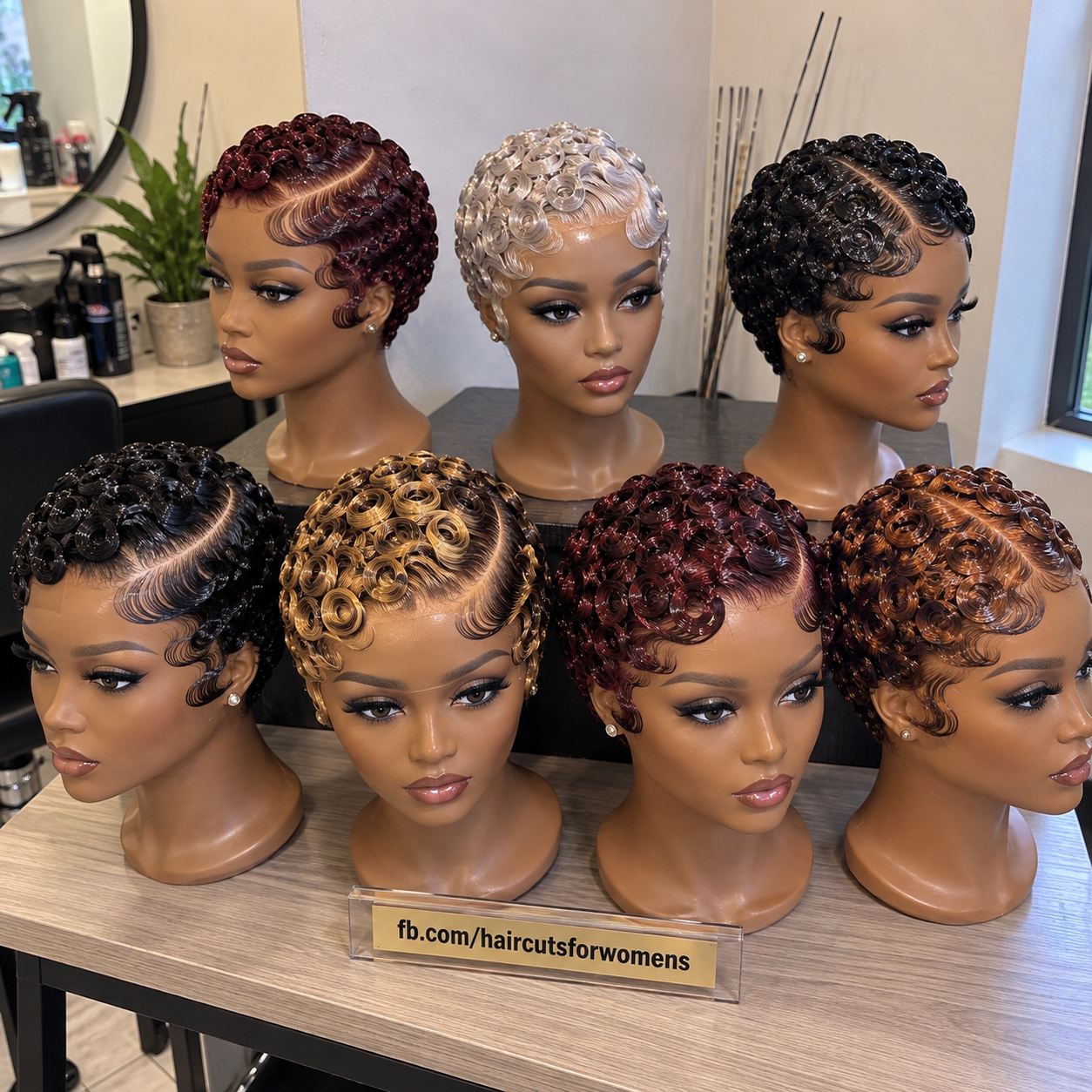
This collection presents seven compact pixie wig ideas built around glossy circular curls, deep side parting and carefully shaped wave work around the forehead and temples. The display moves through several wearable color families, including deep black, burgundy wine, pale pearl silver, golden honey, warm chestnut and copper brown. Even though the shades vary, the wigs share a recognizable structure: closely arranged ring curls across the crown, a visible diagonal part and flatter wave sections that guide the hair around the face.
What makes this collection particularly useful as a buying reference is the clear view of the curl placement. The circular loops do not simply cover the entire head in one direction. Instead, the crown carries most of the volume while the front and temple areas are sculpted into broader curves. The visible parting creates separation between those sections and gives each pixie a deliberate direction.
For customers planning a custom order, this photograph offers more useful information than a basic description such as “curly pixie wig.” A stylist can see the approximate curl diameter, crown density, part placement, front wave direction and color balance. Those individual details should be discussed before production because each one contributes to the final appearance.
The Crown Relies On Polished Circular Loops
The ring curls are the dominant element across all seven versions. Each loop has a recognizable circular center, and neighboring curls overlap just enough to create a full crown without hiding the individual shapes. The result is compact rather than oversized, keeping the hairstyle close to classic pixie proportions.
Gloss is particularly important with this curl arrangement. Light travels around the curved strands and creates reflective edges on each loop. On the darker units, these reflections prevent the curls from merging visually into one solid mass. On the lighter golden and silver versions, the same reflections make the circular construction even more noticeable.
When ordering, ask the stylist about the intended curl diameter and crown height. A crown made with much larger loops would have a different silhouette, while very small coils would change the visual rhythm. Sending this image allows the stylist to understand that the desired result is a dense collection of compact ring curls rather than loose spirals.
Diagonal Parting Separates The Curl And Wave Sections
Several mannequins clearly show a diagonal part beginning near the front and continuing backward through the upper section. This part is an important structural detail because it divides the circular crown curls from the flatter sculpted waves around the forehead.
The front-center golden unit makes the separation especially easy to see. Ring curls occupy one side of the upper area, while a broad wave follows the opposite side of the part and curves toward the temple. Similar construction appears on the black, burgundy and copper versions.
If you have a preferred side for the part, tell the wig maker before styling begins. Reversing the part also reverses much of the visible wave direction. Customers who usually photograph one side of their face may want the strongest curl or wave detail positioned accordingly.
Temple Waves Bring Movement Below The Ring Curls
The perimeter is not treated as an afterthought. Broad wave sections travel from the front hairline toward the temples, and smaller curled pieces continue near the side of the face. This gives the lower portion of the hairstyle visual movement while allowing the crown to remain the highest point.
These wave sections are particularly prominent on the burgundy unit in the upper-left area and the deep black unit on the upper-right. Their strands are arranged together in curved bands rather than falling randomly. That contrast between circular crown loops and sweeping perimeter waves gives the pixie much of its personality.
A custom order should therefore mention the temple treatment separately. Ask for a sculpted wave direction around the forehead and temple that works with the chosen side part. If the stylist has created comparable pixie work before, request photographs showing the perimeter from more than one angle.
Deep Black Makes Shine And Curl Placement The Main Focus
The black variations offer the darkest interpretation of the collection. Their color allows the ring pattern, parting and reflective surface to carry most of the visual interest. Under direct salon lighting, highlights appear around the outer edge of each curl while the deeper spaces remain dark.
This can be a useful option for customers who want a strong dark shade without additional contrasting color. If pure black feels too intense, ask the seller to compare it with espresso or very dark brown samples. A subtle brown undertone can become visible in stronger daylight while still reading as a dark color indoors.
Because color names differ between suppliers, request photographs of the actual available hair or fiber before ordering whenever possible.
Burgundy Wine Gives The Pixie A Rich Red Direction
The burgundy versions provide one of the deepest color alternatives in the display. Their curls shift between dark wine and brighter cherry reflections depending on the light. The darker spaces between the ring curls remain visible, which helps preserve the circular pattern.
Customers looking for a similar result should avoid relying only on the word burgundy. Some burgundy shades lean purple, while others are much brighter red. Show the reference and explain that you want a deep wine-red appearance with enough depth to keep the curl separation visible.
Ask for daylight photographs if color accuracy matters. Burgundy can appear dramatically different under warm salon lights compared with natural window light.
Golden Honey Turns Every Circular Curl Into A Highlight
The golden version near the center creates a brighter interpretation without losing the compact silhouette. The lighter strands make each circular loop immediately noticeable, especially where the curls meet the darker shadows between sections.
A similar color could be approached through golden honey, caramel blonde or deeper honey-brown shades depending on the seller’s available palette. Customers who want less brightness can ask for a darker foundation with golden pieces distributed through the crown rather than choosing an entirely light unit.
This type of dimensional coloring works particularly well with ring curls because every loop reflects light differently. The crown can therefore show several levels of warmth even when the colors belong to the same general family.
Pearl Silver Creates A Cooler Contrast
The pale unit in the upper center introduces a cooler direction. Its color appears between pearl silver and very light champagne under the available lighting. The pale strands make the ring curls easy to distinguish, while subtle shadows between the loops preserve depth.
Very light shades are sensitive to surrounding light, so customers should request more than one photograph before choosing a color. A shade that appears silver under cool light can appear creamier or more champagne under warm lighting.
If a darker root or underlying shade is desired, discuss that separately with the colorist. The reference provides inspiration for the general color family but does not establish a standardized manufacturer shade number.
Chestnut And Copper Offer Two Different Warm Directions
The warm brown units demonstrate that brown does not have to mean one uniform shade. One variation leans toward chestnut with rich brown reflections, while another moves further into copper territory with stronger reddish warmth.
Chestnut can be a useful middle ground for someone who wants more warmth than espresso without moving into a bright copper shade. Copper brown provides greater contrast and can make the individual ring curls more visible under natural light.
For custom coloring, ask whether the stylist can show chestnut, cinnamon, auburn and copper-brown samples beside one another. Seeing them together makes it easier to decide how much red or golden warmth you actually want.
Matching Crown Density To The Reference
Curl density has a major influence on this hairstyle. Too few loops can leave large spaces across the crown, while excessive density can make the ring pattern difficult to read. The displayed wigs maintain a packed crown while still allowing individual circular curls to remain visible.
When consulting a wig maker, ask whether the proposed base unit has enough hair for this arrangement. If you already own a wig and plan to have it restyled, send photographs to the stylist before booking. They can evaluate whether the existing density and length are suitable.
A professional can also advise whether additional cutting or thinning is necessary. The goal is not simply maximum volume; the crown needs enough structure to support the ring pattern while remaining proportional to the compact pixie shape.
Questions To Settle Before Your Custom Wig Appointment
- Which side should carry the visible diagonal part?
- What ring-curl diameter will be used across the crown?
- How much crown height will the finished wig have?
- Can the broad forehead and temple waves be recreated?
- Which available shade is closest to the selected mannequin?
- Can darker roots or dimensional accents be added?
- What hair or fiber material will be used?
- Which head measurements are required before production?
- Will the curls arrive fully arranged?
- What products should be used between wears?
- How can individual curls be reset if they loosen?
- What alteration policy applies to customized orders?
Premium Custom / Standard Custom / Basic Human Hair / Premium Synthetic / Basic Synthetic
No product price is visible in the photograph, so the exact cost of the pictured units cannot be verified from the image. The figures below are general planning examples only. Actual quotations can vary according to material, density, cap construction, coloring, stylist labor and customization requirements.
| Category | General Planning Range | Possible Cost Factors |
|---|---|---|
| Premium Custom | $350–$750+ | Individual sizing, advanced color work, detailed curl setting and extensive perimeter styling |
| Standard Custom | $220–$450 | Custom shade selection, diagonal parting, ring-curl crown and sculpted wave work |
| Basic Human Hair | $140–$300 | Hair grade, density, cap construction and additional styling |
| Premium Synthetic | $80–$180 | Higher-grade fiber, dimensional color and stronger curl retention |
| Basic Synthetic | $45–$100 | Stock color choices, standard sizing and fewer custom options |
A Better Way To Send This Reference To A Wig Seller
When contacting an online seller, identify one mannequin as the primary reference rather than simply sending the entire collection without explanation. Tell the seller which color you want and whether you also want that mannequin’s exact part direction and front-wave placement.
Then list the structural requirements separately: compact circular curls, rounded crown, visible diagonal part, broad forehead wave and curled temple pieces. If you want the structure from one mannequin but the color from another, say so clearly.
Request a written quotation that explains what customization is included. Confirm production time, required deposit, shipping terms and whether personalized units can be returned or altered. This is particularly important when custom coloring or sizing is involved.
Salon Styling Can Be Useful For Final Adjustments
Some buyers prefer to purchase the wig first and have a local wig stylist complete the final shaping. If you plan to do this, contact the stylist before purchasing the base unit. Show them the reference and ask what length, density and material they would prefer to work with.
A salon appointment can also be useful after the wig has been worn repeatedly. The stylist can restore loosened ring curls, reposition perimeter waves and check whether the crown still retains its intended proportions.
Bring photographs from when the wig was newly styled. They provide a clear target for the refresh appointment and help the stylist understand where individual curls were originally positioned.
Protect The Circular Crown When The Wig Is Not Being Worn
Storage has a direct effect on a structured ring-curl crown. Keep the unit on an appropriate mannequin head or wig stand so that the loops are not crushed. Avoid stacking other wigs, clothing or storage items directly against the crown.
Do not automatically brush through the curls. Separating the loops can change the entire appearance of the hairstyle. Instead, follow the care instructions supplied for the specific material and use only products recommended for that type of wig.
If heat is required to restore a curl, verify the safe temperature first. Human hair and synthetic fibers can respond very differently to heated tools, and some synthetic materials require very low temperatures or alternative resetting methods.
Color Rotation Can Turn One Pixie Concept Into A Full Product Range
For wig businesses, this collection demonstrates how one recognizable silhouette can support several products. Instead of redesigning the hairstyle for every shade, the seller can retain the ring-curl crown and sculpted perimeter while rotating through dark, red, warm brown and pale color families.
A coordinated range could include deep black, espresso, burgundy wine, chestnut brown, copper brown, golden honey and pearl silver. Dimensional versions could combine espresso with caramel, dark brown with copper or black with silver accents.
Consistent photography is valuable when displaying these options online. Photographing every shade from the same front and three-quarter angles makes color comparison easier and allows customers to see whether the crown structure remains consistent across the collection.
Search Terms
Ring Curl Pixie Wig · Deep Side Part Pixie Wig · Burgundy Wine Curl Wig · Golden Honey Ring Curl Wig · Pearl Silver Pixie Wig · Copper Brown Curl Wig · Sculpted Temple Wave Wig · Glossy Finger Wave Pixie Wig
Turning The Reference Into Clear Ordering Instructions
The most reliable way to recreate this collection is to separate the hairstyle into individual decisions. First choose the color family. Next establish the curl diameter and crown density. Then select the side of the diagonal part and confirm the direction of the forehead and temple waves. Finally, discuss cap sizing, material and maintenance.
Deep black places the greatest emphasis on shine and structure. Burgundy wine offers richer red depth. Golden honey makes the circular loops highly visible, pearl silver provides a cooler alternative, and chestnut or copper shades introduce different levels of warmth. None of these choices requires abandoning the compact ring-curl silhouette.
Use the photograph throughout the consultation instead of relying on hairstyle names alone. Ask the wig maker to confirm which visible elements can be reproduced with the selected material and request examples of comparable work when available. With the crown structure, part direction, perimeter waves, color and sizing agreed before production, both customer and stylist have a much clearer reference for creating a polished ring-curl pixie wig inspired by this collection.