
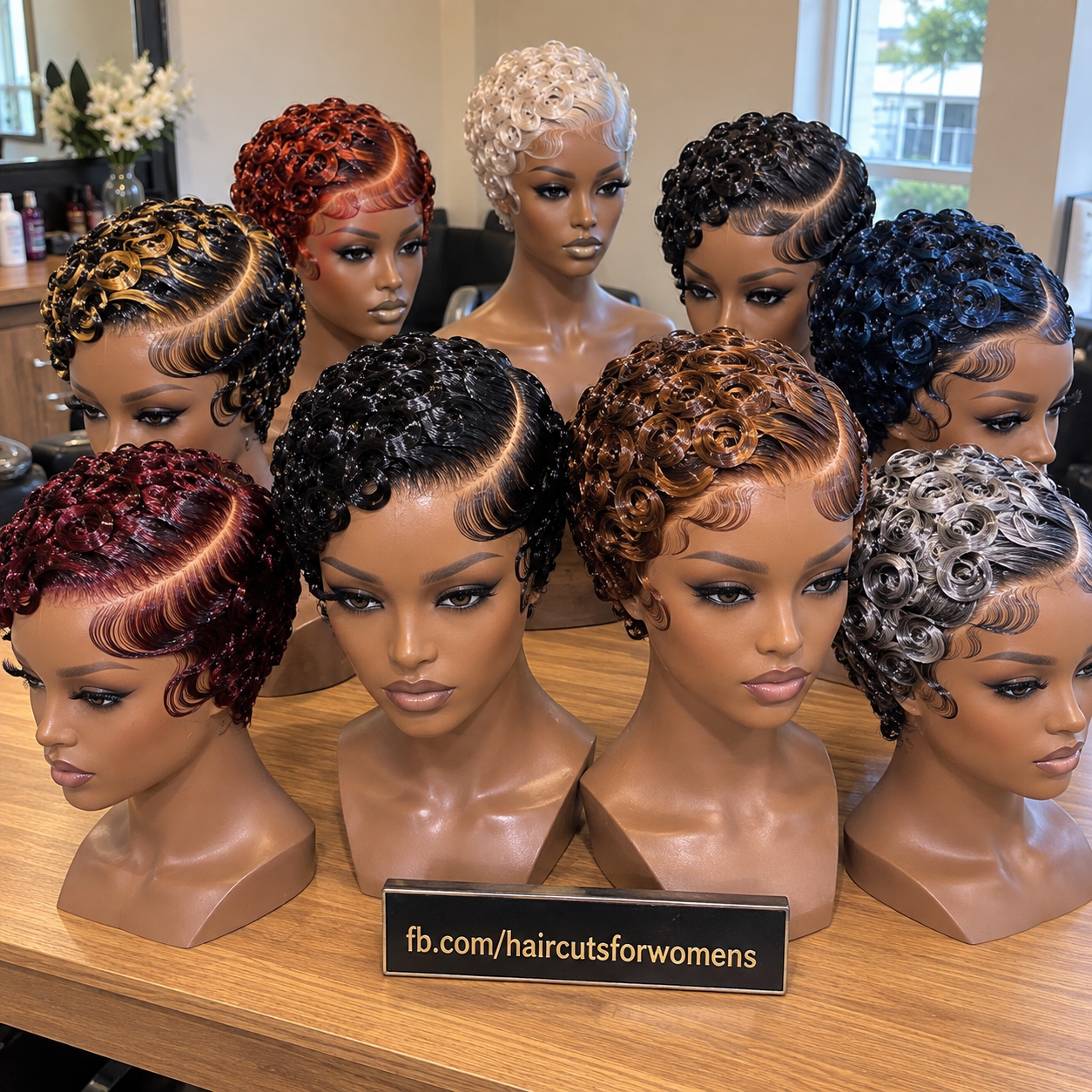
This nine-wig collection presents a sculpted pixie concept built around glossy ringlet curls, pronounced side parting and sweeping wave work across the forehead and temple. Although every mannequin follows the same overall styling direction, the color selection creates noticeably different results. The display includes deep black, burgundy wine, copper brown, golden caramel, silver-pearl, black with golden accents and a dark blue-black variation. That makes the image especially useful for customers who want to choose a color without changing the basic curl architecture.
The most recognizable element is the contrast between the circular curls and the flatter sections around the part. Numerous polished loops sit across the crown, while longer strands are guided into broad curved waves beside the parting. Those waves travel toward the forehead and temple before joining smaller curled pieces around the perimeter. This combination gives the style a deliberate direction instead of allowing the curls to sit randomly across the head.
For a custom order, the photograph should be used as a visual specification rather than simply requesting a curly pixie wig. The curl diameter, part direction, crown density, perimeter wave placement and selected shade should all be discussed separately. A stylist who understands those individual elements has a much clearer target for recreating the look.
The Swept Parting Controls The Entire Curl Arrangement
The visible side part is one of the strongest structural details across the collection. It begins near the front and travels diagonally through the upper section, creating a clear boundary between the compact ringlets and the sweeping forehead wave. Several mannequins are positioned at slightly different angles, making it possible to see how the part continues beyond the hairline.
On the front-center black unit, the parting is especially prominent. Dense circular curls occupy one side, while a broad polished section follows the opposite edge before curving toward the forehead. The copper unit beside it follows a similar arrangement, showing that the same structure can remain recognizable after a major color change.
When placing an order, specify whether you want the part on the left or right. This decision affects the direction of the larger front wave and determines which side displays more of the circular crown curls. If you regularly wear or photograph your hair from one preferred side, mention this during the consultation.
Compact Ringlets Give The Crown Its Sculpted Volume
The crown uses numerous circular curls with clearly visible centers. These loops are packed closely together, but there is still enough separation for the individual shapes to remain readable. The curls create fullness without extending excessively far from the head, keeping the overall pixie silhouette compact.
Lighting plays an important role in how these ringlets appear. On the black units, narrow reflections travel around each circular curl and reveal the structure despite the very dark color. On the burgundy, copper and golden variations, the same reflections become warmer and more noticeable.
If you want a similar result, ask the stylist for closely arranged polished ringlets rather than loose spiral curls. Curl diameter should also be discussed. Larger rings would create a more open crown, while very small coils would produce a substantially different surface. The photograph provides a useful guide for the approximate scale and density of the loops.
Broad Forehead Waves Connect The Part To The Temple
The flatter wave sections are just as important as the ringlets. Beside the diagonal part, several strands are grouped together and directed forward before curving around the forehead. They then narrow toward the temple, where smaller curled sections continue the movement.
This is particularly easy to see on the front burgundy, black and copper mannequins. Their color differences make the styling technique easier to compare because the basic wave direction remains similar. The burgundy version produces rich red reflections through the broad curve, while the black version places greater emphasis on shine and strand placement.
When discussing the wig with a stylist, ask for a broad sculpted finger-wave section beside the part with coordinated temple curls. A simple request for baby hairs would not describe what is visible here. The perimeter styling is a substantial part of the hairstyle rather than a small finishing detail.
Burgundy Wine Creates A Deep Jewel-Tone Option
Several burgundy variations appear throughout the collection. The shade moves between dark wine and brighter cherry-red depending on how the light strikes the curls. Deeper areas between the loops remain considerably darker, which gives the crown more depth.
This color works particularly well with circular curls because each ring reflects light independently. The raised sections appear brighter while the recessed areas retain their darker wine tone. As a result, the crown can look dimensional even without adding a separate highlight color.
If ordering burgundy, ask the seller for photographs of the actual available shade in daylight. Burgundy terminology varies widely between suppliers. Some shades lean purple, others lean cherry red, and some are closer to dark auburn. The reference image is therefore more useful than relying exclusively on a color name.
Silver-Pearl Ringlets Create A High-Contrast Alternative
The pale wigs introduce a cooler color family. Their curls appear silver-pearl with hints of champagne under the available salon lighting. Because the strands are so light, shadows inside the circular loops become highly visible and emphasize the ring pattern.
The pale color also makes the sweeping forehead sections easy to follow. Individual strands can be seen moving together from the part toward the temple, making these versions useful references for both color and styling direction.
Customers considering this shade should compare pearl silver, icy beige, champagne blonde and similar samples offered by the seller. The image cannot confirm a standardized manufacturer color number, and pale shades can change considerably under warm or cool lighting.
Copper Brown Gives The Loops A Warm Reflective Surface
The copper-brown mannequin near the front introduces rich warmth without moving into an extremely bright orange direction. Its curls contain deeper brown areas combined with stronger copper reflections along the raised strands. The result works particularly well with the circular curl pattern.
For customers who want something between brown and red, this color family can be explored through copper brown, cinnamon, auburn and warm chestnut samples. Ask the stylist to place the options beside one another before selecting a final formula or ready-made shade.
If a darker foundation is preferred, request deeper roots with copper through the upper curls. That approach can retain depth around the part while allowing the ringlets to catch more light.
Golden Caramel Accents Increase Separation Between Dark Curls
One of the collection’s most dimensional options combines a dark foundation with golden or caramel-colored sections. Instead of turning the entire wig blonde, lighter strands appear through selected areas of the curls. This creates strong contrast between neighboring loops.
Highlight placement matters with this type of styling. Concentrating the lighter pieces around selected ringlets can emphasize their circular shape, while distributing them too evenly may reduce the contrast. Customers should tell the colorist whether they prefer scattered accents, concentrated front highlights or a more balanced blend across the crown.
A useful request could describe a dark brown foundation with golden-caramel accents through the ringlet crown while retaining deeper color around selected sections of the part and perimeter.
Blue-Black Adds A Cooler Dark Direction
The dark blue variation provides a less expected alternative to traditional black. At first glance the wig remains very dark, but stronger light reveals cool blue reflections across the circular curls. This allows the wearer to keep the depth of a dark pixie while introducing a cooler color effect.
If this direction is appealing, ask the seller whether the available shade is blue-black, navy-black or a brighter sapphire-based mixture. These options can look dramatically different in daylight. A very subtle blue-black may appear almost black indoors, whereas stronger sapphire tones remain visible in most lighting.
The ringlet construction is particularly suitable for dimensional dark colors because the curved strands naturally create multiple reflective angles.
Black Remains A Strong Choice For Emphasizing Shape
The deep black versions put the greatest emphasis on the styling itself. Without strong color contrast, attention moves toward the ringlet pattern, diagonal part and sweeping front wave. Their glossy surface prevents the curls from disappearing into a single dark shape.
Buyers who want a dark result can compare natural black, raven black and deep espresso. These shades may appear similar indoors but reveal different undertones near a window. Requesting actual hair samples or unfiltered photographs can help avoid color surprises.
A dark foundation can also be useful for buyers who plan to add selected caramel, copper or silver accents later, provided the material is suitable for the intended coloring process.
Crown Density Should Be Agreed Before The Wig Is Built
The wigs shown here carry enough density to create numerous ringlets while maintaining clear separation between individual loops. This balance is important. Too little hair could leave gaps around the crown, while excessive density could make the circular arrangement appear crowded.
If you already own a base wig, send photographs to the stylist before booking a transformation. They should evaluate whether the unit contains enough usable length and density for this type of curl setting. Buying additional hair or a completely different base after the appointment has begun can increase the cost unnecessarily.
For a new custom unit, ask how much crown volume the stylist recommends and whether the wig will arrive fully styled. Also ask whether the ringlets can be reset later if repeated wear causes some loops to loosen.
Questions Worth Sending Before Paying A Deposit
- Can you recreate compact circular ringlets across the crown?
- Which side will carry the diagonal part?
- Can you reproduce the broad forehead wave shown in the reference?
- Will smaller curled pieces continue around the temple?
- Which available shade is closest to my selected mannequin?
- Can dimensional caramel or copper accents be added if requested?
- What hair or fiber material will be used?
- What measurements are required for the cap?
- Will the ringlets arrive fully arranged?
- How should loosened curls be restored?
- What is the expected production time?
- What alterations are available if the fit needs adjustment?
Premium Custom / Standard Custom / Basic Human Hair / Premium Synthetic / Basic Synthetic
No verified selling price is visible in the photograph. The ranges below are general budgeting examples and should not be interpreted as prices for the exact wigs shown. Final quotations depend on material, cap construction, density, coloring, labor and the amount of custom styling requested.
| Category | General Planning Range | Typical Cost Considerations |
|---|---|---|
| Premium Custom | $350–$750+ | Individual sizing, advanced color placement, extensive curl setting and detailed perimeter styling |
| Standard Custom | $220–$450 | Selected color, custom part direction, ringlet crown and sculpted wave work |
| Basic Human Hair | $140–$300 | Hair grade, density, cap construction and additional styling labor |
| Premium Synthetic | $80–$180 | Higher-grade fiber, dimensional shades and stronger preset curl retention |
| Basic Synthetic | $45–$100 | Stock shades, standard sizing and fewer customization choices |
Ordering Online Works Better When You Separate Color From Structure
With nine variations visible in one photograph, it is easy for a seller to misunderstand which details the customer wants. Start by selecting one mannequin as the primary reference. State its position in the photograph and identify the color you want.
Next, describe the structural elements independently: compact ringlet crown, diagonal side part, broad forehead wave and smaller temple curls. If you want the color from one mannequin but the curl placement from another, explain that explicitly.
Ask the seller to confirm the request in writing before paying. The confirmation should include the chosen shade, material, cap size, customization work, production period, shipping method and total cost. For custom-colored units, also check the seller’s alteration and return conditions.
A Salon Consultation Can Prevent Problems With The Base Unit
If you plan to buy an unfinished wig and have it styled locally, contact the stylist before purchasing the base. Send this photograph and ask what length, density and material they need to create the ringlet crown and sculpted wave sections.
The stylist may recommend a specific amount of usable hair around the crown or a particular construction that makes the side part easier to position. Getting that advice first can prevent spending money on a base that cannot support the desired arrangement.
During the appointment, confirm the part direction before the ringlets are completed. Once the crown is fully arranged, changing the part can require substantial restyling.
Protecting The Ringlets Between Wears
Storage is especially important for a style made from carefully arranged loops. Keep the wig on a suitable mannequin head or stand so the crown is not compressed. Avoid placing clothing, another wig or a storage lid directly against the ringlets.
Do not brush through the circular curls unless the stylist specifically instructs you to reset the hairstyle. Brushing can separate the loops and remove the visual pattern that gives the wig its distinctive crown.
Before applying heat, verify the material and safe temperature. Human hair and synthetic fibers require different care. Some synthetic materials can be permanently damaged by temperatures commonly used on human hair.
Photographing Each Color Helps Customers Compare The Collection
For a wig business, this type of collection works best when every color is photographed from consistent angles. A direct front view shows the overall silhouette, while a three-quarter view reveals the part and temple work. A slightly elevated view can show how the ringlets are distributed across the crown.
Color photographs should ideally include consistent lighting as well. Burgundy, copper, silver and blue-black can all change noticeably depending on the light source. Providing both salon-light and daylight photographs can help customers understand the shade before ordering.
The product description should also distinguish visible styling from construction details that cannot be confirmed through photographs. If the cap type, fiber specification or other technical information is important, it should come from the actual product record rather than assumptions based on appearance.
Search Terms
Side Part Ringlet Pixie Wig · Burgundy Wine Curl Pixie Wig · Pearl Silver Ringlet Wig · Copper Brown Pixie Wig · Golden Caramel Highlight Wig · Blue Black Curl Pixie Wig · Sculpted Finger Wave Wig · Glossy Circular Curl Wig
Building A Custom Color Rotation Around One Recognizable Pixie
This collection demonstrates how a single styling concept can support a broad product range. The recognizable elements remain the compact circular curls, diagonal part and sculpted forehead waves, while color changes create different personalities. Burgundy provides deep red richness, copper adds warmer reflections, golden caramel increases contrast, pearl silver creates a brighter cooler option and blue-black offers subtle color within a dark foundation.
Customers should decide which of those elements are essential before contacting a seller. Some may prioritize the exact ringlet arrangement, while others may care most about the sweeping part or a specific color combination. Listing those priorities gives the wig maker clearer instructions and makes it easier to discuss what can realistically be reproduced.
Before confirming the final order, review the selected shade, curl diameter, crown density, part direction, front-wave placement, cap measurements, material and maintenance instructions. Request photographs of comparable work when available and confirm whether the wig will arrive ready to wear or require final salon styling. Treating each of these decisions separately gives both customer and stylist a precise plan for creating a glossy ringlet pixie inspired by the collection without relying on vague hairstyle descriptions.