
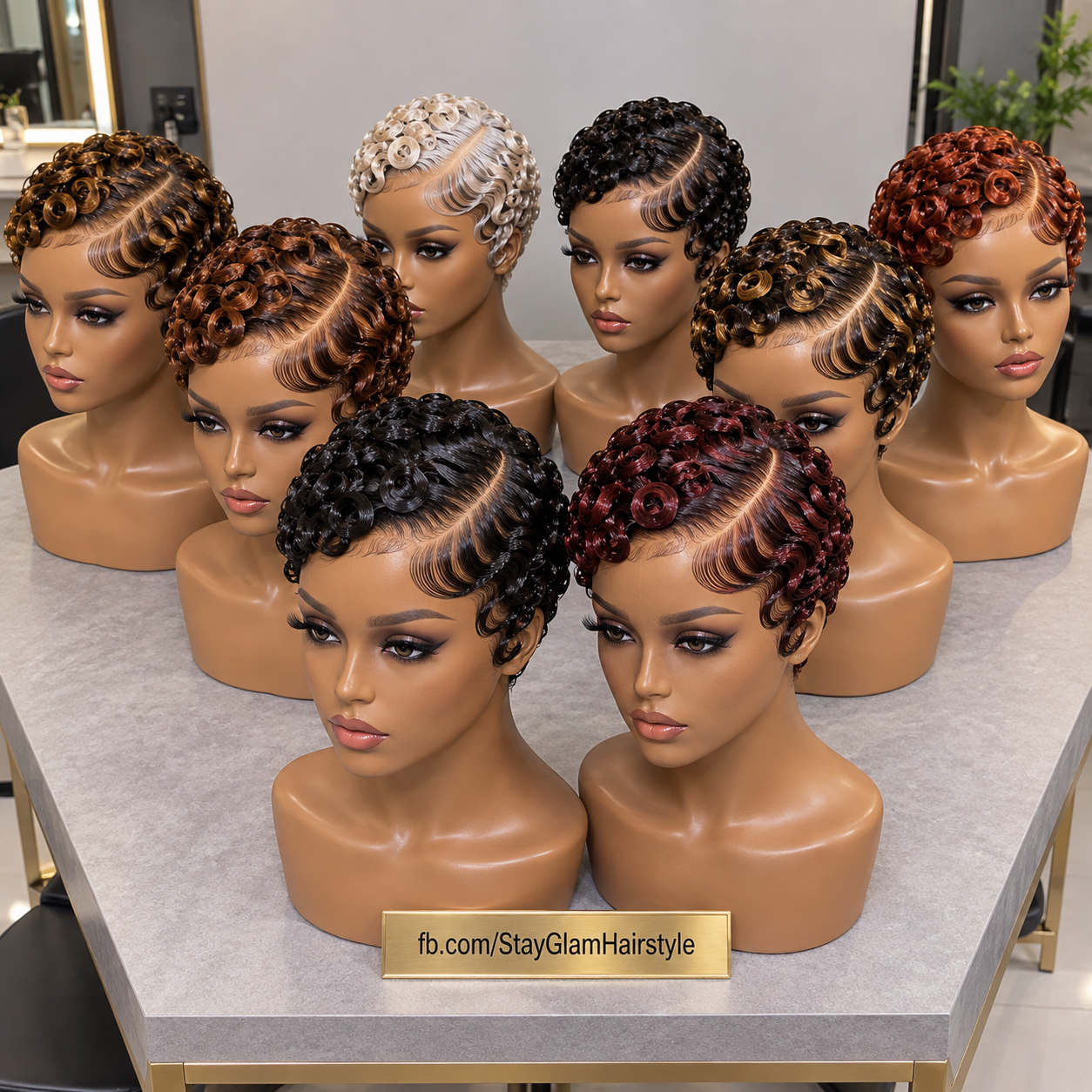
This side-swept ring curl pixie wig collection focuses on one highly recognizable salon silhouette while showing how dramatically the finished look can change through color. The wigs share a compact curled crown, a visible diagonal side part, glossy circular curls and broad finger-wave styling that sweeps across the temple. The displayed color family ranges from deep natural black and espresso brown to caramel-highlighted brown, burgundy wine, copper auburn and pale pearl blonde. Instead of relying on extra length, the collection gets its impact from curl placement, shine, directional styling and carefully shaped front sections.
The strongest detail is the relationship between the curls and the side part. The crown carries numerous polished ring curls, while the diagonal part opens a clear line through the hairstyle. From that part, the hair is arranged into sweeping sections that curve toward the forehead and temple. This gives the style a deliberate asymmetry: one area appears densely curled while the opposite section becomes more sculptural and directional.
For anyone ordering a similar wig, the reference is useful because it shows several decisions that should be discussed separately with a wig stylist. Color, ring size, part placement, crown density and finger-wave direction all contribute to the final result. Simply requesting a curly pixie wig may not reproduce this appearance. The stylist needs to understand the exact curl formation and the broad sweeping pattern visible around the side part.
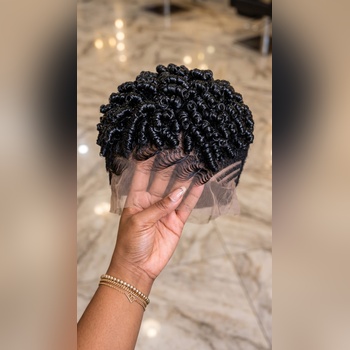
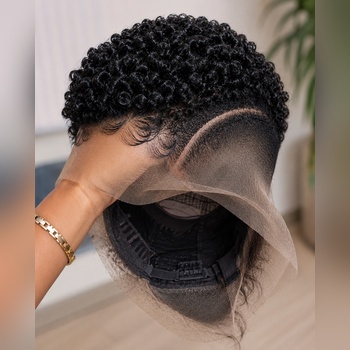
The Diagonal Part Creates The Main Direction Of The Hairstyle
A clearly visible diagonal part is one of the most important elements in this collection. It begins near the front and travels backward, separating the densely curled crown from the flatter sculpted section. Because the part is exposed rather than hidden beneath curls, it becomes part of the design itself.
The placement also controls how the curls fall. On one side, compact ring curls sit closely together and create volume. On the other, the strands are directed into broad curved sections that follow the shape of the head. This contrast prevents the hairstyle from looking like a uniform mass of curls.
When requesting this look from a salon, show the stylist exactly where you want the part to begin and how far back it should travel. A part positioned too close to the center will create a different balance, while one placed farther toward the temple will make the curled section appear broader. Front and three-quarter reference photographs are particularly useful for communicating this detail.
Glossy Ring Curls Give The Crown A Polished Salon Shape
The crown is built from small to medium circular curls with clearly visible openings. Many of the rings sit flat or slightly raised rather than hanging downward. This arrangement produces a compact rounded shape that follows the head closely.
The curls are also highly reflective. Their glossy surface makes each loop easier to distinguish and gives the darker wigs strong dimensional highlights. On the lighter colors, the same ring formation becomes even more visible because the shadows between individual curls create additional contrast.
Curl size should be discussed before ordering. Larger rings would create a softer and more open appearance, while very tiny curls would produce a denser surface. The reference sits between those extremes, using enough separation for individual rings to remain visible without leaving obvious empty areas across the crown.
Finger-Wave Sections Frame The Forehead And Temple
The broad curved sections around the front are just as important as the ring curls. These strands are arranged into sweeping finger-wave shapes that follow the diagonal part and move toward the temple. The pattern creates elongated curves beside the smaller circular curls, giving the hairstyle two distinct forms of movement.
Some sections form long S-shaped sweeps, while smaller curls appear around the edge of the hairstyle. This layered approach helps connect the crown to the hairline. The result looks intentional from both frontal and three-quarter viewing angles.
If a stylist is recreating this reference, ask for the front wave placement to be planned before all the crown curls are finalized. The waves should have enough room to remain visible rather than becoming hidden underneath the surrounding rings.
Espresso Black Brings Out The Shine And Curl Separation
The darkest wigs in the collection use a deep natural black to espresso-black appearance. These versions place maximum attention on the architecture of the hairstyle. Under salon lighting, reflections travel around the circular curls and across the sweeping side sections, allowing the pattern to remain visible despite the dark color.
This is a strong option for someone who prefers a deep shade but still wants a highly detailed style. Rather than depending on contrasting highlights, the visual interest comes from the relationship between light, curl direction and the exposed part.
For custom orders, it is worth confirming whether the desired shade is natural black, soft black, espresso or another very deep brown-black. Similar shades can photograph almost identically under bright lighting but look different in daylight.
Caramel Brown Highlights Emphasize Individual Rings
Several pieces introduce caramel and golden-brown accents through a deeper brown foundation. These warmer strands make the circular pattern particularly noticeable because highlights travel around the outer edges of the curls.
The effect is dimensional rather than flat. Darker areas remain visible underneath, while the warmer brown appears across selected raised sections. This gives the crown additional depth and prevents the highlighted portions from appearing like one solid block of color.
When ordering this variation, describe whether you want scattered caramel accents, a brown-to-caramel blend or stronger highlighting around the upper curls. A color consultation or physical swatch can help because warm browns may appear more golden, copper or neutral depending on lighting.
Copper Auburn Creates A Warm Statement Without Losing Depth
The copper-auburn versions shift the collection toward a warmer palette. The color combines deep brown undertones with copper reflections that become especially visible around the ring curls. Because the style is compact, the warm shade remains concentrated around the head instead of spreading through long lengths.
This coloring works particularly well with the glossy finish. Light catches the raised curls and produces brighter copper reflections, while the deeper areas between the rings remain darker. The result gives the crown a layered appearance even though the hairstyle itself remains relatively compact.
A buyer requesting this shade should avoid relying only on broad terms such as brown or auburn. Show the reference and ask the stylist to identify the closest available color combination before production begins.
Burgundy Wine Gives The Curl Pattern A Deeper Red Direction
The burgundy variation adds a rich wine-red option to the same side-swept construction. Dark undertones remain visible beneath the red surface, which helps preserve depth between the curls. Under brighter light, individual rings reveal cherry and burgundy reflections rather than appearing as one uniform dark red area.
This can be a useful choice for customers who want a noticeable color change while retaining a deeper overall palette. The sculpted side waves are particularly striking in burgundy because the direction of each strand becomes visible as light travels across the curved surface.
Ask the colorist whether the available shade leans toward wine, cherry, plum or auburn-red. These tones are not interchangeable, and checking a sample before ordering can prevent unexpected results.
Pearl Blonde Makes Every Curl Highly Visible
The lightest wig in the display uses a pale pearl-blonde appearance. Against this color, the individual rings become extremely easy to see. The diagonal part is also more prominent because the pale strands frame the exposed line clearly.
The front waves take on a different character in the lighter shade. Instead of relying primarily on reflected shine, their shape is visible through the contrast created by overlapping strands. This makes the pearl variation useful for anyone who wants the sculpted pattern itself to be the dominant visual element.
When ordering a pale version, discuss whether you prefer pearl blonde, platinum blonde, creamy blonde or silver-blonde. The reference appears light and relatively neutral, but exact color should always be confirmed through the seller’s available shade system.
Why The Same Construction Looks Different In Every Color
Although the wigs share a common structure, each shade changes what the eye notices first. Dark hair emphasizes reflected shine and the silhouette. Caramel-highlighted brown emphasizes separation between individual rings. Burgundy draws attention to the front and crown through rich red reflections. Copper adds warmth, while pearl blonde exposes nearly every curve in the styling.
This is useful when choosing a custom wig because color should not be treated as an afterthought. Consider whether you want the overall silhouette, the individual curls or the sweeping side waves to attract the most attention. The answer can help determine which shade will best display the details you care about.
What To Request During A Salon Consultation
Bring several reference angles whenever possible. Tell the stylist that the crown should consist of compact polished ring curls rather than loose spirals or fluffy curls. Point out the visible diagonal part and explain that the front section should be directed into broad finger-wave curves.
Discuss crown height as well. The wigs shown have enough volume to display the rings clearly, but the shape remains close to the head. Excessive height would change the proportions and make the style look less like the reference.
Color placement should be confirmed separately. If you select a highlighted brown variation, specify whether the lighter strands should appear throughout the crown or primarily across selected curls. For burgundy, copper or pearl shades, request a color sample or completed unit photograph whenever the seller can provide one.
Visible Construction Should Be Separated From Unverified Specifications
The image clearly shows the finished hairstyle, color variations, diagonal part, circular curls and sculpted front sections. It does not reliably establish every technical specification of the wigs. A photograph alone cannot confirm a particular lace grade, exact fiber composition, hair origin or manufacturing method.
For that reason, ask the seller directly about cap construction, lace type, attachment system, adjustable straps, combs, density and material. If you specifically need HD lace, transparent lace or another technical feature, confirm that it is listed in the actual product description or custom-order agreement rather than assuming it from appearance.
Human Hair Or Synthetic Fiber For This Curl Pattern
A human-hair version may suit customers who want greater flexibility for professional restyling. Depending on hair quality and processing history, a stylist may be able to refresh curls, adjust the direction or perform certain color services. However, human hair varies widely in quality, so ask for detailed information before paying a premium price.
A quality synthetic option may be attractive when retaining a preset ring formation is the main goal. Synthetic fibers can hold sculpted shapes well, but heat tolerance and maintenance requirements vary significantly. Never assume that a synthetic unit can be curled with hot tools unless the manufacturer confirms an appropriate temperature range.
Whichever material you choose, ask how the ring curls should be refreshed. This hairstyle depends on deliberate placement, so maintenance instructions are more important than they would be for a loose, intentionally tousled curl pattern.
Premium Custom And Ready-Made Price Planning
Prices vary substantially by salon, country, material, customization and coloring work. The following ranges are general planning estimates rather than prices for the wigs pictured. Always request an individual quotation from the seller or stylist.
| Category | Estimated Range | What To Confirm |
|---|---|---|
| Premium Custom | $350–$750+ | Hair quality, custom color, measurements, curl setting, part placement and final fitting |
| Standard Custom | $220–$450 | Available colors, crown density, cap construction and styling service |
| Basic Human Hair | $140–$300 | Hair quality, processing, included styling and customization charges |
| Premium Synthetic | $80–$180 | Fiber quality, heat tolerance, ring retention and cap adjustment |
| Basic Synthetic | $45–$100 | Preset shape, color availability, care instructions and expected longevity |
A Practical Ordering Checklist For This Side-Swept Pixie
- Choose the exact color variation you want to use as the reference.
- Send clear front and three-quarter photographs to the wig stylist.
- Request compact circular ring curls across the crown.
- Show the exact diagonal part position you want.
- Specify broad sculpted finger waves around the front and temple.
- Confirm the preferred crown height and overall density.
- Provide accurate head measurements using the seller’s instructions.
- Ask whether the unit is human hair, synthetic fiber or another material.
- Confirm the actual lace and cap construction instead of relying on photographs.
- Ask whether the unit arrives fully styled or requires a salon appointment.
- Confirm the total price for the wig, coloring, styling, customization and shipping.
Preserving The Circular Curls After Purchase
Maintenance should protect the ring formation rather than repeatedly disturbing it. Avoid pulling a conventional brush through the crown unless the stylist specifically instructs you to do so. Brushing can separate carefully arranged rings and change the compact silhouette.
When the wig is not being worn, place it on a suitable wig stand or mannequin head so the crown is not crushed. Keep the curled surface away from rough fabrics and avoid stacking other items on top of the unit. The broad front waves should also remain supported rather than folded against a storage container.
Use only products compatible with the actual material. Heavy oils or excessive styling products may accumulate between tightly placed curls. Ask the seller for a washing and refreshing routine designed for the specific hair or fiber used in the wig.
Booking A Stylist For Final Personalization
Even when purchasing a finished wig, a salon appointment can help personalize the fit and presentation. A wig stylist can evaluate cap placement, adjust the front position and refine the curls so they sit correctly on the wearer’s head. If additional cutting or heat styling is required, it should only be performed when the material supports those services.
Before booking, send the salon photographs of both the purchased wig and the desired finished appearance. Ask whether the stylist regularly works with compact pixie units and sculpted curl patterns. This helps ensure that the person handling the wig understands that the ring arrangement and side waves are intentional elements that should be preserved.
Search Terms
Side-Swept Ring Curl Pixie Wig · Burgundy Ring Curl Wig · Pearl Blonde Pixie Wig · Caramel Highlight Curl Wig · Copper Auburn Pixie Wig · Deep Natural Black Ring Curl Wig · Finger Wave Pixie Wig · Diagonal Side Part Curly Wig
Choosing A Color Without Losing The Original Design
The advantage of this collection is that the underlying hairstyle remains recognizable across very different shades. This means buyers can choose color according to personal preference without abandoning the compact ring-curl concept. A deep shade gives the design a rich glossy appearance, warm brown adds visible dimension, burgundy introduces wine-red depth, copper provides warmth and pearl blonde creates strong visual separation between the curls.
When comparing colors, look at the entire wig rather than only the crown. The selected shade also changes the appearance of the finger waves and side part. A light color makes every directional strand obvious, while a dark color produces a more unified silhouette with strong reflected highlights.
For mixed-color versions, ask the stylist how the lighter strands will be distributed. Random highlighting, concentrated crown highlights and a gradual color transition can produce very different results even when similar colors are used.
Turning This Reference Into A Detailed Custom Order
A successful custom order begins with specific visual instructions. Identify the color you want, then describe the hairstyle as a compact ring-curl pixie with a diagonal side part and sweeping finger-wave sections. Discuss the size of the rings, the amount of crown volume and the direction of the front styling.
Next, confirm all construction details separately from the appearance. Ask about material, cap size, lace specification, attachment options and adjustment features. If the stylist is coloring the wig specifically for you, request confirmation of the final shade before the styling process is completed.
Finally, establish what happens after purchase. Ask whether maintenance appointments are available, how frequently the ring curls may need professional refreshing and which products should be used at home. A carefully planned order makes it easier to preserve the qualities visible in this collection: polished circular curls, a prominent diagonal part, sculpted temple waves and rich color variation in a compact salon-inspired silhouette.