
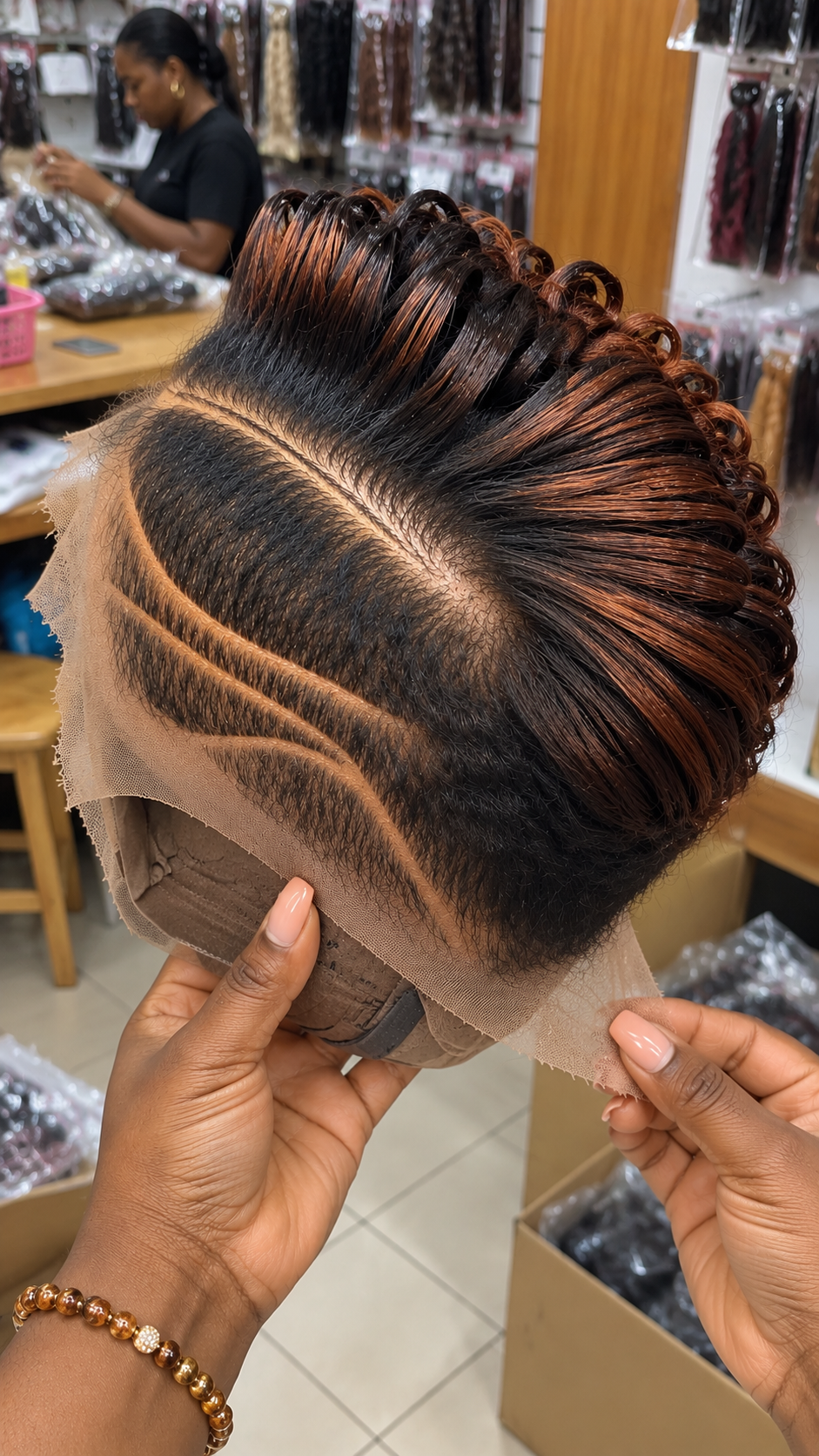
This sculpted pixie wig uses color placement, controlled loop formation and precise side detailing to create a design that looks especially strong from a three-quarter angle. The foundation appears deep espresso, while burnished copper ribbons travel through selected sections of the upper hair. Rather than coloring the entire crown, the warmer shade is concentrated inside individual loops and sweeping strands. That selective placement gives the hair depth and makes the curl direction easier to see.
The photograph is particularly useful for anyone considering a custom order because the wig is shown before installation. The extended lace, interior cap area, long diagonal separation and curved side pattern are all visible. It shows that this is not simply a curly unit with color added afterward. The visual structure depends on the crown, side panel, parting and color being planned as one design.
Burnished Copper Ribbons Give the Dark Foundation More Dimension
The upper section combines an espresso base with narrow copper-brown ribbons. The warmer color does not appear at equal intervals. Some loops carry a stronger copper presence while neighboring sections remain predominantly dark. This irregular distribution keeps the result dimensional rather than striped.
The color becomes particularly noticeable where the hair bends over the crown. Light reflects from the copper sections while the darker foundation creates shadow beneath them. A stylist recreating this look should therefore concentrate on placement rather than simply increasing the percentage of highlighted hair.
If ordering remotely, send the reference photograph instead of relying only on a commercial shade number. Ask the seller to show a sample of the proposed copper tone before completing the unit because lighting, fiber type and processing can all affect how warm brown shades photograph.
The Crown Moves From Tall Loops Into a Sweeping Rear Flow
The silhouette is not uniformly curly. Near the upper front, the hair rises into large elongated loops. Moving backward, those loops gradually curve and settle into a lower directional flow. Smaller curled sections are visible around the rear edge, helping the shape transition without an abrupt stop.
This variation is important. Repeating the same curl diameter across the entire wig would produce a much rounder silhouette. Here, the stylist uses larger loops for height and flatter directional sections for contour.
When requesting the design, specify that the crown should remain elevated while the side and rear should stay closer to the base. That instruction is more useful than simply asking for “curly hair,” because the defining feature is the relationship between different curl heights.
A Long Sweeping Part Separates the Crown From the Side Panel
A prominent curved diagonal part begins near the front and travels toward the back of the wig. It acts as the main boundary between the raised upper hair and the closely shaped side. Because the crown hair is directed away from this line, the separation remains highly visible.
The part also creates an elongated visual path through the style. It is not a conventional straight center part. Repositioning it would substantially alter the profile, especially once the wig is installed.
For a custom commission, show the stylist which side should carry the visible separation. Mirroring a hairstyle from one side to the other may require changes to curl direction and side detailing, so that decision should be made before construction begins.
The Double Curved Side Pattern Is a Key Custom Detail
Below the primary part, two narrow curved separation lines sweep backward through the close side section. The upper line follows the main diagonal direction while the lower line creates a second contour beneath it. Together they form a layered side pattern without overwhelming the rest of the wig.
The spacing between these lines is especially important. If they are positioned too closely, they can visually merge. If they are placed too far apart, the side panel becomes much heavier. The photograph provides a useful reference for maintaining a slim, balanced gap.
Anyone commissioning the unit should explicitly request a double curved side pattern. Sending both a close side photograph and an overall reference can help the wig maker understand how the lines should connect visually with the crown.
Directional Side Hair Keeps the Profile Controlled
The hair between the main diagonal separation and the lower pattern is styled close to the base. Fine strands follow the curve rather than standing outward. This creates a controlled surface that contrasts with the larger loops above.
The lower section also appears compact, allowing the side design to remain visible. Excessive density in this area could conceal the curved lines and make the wig appear bulky around the temple and ear area.
For this reason, density should be discussed by zone. The crown needs enough hair to support the loop structure, while the side requires a much more restrained finish.
The Lace Perimeter Is Clearly Visible Before Installation
The image shows lace extending beyond the styled hairline. This indicates that the photographed unit has not yet received its final wearer-specific perimeter trimming. The visible lace provides additional material for fitting and customization.
However, the photograph alone does not establish the commercial grade or technical specification of that lace. Buyers should ask the seller what lace type and shade are supplied rather than assuming a particular product category from appearance.
It is also worth confirming whether the seller delivers the unit with the lace untrimmed, partially prepared or completely customized. That choice determines how much work remains for the installing stylist.
What to Request When Ordering This Copper-Ribbon Pixie
- Deep espresso foundation with selective burnished copper accents.
- Large raised loops concentrated through the upper crown.
- Directional sweeping strands through the side and rear.
- Long curved diagonal separation from the front toward the back.
- Two slim parallel curved lines through the lower side panel.
- Compact density around the lower side and back.
- Visible strand separation rather than fluffy curl formation.
- Custom fitting and lace finishing appropriate for the wearer.
Keep the reference image attached to the order. This particular design contains enough small details that a written description alone may not communicate the exact proportions.
Finding a Stylist Who Can Reproduce the Sculpted Structure
Look for a wig stylist or salon with previous work involving molded pixies, loop curls, directional side styling and detailed parting. A portfolio consisting mainly of long straight or loose-wave units does not necessarily demonstrate experience with this type of construction.
Pay close attention to side-view photographs. The strongest technical elements of this wig are visible from the side: the diagonal separation, double curved pattern, close lower section and transition into the raised crown.
When booking, ask whether the stylist can both construct and install the unit. If different professionals handle those stages, provide the same reference images and specifications to both so the final installation does not alter the intended shape.
Price Guide for a Custom Copper-Accent Sculpted Wig
| Wig Category | Estimated Range | Typical Scope |
|---|---|---|
| Premium Custom | $420–$780+ | Higher-grade hair, custom color placement, cap sizing, sculpted crown, detailed side work and advanced finishing |
| Standard Custom | $260–$440 | Custom measurements, two-tone coloring, loop styling and personalized side detailing |
| Basic Human Hair | $170–$290 | Human-hair foundation with simplified color and sculpting |
| Premium Synthetic | $105–$195 | Quality fiber with preset tones and selected hand-shaped sections |
| Basic Synthetic | $65–$130 | Budget interpretation with reduced customization |
These figures are general planning estimates rather than a price for the exact wig pictured. Hair material, stylist experience, color work, cap construction, location and installation services can all change the final cost.
How to Place a Custom Order With Fewer Surprises
Begin by sending clear photographs from the front, side and rear whenever available. State that the desired palette is an espresso foundation with warm copper ribbons rather than an all-over copper color. Point out the long diagonal part and double curved side pattern separately.
Next, confirm cap measurements, lace shade, hair material and whether the quoted price includes installation. Ask for the expected completion time before paying a deposit. For remote purchases, requesting finished-unit photographs before dispatch can help identify obvious differences while adjustments may still be possible.
If the stylist offers several curl options, emphasize the elongated loop formation shown in the reference. Standard ringlets or small coils will not create the same upper silhouette.
Preserving the Loops After the Wig Is Finished
The crown should be protected from compression during storage. A box that presses directly against the upper loops can distort their shape. Store the unit upright on suitable support when possible and keep heavier objects away from the crown.
Avoid brushing through the finished loops. The design relies on individually arranged sections, so general brushing can merge them into a different texture. Minor flyaways can be addressed locally, while substantial reshaping is better handled by a stylist familiar with molded pixie work.
Heat should only be used when appropriate for the hair or fiber supplied. Ask the seller about temperature limits and recommended products before attempting home maintenance.
Why This Design Works Well for a Custom Wig Portfolio
This piece offers several visible customization choices in one compact silhouette. The copper ribbons create immediate color contrast, the raised loops provide volume, and the double curved side pattern gives the wig an identifiable profile. For wig businesses, that makes it suitable for showcasing craftsmanship from several camera angles.
Variations can be developed by changing the accent tone while retaining the basic construction. Cinnamon brown, amber copper, muted bronze or warm chestnut could each create a different appearance without removing the signature crown-and-side relationship.
The strongest product photography should include a side view similar to the reference because that angle explains far more than a simple frontal photograph. Customers can see the color distribution, loop scale, part direction, side pattern and unfinished lace in one frame.
Search Terms
espresso copper pixie wig · burnished copper ribbon curls · double curved side part wig · sculpted loop crown unit · copper highlighted pixie lace wig · diagonal part curly pixie · molded side panel wig · espresso and copper wig