
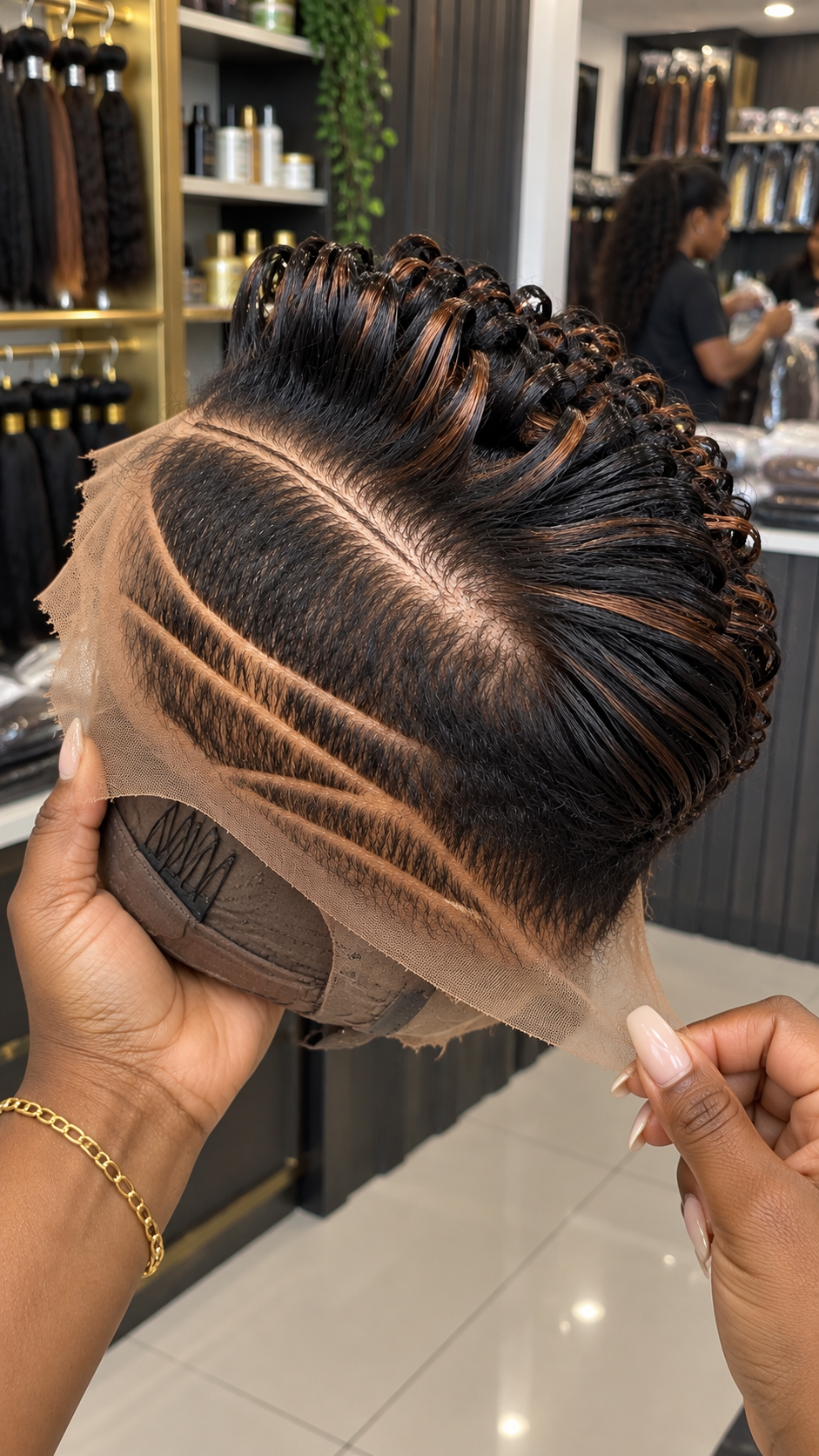
This custom pixie wig is built around contrast, direction and precision. The photograph shows a dark espresso base accented with warm caramel ribbons through the raised crown, while the side is shaped into a close, sweeping panel with two narrow curved separation lines. Instead of covering the entire unit with tight curls, the design uses larger looped sections through the upper area and increasingly compact shaping toward the back. That combination gives the wig a distinctive salon-made appearance from the side.
The unit is photographed before installation, which makes several construction details visible. The lace extends around the perimeter, the interior cap can be seen beneath it, and the side design is already incorporated into the wig. For anyone ordering a similar piece, this view is useful because it shows that the crown, color placement and side pattern need to be planned together rather than treated as separate finishing choices.
The Espresso and Caramel Color Placement Creates the First Point of Interest
The color is not distributed as an all-over highlight. Most of the foundation remains a rich espresso-black tone, while narrow caramel-brown ribbons appear selectively through the raised loops. Some highlighted strands travel through an entire loop, allowing the warmer shade to catch the light as the hair curves backward.
This placement matters because too many light sections would completely change the balance of the design. The photograph keeps enough dark hair between the caramel pieces to preserve depth. When commissioning the style, ask for selective ribbon placement rather than uniform streaks across every curl.
A stylist can adjust the warmth of the accent shade to suit the client, but photographs are more useful than relying solely on names such as caramel, honey or chestnut. Hair suppliers frequently use those labels differently.
Raised Loop Styling Gives the Crown Its Architectural Shape
The upper section is arranged in broad polished loops that rise away from the base before curving toward the rear. These loops are noticeably larger near the front and center. Moving toward the back, the pattern becomes tighter and more compact, allowing the silhouette to follow the head rather than remaining equally high everywhere.
This graduated construction is one of the reasons the wig appears balanced. A crown made entirely from identical loops could become too round or heavy. Here, the larger front loops create height while the rear sections provide a controlled transition.
The reflective finish also emphasizes individual strands. A wig stylist recreating the look should focus on separation and direction instead of simply adding more styling product. Excess product can make sculpted sections appear stiff rather than polished.
The Long Diagonal Part Organizes the Entire Design
A sweeping diagonal separation runs from the front toward the rear and divides the raised crown from the close side panel. This line is visually important because the upper loops are directed away from it, making the part appear longer and more pronounced.
Changing this part to a center position or a much steeper angle would create a different hairstyle. If this exact profile is the goal, provide the wig maker with a clear side photograph and specify that the long curved diagonal placement should remain visible after fitting.
The scalp-toned separation also creates contrast against the dark base. For a custom order, the final appearance will depend on the construction, density, lace tone and how the unit is fitted to the wearer.
Two Sweeping Side Lines Add a Graphic Signature
Beneath the main diagonal part, the close side section contains two slim curved separation lines. They travel backward in parallel before gradually following the contour of the lower panel. Their spacing is deliberate: they are close enough to read as one coordinated design but separated enough for each line to remain visible.
This is one of the most recognizable details in the photograph. A client who wants the same concept should specify two curved lines rather than simply requesting a side design. Width, spacing and direction should be agreed on before the wig is completed.
The remaining hair between and beneath the lines stays very close to the base. That restrained density allows the pattern to remain visible instead of disappearing underneath longer side hair.
The Side Panel Uses Directional Waves Rather Than Loose Hair
Above the two curved lines, the hair is laid into elongated directional waves that flow toward the rear. These sections create a bridge between the large crown loops and the closely cropped lower area. The wave pattern is subtle compared with the crown, but it contributes significantly to the overall silhouette.
For a convincing recreation, the side should not be left fluffy. It needs controlled strand direction so the surface appears intentionally sculpted. This type of finishing is best discussed with a wig stylist who already works with pixie units, molded sections and detailed side designs.
The Visible Lace Makes Pre-Installation Customization Easier to Understand
The photograph clearly shows untrimmed lace around the perimeter. Because the unit is being held rather than worn, the lace has not yet been cut to a specific hairline. That provides room for a stylist to fit and finish the perimeter for the eventual wearer.
The image does not confirm a specific commercial lace grade, so buyers should ask the seller directly what lace material and shade are being supplied. Do not assume terms such as HD lace or transparent lace from appearance alone.
Also ask whether the quoted service includes lace trimming, cap adjustment, fitting and final styling. A custom unit can be sold at several different stages of completion, and those differences affect both price and the amount of salon work required afterward.
What to Tell Your Wig Stylist Before the Order Is Started
- Deep espresso-black foundation rather than a flat single-tone appearance.
- Selective warm caramel ribbons concentrated through the upper loops.
- Large elevated loop sections at the front and crown.
- Progressively tighter shaping toward the rear.
- Long sweeping diagonal part from front toward back.
- Two slim curved separation lines through the close side panel.
- Directional molded waves above the side detailing.
- Compact lower side and back profile.
These instructions should be accompanied by the reference photograph. Written descriptions help establish the specifications, but the image communicates the exact relationship between the crown, color and side pattern more effectively.
Choosing a Stylist for a High-Detail Pixie Unit
This design requires more than basic wig construction. Look for a stylist whose portfolio contains molded pixies, sculpted loop curls, close side sections and custom directional parting. Examine photographs taken from the side and rear as well as frontal promotional shots.
Ask whether the stylist creates the side pattern directly in the unit or modifies a finished wig afterward. The crown and side design should align naturally, so planning them together can produce a more coherent result.
For local work, booking an in-person consultation can be useful because the stylist can discuss cap measurements and where the diagonal part should sit relative to the client’s face. For remote orders, follow the seller’s measurement instructions carefully rather than estimating cap size.
Price Expectations for a Sculpted Two-Tone Pixie Wig
| Wig Category | Estimated Price Range | What May Be Included |
|---|---|---|
| Premium Custom | $400–$750+ | Higher-grade hair, custom sizing, detailed color placement, sculpted loops, side pattern and fitting |
| Standard Custom | $250–$420 | Personalized cap sizing, two-tone styling, molded crown and detailed side work |
| Basic Human Hair | $160–$280 | Human-hair foundation with simplified customization and styling |
| Premium Synthetic | $100–$190 | Higher-quality fiber with preset color and selected hand finishing |
| Basic Synthetic | $65–$125 | Budget interpretation with simpler color placement and construction |
These ranges are general estimates for planning purposes and are not the confirmed price of the photographed wig. Custom coloring, hand sculpting, cap construction, hair source, lace selection, stylist experience and location can substantially affect the final quote.
Questions Worth Asking Before Paying a Deposit
Confirm whether the wig shown in the seller’s portfolio is an example or the exact unit being sold. If the order is custom-made, ask how closely the curl scale, caramel placement and two-line side pattern can be reproduced.
Request information about the hair material, cap size, lace shade, density, processing time and customization included in the quoted price. It is also sensible to ask for photographs or a video of the finished unit before shipping when ordering remotely.
For color, send the reference image and describe the desired contrast as dark espresso with selective warm caramel ribbons. That is more specific than requesting a generic brown highlighted wig.
Installation Should Preserve the Crown Instead of Flattening It
The upper loops are the centerpiece of the design, so installation should be performed without repeatedly pressing down the crown. A stylist experienced with sculpted pixies can work around the perimeter while protecting the established loop pattern.
During the appointment, keep the reference photograph available. Once the wig is positioned, the stylist can check whether the long diagonal part and side lines are sitting at the intended angle before completing the perimeter work.
Storage Matters More With Hand-Shaped Loop Curls
After wear, the unit should be stored in a way that protects its height. Avoid placing it flat underneath clothing, other wigs or heavy packaging. Pressure on the top can distort the large loops and alter the graduated crown silhouette.
Routine brushing is also inappropriate for this type of finish. The styling depends on separated loops and molded directional sections. If the pattern eventually needs refreshing, targeted reshaping by a stylist is preferable to combing through the entire crown.
A Strong Portfolio Piece for Custom Wig Sellers
From a wig-business perspective, this design offers several customization points without requiring extreme length or excessive density. Sellers can present different accent colors, alternative side-line arrangements and slightly different crown heights while keeping the underlying sculpted concept recognizable.
The photograph also demonstrates why side-angle product photography is valuable. A straight frontal image would not fully show the long diagonal part, the dual curved lines or the way the caramel ribbons travel through the crown. Multiple viewing angles help customers understand what they are ordering and reduce ambiguity during custom consultations.
Search Terms
espresso caramel pixie wig · caramel ribbon loop curls · diagonal part pixie wig · double curved side design · sculpted loop crown wig · two tone curly pixie unit · molded side wave wig · caramel highlighted lace pixie