
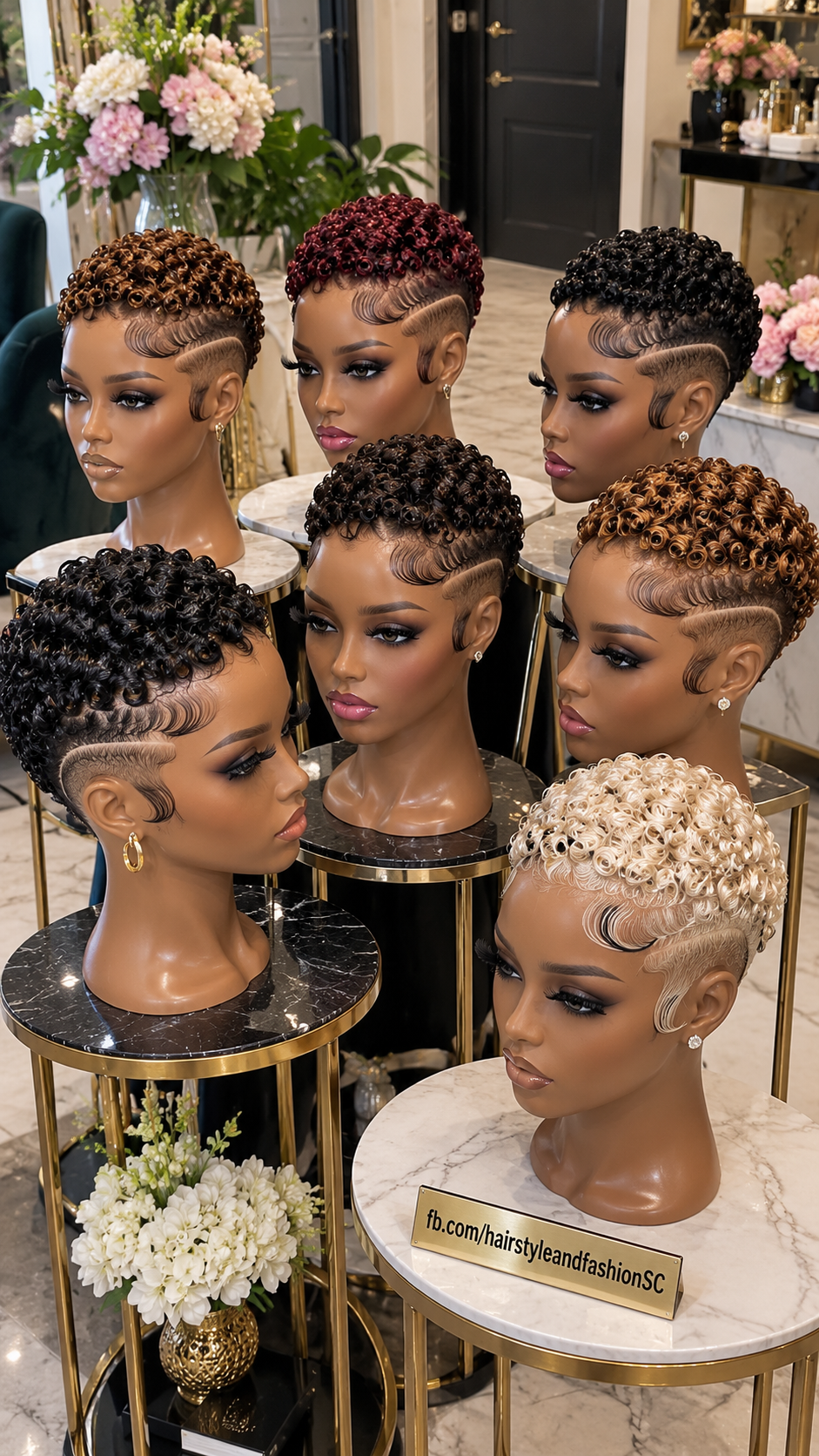
This seven-piece wig display centers on a distinctive pixie construction: densely packed glossy ringlets across the crown, dramatically reduced sides, broad arched side panels and carefully molded temple waves. The color range includes jet black, deep burgundy, warm copper, honey caramel, dark brown and pale champagne blonde. Although each unit has its own color personality, the repeated crown-to-side proportions make the collection visually consistent.
The side treatment is especially important here. Rather than using two thin parallel lines alone, the wigs show a wider curved separation that creates a pronounced tapered panel above the ear. Fine sculpted strands sit between this close section and the ringlet crown, giving the hairstyle a more elaborate profile while keeping the lower perimeter compact.
Tightly Packed Ringlets Shape the Upper Silhouette
The crowns are formed from numerous small circular curls placed very close together. Some ringlets have clearly visible openings, while tighter coils fill the gaps and maintain density across the surface.
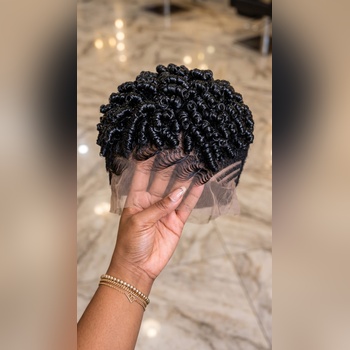
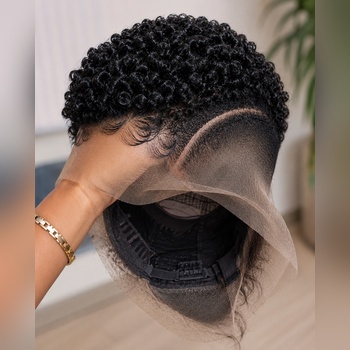
The curls remain relatively compact instead of extending upward into tall loops. This creates a rounded crown that carries noticeable volume without making the wig appear excessively high.
When commissioning a similar unit, request small polished ringlets arranged densely across the crown. Curl diameter matters because oversized spirals would change both the texture and overall proportions.
The Side Drops Dramatically Beneath the Curl Crown
The transition from crown to side is intentionally strong. Dense curls end above the temple, and the hair beneath them becomes considerably closer around the ear.
This reduction makes the ringlet section appear fuller and places more attention on the side design. It also keeps the lower silhouette narrow, which is important for the sculpted pixie shape visible throughout the display.
A stylist recreating the look should establish the intended crown boundary before reducing the side density so enough hair remains for the transitional wave work.
A Broad Arched Division Defines the Side Panel
One of the clearest details visible across the collection is the curved division traveling backward above the ear. The line forms an elongated arch rather than following a perfectly straight horizontal path.
Below this division, the side is kept extremely close. Above it, a narrow area of directional hair connects with the sculpted temple section and crown.
This broad curved architecture gives the wigs a different profile from versions that use only narrow decorative stripes. For custom work, a direct side reference is essential because the height and curvature of the arch strongly affect the finished appearance.
Fine Temple Waves Create a Feathered Transition
Immediately beneath the ringlet crown, fine strands are molded into long sweeping curves. The individual hairs remain visible and travel together in a feather-like direction toward the temple.
These sections provide an intermediate texture between the circular curls above and the close side underneath. Their flatter orientation also gives the crown a cleaner visual boundary.
Ask the stylist to preserve these elongated temple sweeps rather than replacing them with ordinary small baby hairs. They occupy enough space to be considered a major part of the hairstyle.
Jet Black Highlights the Difference Between Curl and Taper
The jet black versions create strong visual depth through reflection alone. Bright highlights travel around the outer surfaces of the ringlets while their centers remain deep black.
The side panels appear even darker and closer because they contain far less volume. Against the display heads, the exposed curved divisions become especially noticeable.
A monochromatic black version does not require additional highlights to create dimension when the curl setting and side sculpting are executed precisely.
Burgundy Gives the Ringlets a Deep Berry Finish
The burgundy crown introduces dark wine, cherry and berry-red reflections. The color remains considerably deeper in the spaces between the curls, producing natural tonal separation.
This is particularly effective on compact ringlets because every curved surface reflects a slightly different intensity of red. The crown therefore looks dimensional without requiring separate blonde highlights.
Use the image as the color reference when ordering because generic burgundy shades can range from brown-red to violet-red.
Copper Auburn Adds Warm Red-Brown Depth
The copper-toned units combine deep brown foundations with warmer auburn and copper reflections. The brightest portions appear on the upper surfaces of the ringlets where direct light reaches the strands.
Shadowed sections remain substantially deeper, preventing the color from becoming flat or overly orange.
For a similar result, request a rich copper-auburn direction with darker depth rather than uniform bright copper.
Honey Caramel Brings Out Individual Curl Openings
The warm caramel versions reveal the circular curl construction particularly well. Golden-brown reflections follow the outer surfaces while deeper caramel and brown remain visible inside the ringlets.
This color makes even smaller curls easier to distinguish from neighboring sections. It also contrasts strongly with the closely tapered side beneath the crown.
For custom coloring, preserving some darker depth at the base can help maintain the three-dimensional appearance.
Champagne Blonde Shows the Fine Strand Work Clearly
The lightest wig in the display uses a pale blonde direction that appears somewhere between champagne, creamy blonde and light beige under the salon lighting.
The lighter shade makes both the compact ringlets and sculpted temple strands highly visible. Even subtle changes in direction can be followed across the side.
If ordering a human-hair unit in this color family, ask about the starting hair quality and processing history because achieving very light shades may require substantial color treatment.
The Ringlet Density Remains High Toward the Rear
The curls are not limited to the frontal crown. They continue backward with enough density to maintain a rounded upper silhouette when the wig is viewed from the side.
This rear continuation is important. Concentrating all of the volume at the front would make the crown appear unbalanced and could expose too much of the tapered back.
For online custom work, request a rear three-quarter approval image so the distribution can be checked before shipment.
The Lower Side Follows the Ear Closely
Hair around the ear is reduced substantially and follows the contour of the mannequin head. This creates the sharp difference between the dense crown and narrow lower perimeter.
The close section also leaves enough visual space for the broad curved division to remain readable. If the lower side were fuller, much of this detail would disappear.
Correct cap positioning matters because the side design needs to sit at the intended height relative to the wearer’s temple and ear.
Some Units Use Additional Narrow Side Accents
While the general collection follows the same arched-panel concept, several units contain subtle secondary line work beneath or alongside the larger division. These accents are narrower and less dominant than the main curve.
This variation means the display should not be treated as seven perfectly identical wigs in different colors. If ordering a recreation, choose the specific side pattern you prefer and send that individual unit as the primary reference.
Combining every visible line from multiple wigs could result in a side design that is much busier than any one example shown.
Reflective Styling Keeps the Compact Curls Separated
The hair displays a mirror-like glossy finish, silky reflective surface, healthy wet-look shine, individually visible strands and ultra-defined texture. This reflective quality helps maintain visual separation across a crown containing many closely positioned curls.
On the black versions, thin highlights trace each ringlet. On caramel, copper and blonde versions, tonal changes provide additional separation.
Heavy oils should be avoided during maintenance because neighboring ringlets can stick together and lose their distinct circular appearance.
How to Explain This Design to a Wig Stylist
Begin by describing the upper section as a compact crown filled with numerous small glossy ringlets. Explain that the curls should remain dense but individually recognizable.
Next, request a close tapered side with a broad arched separation above the ear. Add the sculpted temple waves that travel between the ringlet crown and tapered panel.
Finally, select one specific color and side pattern from the display. Providing a cropped reference of your preferred mannequin can help prevent details from different units being mixed together.
Where to Have the Side Work Recreated
A custom wig stylist experienced with pixie units and molded curl work is a suitable starting point. Because the side requires precise reduction and curved detailing, experience with barber-inspired wig shaping is also valuable.
Send the reference before making an appointment and ask whether the same professional can complete both the crown setting and side work. Some salons may divide those services between specialists.
If you already have a base wig, provide photographs so the stylist can evaluate whether its crown length and side density are suitable for this construction.
Finding a Comparable Wig to Purchase
Search specialist pixie wig makers, custom wig boutiques and salons that sell fully styled units. Prioritize sellers who provide clear profile photographs because much of this design’s character is located around the temple and ear.
When contacting a seller, identify the essential details: compact ringlet crown, broad arched side division, close taper, sculpted temple strands and your preferred color.
Confirm whether the wig arrives fully shaped or requires additional local styling after delivery.
A Practical Custom Ordering Sequence
Select the hair material and color first, then submit the measurements requested by the wig maker. Identify which side should contain the visible arched panel and whether the reference should be followed directly or mirrored.
Specify the desired ringlet size and crown density separately from the side instructions. This reduces the chance of receiving the correct curls but an inaccurate perimeter.
Before completing the order, confirm cap construction, production time and final styling services. Request side and rear approval photographs whenever the seller offers them.
Estimated Pricing for Comparable Pixie Wig Work
| Category | Estimated Range | Typical Configuration |
|---|---|---|
| Premium Custom | $475–$950+ | Premium human hair, custom coloring, intensive ringlet setting, precision taper and detailed side sculpting |
| Standard Custom | $275–$525 | Human-hair pixie with compact ringlet crown, arched side panel and molded temple work |
| Basic Human Hair | $150–$310 | Human-hair foundation requiring additional professional curling, tapering and side customization |
| Premium Synthetic | $90–$195 | Higher-grade fiber with structured ringlets and stronger pre-set shape retention |
| Basic Synthetic | $45–$105 | Lower-cost fiber option with simpler curl placement and limited precision customization |
These figures are broad estimates for comparable custom work rather than prices for the exact wigs shown. Hair quality, color processing, cap construction, stylist location and the amount of manual sculpting can substantially change the final quotation.
Check the Crown Shape Before Final Approval
Inspect whether the ringlets maintain a rounded distribution from the frontal section toward the rear. The crown should appear full without becoming excessively tall or spreading too far over the tapered sides.
Individual curl openings should remain visible throughout the surface. If the curls blend into one undefined texture, much of the intended ringlet character is lost.
For highlighted or lighter versions, also verify that the color distribution remains consistent across the rear crown.
Inspect the Arched Side Panel From a Direct Profile
A frontal photograph cannot fully reveal the shape of the side division. Request a direct profile view and inspect the curve from the temple toward the rear.
The exposed line should remain controlled and the lower tapered panel should retain enough hair to create a visible contrast. Additional narrow accents, when requested, should remain secondary to the main arch.
Checking these proportions before lace trimming or final delivery can prevent difficult corrections later.
Maintaining the Sculpted Temple Strands
The fine side waves can lose their direction after repeated handling. Avoid brushing them aggressively because this can separate the grouped strands and remove their feathered appearance.
For minor maintenance, preserve the existing direction rather than attempting to redesign the waves. More substantial resetting is best handled by a stylist familiar with molded pixie work.
Keep a clear photograph of the original side profile for future appointments so the intended wave placement can be restored accurately.
Protecting the Ringlet Crown Between Wears
Store the wig upright on an appropriately sized stand and avoid pressing objects against the crown. Compact ringlets can flatten when stored under pressure for extended periods.
Do not brush through the curls during routine care. If individual ringlets loosen, targeted resetting is preferable to disturbing the entire crown.
Before applying heat to synthetic hair, confirm the manufacturer’s heat limits. Human-hair versions should also be styled conservatively to preserve the original ringlet formation.
Search Terms
Arched Side Panel Ringlet Pixie · Double Curved Side Detail · Compact Glossy Ringlet Crown · Champagne Blonde Tapered Pixie · Burgundy Close Side Ringlets · Copper Auburn Curl Crown · Black Caramel Ringlet Pixie · Sculpted Temple Wave Panel