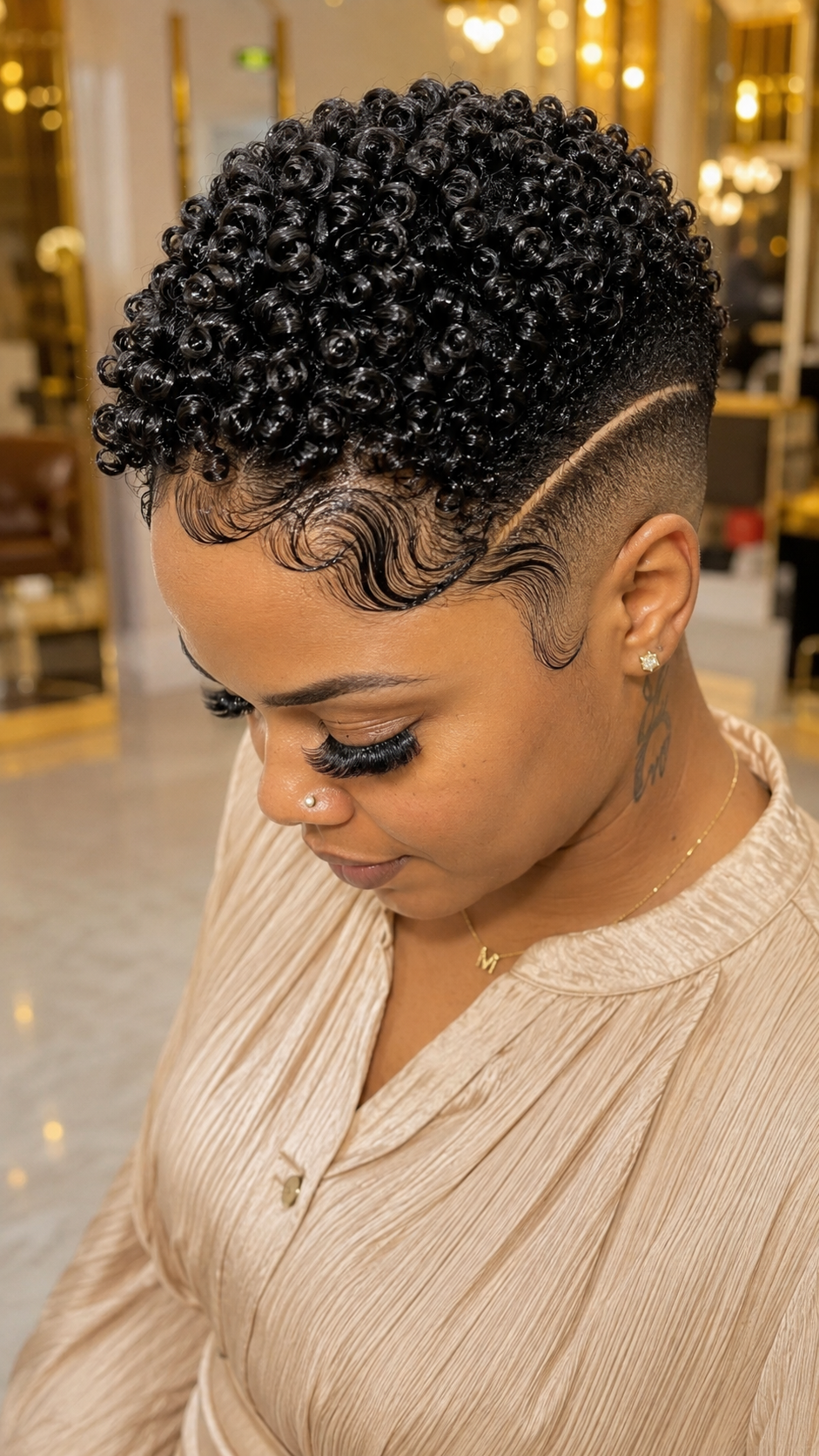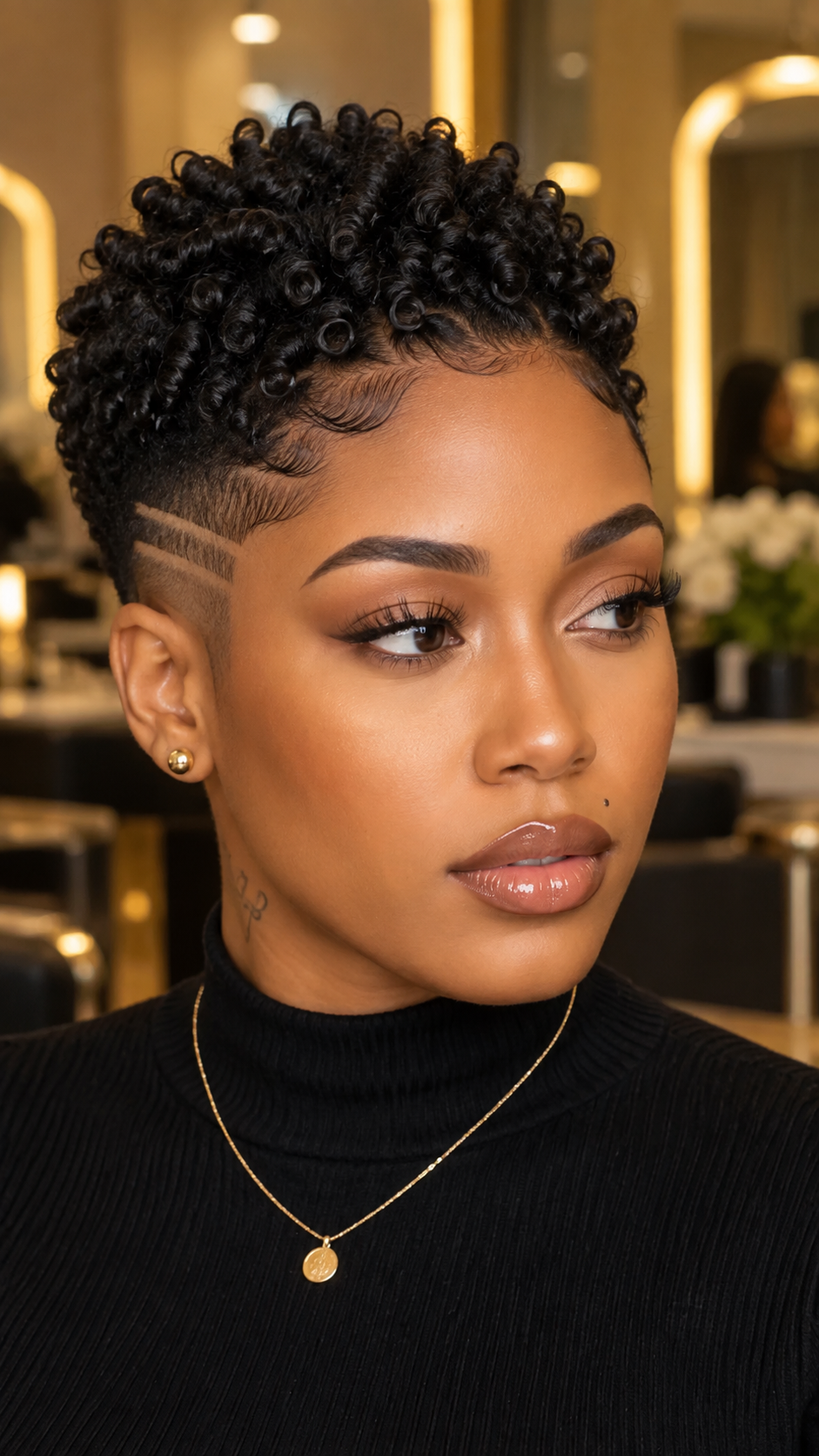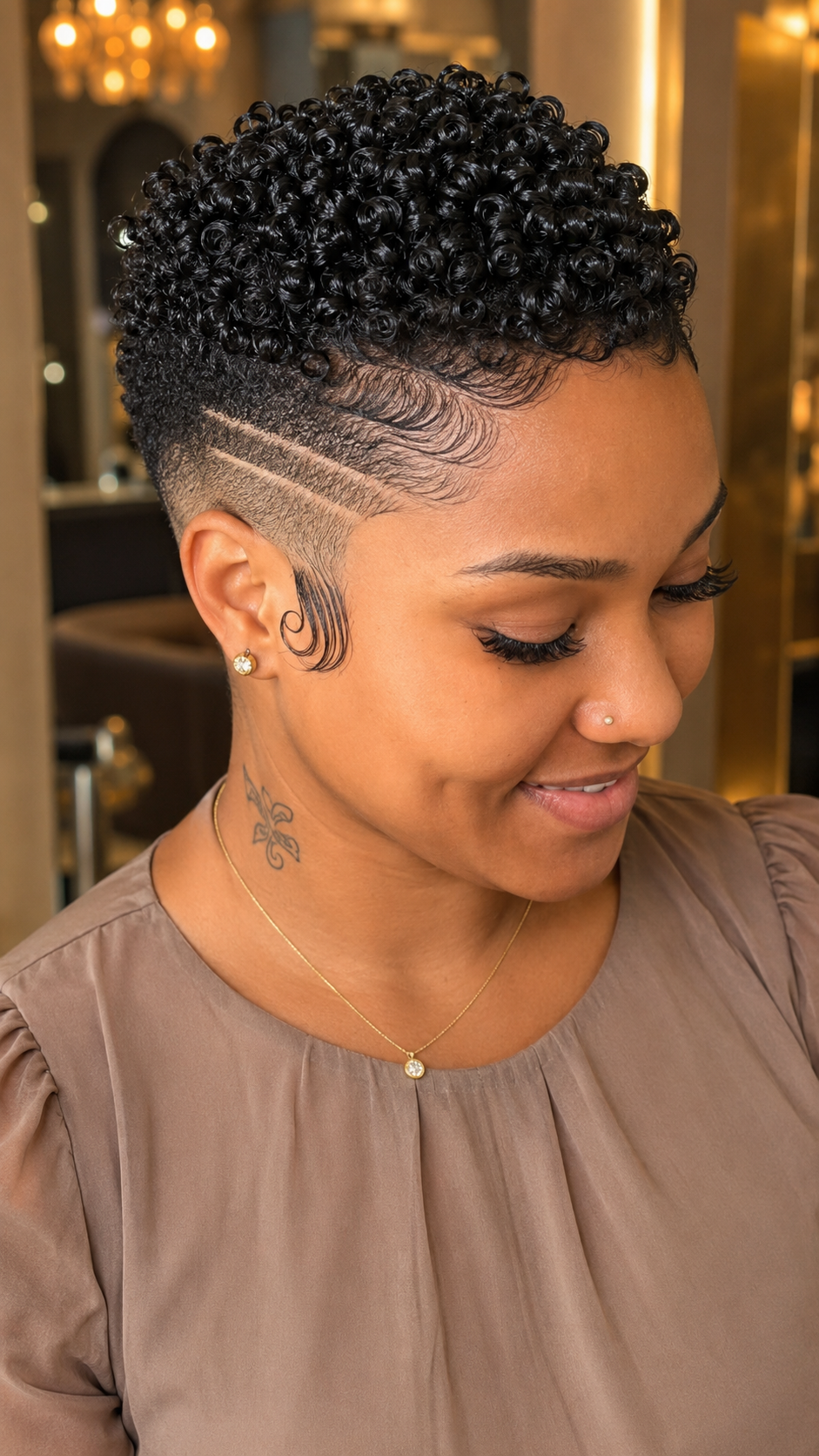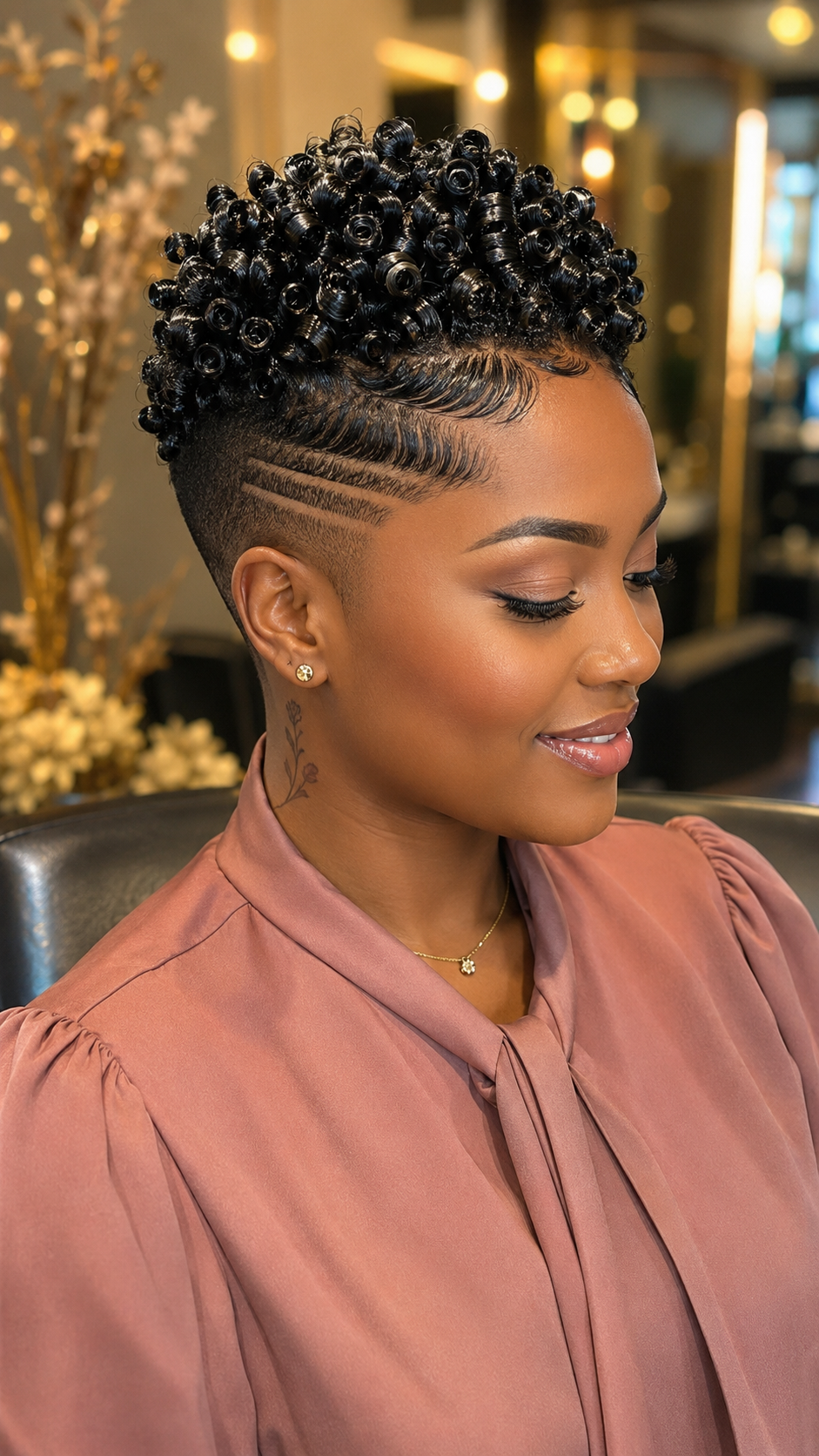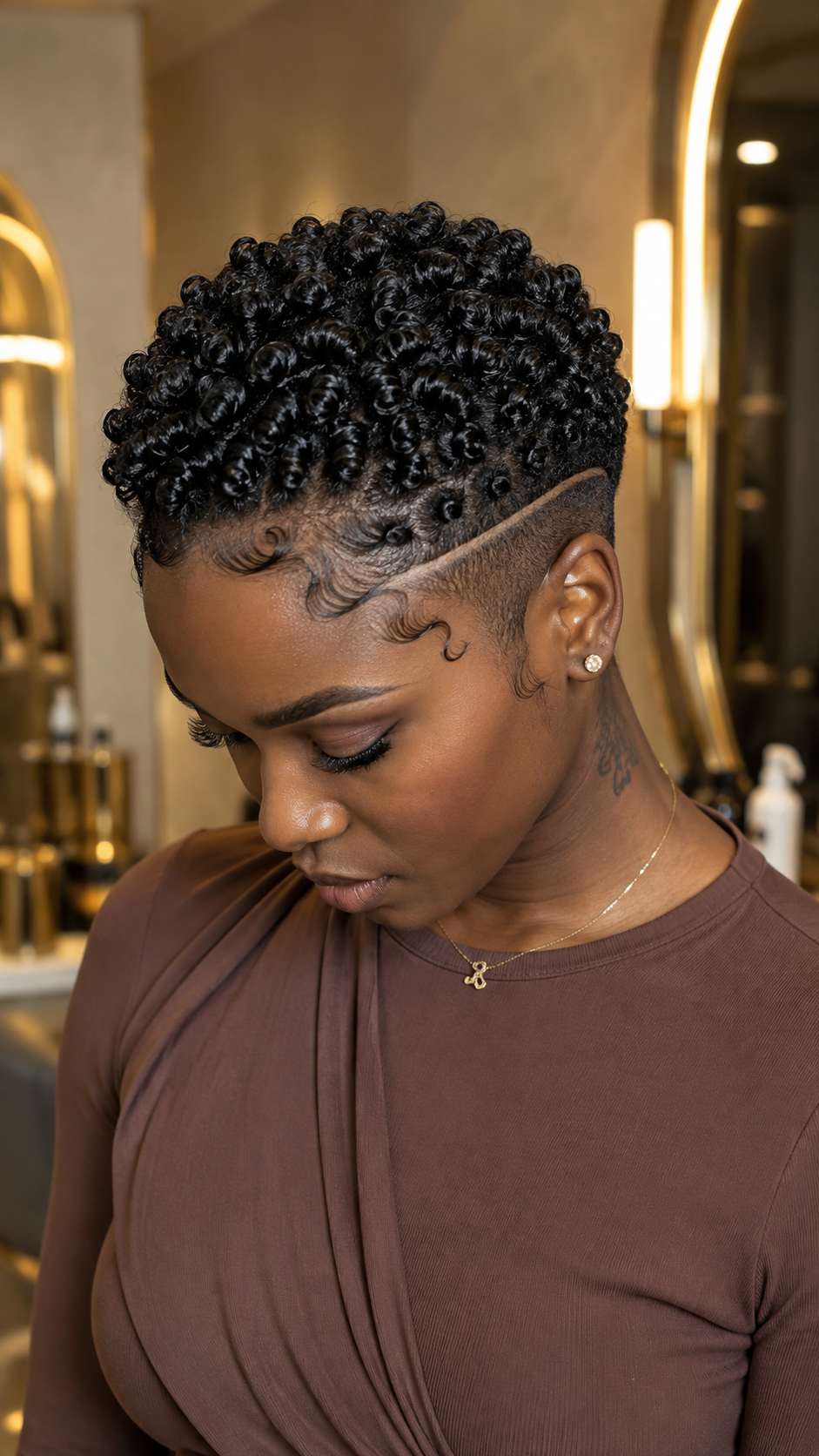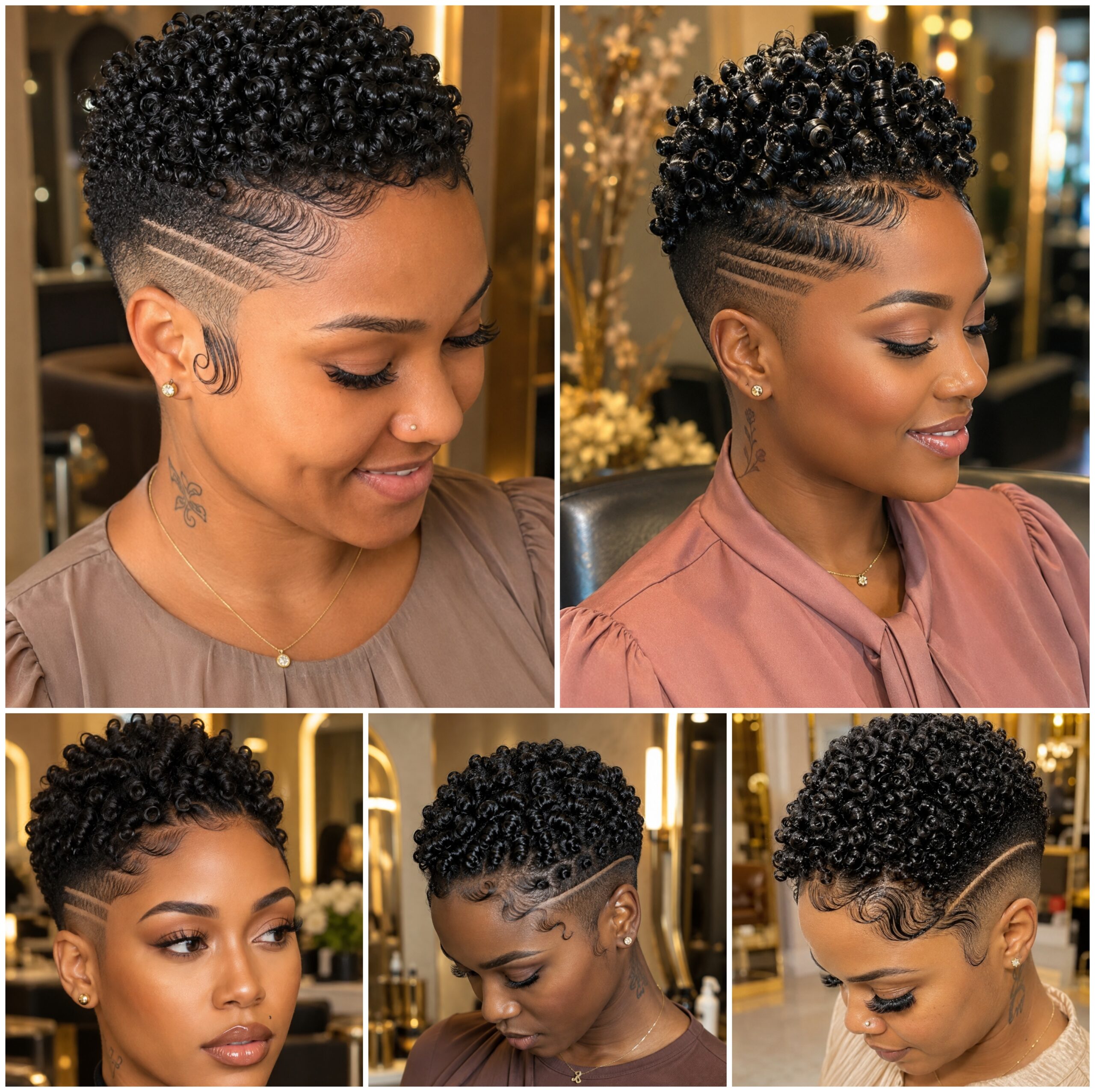
A beautifully shaped coil crown can completely change the character of a cropped hairstyle. This look combines a dense arrangement of glossy coils across the crown with closely tapered sides and a carefully curved temple line. The contrast between the soft circular movement on top and the precise detailing near the temple gives the hairstyle a distinctive profile from almost every viewing angle.
For women searching for a hairstyle that keeps natural-inspired texture at the center of the look, this combination offers plenty of visual interest without relying on excessive length. The crown carries most of the volume, while the sides remain controlled so the coils can stand out clearly. A curved line near the temple adds another layer of detail and makes the side profile especially noticeable.
This type of hairstyle can be recreated directly on suitable natural hair, incorporated into a custom unit, or used as inspiration when ordering a professionally constructed wig. The best route depends on the wearer’s hair, desired maintenance level, budget, and how frequently the style will be worn.
Understanding the Coil Structure at the Crown
The crown is the main attraction. Instead of loose waves or elongated curls, the hair is arranged into compact coils that create a rounded silhouette. Individual sections remain visible, which helps prevent the top from appearing like one solid mass of hair.
A strong version of this look requires balance. If the coils become too large, the silhouette can lose its cropped character. If they are made extremely small, much of the visible spiral pattern disappears. Medium-small coils provide enough definition to be recognizable while still allowing the crown to maintain fullness.
Shine also plays an important role. A glossy surface allows light to catch different parts of each coil, emphasizing the spiral construction. Under natural daylight or salon lighting, this can create small reflective points throughout the crown.
When discussing the hairstyle with a stylist, showing clear reference photographs from the front, side, and rear is useful. The stylist needs to understand not only the curl pattern but also the height, density, taper placement, and relationship between the crown and temple area.
Why the Curved Temple Line Changes the Side Profile
The curved temple line is a relatively small detail, but visually it has considerable impact. Instead of placing a straight shaved line through the side, the design follows a gentle curve near the temple. This creates movement that complements the circular shapes of the coils above it.
Placement matters. The line should remain visible without cutting too deeply into the upper hair. A barber can adjust its position according to the client’s natural hairline and head shape. On a custom wig, a wig stylist may reproduce a similar effect through careful shaping and density control around the side section.
The curve can be kept subtle for a softer appearance or made slightly more pronounced when the side detail is intended to become a focal point. However, adding too many extra lines can compete with the coil crown. A single curved accent generally gives the hairstyle enough distinction while keeping the overall composition balanced.
Creating the Tapered Sides Without Losing the Crown Shape
The transition between the crown and the sides is one of the most important technical areas. The sides should gradually reduce in length while the upper coils retain enough density to create a rounded dome. An abrupt transition may make the crown appear disconnected from the rest of the hairstyle.
For natural hair, a barber experienced with coily textures can establish the taper first and then refine the temple design. The upper hair can subsequently be shaped and coiled using an appropriate styling method.
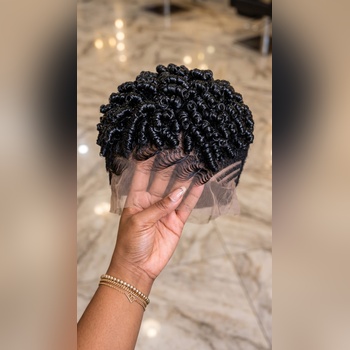
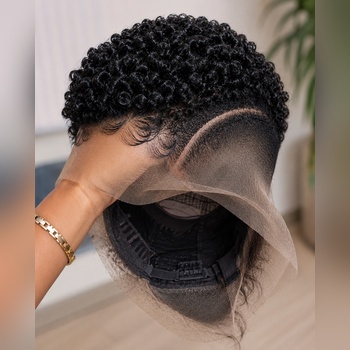
For wigs, the process is different because the maker must consider cap construction, ventilation or hair attachment, density distribution, and the amount of hair required around the tapered zones. Simply cutting a conventional curly wig very close at the sides may not reproduce the same appearance. A unit designed specifically around a cropped tapered silhouette usually provides greater control over the final proportions.
Getting a High-Shine Coil Appearance
The glossy appearance should highlight the coil pattern rather than make the hair look heavy. Products and techniques will vary according to whether the style is created on natural hair, human hair, or synthetic fiber.
On natural hair, moisture and appropriate styling products can help the coils retain their shape while reducing unwanted frizz. Finger coiling is one possible technique when the hair length and texture are suitable. Small sections are shaped individually so that the spirals remain clearly separated.
Human-hair units may allow greater flexibility with reshaping, depending on the hair used and the manufacturer’s care instructions. Synthetic fibers require more caution because heat tolerance differs significantly between products. Heat should never be assumed safe unless the wig manufacturer specifically confirms that the fiber is heat-resistant.
The objective is a reflective finish with individually visible strands and recognizable coil separation. Excessive product can weigh down the crown and reduce the spring of the curls, so controlled application is preferable.
Natural Hair, Custom Wig, or Salon-Made Unit?
There are several ways to approach this hairstyle, and each has practical differences.
Natural hair: This route works particularly well when the wearer’s texture and length can support the desired coils. A barber can establish the tapered perimeter and curved temple line, while a natural-hair stylist can form the crown.
Custom human-hair wig: A custom maker can work from reference photographs and construct a unit around the required crown height, curl dimensions, side density, and temple detailing. Human-hair options are usually more expensive, particularly when extensive customization is required.
Custom synthetic wig: Synthetic fibers can provide a more accessible option and may retain a predetermined curl pattern well. The exact result depends heavily on fiber quality and construction.
Buyers should avoid assuming that every cropped curly wig can automatically be converted into this design. The base construction and hair distribution must allow enough control around the tapered sections.
Estimated Price Range for a Custom Version
Prices vary considerably between countries, salons, independent wig makers, hair quality levels, cap construction, customization requirements, and shipping costs. The figures below are therefore best treated as general planning ranges rather than fixed retail prices.
| Option | Typical Positioning | What May Be Included |
|---|---|---|
| Premium Custom | Highest price range | Advanced construction, detailed density work, customized coil formation, tapered shaping and extensive finishing |
| Standard Custom | Upper-mid price range | Custom sizing or shaping with selected curl pattern and side detailing |
| Basic Human Hair | Mid to upper range | Simpler construction using human hair with less extensive customization |
| Premium Synthetic | Lower to mid range | Higher-grade synthetic fiber with pre-shaped coils and tailored cutting |
| Basic Synthetic | Entry range | Ready-made synthetic construction with limited customization |
When requesting a quote, buyers should send reference images instead of relying only on the hairstyle name. Terms such as “coily pixie” or “tapered curly wig” can describe many different products. A photograph communicates the required proportions much more accurately.
What to Tell a Wig Stylist Before Ordering
A detailed order request can prevent misunderstandings. Start by explaining that the crown should remain visibly fuller than the sides. Specify that the curls should appear as compact individual coils rather than loose waves. Mention the close taper around the side and back areas and point out the curved accent near the temple.
Color should also be confirmed before construction begins. Photographs taken under different lighting can make black and dark brown hair appear similar, so requesting a fiber or hair-color reference may be worthwhile for a custom order.
Ask the seller for current photographs or video of their previous cropped units. Product photos taken from only the front can hide important construction details. Side and rear views are particularly valuable for this hairstyle because the taper and temple design form a significant part of its identity.
Before paying a deposit, confirm the estimated completion time, customization policy, measurements required, shipping cost, return conditions, and whether customized products are eligible for returns. These conditions vary between businesses.
Finding a Stylist Who Can Recreate the Look
A single professional does not necessarily have to complete every stage. For natural hair, a barber experienced with Afro-textured hair can handle the taper and curved temple line, while a curl specialist can work on the upper section.
For a wig, search for wig makers who specifically display cropped curly units in their portfolios. A stylist who primarily creates long straight or body-wave wigs may be highly skilled but may not regularly work with the density distribution required for a tapered coil design.
Useful searches can include local combinations such as “custom pixie wig stylist,” “Afro hair barber,” “tapered coil stylist,” and “custom curly wig maker,” followed by the city or neighborhood. Social media portfolios can also help reveal whether the stylist has previously produced similar side profiles.
For appointments, send the reference image before booking and ask whether both the coil formation and curved side detail can be completed. This is more reliable than arriving at the salon and discovering that one portion of the design requires another specialist.
How to Shop for a Similar Wig Online
When buying online, focus first on construction rather than the model’s styling. Look closely at photographs showing the side, crown, hairline, and back. The crown needs sufficient hair to form visible coils, while the side sections must allow a close tapered appearance.
Read the complete product description and check whether the photographs show the actual unit or simply demonstrate a styling idea. If information is missing, contact the seller before ordering.
A practical ordering sequence is to select the base hair or fiber type, confirm the color, provide head measurements when required, send the hairstyle reference, identify the preferred crown height, request the tapered side profile, specify the curved temple detail, and obtain confirmation from the seller before payment.
For custom work, keeping the written order specifications can be useful. It gives both the buyer and maker a clear record of what was requested.
Maintaining Coil Separation Between Styling Sessions
Maintenance should concentrate on preserving the crown rather than repeatedly restyling the entire hairstyle. Constant manipulation can gradually loosen individual coils and alter the rounded silhouette.
Natural hair should be cared for according to its individual moisture needs and the products recommended by the stylist. Wig maintenance depends on the material. Human hair and synthetic fiber cannot automatically be treated with identical products or temperatures.
When storing a wig, maintaining its shape is important. A suitable wig stand can help prevent the crown from being compressed. Avoid placing heavy objects against the coils during storage or transport.
The temple line may also require occasional attention. On natural hair, regrowth gradually softens the carved detail, so barber maintenance may be needed. On a wig, the frequency of reshaping depends on its construction and how often it is worn.
Who May Enjoy This Type of Hairstyle?
This design can appeal to women who like concentrated volume on top while keeping the perimeter closely shaped. It also works well for anyone who enjoys hairstyles where the side profile carries as much detail as the front.
The combination of rounded coils and a curved temple accent creates two different visual elements without making the hairstyle overly complicated. From the front, attention naturally moves toward the crown and face. From the side, the taper and curved line become much more noticeable.
The proportions can also be customized. Some wearers may prefer a slightly lower crown, while others may request additional height. The temple curve can likewise be adjusted to complement the individual’s hairline and head shape.
Building a Clear Reference Before Booking or Buying
Saving several reference views is one of the easiest ways to improve communication with a barber, salon, or wig maker. Ideally, collect a front view, full side profile, rear angle, and close view of the temple area.
When commissioning a custom unit, describe the visual priorities in order: compact glossy coils across the crown, rounded upper volume, closely tapered sides, visible temple area, and one curved side accent. These instructions give the maker much more useful information than a generic request for a curly pixie.
Before confirming the order, ask whether the stylist can reproduce the overall silhouette rather than simply supplying a similar curl texture. The success of this hairstyle depends on the relationship between the crown, taper, and curved temple detail. When those elements are carefully balanced, the result retains its recognizable shape from the front, side, and rear.
Search Terms
Glossy Coil Crown · Curved Temple Hair Line · Tapered Coil Crown · Finger Coil Crown Style · Curved Side Hair Design · Glossy Coily Pixie · Tapered Sides With Coils · Sculpted Temple Curve