
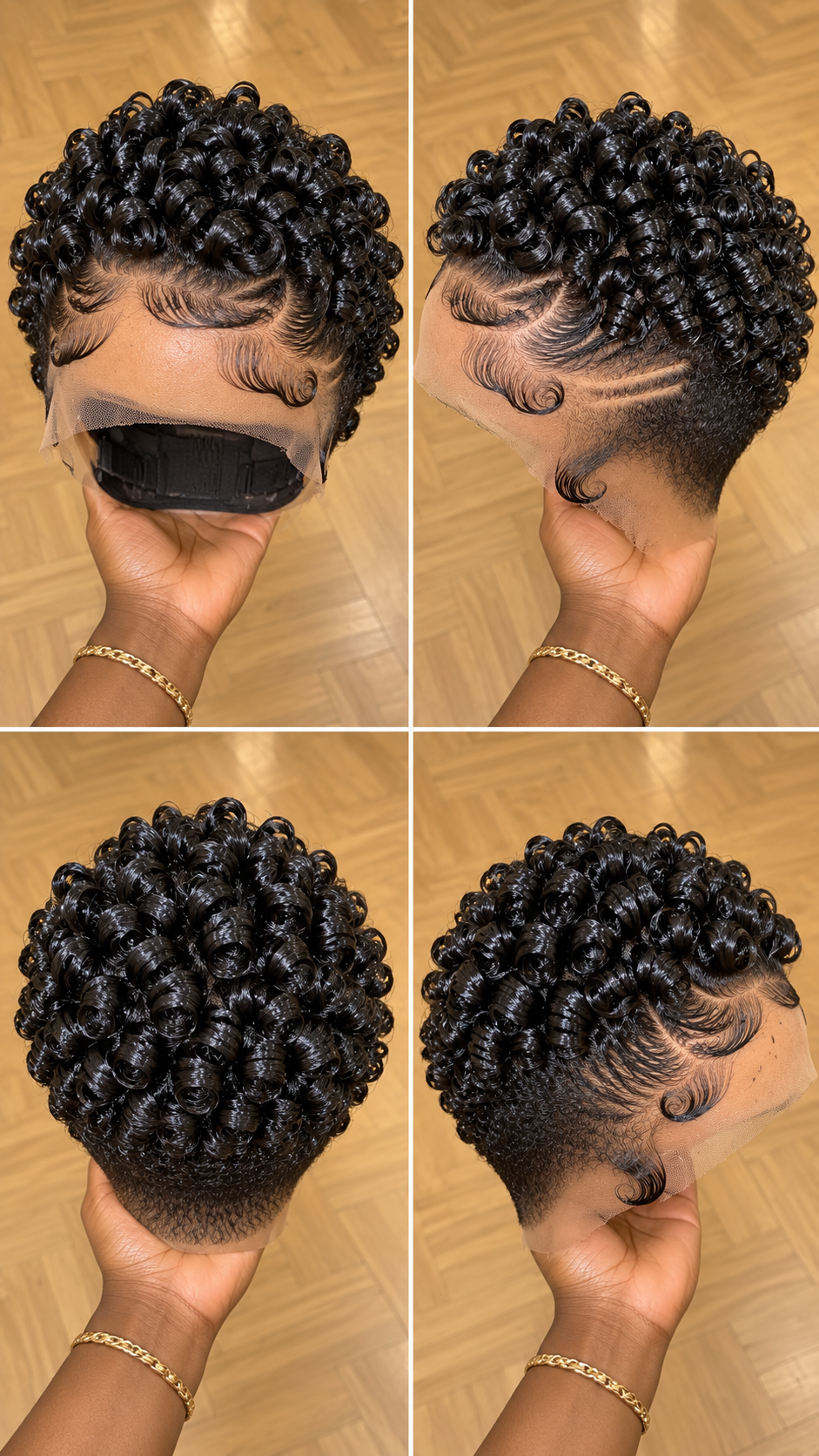
This jet black pixie wig combines dense spiral coils across the crown, layered swoop waves around the temples, curled accent pieces and a closely tapered nape. The four-angle presentation is particularly useful because it shows how dramatically the structure changes between the upper crown and the lower perimeter.
The crown carries substantial volume, but the wig never becomes heavy around the sides or back. Instead, the coils gradually give way to flatter sculpted sections and a compact taper. The visible lace also makes it possible to study the unit before final trimming and installation.
The Crown Uses Deep Tubular Spiral Coils
The upper section is dominated by tightly formed curls with a noticeably cylindrical structure. Many of the coils resemble small polished springs rather than flat circular rings. Their centers remain visible, while the outer strands form multiple glossy rotations around each curl.
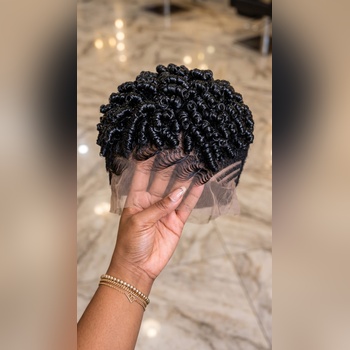
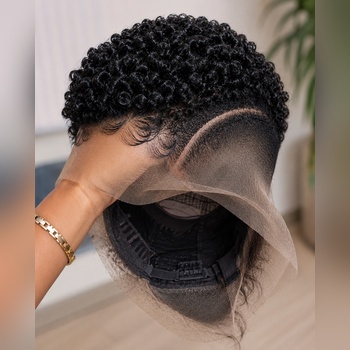
The curls are densely positioned from the frontal crown through the back. Some sit upright, while others lean slightly forward or sideways, creating controlled variation throughout the surface.
For someone commissioning this look, describing the crown simply as curly would be too broad. A more accurate request would be compact glossy spiral coils with visible circular openings and dense crown placement.
Glossy Jet Black Makes Every Rotation Visible
The single-color palette allows the shape of the hair to provide most of the visual detail. Raised strands catch strong highlights while the recessed areas inside the coils remain considerably darker.
This creates excellent depth without balayage, streaks or contrasting tips. The effect depends heavily on the finish of the hair: silky reflective strands, luminous highlights and a healthy wet-look shine make the individual rotations much easier to distinguish.
The shine should still allow separate strands to remain visible. Excess product can merge neighboring hairs together and reduce the intricate appearance of the coil pattern.
Layered Swoops Replace Conventional Side Curls
The temple area introduces a completely different styling technique. Beneath the dense crown are several broad, feather-like swoops that travel diagonally across the side of the wig.
These sections are considerably flatter than the coils above them. Each wave contains numerous fine strands arranged in the same direction, producing a layered appearance rather than a solid block of hair.
The separation between the individual swoops is particularly important. It creates visible negative space and allows each curved section to be read independently.
Curled Tips Add Detail Around the Lower Temples
Several of the sculpted side sections terminate in narrow curled tips. One curl drops lower toward the temple while another turns inward closer to the frontal area.
These small details connect the elaborate side styling with the spiral-heavy crown. Without them, the transition into the close lower section would appear much more abrupt.
When requesting this treatment from a stylist, show close side references. The size, direction and location of these curled accents affect the character of the finished wig considerably.
Both side views use the same general design language—sweeping sections, fine strand placement and curled endpoints—but their visible arrangement changes according to the viewing angle.
This makes the hairstyle visually interesting from either direction. It also demonstrates why a single profile photograph is insufficient when commissioning a detailed pixie unit.
A custom stylist should receive references for both sides so the finished wig does not end up with elaborate work on one temple and a simplified treatment on the other.
The Rear Taper Keeps the Silhouette Compact
Viewed from behind, the spiral coils remain dense across most of the crown before transitioning into a much closer lower section. The nape contains substantially less volume and follows a compact rounded contour.
This gradual reduction is essential to the pixie proportions. Continuing full-size coils to the lowest edge would create a heavier silhouette and obscure the tapered appearance.
When ordering, specifically request that the spiral crown transition into a close tapered nape. A rear reference should accompany that instruction because the degree of taper is difficult to communicate using words alone.
The Front Combines Volume With Sculpted Perimeter Work
From the front, the crown rises immediately behind the flatter hairline sections. This contrast gives the wig height without requiring long hair.
The sculpted front pieces sweep away from the lace edge and then curve back toward the sides. Several narrow sections overlap without completely covering one another, leaving the individual strand directions visible.
The result is much more elaborate than a basic curled fringe. The front styling should therefore be discussed separately when placing a custom order.
Visible Lace Helps Buyers Examine the Construction
The lace extends beyond the styled perimeter in several of the photographs. This indicates that the unit is being displayed before final lace trimming.
For buyers, this can be useful because it reveals where the styled hairline ends and where the remaining lace begins. However, the exact lace specification cannot be determined reliably from photographs alone.
Before purchasing, ask the seller which lace construction is used, whether it arrives uncut and what level of customization is included. Do not assume that every unit advertised with a similar appearance will arrive prepared in exactly the same way.
How to Describe This Wig to a Custom Stylist
Break the request into separate areas rather than sending only the phrase “curly pixie wig.” Ask for a dense jet black spiral-coil crown, layered sweeping temple sections, narrow curled accents and a close tapered back.
Specify that the crown should retain a rounded silhouette and that the lower perimeter should remain considerably flatter. Show all four reference angles during the consultation.
A stylist experienced with pixie wig shaping, molded hair work and precision curl setting is likely to understand the construction more readily than someone whose portfolio primarily consists of long installations.
Getting the Crown Density Right
Density is critical because the spiral pattern requires enough hair to create continuous coverage. Large empty areas between the coils would make the crown appear unfinished.
At the same time, simply adding more hair is not the solution. Excessive density can increase the height and prevent individual spirals from retaining recognizable shapes.
Ask the stylist to prioritize curl placement rather than maximum density. The goal is a full crown where individual coils remain identifiable instead of disappearing into one large mass.
What to Inspect Before Buying Online
Request clear photographs of the actual unit whenever possible. Begin with a top or frontal view and examine whether the spiral curls maintain relatively consistent dimensions across the crown.
Next, inspect both side profiles. Look for the layered sweeping sections visible in the reference rather than ordinary brushed edges. Finally, request a rear photograph to verify that the lower back becomes noticeably closer.
If the listing uses only one highly polished promotional image, ask for additional photographs before placing an expensive custom order.
Booking the Right Salon Service
When searching locally, useful service descriptions include custom wig styling, pixie wig customization, sculpted hair styling and precision curl setting. Contact the salon before booking and send photographs of the desired result.
If you already own the base wig, tell the stylist its hair type, current length and approximate density. They can then advise whether the existing unit contains enough material to recreate the spiral crown.
A barber may help refine certain close areas when appropriate, but the lace perimeter and elaborate wave work are better handled by a professional accustomed to wig construction and styling.
Buying a Similar Unit From a Wig Seller
Search for businesses specializing in customized pixie units rather than relying entirely on general wig marketplaces. Send the reference images and ask whether the seller is reproducing the hairstyle by hand or supplying a pre-styled factory unit.
Before ordering, confirm the cap size, hair material, color, lace configuration, customization options and styling services included in the quoted price.
For a custom commission, it is also useful to agree on the crown height and rear taper before production. Those two characteristics have a major influence on whether the finished silhouette resembles the reference.
Estimated Cost for Comparable Wig Options
| Category | Typical Estimate | Possible Configuration |
|---|---|---|
| Premium Custom | $450–$900+ | Higher-grade human hair with extensive coil setting, sculpted sides and customized perimeter work |
| Standard Custom | $250–$500 | Human hair with hand-styled spirals, tapered shaping and detailed side work |
| Basic Human Hair | $140–$300 | Human-hair foundation that may require additional professional styling |
| Premium Synthetic | $80–$180 | Higher-quality fiber with pre-set coils and better shape retention |
| Basic Synthetic | $40–$95 | Lower-cost fiber with simpler curl construction and fewer customization options |
These are broad reference ranges rather than guaranteed selling prices. Hair quality, cap construction, country, stylist experience and the amount of manual work can move the final price substantially.
Preserving the Spiral Shape After Styling
A wig with this curl arrangement should not be treated like ordinary loose curly hair. Avoid brushing through the spiral crown because doing so can dismantle the individual coils.
Store the wig upright where the crown cannot be compressed. A properly sized wig stand can help maintain the rounded profile, but make sure the delicate temple sections are not rubbing against nearby objects.
If individual coils begin to loosen, a professional curl reset may be preferable to repeatedly manipulating them by hand.
Maintaining the Sculpted Side Sections
The flatter temple work needs special attention because the fine strands can shift through friction. Handle the lace and cap rather than repeatedly gripping the styled sides when putting the wig on or removing it.
Use styling products sparingly and choose them according to the actual hair material. Before applying heat, always verify whether the unit is human hair or a synthetic fiber specifically rated for heat styling.
Taking several photographs when the wig is newly styled can also help a professional reproduce the original wave direction during future maintenance appointments.
Why This Four-Angle Reference Is Valuable for Custom Orders
The four photographs document nearly the entire construction. The front establishes the relationship between the spiral crown and sculpted hairline. Both profiles reveal the layered swoops and curled accents, while the rear confirms the close nape.
Keeping these views together gives a stylist a far more useful reference than sending a single finished beauty shot. It also allows a buyer to discuss individual sections separately during a consultation or online order.
For a design built around precision placement, that additional visual information can make communication between buyer and stylist considerably clearer.
Search Terms
Jet Black Spiral Coil Crown · Layered Swoop Temple Waves · Glossy Tubular Black Curls · Curled Temple Accent Pieces · Close Tapered Jet Black Nape · Sculpted Feathered Side Waves · Dense Spiral Pixie Crown · Black Coil Crown With Side Swoops