
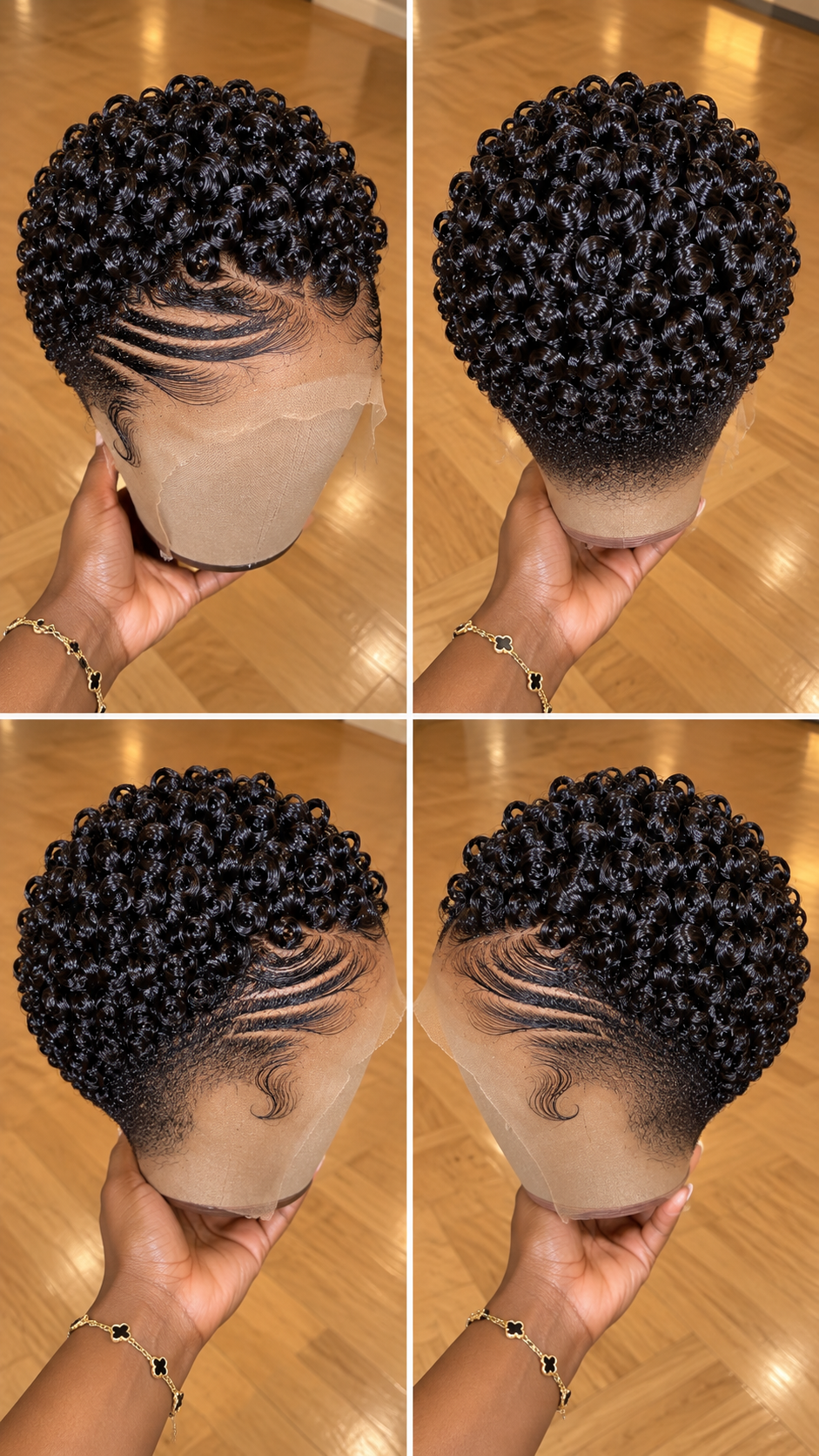
This jet black pixie wig combines a dense crown of compact ring curls with dramatic sweeping wave work around both sides of the hairline. The four-angle presentation makes the construction especially easy to study: the crown stays rounded and full, the back gradually narrows into a closely cropped nape, while the side sections introduce long curved strokes that give the unit its distinctive character.
Unlike a conventional curly pixie where the same curl pattern continues from crown to perimeter, this design deliberately separates the two areas. The upper portion relies on tightly packed circular coils, while the lower side sections are sculpted into flatter, elongated waves. That contrast creates the illusion of a professionally shaped pixie haircut while retaining the flexibility of a lace wig.
Compact Ring Curls Create the Rounded Crown
The upper section is covered with numerous small curls formed into visible rings. Each curl has a recognizable circular center, but the placement is slightly irregular rather than perfectly symmetrical. Some coils face upward, others tilt toward neighboring curls, and several overlap at the edges.
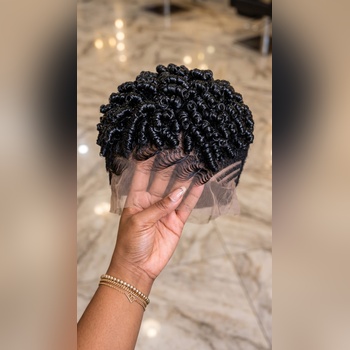
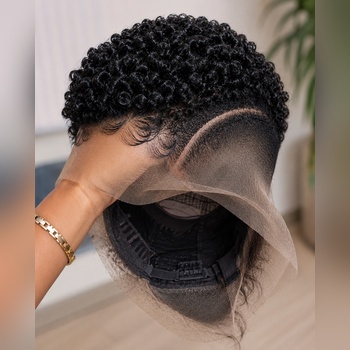
This variation is important because it keeps the crown from resembling a repetitive manufactured pattern. The individual curls remain recognizable while collectively creating a rounded dome.
The hair also carries a noticeable reflective finish. Against the deep jet black base, highlights trace the curves of individual strands and make the ring formation easier to see. For a similar result, ask for small glossy ring curls positioned densely across a compact pixie crown.
Sweeping Side Waves Give This Wig Its Signature Detail
The most distinctive element appears along the temples. Several elongated sections sweep backward underneath the ringlet crown in layered arcs. These are substantially longer and flatter than the curls above them.
The arrangement resembles carefully sculpted finger-wave strokes rather than ordinary baby hairs. Each section begins close to the upper hairline and travels backward in a curved direction, creating several parallel layers.
Because these waves occupy a relatively large portion of both side profiles, they should be treated as a central part of the design when ordering a reproduction. Simply requesting a curly pixie with edges would not accurately describe what is visible here.
A Small Temple Curl Finishes Each Side
Beneath the larger sweeping waves is another subtle detail: a narrow curl descends toward the lower temple area. Its shape is much smaller and more delicate than the surrounding crown curls.
This isolated curl creates a visual endpoint for the longer wave pattern above it. It also prevents the closely cropped lower side from appearing abrupt.
When recreating the style, this section should remain lightweight. Making the temple curl too thick would compete with the layered wave work and change the balance of the side profile.
The Back Uses a Gradual Taper Instead of Full-Length Curls
The rear photograph clearly shows how the volume is controlled. Ring curls remain abundant through the upper and middle back, but they stop before reaching the lowest part of the wig.
Below them, the hair transitions into a closely tapered nape. The density progressively decreases toward the bottom edge, creating the visual proportions associated with a cropped pixie.
This construction also prevents the back from becoming excessively bulky. From the rear, the crown remains rounded while the base stays narrow and close.
Why the Four Views Matter for This Particular Design
A front-only photograph would hide a large part of this wig’s construction. The rear view establishes the taper, while the left and right profiles reveal how far the sweeping waves extend beneath the curls.
The side views also demonstrate that the wave arrangement is intentionally balanced across the unit rather than being a decorative feature placed on only one temple.
If ordering remotely, send all four reference angles. Ask the seller to confirm the crown shape, side-wave placement and rear taper separately before beginning customization.
Jet Black Adds Depth Without Additional Color
The monochrome color is particularly effective with this hairstyle because the contrast comes from texture and light rather than highlights. Deep black areas appear between the curls, while the glossy upper surfaces reflect narrow bands of light.
The result is a crown that looks dimensional even though the hair remains one color. This also allows the sweeping temple work to remain visually connected to the ringlets rather than appearing like a separate colored section.
For photography, moderate directional lighting can reveal the curl pattern especially well. Excessively flat lighting may hide some of the strand separation within the dark crown.
Visible Lace Indicates a Pre-Installation Presentation
The lace remains clearly visible around the front and side perimeter. This suggests the wig is being displayed before the lace has been fully customized and trimmed for installation.
That is useful when evaluating a unit because buyers can inspect more of the construction. Before ordering, confirm the exact lace configuration with the seller rather than assuming it from photographs alone.
Ask whether the unit arrives with uncut lace and whether hairline customization, lace trimming or installation services are included. Those services can vary considerably between wig businesses.
What to Tell a Stylist When Recreating the Look
Instead of asking simply for a black curly pixie, describe the design in separate zones. Request a dense circular ring-curl crown, elongated sculpted waves at both temples, small finishing curls near the lower sides and a closely tapered rear.
Show the stylist the side photographs first because they contain the most distinctive styling information. Then use the rear image to establish how low the ringlets should extend before transitioning into the taper.
A stylist experienced with pixie wigs, finger-wave setting and precision curl placement will generally be better suited to this type of work than someone who primarily installs long straight units.
Choosing the Right Foundation for the Style
The base wig needs enough density through the upper portion to support the numerous individual rings. At the same time, the perimeter must allow the stylist to create flatter sections without leaving excessive bulk underneath.
This balance is important. Too little crown density can leave visible spaces between the curls, while too much hair around the sides can prevent the sweeping wave sections from lying close to the foundation.
If purchasing a base wig for later customization, show the reference to the stylist before ordering. They can advise whether the density and length distribution are suitable for this particular shape.
How to Order a Similar Wig Online
Begin by contacting businesses that specifically advertise custom pixie wigs or hand-styled cropped wigs. Send the four-angle reference rather than relying on a written description alone.
Ask whether the seller can reproduce the compact ring size and sweeping side pattern. Request photographs of previous pixie work when available. Also confirm cap measurements, hair material, lace type, color and whether the unit will arrive fully styled.
Before payment for a custom order, obtain a written summary of the requested design. For higher-priced commissions, asking for photographs before shipment can help confirm that the silhouette and curl placement are reasonably close to the agreed reference.
Finding a Local Salon for Custom Styling
If you already own a suitable wig, search locally for a wig customization specialist, pixie wig stylist or stylist experienced in finger-wave work. A barber may also assist with reshaping the tapered portions when appropriate, although the lace and curl work should ideally be handled by someone accustomed to wigs.
When booking, mention that the appointment involves a wig rather than natural hair and send reference photographs in advance. This allows the salon to determine whether additional setting time or specialized products will be required.
For extensive reshaping, a consultation before the main appointment is worthwhile because the stylist can inspect the existing density and determine how closely the unit can reproduce the reference.
Keeping the Circular Curls Intact Between Wears
The crown should not be brushed like loose curly hair. Brushing through these compact rings can quickly dismantle their carefully arranged shape.
Instead, handle individual curls only when necessary and store the unit upright on an appropriately sized wig stand. Avoid placing clothing, packaging or other wigs against the crown.
If a curl begins to loosen, resist repeatedly twisting it by hand unless you know how the original set was created. A professional reset may produce a more consistent result.
Protecting the Sweeping Temple Sections
The flatter side work requires different care from the ringlet crown. These sections rely on precise direction and strand placement, so friction can disturb them even when the curls above remain intact.
When putting the wig away, make sure the sides are not pressed against the stand, storage box or neighboring units. Lightweight styling products may be used when appropriate for the hair material, but excessive product can leave the narrow wave sections clumped together.
Before applying heat or setting products, confirm whether the wig is human hair or heat-compatible synthetic fiber.
Estimated Price Range for Comparable Custom Work
| Category | Approximate Range | What May Be Included |
|---|---|---|
| Premium Custom | $450–$900+ | Higher-grade human hair, extensive hand setting, perimeter customization and detailed taper work |
| Standard Custom | $250–$500 | Human-hair construction with ring curls, side sculpting and customized pixie shaping |
| Basic Human Hair | $140–$300 | Human-hair base with simpler styling or additional salon customization required |
| Premium Synthetic | $80–$180 | Higher-quality fiber with pre-set curl structure and stronger shape retention |
| Basic Synthetic | $40–$95 | Entry-level fiber with simpler curl placement and limited customization |
These ranges are general estimates rather than fixed prices. Hair origin, lace construction, cap size, stylist labor, location and the amount of hand setting can substantially change the final cost.
Details Worth Checking Before Final Payment
Review photographs of the completed unit from multiple angles. Look closely at whether the ring curls remain compact across the entire crown and whether the back actually transitions into a close nape.
Next, inspect the side profiles. The sweeping sections should remain recognizable underneath the crown instead of disappearing into ordinary curls. Check the condition of the lace and ask whether additional trimming or customization will be needed after delivery.
These checks are particularly useful for a design where much of the visual impact comes from precision placement rather than simply hair length or color.
Search Terms
Jet Black Ring Curl Crown · Sweeping Temple Wave Pixie · Glossy Circular Black Coils · Layered Side Wave Hairline · Close Tapered Black Nape · Sculpted Temple Curl Detail · Dense Black Ringlet Crown · Black Pixie With Curved Side Waves