
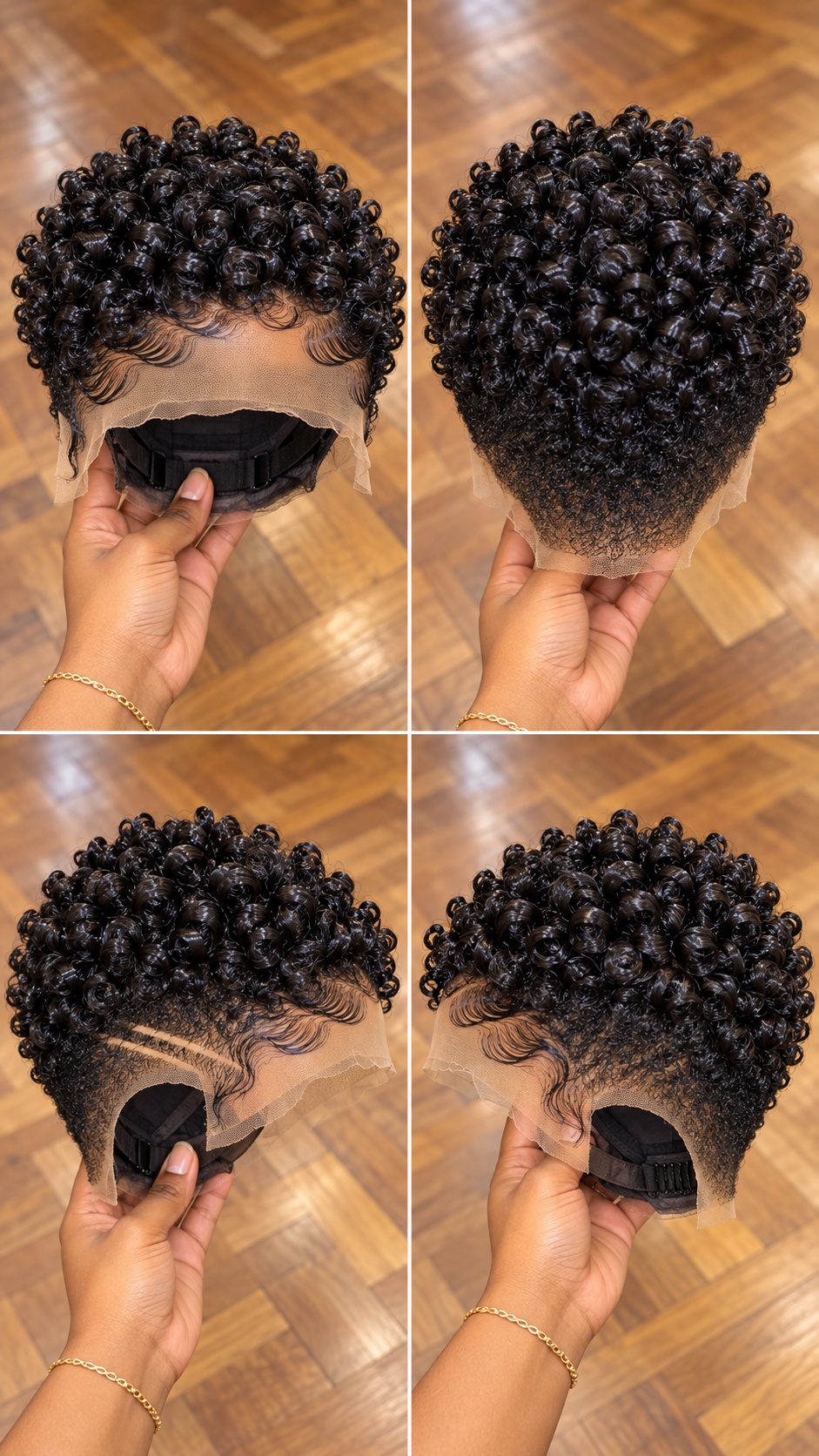
This jet black pixie wig is built around a striking contrast between densely packed glossy ringlets, delicately sculpted temple waves and a closely tapered lower section. The four-angle presentation makes the construction especially easy to examine: the front reveals the lace and sweeping perimeter work, the back shows the gradual reduction in volume, and both profiles expose different details around the temples.
The most noticeable element is the crown. Hundreds of compact curls create a rounded, dimensional surface without requiring long hair. Below them, the silhouette becomes progressively closer until it reaches a neat tapered perimeter. That difference in density is what gives the unit its recognizable pixie proportions.
A Crown Built From Compact Ringlet Clusters
The upper portion contains numerous small ringlets arranged tightly beside one another. Rather than forming large loose curls, each section turns into a compact circular or spiral shape with a clearly visible center.
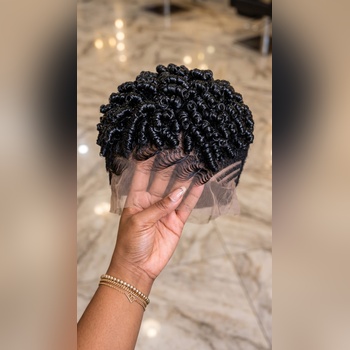
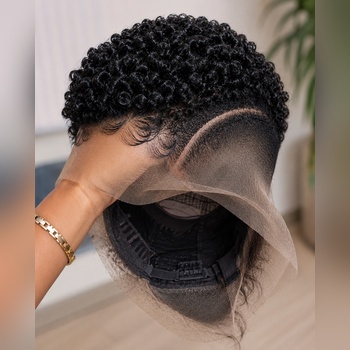
The curls vary slightly in orientation. Some face directly outward, others tilt toward neighboring curls, and a few fall gently toward the frontal perimeter. This variation prevents the crown from appearing mechanically uniform while preserving the same overall curl family.
For a custom order, describe this area as a dense rounded crown of small glossy jet black ringlets. That description is considerably more specific than requesting an ordinary curly pixie.
The Front Hairline Uses Wide Feathered Swoops
The frontal view reveals one of the strongest details in the design. Several thin sections have been molded into broad sweeping curves immediately behind the lace edge.
Each swoop is composed of many individually visible strands. The strands travel together before curving toward the forehead area, producing a feathered appearance rather than one thick painted-looking line.
These frontal sections sit almost flat against the lace, creating a deliberate contrast with the elevated curls directly behind them. The transition from flat sculpting to three-dimensional ringlets gives the front considerable depth.
The Left Profile Introduces Parallel Accent Lines
One profile contains a distinctive pair of narrow parallel divisions beneath the curled crown. These lines travel backward through the closer side section and create a graphic break between the upper curls and lower taper.
This detail is important when recreating the exact look because it is not simply a natural parting. It functions as a deliberate design element within the side styling.
If ordering from a wig stylist, include the profile photograph and specify that you want two slim parallel side accents beneath the ringlet crown. Their placement should follow the head shape instead of appearing as straight horizontal stripes.
The Opposite Temple Uses a Softer Sculpted Pattern
The other side does not rely on exactly the same arrangement. Instead, the emphasis moves toward sweeping feather-like strands and a longer curved accent near the lower temple.
This asymmetry adds interest while maintaining a coherent overall design. Both sides use fine strand work, but they do not look like simple mirrored copies.
For custom production, this is an important distinction. Sending only one side photograph could lead a stylist to duplicate that treatment on both sides and lose the character visible in the reference.
The Rear Reveals the True Pixie Silhouette
The rear photograph clearly demonstrates how the volume is controlled. Ringlets cover the upper and middle crown, but their density gradually decreases toward the nape.
The lowest section is closely cropped in appearance and follows a rounded contour. This creates a compact finish instead of allowing the curls to continue all the way down.
The transition is relatively gradual, which matters. A sudden boundary between dense curls and a very close nape could make the construction appear disconnected. Here, smaller and tighter hair near the lower crown helps bridge the two areas.
Why the Jet Black Color Works With These Curls
Jet black keeps attention on shape, shine and strand direction. The raised portions of each ringlet reflect the light strongly, while the inner openings remain dark. That combination gives every curl considerably more visual depth.
The hairstyle benefits from a mirror-like glossy finish with silky reflective strands and luminous highlights. However, the curls should remain individually readable. Excessive product buildup can cause adjacent ringlets to merge visually.
If commissioning the style, request rich jet black rather than relying solely on a generic “black” description, particularly when ordering online where different manufacturers may use different color numbering systems.
Density Matters More Than Extreme Length
This design demonstrates how a relatively compact wig can still look substantial. Most of its volume comes from curl density and positioning rather than long strands.
The ringlets overlap enough to conceal most of the foundation across the crown. At the same time, they remain separated sufficiently for the circular shapes to be recognized.
A custom stylist should therefore balance coverage against definition of each ringlet. Adding too much hair can make the crown excessively tall, while insufficient density can expose unwanted gaps between curls.
Visible Lace Before Final Installation
The photographs show lace extending beyond the styled perimeter. This presentation is useful because it allows the buyer to see the relationship between the lace edge, sculpted strands and wig cap before final trimming.
The images alone do not establish the exact commercial lace specification, so buyers should confirm that information directly with the seller. Ask about the lace type, coverage, cap construction and whether customization is included.
If the wig arrives with uncut lace, avoid trimming extremely close before checking the fit. A professional wig stylist can help position the unit and determine an appropriate cutting line.
The Interior Cap Should Be Checked Before Ordering
The frontal photograph also provides a glimpse inside the wig. An adjustable fastening system is visible, indicating that fit can be altered to some degree.
Nevertheless, adjustable hardware does not replace choosing the correct cap size. Before ordering, measure the head according to the seller’s instructions and compare those measurements with the available sizing chart.
For a custom unit, ask whether additional securing options are available and whether they are suitable for the way you intend to wear the wig.
How to Request This Look From a Wig Stylist
Divide the hairstyle into zones when explaining it. Request a rounded crown covered with compact ringlets, flatter feathered waves around the frontal perimeter, detailed temple work, a pair of parallel accents on one profile and a closely tapered rear.
Provide all four photographs rather than a single front image. The rear is particularly important because it establishes exactly how much bulk should be removed toward the nape.
Search for professionals whose portfolios include pixie wig customization, sculpted wig styling, precision curl setting and detailed perimeter work. A stylist who regularly works with compact pixie units will usually be better positioned to reproduce these proportions.
Ordering a Similar Wig Online
When shopping online, focus on specialist wig stores and independent custom wig makers offering pixie customization. Instead of searching only for “black curly wig,” use descriptive phrases relating to the actual construction.
Send the seller the front, rear and both side references and ask whether the photographed curl arrangement can be recreated. Confirm whether you are purchasing the actual displayed unit, a made-to-order recreation or a standard wig that will only approximate the reference.
Before payment, verify hair material, cap size, color, lace configuration, approximate density, customization services and expected production time.
What to Ask Before Paying a Custom Wig Deposit
Ask whether the quoted price includes curl setting and side sculpting. Some sellers price the base wig separately from advanced styling, so a low initial quote may not represent the completed design.
Also establish whether the unit will arrive fully styled or require finishing at a local salon. Request photographs or a short video of the completed wig before shipping when the seller provides that service.
For an intricate design like this, agreeing on the crown height, side detailing and rear taper before production can prevent misunderstandings later.
Estimated Pricing for Comparable Options
| Category | Estimated Range | What Buyers May Expect |
|---|---|---|
| Premium Custom | $450–$900+ | Higher-grade human hair, extensive hand setting, sculpted perimeter and detailed custom finishing |
| Standard Custom | $250–$500 | Human-hair unit with ringlet setting, tapered shaping and customized side detailing |
| Basic Human Hair | $140–$300 | Human-hair foundation with simpler styling or additional salon work required |
| Premium Synthetic | $80–$180 | Higher-grade fiber with pre-set curls and stronger shape retention |
| Basic Synthetic | $40–$95 | Affordable fiber construction with less elaborate customization |
These ranges are general estimates rather than fixed retail prices. Hair source, country, stylist experience, cap construction and the amount of hand finishing can significantly change the final cost.
Salon Services That Match This Type of Styling
If you already own a suitable wig, contact salons before booking and ask specifically whether they customize pixie units. Send photographs so the stylist can evaluate whether your existing wig has enough hair and the correct length distribution.
Useful services to look for include custom wig cutting, precision curl setting, lace wig customization, molded perimeter styling and pixie reshaping.
The close rear section may also require careful shaping. Choose someone comfortable working directly on wigs rather than assuming every conventional haircut service can produce the same result on a removable unit.
Keeping the Ringlets Intact Between Wears
A dense ringlet crown should not be brushed through routinely. Brushing can separate the carefully formed rotations and turn the structured crown into a more general curly texture.
When handling the unit, support it from the cap wherever practical rather than squeezing the crown. Store it on a properly sized wig stand with enough clearance around the sides to prevent the curls from being compressed.
If individual ringlets begin losing their circular shape, targeted resetting is preferable to restyling the entire crown unnecessarily.
Protecting the Feathered Temple Work
The temple sections are more delicate than the dense crown because they depend on very precise strand direction. Friction from storage, hats or repeated handling can disturb the narrow sweeping lines.
Avoid gripping the wig directly by these sculpted areas when putting it on. If product is needed for maintenance, use an amount appropriate for the hair material and avoid saturating the fine strands.
For human hair, controlled professional resetting can restore displaced sections. For synthetic units, always confirm heat tolerance before using heated styling tools.
Four Angles Give a Stylist a Better Blueprint
The biggest advantage of this reference is not merely that it displays the finished hairstyle—it documents the construction from four useful directions.
The frontal view establishes the lace placement and sweeping perimeter. One profile documents the parallel accent lines, the opposite side shows the alternative temple treatment, and the rear establishes the tapered silhouette.
Saving the complete four-angle reference and sending it with a custom order gives the stylist substantially more information than a single beauty photograph and makes it easier to discuss exactly which details should be reproduced.
Search Terms
Jet Black Ringlet Crown · Feathered Front Temple Waves · Parallel Side Accent Lines · Glossy Black Circular Ringlets · Close Tapered Black Nape · Sculpted Lace Perimeter Swoops · Dense Rounded Ringlet Crown · Asymmetrical Temple Wave Detail