
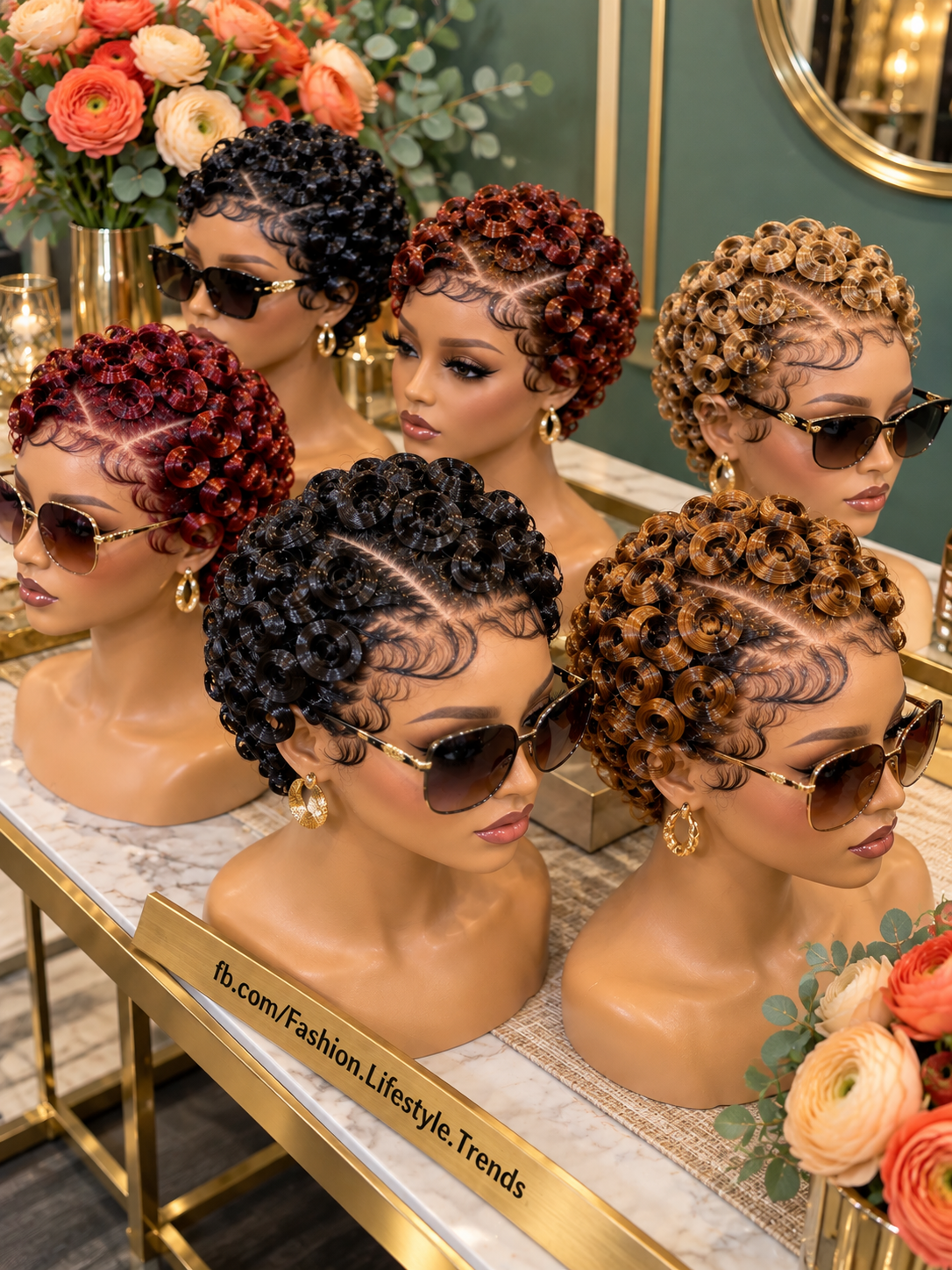
This coordinated wig collection focuses on a highly recognizable combination: compact glossy ring curls, exposed side parting and long sculpted waves sweeping across the temple. The same basic silhouette appears in several rich shades, including jet black, burgundy wine, dark chocolate, warm copper brown and golden caramel.
What makes these units especially eye-catching is the contrast between the crown and the hairline. The upper sections are packed with individually formed circular curls, while the front is flatter and more directional. Instead of continuing the rings all the way to the forehead, the stylist has shaped the hair into fine curved sections that frame the face.
Compact Circular Curls Build the Rounded Crown
The crown consists of numerous small ring-shaped curls arranged closely together. Each curl has a visible center and a polished outer edge, producing a pattern that resembles overlapping miniature spirals when viewed from above.


The curls are intentionally compact rather than tall or fluffy. That keeps the overall profile close to the head and allows the circular construction to remain the main visual element. Someone requesting this look should specifically mention small flat ring curls with controlled crown height, because a conventional curly pixie can produce a very different silhouette.
Spacing also matters. Small areas of separation between the rings allow light to outline individual curls instead of turning the crown into one continuous mass.
The Side Part Creates a Strong Direction Through the Style
A clearly visible part begins toward the front and travels diagonally through the upper section. This line separates the circular curls and establishes the direction of the front wave work.
The part is relatively narrow but visually important. On the darker units, the contrast between the scalp-toned line and glossy hair makes it particularly noticeable. On the golden and copper variations, the lighter hair reduces that contrast slightly while revealing more detail within the surrounding curls.
When ordering a custom version, provide an overhead reference so the wig maker can see both the position and angle of the part. A front-facing photograph alone may not communicate this construction accurately.
Feathered Temple Waves Change the Entire Front Profile
The hair immediately below the part is arranged into broad, sweeping waves. Fine strands run together in parallel before bending toward the temple, creating a feather-like appearance.
Several smaller curls then continue around the sideburn area. This produces a gradual transition from the long front sweep into the compact curls surrounding the ear.
The effect depends on strand separation. If too much styling product is applied, these delicate lines can merge and lose their detailed appearance. A light application with controlled shaping is preferable to heavy saturation.
Jet Black Creates the Strongest Light-And-Shadow Effect
The black versions display the ring pattern with dramatic contrast. Their deepest areas remain almost completely black, while the curved surfaces catch narrow reflective highlights.
Because every curl bends the light differently, the crown can appear dimensional even though it uses a single dark color. The same effect continues through the temple waves, where dozens of fine strands become visible under direct lighting.
For a similar result, ask for a rich reflective jet black rather than a faded natural-black tone.
Burgundy Wine Gives the Rings a Deeper Red Character
The burgundy units introduce dark cherry and wine-red reflections while maintaining depth near the roots and inside each curl. The shade appears brightest on the elevated portions of the rings and deeper where neighboring curls overlap.
This tonal variation works particularly well with circular styling because the curved hair naturally creates alternating areas of highlight and shadow.
When discussing the shade with a colorist or custom wig maker, use the photograph alongside descriptions such as deep burgundy, wine red or black-cherry burgundy. Color names alone can vary considerably between suppliers.
Dark Chocolate Provides a Rich Neutral Option
The chocolate-brown variation sits between the intensity of black and the brightness of copper. It retains a deep base while revealing warmer brown reflections across the outer surface of each ring.
This color can shift noticeably depending on illumination. Warm salon lights may bring forward chestnut and bronze notes, whereas indirect daylight can make the same hair appear much deeper.
Anyone buying online should therefore request unfiltered daylight photographs whenever precise color matching is important.
Copper Brown Emphasizes Every Curved Strand
The warm copper-brown versions reveal more of the internal construction of each curl. Highlights travel around the circular strands, making the individual rings particularly easy to distinguish.
The shade combines deeper brown areas with cinnamon and copper reflections rather than appearing uniformly orange. That depth is useful because it prevents the hairstyle from losing definition under bright lighting.
A comparable custom color might be described as copper brown with deeper brunette undertones.
Golden Caramel Produces the Brightest Interpretation
The lightest unit moves into a golden caramel and honey family. Its circular crown reflects significantly more light, revealing small details that are less obvious in the black version.
The color remains distinctly warm. It does not have the pale, cool appearance associated with platinum or icy blonde hair. Golden, caramel and amber tones dominate instead.
For buyers trying to reproduce this shade, a physical swatch or supplier color ring is more reliable than choosing a color number from a screen.
Why Curl Size Matters When Recreating the Look
The visual character depends heavily on the diameter of the rings. Oversized curls would reduce the number that fit across the crown and create a looser appearance. Extremely tiny curls could make the surface look overly dense.
The reference uses numerous small-to-medium circular formations distributed throughout the head. Some variation in diameter keeps the pattern organic, but the overall scale remains consistent.
Ask the stylist to complete a small test section before setting the entire wig if you are commissioning a high-value custom unit.
Choosing a Wig Stylist for This Construction
A stylist experienced only with installations may not necessarily specialize in this kind of sculptural work. Search for professionals who regularly create pin curls, finger waves, molded pixie wigs and precision hairline styling.
Review their portfolio closely. Look for clear photographs showing the crown from above as well as close-ups of their wave work. Those angles reveal considerably more about craftsmanship than distant frontal photographs.
For an in-person service, a specialist wig salon or experienced pixie stylist is generally more relevant than a salon focused primarily on long extensions or braiding.
Ordering the Correct Base Wig
The starting unit needs sufficient hair across the crown to form many individual rings, but excessive density can make the finished style unnecessarily bulky. The front also needs enough workable length to create the sweeping temple sections.
Human hair offers greater flexibility for reshaping and custom coloring. Quality heat-compatible synthetic fibers can also hold a preset curl structure effectively, although the allowable styling temperature and recoloring options may be more limited.
Before purchasing the base unit separately, send its specifications to the stylist who will perform the final work.
How to Explain the Design During Your Appointment
Break the hairstyle into several visible components instead of simply requesting a curly pixie. Mention the compact circular crown, diagonal exposed part, broad feathered front waves and smaller temple curls.
Then choose the color direction independently. This makes it easier to preserve the same hairstyle while moving between black, burgundy, chocolate, copper and golden shades.
Save photographs from different angles to your phone before the appointment. The stylist can use the crown image for curl placement and a closer front view for the wave direction.
Price Guide for Comparable Custom Units
| Category | Typical Range | What May Be Included |
|---|---|---|
| Premium Custom | $450–$950+ | Premium hair, personalized color work, extensive hand-set rings, precision front shaping and fitting |
| Standard Custom | $250–$500 | Custom cutting, selected shade, molded crown styling and professional finishing |
| Basic Human Hair | $130–$320 | Human-hair base that can be professionally cut, colored and reshaped |
| Premium Synthetic | $80–$210 | Higher-grade fiber with better shape retention and detailed pre-styling |
| Basic Synthetic | $35–$100 | Entry-level construction with fewer customization possibilities |
Actual prices vary by market, hair quality, stylist experience, coloring requirements and the amount of hand styling involved. A crown containing many individually formed rings can require considerably more labor than a conventional curled unit.
Booking and Ordering Without Missing Important Details
Begin by sending the stylist the reference image and preferred color. Confirm whether the quoted service includes the wig itself or only cutting and styling. Also ask about color work, fitting, customization and any deposit required to secure the appointment.
For an online order, request photographs of the completed unit before shipment. Ideally, these should include the front, both sides and an overhead view. The overhead photograph is particularly useful for checking the part and distribution of the ring curls.
If purchasing from a social-media seller, verify that the seller actually produces or stocks the displayed design. A promotional photograph does not necessarily mean the exact pictured unit is available.
Keeping the Ring Curls Intact Between Wears
A hairstyle this sculpted should be handled differently from loose curls. Avoid brushing through the crown, because doing so can immediately disturb the individual circular formations.
Place the wig on an appropriately sized stand and keep the crown away from surfaces that could compress it. When transporting the unit, use enough internal and external support to prevent the rings from being flattened.
Product buildup should also be minimized. The desired appearance is mirror-like glossy hair, silky reflective finish, healthy wet-look shine, individually visible strands and ultra-detailed curl separation. Excessive product can make neighboring rings stick together and hide the workmanship.
One Construction Can Support a Broader Color Collection
The strongest commercial idea behind this presentation is consistency. Instead of changing both hairstyle and color simultaneously, the same recognizable curl construction is presented across several shades.
That makes comparison easier for customers and allows a wig business to expand one successful silhouette into a larger collection. Additional options could include espresso-to-toffee, dark chocolate-to-copper ginger, natural black-to-mocha toffee, cinnamon-to-amber copper or jet black-to-caramel honey.
The important element is preserving the compact ring crown and sweeping front sections so that the hairstyle remains recognizable even when the color changes.
Search Terms
Deep Side Part Ring Curls · Jet Black Circular Curl Crown · Burgundy Wine Pin Curls · Golden Caramel Ring Curls · Copper Brown Sculpted Curls · Chocolate Brown Temple Waves · Feathered Side Hairline Waves · Glossy Circular Pixie Crown