
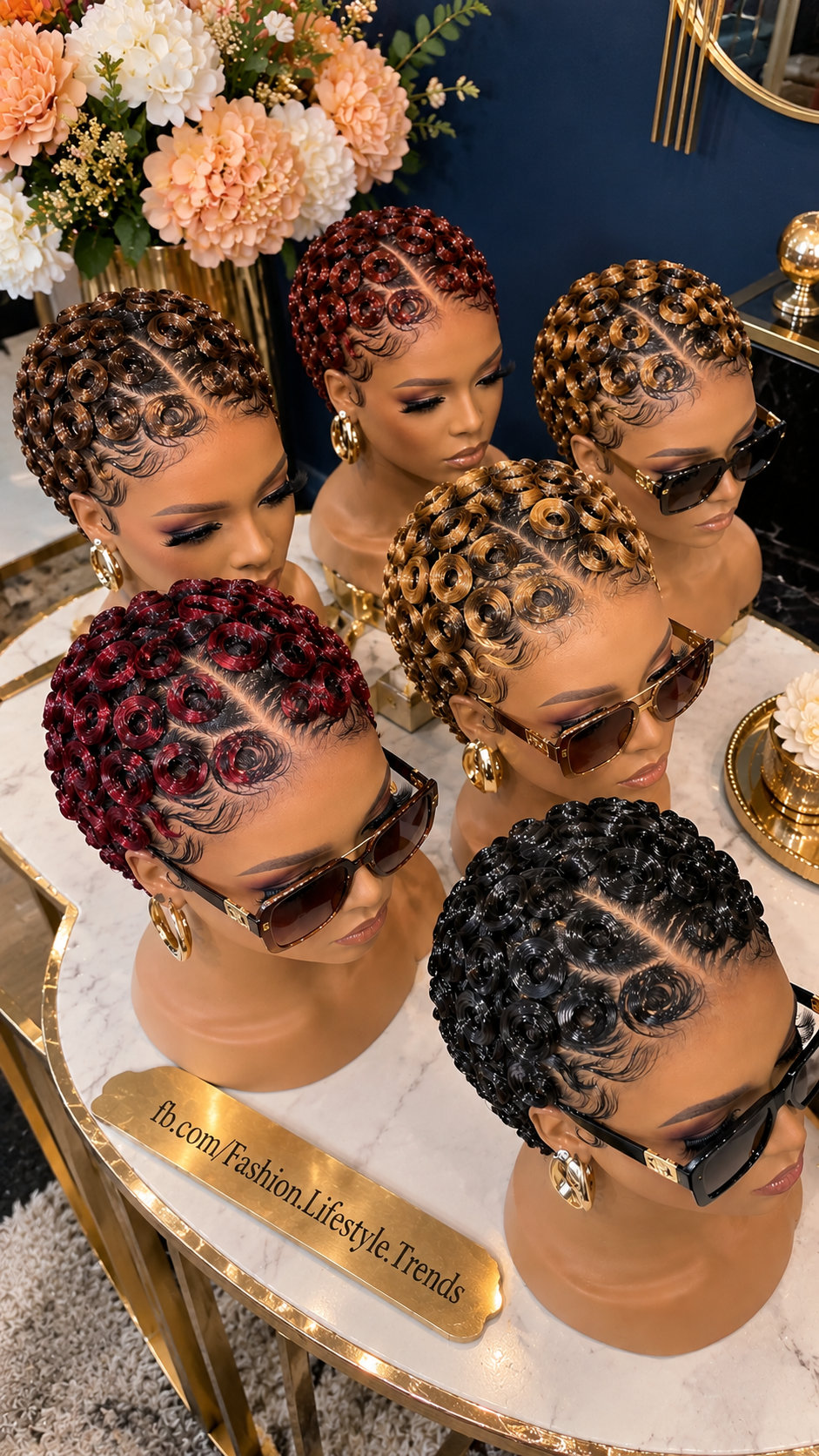
This six-piece collection showcases a striking combination of small polished pin curls, a visible center-to-diagonal part and carefully sculpted temple waves. The wigs share the same compact pixie construction while exploring jet black, burgundy red, deep chocolate, copper brown and golden honey color families.
The most distinctive element is the crown. Instead of loose spirals or fluffy curls, the hair is arranged into numerous flat circular formations with clearly visible centers. These rings sit close to one another and follow the contour of the head, creating a rounded silhouette without excessive height.
Flat Pin Curls Give the Crown Its Signature Pattern
Each wig is covered with dozens of small circular curls that resemble individually sculpted pin curls. The rings vary slightly in diameter and orientation, which keeps the crown visually interesting while preserving a consistent overall shape.
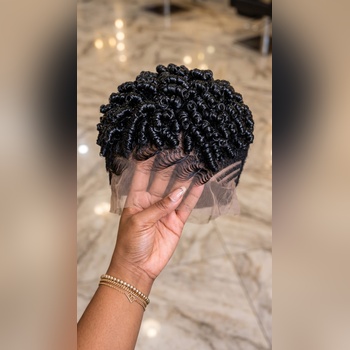
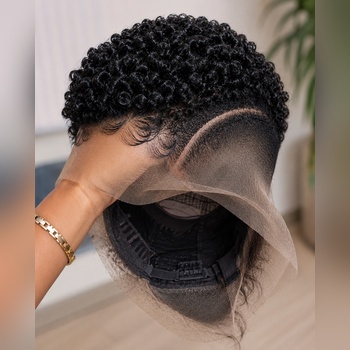
Because the curls lie relatively close to the base, the hairstyle remains compact. This is important for anyone ordering a similar wig: requesting ordinary curls may produce much more height and movement than the reference. The stylist should understand that the goal is a controlled circular curl pattern positioned close to the head.
The glossy finish makes the construction even easier to see. Light travels around the curved strands of each ring, producing bright highlights along the outer edges and deeper shadows inside the curl.
A Visible Part Breaks Up the Dense Curl Placement
The crown includes a narrow exposed part that begins near the forehead and travels backward. Its placement creates a clear division between the curls on either side while giving the hairstyle a more intentional direction.
Rather than hiding the base completely beneath dense curls, the visible line introduces contrast. This is especially noticeable on the jet-black and burgundy versions, where the darker hair stands strongly against the scalp-toned section.
When commissioning this style, show the stylist exactly where the part should begin and where it should travel. Even a relatively small change in placement can alter the balance of the front curls.
Temple Waves Soften the Circular Crown
A second styling technique appears around the forehead and temple. Here, the hair changes from circular rings into elongated feathered waves composed of many fine strands.
These waves follow the contour of the hairline and gradually curve toward the ear. Several smaller curled pieces appear near the temple, creating a transition between the flatter front section and the densely curled crown.
This contrast is one of the strongest elements of the design: structured circular curls above, sweeping strand-by-strand waves below.
Jet Black Highlights the Sculpted Construction
The deepest black version offers strong visual contrast and makes the arrangement of the curls particularly noticeable. The hair remains intensely dark inside each ring while direct light creates narrow reflective highlights across the upper surfaces.
Black also emphasizes the separation between the visible part and surrounding hair. Buyers who want this appearance should ask for a rich jet-black shade rather than a softer brown-black color.
Under bright salon lighting, the reflective surface may appear almost metallic in isolated areas, but the underlying color remains black.
Burgundy Red Adds Wine-Colored Depth
The burgundy units introduce a deep wine-red direction without sacrificing the visibility of the pin curls. Darker areas remain around the base and between individual rings, while raised sections catch brighter ruby reflections.
This variation creates depth throughout the crown. The color does not appear like one flat block of red because every curl reflects the light differently.
For a custom order, terms such as deep burgundy, wine red or black-cherry red can help describe the desired family, but the reference photograph should remain the primary color guide.
Chocolate Brown Offers a Deeper Warm Alternative
The darkest brown variation combines chocolate depth with subtle warm highlights. It provides a softer alternative to jet black while still maintaining enough contrast to reveal the parting and individual ring formations.
Under warm indoor lighting, sections of the hair can move visually toward chestnut or bronze. In cooler daylight, the same unit may appear considerably deeper.
This is why remote buyers should request photographs in more than one lighting condition before approving a custom brown shade.
Copper Brown Brings More Warmth to the Collection
The brighter warm-brown version leans toward copper and cinnamon. Its elevated curls catch orange-brown reflections, while deeper sections retain enough darkness to keep the circular pattern clearly separated.
The color is particularly effective around the front because the fine temple waves reveal several warm tonal changes within a relatively small area.
A stylist or colorist could use descriptions such as deep copper brown, cinnamon auburn or warm ginger-brown as a starting point when discussing a comparable shade.
Golden Honey Makes Individual Rings Highly Visible
The golden version is considerably brighter and therefore reveals nearly every curl across the crown. Each circular formation has a clearly visible outline, with golden highlights around its surface and deeper honey tones between neighboring rings.
The color remains warm rather than platinum or icy. Buyers looking for something similar should emphasize golden honey with amber warmth instead of simply requesting blonde.
This shade can be particularly effective for displaying the workmanship of the curl pattern because the lighter hair makes small structural details easy to see.
The Front Requires More Precision Than the Crown
Although the circular curls dominate the first impression, the front wave work is arguably the more technically demanding area. Multiple groups of fine strands must travel together without merging into one heavy section.
The wave immediately beside the part follows a broad curve, while smaller sections beneath it gradually change direction as they approach the temple. The result should appear deliberate but still retain visible individual strands.
Look for a stylist experienced in finger waves, molded pixie styling, pin curls and precision edge work rather than relying only on general wig-installation experience.
The Right Base Makes the Styling Easier
A suitable base wig needs enough density through the crown to create numerous individual curls without exposing unwanted gaps. The front and temple sections also need adequate workable length for the sweeping waves.
However, more density is not automatically better. An excessively heavy unit can make the circular curls bulky and prevent them from sitting close to the head.
Before purchasing an unfinished wig specifically for this project, send photographs and specifications to the stylist who will perform the work. Ask whether the length, density and fiber type are appropriate for the desired curl construction.
How to Request This Style at a Salon
Instead of asking only for a curly pixie, describe the visible elements individually. Request a compact crown filled with small circular pin curls, a narrow visible part, elongated feathered waves near the forehead and smaller sculpted curls around the temple.
Bring several reference angles whenever possible. An overhead image communicates crown placement much better than a straight frontal photograph, while a side view helps the stylist understand how the temple curls should terminate.
Confirm the color before the styling process begins, particularly if the wig will require bleaching or permanent coloring.
Where to Find a Similar Wig
Custom wig makers, specialist wig salons and stylists who regularly produce sculpted pixie units are the most relevant places to begin. When searching online, concentrate on terminology describing the actual hairstyle rather than broad phrases such as curly wig.
Search phrases such as pin curl pixie wig, sculpted circular curl wig, glossy finger-wave pixie, molded ring curl wig and side-part pin curl unit may produce closer visual matches.
If ordering through an online seller or social-media business, ask whether the displayed photograph represents the exact wig for sale or merely an example of a style they can recreate.
Custom Wig Price Guide
| Category | Estimated Price Range | Typical Offering |
|---|---|---|
| Premium Custom | $450–$950+ | Higher-grade hair, personalized coloring, extensive hand-set curls, precision wave work and final fitting |
| Standard Custom | $250–$500 | Custom shaping, selected color, pin-curl crown and professional finishing |
| Basic Human Hair | $130–$320 | Human-hair base suitable for additional cutting, coloring and professional sculpting |
| Premium Synthetic | $80–$210 | Higher-quality fiber with stronger shape retention and polished pre-styling |
| Basic Synthetic | $35–$100 | Entry-level pre-styled unit with fewer options for major alterations |
These are broad reference ranges rather than fixed retail prices. The final cost can change considerably according to hair quality, location, coloring requirements, density and the amount of manual styling required. Individually arranging a large number of small curls can add substantial labor to a custom order.
Booking a Custom Pin Curl Unit
Contact the stylist before purchasing the base wig whenever possible. Send the reference image, preferred color and desired part direction, then ask whether they recommend human hair or a particular type of synthetic fiber for the project.
Confirm what the quoted price includes. Cutting, coloring, styling, the base wig and fitting may be billed separately depending on the business.
For a remotely produced unit, request final images before shipment. Ask for an overhead crown photograph, front view and both side angles. These views make it easier to check curl density, part placement and temple-wave construction.
Maintaining the Polished Circular Shape
These curls should not be maintained like loose everyday curls. Running a brush through the crown would disturb the carefully arranged rings and could eliminate the characteristic circular pattern.
Store the wig on a suitable stand where nothing presses against the top. Protecting the crown from compression is particularly important because many of the curls depend on their raised circular edges to remain visible.
Use styling products sparingly. The desired appearance is mirror-like glossy hair, silky reflective finish, healthy wet-look shine, individually visible strands and crisp curl separation, not a heavily coated surface where neighboring curls stick together.
Turning One Curl Pattern Into a Full Color Range
The collection demonstrates how one recognizable construction can support several distinct color options. Jet black provides maximum contrast, burgundy introduces deep red reflections, chocolate gives a richer neutral direction, copper adds warmth and golden honey creates the brightest interpretation.
For wig sellers, this approach also makes product presentation easier. Customers can compare colors while seeing essentially the same curl size, crown volume and front-wave arrangement.
Further color variations could include espresso-to-toffee, dark chocolate-to-copper ginger, natural black-to-mocha toffee or jet black-to-caramel honey while preserving the signature circular crown.
Search Terms
Glossy Pin Curl Crown · Sculpted Center Part Curls · Burgundy Wine Pin Curls · Golden Honey Circular Curls · Copper Brown Ring Curl Pixie · Chocolate Brown Crown Rings · Jet Black Temple Waves · Feathered Hairline Curl Pattern