
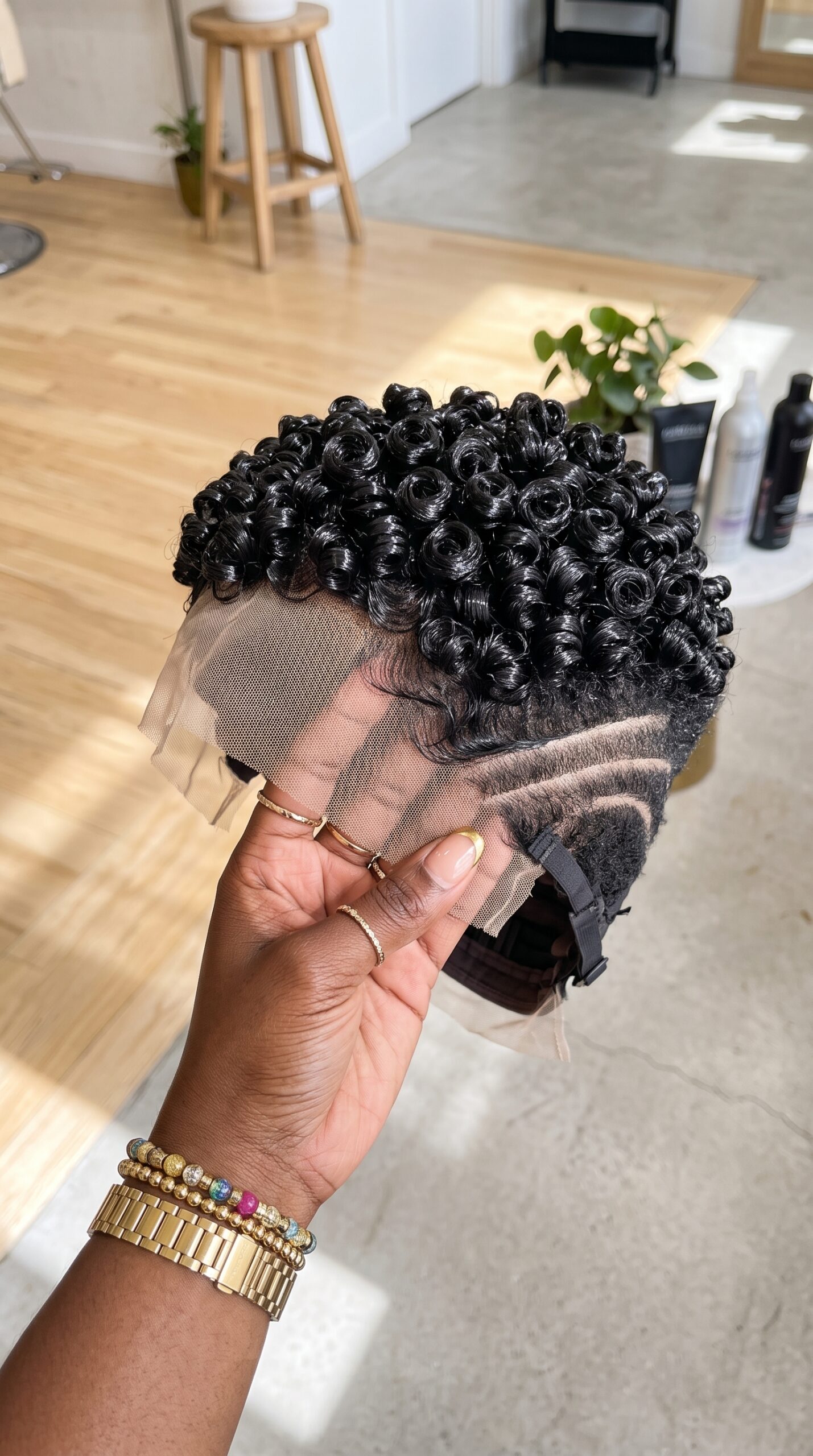
A carved side design can look simple because there may be only two or three visible lines, but simplicity actually makes mistakes easier to notice. On this black curly pixie wig, three narrow shaved lines travel across the short side beneath a dense crown of glossy ringlets. The design works because the lines are not only clean. They also maintain a controlled relationship with one another.
That space between the lines matters more than many buyers realize. If one gap is narrow and the next is noticeably wider, the pattern starts looking accidental. If the lines begin parallel but slowly converge toward the back, the whole design can appear crooked even when each individual line has been carved cleanly.
When buying a pixie like this, do not inspect only the lines themselves. Inspect the negative space between them. A professional carved design depends on both.
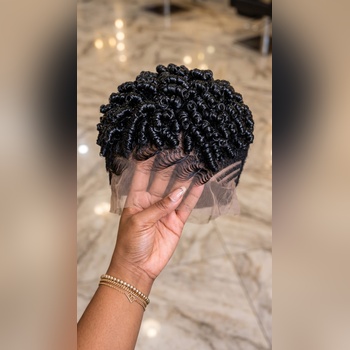
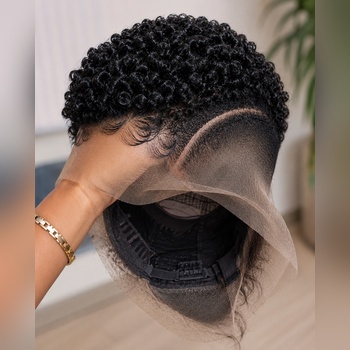
Where To Buy A Curly Pixie Wig With Clean Parallel Carved Lines
Custom wig makers. A custom maker is usually the safest choice when the exact side design matters. Send a close side-profile reference and specify how many lines you want, approximately how far apart they should sit, and whether they should stay parallel or gradually curve together.
Instagram and TikTok sellers. Ask for a slow side video under neutral lighting. Strong shine and dramatic camera angles can make slightly uneven spacing difficult to notice in a single photograph.
Etsy. Independent wig makers may allow more customization of the fade, curl crown, line count, spacing, and overall direction. Do not request only “three shaved lines.” That leaves too much of the geometry open to interpretation.
Marketplaces like Amazon, AliExpress, and Temu. Similar carved pixies may use completely different line widths and spacing even when the listing photos look close. Customer photos are particularly valuable because factory consistency can vary between batches.
Local beauty supply shops and salons. Local buying gives you the easiest inspection method. Hold the wig directly at eye level and follow all three lines from the temple toward the rear. You should not need to tilt the unit dramatically to make them appear balanced.
Vendors and wholesalers direct. If you are ordering several units, ask for a group photograph showing the carved sides. Small spacing differences become much easier to detect when several pieces are placed beside one another.
Vet the seller. Look for true side views rather than only front three-quarter photographs. Parallel-line quality is judged most accurately when the camera is almost perpendicular to the carved panel.
Red flags. Be cautious if the three lines merge near the back, if one line suddenly becomes much thicker, if the spaces vary dramatically, or if the design only looks straight when the wig is held at an unusual angle.
When you order, send. Provide your cap size, curl reference, fade height, number of carved lines, approximate spacing, preferred curve, and a clear side photograph.
Contact / order inquiries: WhatsApp [WhatsApp: +XX XXX XXX XX XX]
How Much It Costs
Premium custom human hair. A detailed human-hair curly pixie with lace construction, a sculpted ringlet crown, faded side, and carefully spaced carved lines can commonly range from around $230–$450 depending on the hair quality, cap work, and amount of hand finishing.
Standard custom human hair. Around $180–$320 can cover many strong short units. The carved design itself should still look deliberate at this level rather than being treated as a quick decorative extra.
Basic human hair. Around $150–$240 may buy a simpler version with more generic fade work or less exact side detailing.
Good synthetic. Around $60–$150 can provide a convincing compact pixie if the side construction is carefully manufactured. Synthetic fibre can also maintain the upper curl pattern with relatively little daily styling.
Basic synthetic. Around $25–$70 is common for budget units. Inspect the carved side closely because lower-cost versions may imitate the design with coarse lines or inconsistent short-hair density.
What the price may exclude. Custom cap sizing, lace tinting, knot work, detailed side carving, custom curl resetting, and professional fitting may all cost extra.
Shipping and duty. International delivery, customs charges, and local taxes can raise the final price significantly. Compare the full delivered cost rather than only the listing amount.
Cost per wear. A carved side is highly visible on a short pixie. Paying slightly more for precise geometry can make more sense than saving money on a unit whose side design bothers you every time you wear it.
What a very low price may signal. It can indicate rushed side work, generic cap construction, or a carved pattern designed mainly to photograph well from one specific angle.
The Empty Space Is Part Of The Design
When people inspect carved pixies, their eyes naturally focus on the visible scalp-like lines.
But a three-line pattern actually contains more than three visual elements.
There is the first line, the space below it, the second line, another space, and then the third line.
Those empty sections create rhythm.
If the spaces are balanced, the eye reads the design as one organized group. If they are inconsistent, the lines begin looking unrelated.
Equal Spacing Does Not Mean Measuring Every Millimeter
A carved design follows the curved surface of the head, so perfect mathematical spacing is not always necessary.
Perspective also changes what you see. A line farther around the side may visually appear closer even when the physical spacing is similar.
What matters is visual consistency.
The gaps should feel intentional from normal viewing distance. You should not immediately notice one unusually narrow section or one large empty area.
The Lines Need To Curve Together
Spacing alone is not enough.
Three parallel lines also need compatible curvature.
If the top line bends upward strongly while the lower lines remain almost straight, the distance between them will change automatically.
The design begins opening like a fan.
That can be intentional in some patterns, but if the reference shows parallel curves, all three lines should generally follow the same flow.
Line Width Changes Perceived Spacing
A thicker carved line occupies more visual space.
That means two physically equal gaps can appear different if one neighbouring line is much wider than another.
For example, a very thick middle line can make both surrounding spaces feel compressed even when the actual measurements have not changed.
This is why line width and spacing should be judged together.
Short Hair Makes Every Millimeter More Visible
Long hairstyles can hide small structural inconsistencies because hair moves, overlaps, and falls across the head.
A closely faded pixie does not offer that forgiveness.
The carved panel is exposed.
A slight change in line width or spacing can remain visible throughout the entire wear because nothing covers it.
That is why simple short designs often require more precision than complicated-looking long hairstyles.
The Top Line Sets The Direction For Everything Below It
On a three-line design, the first carved line often acts as the main visual guide.
The second and third lines usually make sense because they follow that initial path.
If the first line is badly positioned, the stylist may try to compensate with the lower two.
That usually creates inconsistent spacing.
For custom work, the maker should establish the main line first and build the remaining pattern around it rather than carving three independent curves.
The Fade Density Affects How Clean The Gaps Look
The hair between carved lines needs to be short enough for the negative space to remain clear.
If the surrounding faded hair is too long, individual hairs can fall across the carved lines and visually narrow the gaps.
If the side is extremely sparse, the entire area may begin looking pale and the carved lines lose contrast.
Good carving therefore depends partly on the fade underneath it.
Dark Hair Gives Very Little Room For Error
Jet-black or very dark brown hair creates strong contrast against exposed scalp-like sections.
That makes carved lines look sharp and dramatic.
It also makes inconsistencies easy to see.
A one-sided curve, sudden widening, or uneven gap is much more obvious on solid black hair than it may be on a lighter shade.
If you choose a dark unit specifically because you want a bold carved design, workmanship becomes especially important.
The Crown Must Not Cover The Upper Line
The dense ringlet crown above the carved side creates another challenge.
If the lower crown curls hang too far downward, they can partially cover the top carved line.
That changes the apparent spacing because one line becomes less visible than the others.
The design may suddenly look like two lines in some areas and three lines in others.
A good upper boundary leaves enough clearance for the full pattern to remain readable.
But Too Much Clearance Creates A Large Empty Band
The opposite problem is also possible.
If the curls end too high above the first carved line, a large band of short hair appears between the crown and the pattern.
That can make the design feel disconnected from the hairstyle above it.
The strongest placement leaves enough breathing room for the lines to remain visible without isolating them completely from the crown.
The Pattern Should Follow The Head, Not The Camera
A carved side may look perfect in a photograph simply because the wig has been tilted until the lines appear horizontal.
But once the unit is placed correctly on the head, the same pattern may rise or fall awkwardly.
Judge the lines while the wig sits in its real wearing orientation.
The design should relate naturally to the temple, ear, and crown rather than to the edge of a photograph.
Behind The Ear Is Where Parallel Lines Often Break Down
The side of the head begins curving away sharply as it approaches the rear.
This makes it harder to maintain visually parallel spacing.
One line may begin disappearing sooner than another, or the gaps may appear narrower because of perspective.
Ask for a rear three-quarter view when possible.
You want to know whether the pattern finishes intentionally or simply fades out because the maker struggled to continue it around the curve.
The Lines Do Not Need To Continue Forever
A clean ending is often better than forcing three decorative lines too far around the head.
The maker can gradually taper their length or end them before the rear section becomes too curved.
What matters is that the endings feel coordinated.
If one line stops abruptly while the other two continue far beyond it without a clear design reason, the pattern may feel unfinished.
Symmetry Is Not Always The Goal
Most carved pixies use the decorative pattern on one side only.
That asymmetry gives the hairstyle character.
You therefore do not need identical lines on the opposite side.
But within the actual carved panel, internal consistency remains important.
The hairstyle can be asymmetrical overall while the three-line pattern itself still feels controlled.
Carved Spacing Cannot Be Easily Corrected Later
This is one of the biggest reasons to inspect carefully before buying.
If a line is too thin, a stylist may sometimes widen it slightly.
But once too much hair has been removed, you cannot simply move the line back.
Likewise, if two lines are too close together, widening the gap often means removing even more hair and changing the whole design.
Carved geometry is therefore much less forgiving than ordinary curl styling.
Do Not Keep Re-Carving A Wig To Chase Perfection
A human-hair carved pixie does not regenerate hair the way a real haircut does.
On a real head, a barber can wait for hair to grow and redesign the pattern.
On a wig, the short side contains a finite amount of attached hair.
Repeated correction gradually removes more material.
If the design is already acceptable, small handmade variation is usually safer than repeatedly carving the side thinner.
Product Buildup Can Make Lines Look Narrower
Gel, edge product, mousse residue, and oils can collect along the short side.
That can push neighbouring hairs across a carved line and make it appear narrower or less sharp.
Before assuming the pattern has degraded, clean the side carefully and reassess it.
Sometimes the geometry is still intact underneath product buildup.
Lighting Can Change The Apparent Spacing
Strong direct light brightens the exposed carved lines and increases contrast.
Soft shadow can make those same lines look thinner.
This is another reason seller photos should not be your only evidence.
Ask for a normal-light video so you can see how the three-line pattern reads outside a highly controlled beauty shot.
For Wholesale Buyers, Spacing Is A Quality-Control Metric
If you buy carved pixie wigs in quantity, line spacing is an excellent way to judge batch consistency.
Place several units beside one another and compare the side designs.
You do not need every line to be identical, but the overall width, spacing, curve, and placement should stay within the same visual family.
If every unit looks like a different barber designed it, selling them under one product photo may create customer complaints.
Before You Pay
- Can you show the carved side from a true side angle rather than only a three-quarter view?
- Do the three lines stay visually parallel from the front toward the back?
- Are the spaces between the lines approximately consistent throughout the design?
- Can you show where all three lines end behind the side of the head?
- If I order another unit later, can you reproduce approximately the same spacing and curve?
Trimming The Lace
Place the wig in its intended position before cutting the lace.
The carved design has a fixed relationship with the temple and side of the head. If the cap is rotated, even perfectly carved parallel lines can suddenly appear crooked.
Check the hairline, crown, side design, ear area, and nape first.
Once the wig is centered correctly, trim the excess lace gradually.
Do not rotate the entire cap simply to straighten the carved lines. If the pattern only looks balanced when the wig is worn incorrectly, the problem belongs to the design or construction rather than the lace placement.
Search Terms
three line carved pixie wig · parallel line curly pixie wig · shaved line pixie wig · black ringlet carved pixie wig · triple line fade pixie wig · short curly wig shaved design · carved side lace pixie wig · black curly fade wig design
Final Thoughts
A three-line carved pixie looks simple because there are only a few visible elements. That simplicity is exactly why precision matters.
The lines themselves need to be clean, but the empty spaces between them also need control. Uneven spacing, inconsistent width, or curves that slowly move toward one another can change the entire side design even when the crown above is beautifully curled.
When you inspect a carved pixie, stop looking only at what was shaved away. Look at the short sections of hair left between those lines too.
Those narrow bands are what hold the pattern together.