
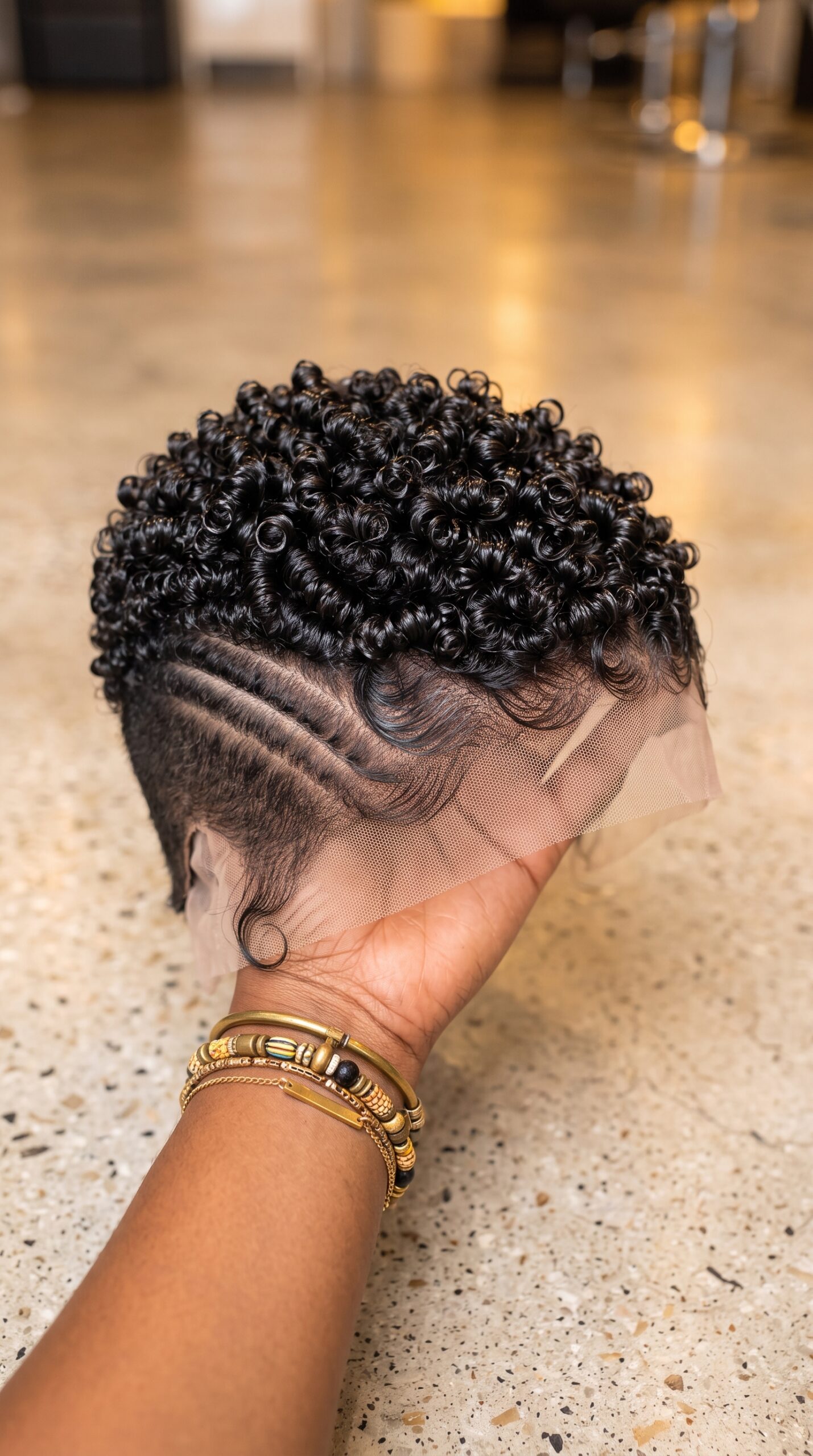
Look closely at a sculpted curly pixie wig like this and you can see that the hairstyle is doing two very different things at once. The upper section is filled with compact, glossy spiral curls, while the lower front and side sections are pressed into flatter, elongated waves that travel close to the lace.
That separation is one of the details that gives this type of pixie its polished shape. If the spiral curls drop too far down the side, they cover the wave work. If the flat waves travel too high into the crown, they reduce the fullness of the curls and make the top look compressed.
A well-made sculpted pixie therefore needs a controlled transition zone between the raised curl crown and the flatter side waves. When shopping for this style, that transition deserves just as much attention as the curls themselves.
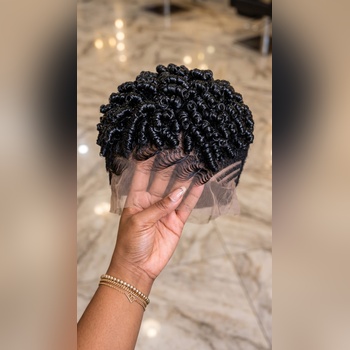
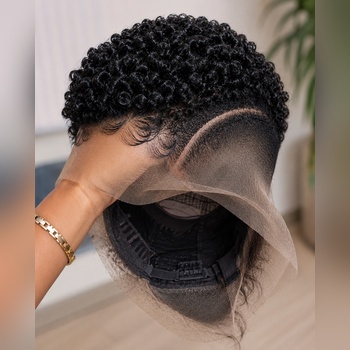
Where To Buy A Sculpted Curly Pixie Wig
Custom wig makers. Custom ordering is one of the best options when you want this exact combination of compact curls, sculpted waves, lace construction, and a closely shaped side. Send several reference photographs rather than describing the unit simply as a curly pixie. Make it clear that the crown should remain full while the lower waves stay flat and visible.
Instagram and TikTok wig sellers. Social sellers often show these highly styled pixies in short videos. Ask for a slow video showing the front, both sides, crown, lace, and interior cap. Pay particular attention to the point where the circular curls meet the flatter waves.
Etsy and independent wig makers. Independent makers may offer more control over curl size, density, side-wave placement, lace colour, cap dimensions, and overall silhouette. Ask whether the wig arrives fully styled or whether the product photographs show a salon finish that must be recreated after delivery.
Online marketplaces. Amazon, AliExpress, Temu, and similar marketplaces can carry inexpensive curly pixie wigs, but product names are often broad. A listing called a finger-wave pixie may have loose curls, tight spirals, molded waves, or a combination of all three. Customer photographs are particularly useful for judging what actually arrives.
Local wig shops and beauty supply stores. Buying locally gives you the advantage of inspecting the unit from several angles. Hold the wig at normal viewing distance first. The crown and side sections should immediately look like intentional parts of the same hairstyle.
Professional wig stylists. Another option is buying a suitable human-hair pixie base and having a stylist create the finished curl-and-wave arrangement. Search for stylists experienced with pixie wigs, finger waves, molded hair, lace customization, and short human-hair units.
Before ordering. Send your head measurements, preferred cap size, lace preference, crown density, curl size, side-wave reference, and desired colour. If the sculpted layout is the main reason you like the wig, tell the seller not to substitute a generic curly pixie.
Contact / order inquiries: WhatsApp [WhatsApp: +XX XXX XXX XX XX]
How Much A Wig Like This Can Cost
Premium custom human hair. A detailed human-hair pixie with a hand-styled spiral crown, molded side waves, lace construction, and custom finishing can commonly cost around $230–$450 or more depending on hair quality and workmanship.
Standard human hair. Around $170–$320 can cover many good-quality pixie wigs. At this price, inspect whether the style is actually built into the unit or heavily dependent on temporary product and photography preparation.
Entry-level human hair. Around $120–$230 may provide a simpler version. Curl consistency, lace quality, side detailing, and cap construction can vary considerably.
Good synthetic units. Around $60–$150 can be practical if you want the hairstyle to retain a preset form. Quality synthetic fibre can preserve tight curls and molded shapes with less restyling than human hair.
Budget synthetic units. Around $25–$70 is common. At this level, check whether the crown looks naturally layered rather than like identical synthetic coils attached in rows.
Additional expenses. Lace tinting, installation, custom cap sizing, professional cutting, curl resetting, and future styling appointments may not be included in the advertised price.
Cost per wear. For a highly sculpted pixie, the cheapest purchase price is not necessarily the lowest long-term cost. A unit that repeatedly loses its wave pattern may require more products and salon visits than a better constructed wig.
The Crown And Side Should Have Different Heights
The crown in this style is intentionally three-dimensional.
Individual spirals rise away from the base and overlap one another to create fullness. The lower side waves behave differently. They sit close to the foundation and follow the shape of the head.
This height difference gives the haircut its silhouette.
If every section has the same height, the pixie can become round and bulky. If everything is pressed flat, the crown loses the lively curl effect that makes the style attractive.
There Should Be A Visible Transition Zone
The strongest versions do not move abruptly from large spirals to completely flat hair.
Between those two sections, smaller curls and curved strands help connect the shapes.
Think of this area as a bridge. It allows the raised crown to gradually settle toward the side rather than ending suddenly.
Without that bridge, the crown can look like a separate curly piece placed on top of a molded base.
The Transition Should Follow The Shape Of The Head
A pixie wig is viewed from several angles during normal wear.
The boundary between the curl crown and side waves should therefore continue naturally around the head rather than working only from the front.
Ask for side and rear three-quarter photographs when buying online.
A beautifully blended front section does not guarantee that the same transition has been maintained around the back.
Crown Curls Should Not Collapse Onto The Waves
One common problem appears when the lower row of crown curls becomes too heavy.
Gravity pulls those curls downward until they begin covering the sculpted wave section.
The hairstyle then loses visual separation.
This is especially important with human hair because styling products, moisture, and repeated handling can gradually change how the curls sit.
If the lower crown starts dropping, reshape those curls rather than simply adding more product to the entire side.
Side Waves Should Not Invade The Crown
The opposite problem happens when too much of the hair is molded flat.
A stylist may continue the wave pattern upward because it looks neat during styling, but doing so can reduce crown volume.
The top begins looking smaller and the wig may lose its rounded pixie silhouette.
The best placement preserves enough flat wave work to frame the side without sacrificing the density above it.
Curl Size Helps Create The Transition
The crown does not necessarily need identical spirals from front to back.
Slightly smaller curls near the boundary can help connect the full upper section with the flatter waves underneath.
This creates a gradual visual change.
Large curls immediately beside very thin molded waves can create an abrupt step. Intermediate shapes make the hairstyle look more cohesive.
The Front Hairline Needs Its Own Treatment
Near the front lace, the hairstyle becomes even more delicate.
The wearer needs enough softness around the hairline for the wig to blend naturally, but the front should still connect with the sculpted side.
Long sweeping strands and controlled baby hairs can help create this connection.
Too many tiny curls directly on the lace may make the front look crowded. Too little hair can expose more lace than intended.
Lace Visibility Matters With A Sculpted Pixie
Short wigs leave very little hair available to hide construction.
That means lace quality becomes particularly important.
Inspect the mesh around the front and temple areas. It should be fine enough to blend against the skin after appropriate trimming and tinting.
Also inspect where hair is ventilated into the lace. Excessively dense knots can make the transition from lace to sculpted hair appear harsh.
The Side Waves Need Flexible Hold
A wave that is too soft may disappear quickly.
A wave coated in extremely hard gel may keep its shape but look stiff and unnatural.
The ideal result sits between those extremes.
The hair should remain close to the base while still reflecting light like individual strands rather than one solid shell.
Light mousse, setting foam, or a suitable styling product can often provide enough control without saturating the section.
Heavy Product Can Destroy The Difference Between Sections
It can be tempting to apply the same strong product everywhere because the hairstyle contains so many precise shapes.
But the crown and side waves have different needs.
The spiral crown needs definition while retaining dimensional separation. The molded side requires closer control.
Applying a heavy gel across everything can glue neighbouring crown curls together and make the upper section look flatter.
Use product according to the job each section needs to perform.
Washing Can Reset The Entire Relationship
This point is especially important for human-hair buyers.
A professionally sculpted pixie may look highly structured when it arrives, but washing can relax both the crown curls and side waves.
Before purchasing, ask what the unit looks like after washing and what must be done to restore it.
If the seller says the wig is human hair, do not automatically assume the original sculpted arrangement will return by itself after shampooing.
Take Reference Photos Before The First Wash
Photograph the wig from the front, both sides, back, and top before washing it for the first time.
Those photographs become a styling map.
You can see where the crown ends, where the flatter section begins, which direction the waves travel, and how much volume the original stylist used.
This is particularly helpful if you eventually take the wig to another stylist for maintenance.
Reset The Crown Before Perfecting The Side
If a human-hair unit needs a full restyle, establish the crown shape first.
The final position of those curls determines how much space remains for the side waves.
If you perfect the lower waves first and then create a larger crown, the curls may drop over work you have already completed.
Building the overall silhouette before refining small details usually produces a more balanced result.
The Side Design Should Remain Visible
This wig also uses closely shaped side work beneath the curl crown.
That decorative section adds another layer of structure.
The upper curls and molded waves should not hang so low that they completely hide the shorter design underneath.
At the same time, the side should not be exposed so aggressively that the crown appears disconnected from it.
Balance is the key.
Check The Wig From Normal Viewing Distance
Macro photographs are excellent for judging lace, curl formation, and individual strands.
But a wig is not normally viewed from ten centimeters away.
Step back and look at the entire silhouette.
You should see a clear progression: dimensional curls on top, a controlled transition, flatter sculpted waves below, and a closely shaped side supporting the design.
If your eye immediately notices a hard horizontal boundary between sections, the transition may be too abrupt.
Black Hair Makes The Shape More Important
On a deep black pixie, colour variation does not separate the sections for you.
Everything depends on texture, direction, height, shine, and negative space.
The raised spirals catch light differently from the flatter waves, creating enough contrast for the two zones to remain readable.
This is one reason glossy black hair works so well for sculpted pixie styles.
Shine Should Reveal Structure, Not Hide It
A healthy reflective finish can make individual curls and wave ridges easier to see.
However, excessive oil can reduce separation.
If every strand is saturated, small curls begin clumping together and the transition zone loses detail.
Use shine products sparingly, particularly on already polished hair.
Storage Should Protect Both Sections
Throwing a sculpted pixie into a drawer can flatten the crown while simultaneously disturbing the molded sides.
Store the unit on an appropriate wig stand or form whenever possible.
Avoid placing objects on top of it.
If you travel with the wig, support the crown so the spiral curls are not pressed completely flat during transport.
Sleeping In The Wig Can Blur The Boundary
Repeated pillow friction pushes crown curls downward and rubs against the flatter side waves.
Over time, the two zones can begin blending into one less organized texture.
If the wig is removable, taking it off before sleeping is usually the easiest way to protect detailed styling.
If you must sleep in it, use appropriate protection and minimize friction as much as possible.
When To Visit A Wig Stylist
Professional help becomes useful when the crown still has healthy hair but no longer holds its original arrangement, or when the side waves have lost their path completely.
Search locally for a pixie wig stylist, short wig specialist, finger wave stylist, human hair wig customization salon, or lace wig stylist.
Show the stylist photographs of the original unit.
Explain that you want to preserve the separation between the raised spiral crown and the flatter sculpted side rather than converting the entire wig into one uniform curl pattern.
How To Book The Style At A Salon
Before booking, send photographs and ask whether the stylist regularly works on wigs rather than only natural hair.
Ask whether they can reset compact curls, mold finger-wave sections, work around lace safely, and preserve short side detailing.
Also confirm whether the quoted appointment price includes washing, conditioning, drying, curl resetting, wave molding, lace work, and finishing.
This prevents a basic styling appointment from turning into several unexpected services.
Before You Pay
- Can you show the exact point where the crown curls transition into the flatter side waves?
- Will the sculpted pattern remain after washing, or does it need to be completely reset?
- Is the unit human hair, synthetic fibre, or a blend?
- Can you show both side profiles and the crown under normal indoor lighting?
- What products do you recommend for maintaining the crown without flattening the wave section?
Trimming The Lace
Position the wig correctly before removing any excess lace.
This style contains several directional elements, so rotating the cap even slightly can change where the sculpted waves sit in relation to the temple and side of the head.
Check the crown balance, front hairline, temple placement, side design, ear area, and nape first.
Once everything sits naturally, trim the lace gradually rather than cutting directly against the hairline in one pass.
Do not remove extra lace simply because a wave appears too far forward. First confirm that the entire wig is positioned correctly.
Search Terms
sculpted curly pixie wig · black spiral curl pixie wig · finger wave curly pixie wig · lace pixie wig with side waves · molded wave pixie wig · black curly lace pixie · ringlet crown pixie wig · short human hair curly pixie wig · sculpted side curly wig · curly pixie wig with finger waves
Final Thoughts
A sculpted pixie like this succeeds because it does not treat every part of the wig the same way. The crown is allowed to rise into compact spiral curls while the lower sections stay closer to the head in long, controlled waves.
The area connecting those two textures is easy to overlook, but it determines whether the hairstyle feels cohesive. Too much crown hair dropping downward hides the wave work. Too much molded hair travelling upward steals volume from the crown.
When shopping for this style, examine that boundary from the front, side, and rear three-quarter angles. A strong unit should preserve two clearly different styling zones while making the transition between them feel natural.
That controlled change from dimensional curls to flatter sculpted waves is one of the details that gives a well-made pixie its distinctive salon-finished appearance.