
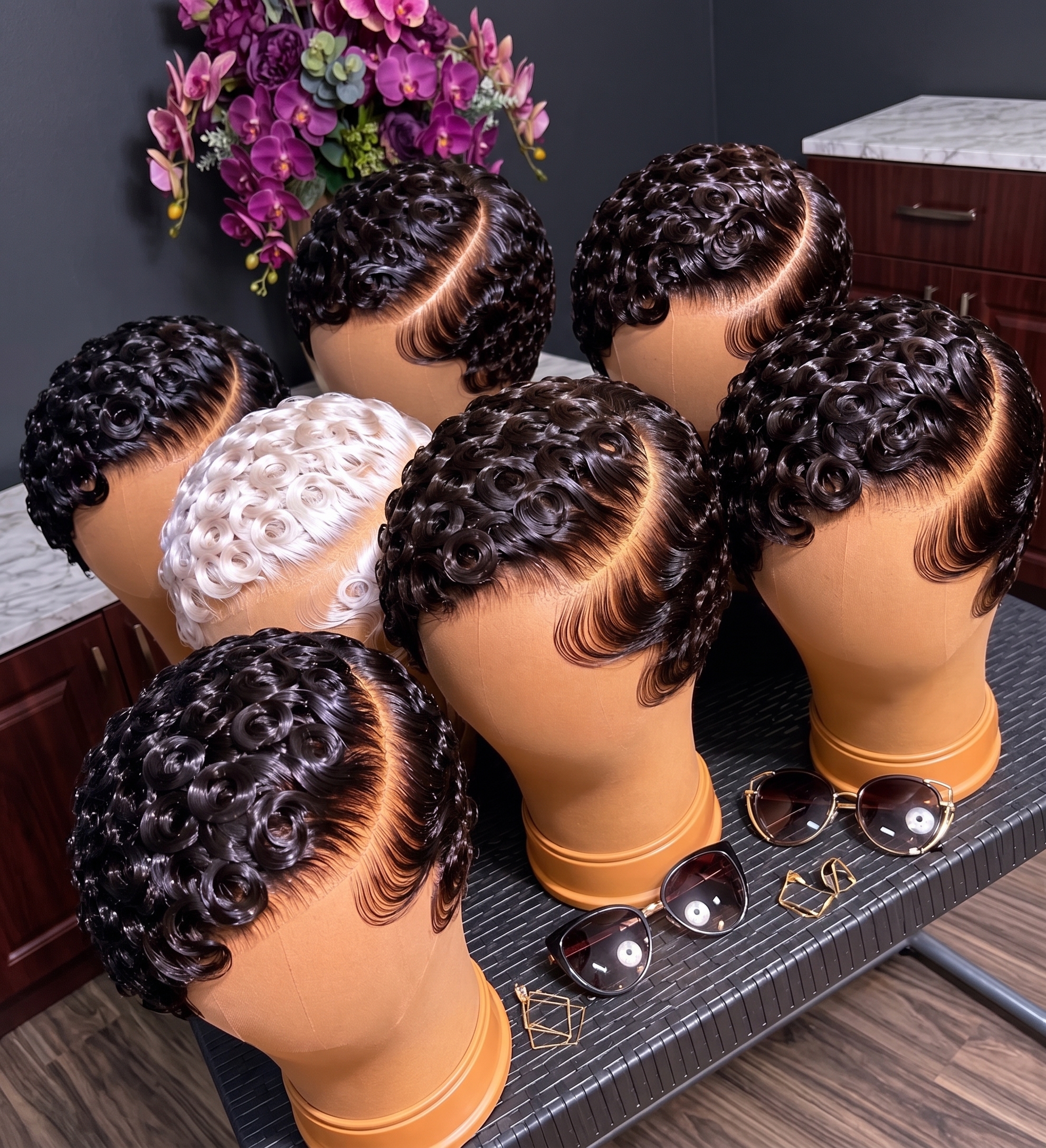
Look across the crown of a rosette pixie wig and the most important detail is not simply whether the hair is curly. It is whether you can still see the center of each curl.
On this collection, many of the curls form compact circles with a visible opening in the middle. That open center is what gives the crown its rose-like appearance. Once the center becomes crushed, stretched, filled with neighbouring strands, or coated with too much styling product, the curl may technically remain curled while losing the exact geometry that made the wig attractive in the first place.
That makes rosette curls different from ordinary loose curls. The shape is not judged only by curl diameter or overall volume. The opening in the center has to survive too.
Where To Buy A Rosette Curl Pixie Wig
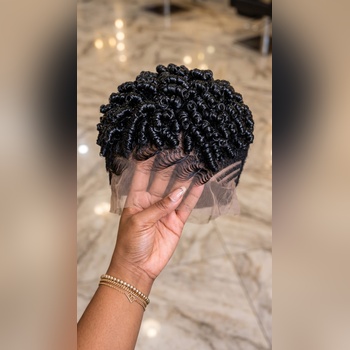
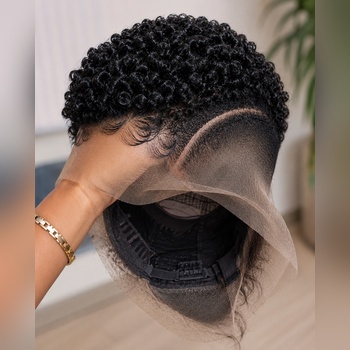
Custom wig makers. If you want this exact crown, send a close photograph showing the circular openings rather than only a full mannequin shot. Tell the maker that you want individual rosette curls with visible centers instead of a general curly pixie.
Instagram and TikTok sellers. Ask for a close video moving slowly across the crown. A still photograph can hide crushed or overlapping centers because glossy highlights distract the eye. Video makes it easier to see whether the rosettes remain readable across the full unit.
Etsy. Independent makers may give you more control over rosette size, crown height, part placement, colour, cap dimensions, and how tightly each curl is set. Ask specifically whether the rosettes are hand-shaped after the wig is constructed.
Marketplaces like Amazon, AliExpress, and Temu. Product names such as curly pixie, pin curl wig, finger curl wig, or spiral pixie may describe very different crowns. Compare customer photographs closely because many lower-cost versions arrive with compact curls that do not preserve a clear center opening.
Local beauty supply shops and salons. Local buying gives you an excellent inspection advantage. Look at the crown from normal distance first and then move closer. You should see repeated circular shapes without the crown looking like a collection of identical plastic rings.
Vendors and wholesalers direct. Ask whether the rosettes are formed from human hair, heat-safe synthetic fibre, or permanently preset synthetic material. Also ask whether the style has been heavily coated for photography.
Regionally. Sellers in Lagos, Accra, Atlanta, London, and major South African hair markets may call these pin curls, rose curls, rosette curls, sculpted curls, or salon-set pixie curls. A close reference image is more reliable than terminology.
Vet the seller. Favor sellers who show the crown before and after gentle handling. A beautiful rosette should not disappear simply because the wig was moved once.
Red flags. Be cautious if the centers are filled with gel, if several neighbouring curls have merged into one dark lump, if every rosette looks mechanically identical, or if the seller refuses to show the wig after unpacking.
When you order, send. Provide your cap size, preferred rosette diameter, crown height, colour, part placement, and a close reference showing how open you want the curl centers to remain.
Contact / order inquiries: WhatsApp [WhatsApp: +XX XXX XXX XX XX]
How Much It Costs
Premium custom human hair. A carefully set human-hair rosette pixie with lace construction, hand-shaped crown curls, detailed side styling, and custom colour can commonly range from around $240–$460 depending on the hair and amount of styling labour.
Standard custom human hair. Around $180–$320 can cover many good human-hair pixies. At this level, check whether the rosette centers continue across the crown instead of appearing only in the most photographed front section.
Basic human hair. Around $150–$240 may buy a simpler unit with less consistent rosette formation, heavier lace, or curls that require more frequent resetting.
Good synthetic. Around $60–$150 can be a strong option for this geometry because quality synthetic fibre can preserve circular curl shapes for longer with relatively little daily work.
Basic synthetic. Around $25–$70 is common for budget units. Inspect whether the circular curls look flexible and hair-like rather than stiff rings sitting independently on the cap.
Colour premium. Human-hair burgundy, copper, blonde, or other processed colourways may cost more than dark natural shades because additional colouring work is required.
What the price may exclude. Custom cap sizing, lace tinting, knot work, colour refreshing, professional rosette resetting, and first fitting may all cost extra.
Shipping and duty. International delivery, customs fees, and local taxes can significantly increase the final purchase cost. Compare the full delivered total rather than only the advertised wig price.
Ongoing costs. Human-hair rosettes may require foam, light setting product, small rollers, finger shaping, or occasional salon resetting after washing.
First-year total. Include styling products, lace care, colour maintenance where needed, and possible professional help if the circular openings become difficult to recreate.
Cost per wear. A unit that naturally keeps its rosette centers open may provide better value than a lower-priced wig that requires every curl to be rebuilt constantly.
What a very low price may signal. It may indicate ordinary curled fibre arranged into temporary circles for the product image rather than a crown designed to preserve the rosette geometry through regular wear.
Deposit structure. Custom makers commonly request around 30–50% upfront and the balance before shipping. Keep the close curl reference with your written specifications.
Shipping, Delivery, And What To Expect After Ordering
When the wig arrives, inspect the crown before adding any product.
Shipping pressure can temporarily compress the rosettes. Look at whether the centers are merely flattened or whether the strands have actually lost their circular path.
Gently lift several curls with your fingers. A well-set rosette may need a little encouragement after packaging, but the basic circular pattern should still be visible.
The Center Opening Is Part Of The Curl
People often judge a curl by its outside edge.
With a rosette, the inside matters just as much.
The strand circles around itself and leaves a small open center. That negative space helps the eye understand the curl as one complete shape.
Fill that opening and the rosette becomes harder to read.
The hair has not necessarily become straight or damaged. The visual architecture has simply changed.
A Crushed Rosette Can Still Be Curly
This distinction explains why some pixie wigs still look curly after months of wear but no longer resemble their original product photographs.
The hair may retain plenty of bend.
What disappears is the organized circular structure.
Centers flatten, neighbouring curls overlap, and strands begin travelling through openings that used to be empty.
The result is still a curly crown, but not the same rosette crown.
Too Much Product Can Fill The Center
Heavy gel or thick wax can cause neighbouring layers of the same curl to stick together.
At first, this may increase shine and make the outside edge look precise.
But excess product can gradually pull the inner section inward until the center becomes tiny or disappears completely.
It can also collect dust and lint inside the curl opening.
Use enough product to hold the rosette without turning the entire ring into one coated piece.
Too Little Hold Can Make The Circle Open Too Far
The opposite problem also exists.
If a human-hair rosette receives almost no support after washing, the circular opening can expand while the surrounding strand relaxes.
Instead of a compact rose-like curl, you get a larger irregular loop.
The hair may still look attractive, but the character of the pixie changes.
The goal is not maximum rigidity. It is controlled shape retention.
The Opening Should Not Be Perfectly Identical On Every Curl
A crown made from dozens of mathematically identical circles can begin looking artificial.
Some rosettes can be tighter. Others can have slightly larger centers. A few may lean or overlap naturally.
What should repeat is the general language of the curl.
You want to recognize the same rose-like concept across the crown without feeling that every piece came from a mold.
Large Open Centers Create A Different Mood
When the center opening becomes larger, the rosette looks lighter and more airy.
You see more negative space and less continuous hair surface.
This can make a crown appear slightly less dense even when the same amount of hair is present.
Larger openings also make individual rosettes easier to identify from a distance.
For someone who wants a dramatic salon-set crown, that can be appealing.
Small Open Centers Make The Crown Look Denser
Tighter rosettes place more hair close to the center.
The visible gaps shrink and neighbouring curls begin forming a darker continuous surface.
This can make the crown appear denser and more compact.
But if the center gets too small, you lose the visual cue that separates a rosette from an ordinary compact curl.
There is therefore a balance between density and readability.
Rosette Spacing Matters Too
Even beautifully formed curls can fail if they are packed too tightly together.
One rosette may press into another and partially cover its center.
Several overlapping curls can create a visually heavy patch while another area remains open.
Good placement leaves enough room for individual curl centers to remain visible without producing obvious empty gaps between them.
The Part Creates A Natural Boundary For The Rosettes
Several units in this collection use a prominent curved side part.
That line helps organize the circular crown.
Rosettes on one side can travel in one direction while those on the opposite section follow another.
The part therefore prevents the crown from becoming one random field of circles.
When ordering, inspect whether the curls appear to originate logically from each side of the part.
Rosettes Near The Part Need Extra Control
The curls closest to a visible part have less room to wander.
If one expands dramatically across the scalp line, it can hide the part.
If it contracts too tightly away from the line, it can make the part look wider.
These curls therefore influence two design elements at once: rosette geometry and scalp-line visibility.
The strongest styling balances both.
Temple Waves Should Not Compete With The Rosettes
The side sections in this collection use long sculpted waves close to the temple.
Those shapes are flatter and more elongated than the circular crown curls.
That contrast works because the two zones perform different visual jobs.
The crown supplies repeated round forms. The temple section guides the eye downward toward the face.
If the temple were filled with equally large rosettes, the silhouette could become bulky around the face.
The Transition Needs Intermediate Shapes
Look between the large crown rosettes and the long side wave.
The best units do not jump abruptly from one geometry to the other.
Smaller curved pieces help connect them.
This prevents the side panel from looking like a separate hairstyle pasted beside the circular crown.
Even when two zones are intentionally different, their meeting point still matters.
Gloss Makes The Center Opening Easier To Read
These wigs have a strong polished sheen.
Light hits the outer curve of each rosette while the center stays darker.
That contrast makes the opening highly visible.
This can make rosettes look exceptionally crisp in photographs.
Remember, however, that lighting and serum can exaggerate the effect. Ask to see the crown under ordinary indoor light as well.
Dark Colours Depend More On Shape
On black and deep chocolate units, neighbouring curls can visually merge because the shade is so dark.
The center openings become especially important because they give the eye boundaries to follow.
Without those openings, a high-density black crown can quickly become one glossy mass.
This is why open-center preservation is particularly useful on deep single-tone colours.
Pale Colours Reveal Every Irregularity
The white or very pale unit in this collection behaves differently.
Lighter hair reflects more light and makes each individual curve easy to inspect.
A crushed center, stray strand, or irregular circle may therefore become more obvious.
The pale colour can make the rosette pattern spectacular, but it also gives the stylist less visual forgiveness.
Human Hair Gives You The Best Repair Options
If a human-hair rosette collapses, you can usually reshape it.
The exact method depends on the hair, but small rollers, finger forming, setting foam, or controlled heat can help restore the circular path.
The advantage is flexibility.
The disadvantage is that you may eventually have to do that work yourself.
A precise salon-set human-hair crown does not automatically rebuild itself after washing.
Synthetic Fibre Can Preserve The Center Longer
A quality synthetic rosette can maintain its circular opening for many wears if the shape was engineered into the fibre.
That makes synthetic material practical for highly repetitive geometry.
The tradeoff appears when something goes wrong.
A permanently crushed synthetic ring may be harder to repair, especially if the fibre cannot safely tolerate heat.
Ask what type of fibre you are buying before attempting correction.
Sleeping Pressure Flattens The Centers
One of the fastest ways to change a rosette crown is repeated pressure.
Sleep directly on the unit and the circles touching the pillow become oval or flat.
Do that repeatedly and the crown begins losing its uniform rose-like language.
Whenever practical, remove the wig before sleeping and store it on a form that does not compress the curls.
Packing Pressure Can Create One-Sided Damage
Shipping or storage can also flatten only one area.
If the wig sits against one side of a box, the rosettes touching that wall receive more pressure than those on the opposite side.
That can make a new unit look uneven immediately after unpacking.
Give the crown a gentle refresh before concluding that the maker produced different curl quality on each side.
Do Not Push Fingers Through Every Center
The circular opening can tempt you to put a fingertip through the curl and pull it into shape.
That works occasionally, but repeated stretching can enlarge the center too much.
Support the curl from the outside and encourage its original circular path rather than constantly pulling the center open.
Preservation requires restraint.
Do Not Separate A Rosette Like A Natural Curl
With some curly wigs, separating one curl into two or three pieces creates attractive volume.
That technique changes a rosette completely.
Once the circular strand is divided, the open center disappears because the curl no longer travels as one organized ring.
If you love this exact rose-like crown, resist the instinct to separate every curl for volume.
Volume Should Come From Placement First
If the crown feels flat, inspect how the rosettes are positioned before dividing them.
A slight lift at the root or a small change in angle may create more apparent fullness while preserving every circular center.
You can gain volume through placement without sacrificing the design.
That is usually preferable to turning the entire crown into loose separated curls.
The Best Seller Test Is A Gentle Touch
Ask the seller to press lightly on one rosette and release it.
You are not expecting a spring toy.
But the curl should show some ability to retain or recover its general circular form.
If one light touch permanently destroys the opening, the product photograph may represent a very fragile salon set.
If the curl is completely rigid, heavy product may be responsible for the apparent perfection.
Before You Pay
- Can you show a close video where the open centers of the rosette curls are clearly visible across the crown?
- Are these rosettes hand-set human hair or preset synthetic fibre?
- What happens to the circular centers after the first full wash?
- Can you show the wig after it has been unpacked rather than only immediately after salon styling?
- What is the recommended way to restore a crushed rosette without separating the entire curl?
Trimming The Lace
Place the unit in its correct wearing position before trimming the lace.
The curved part, rosette crown, and temple waves create a strong directional layout, so the cap should not be rotated simply to improve one curl.
Check the front hairline, part, temple waves, crown balance, and both sides first.
Once the wig is centered correctly, trim the excess lace gradually.
If one front rosette sits too low or hides the hairline, correct that curl rather than shifting the entire unit away from its intended position.
Search Terms
rosette curl pixie wig · rose curl pixie wig · pin curl pixie wig · open center curl wig · sculpted rosette pixie · retro curl pixie wig · side part rosette wig · finger wave rosette pixie wig
Final Thoughts
The circular center of a rosette curl may look like a tiny detail, but it is one of the main reasons this pixie reads differently from an ordinary curly unit.
The strand circles around an open space, creating a clear rose-like form. Crush that opening, fill it with product, pull it too wide, or split the curl apart and the hairstyle begins changing even while the hair remains curly.
That is why rosette maintenance is partly about protecting empty space.
When you shop for this look, inspect the curls themselves, but also inspect what sits inside them. The open centers are doing more work than they seem.