
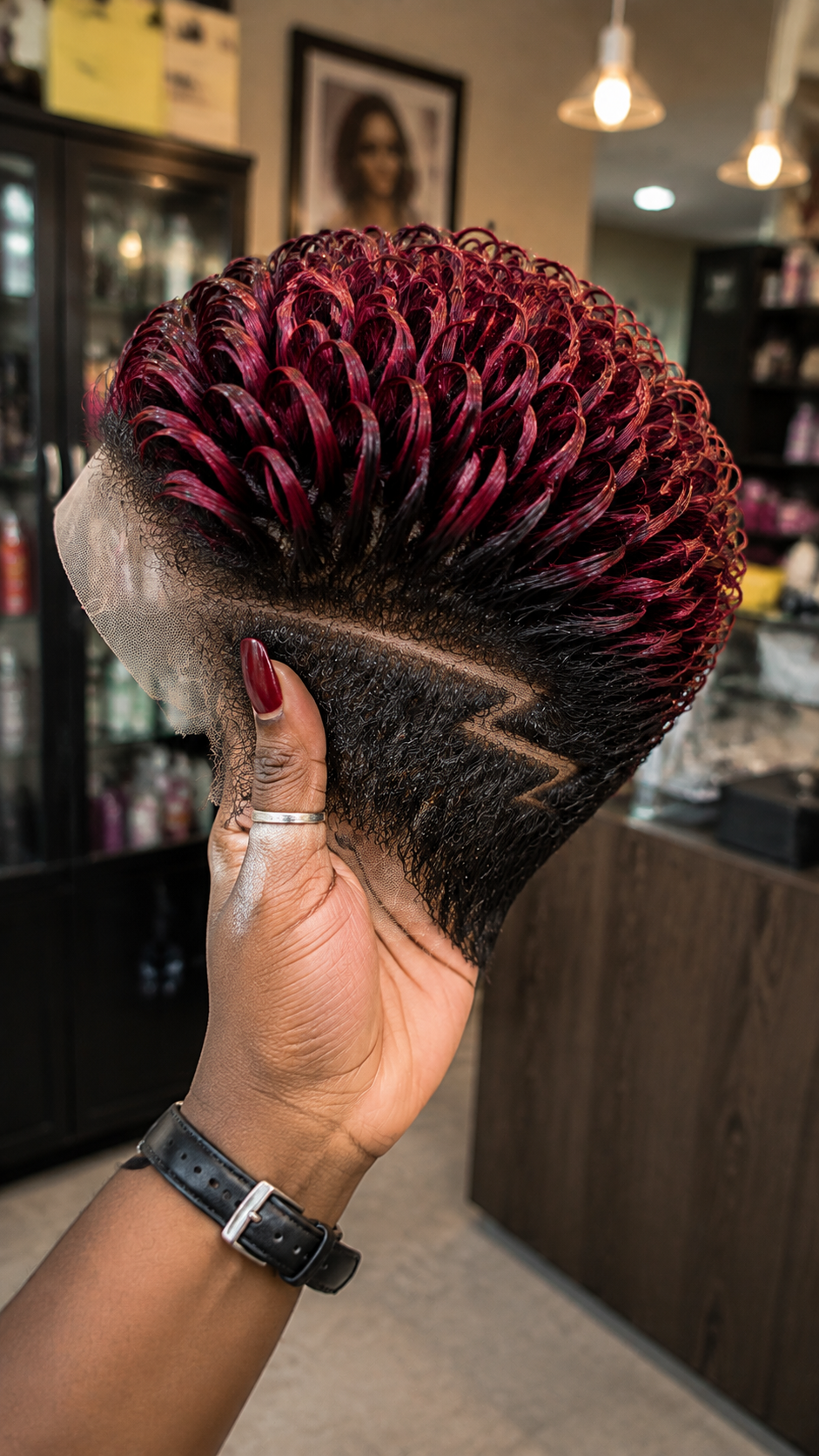
Count the open loops on the crown, then look at the tight black coils packed into the fade. The lightning bolt is not what makes those two zones disagree. The curl diameter is.
Two Curl Families, One Cap
The top is burgundy-to-wine spring loops — long enough to open, shiny enough to read as a set, dark only at the root. The side is short black hair with a much tighter coil, packed down into a fade, with a bolt razored through it. That is not a wine pixie with a decorative side. It is two curl families sharing a lace.
A single head of hair can do this in real life: length holds a looser spiral, a buzz collapses into a kink. On a wig it is usually a construction choice. The maker either took one texture short and left it dark, or they built a kinky fade panel and a looser wine crown as separate work. You cannot tell from this grip shot. You can tell that they will not maintain as one object.
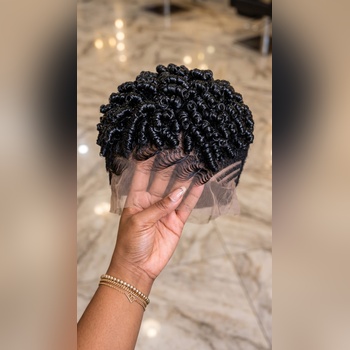
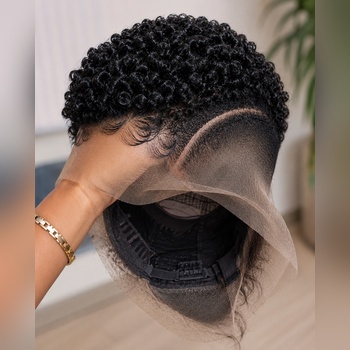
The wine loops want a finger, leave-in, and a pick at the root. The black side wants almost nothing except a recarve when the bolt blurs. Product that defines the loops will make the fade look greasy and clump the short kinks into lumps. Product that the fade can tolerate will leave the loops dry and stringy. Split the routine or the unit looks like two wigs stacked.
This is not the set-curl-on-natural-kinky blend, where one fibre changes finish from top to bottom. Here the pattern size changes. Open wine loops versus tight black kink is a bigger jump than wet gel versus dry coil. If you wanted one texture, this photo is already telling you that you do not have it.
The Bolt Sits In The Tighter Hair On Purpose
A lightning line only reads when the field around it is short. On open loops it disappears between the gaps. So the graphic is locked to the kinky panel. That panel is also the half that cannot hide lace. Black tight coil on mesh shows every knot and every untinted hole, same as any black short side — only now the hair has a kink, so the surface is rougher and the grid flashes more.
Recarving a bolt through kinky short hair is not the same as recarving a sleek buzz. The kink springs. Edges look softer the next morning even if the line was sharp last night. If you cannot live with a slightly fuzzy bolt, do not buy the motif. Buy a plain taper under the wine and stop paying for a drawing that the texture will argue with.
The hanging lace is still trim margin. Tint what you keep toward the black panel, not toward the wine. A pink-tinted mesh under a black kink looks like a burn.
Wine Is Deposit. Black Is Not.
The loops are a fashion red sitting on lifted or pre-lightened fibre, or they are wine dyed through a darker base and left with a dark root. Either way the colour lives in the longer hair. The fade stays black so the side does not go pink when the dye shifts.
Wine bleeds. First washes are cold, separate, away from anything white. Wine also drifts: maroon to rose-brown, then to a tired cocoa if you ignore it. The black panel will not drift with it. In two months you can have warm, faded loops over a still-jet side. That contrast can look sharp or it can look like a unit that was only dyed on top. Depositing conditioner on the loops only — not raked through the fade — is how you keep the split intentional.
Synthetic wine fibre skips the bleed and the drift. It will not give you a soft human kink on the side. If the side kink is why the photo feels real, human or a very good kinky synthetic on the panel matters more than the wine word on the tag.
How Much It Costs
Human-hair wine loop pixies with a kinky black carved side usually sit $200–$450. You are paying for two textures and for a colour that needed extra process on the long hair. A single-texture black coil cap in the same shape is cheaper for a reason.
Synthetic wine-on-black units land around $45–$130. They hold the red. They often fake the side kink with a printed or lightly waved buzz. Look at a close-up of the panel, not the crown, before you let the fibre discount talk you into it.
First-year extras: cold clarifying washes for the wine, a depositing conditioner used only on the loops, lace tint for the leftover flap, and occasional recarve of the bolt. Shipping is ordinary. Returns get difficult once the lace is cut and the wine has run once — ask that policy before the box moves.
Where To Buy This Wine Bolt
Ask for three stills: this grip, a straight side of the bolt in daylight, and the crown after a wash with no extra gel. The third picture tells you whether those loops are a pattern or a session.
[WhatsApp: +XX XXX XXX XX XX]
Get fibre, cap size, and a sentence on whether the side hair is the same batch taken short or a different texture sewn in. That sentence changes what you can do with heat and with product.
Pay on a route you can reverse. Wine units stain packaging. Photograph the box and the first rinse water if it runs hard; that is evidence, not drama.
If you want the bolt more than the wine, say so. A black kinky pixie with a carved side and no dye bill may be the cleaner unit. If you want the wine more than the kink, a coil cap without a graphic fade will save you the recarve.
Before You Pay
Daylight on the black panel. If you can count mesh holes in the kink, the lace work is not finished.
A washed photo of the loops. Listing wine is wet wine.
Cap size on a tape. A tall loop crown on a loose cap flashes the panel.
A split-care plan: loops get the colour products, fade does not.
Search Terms
burgundy coil pixie lightning bolt, wine red loop pixie black fade, two texture wine pixie wig, kinky fade burgundy curly pixie, carved bolt black side pixie, maroon spring coil pixie, wine root melt short fade wig, burgundy kinky taper pixie
Final Thoughts
The bolt is the screenshot. The problem is the two curl families. If you cannot maintain an open wine loop and a tight black kink as separate jobs, this unit will look like a colour sitting on the wrong haircut. Buy the split on purpose, or buy one texture and let the lightning go.