
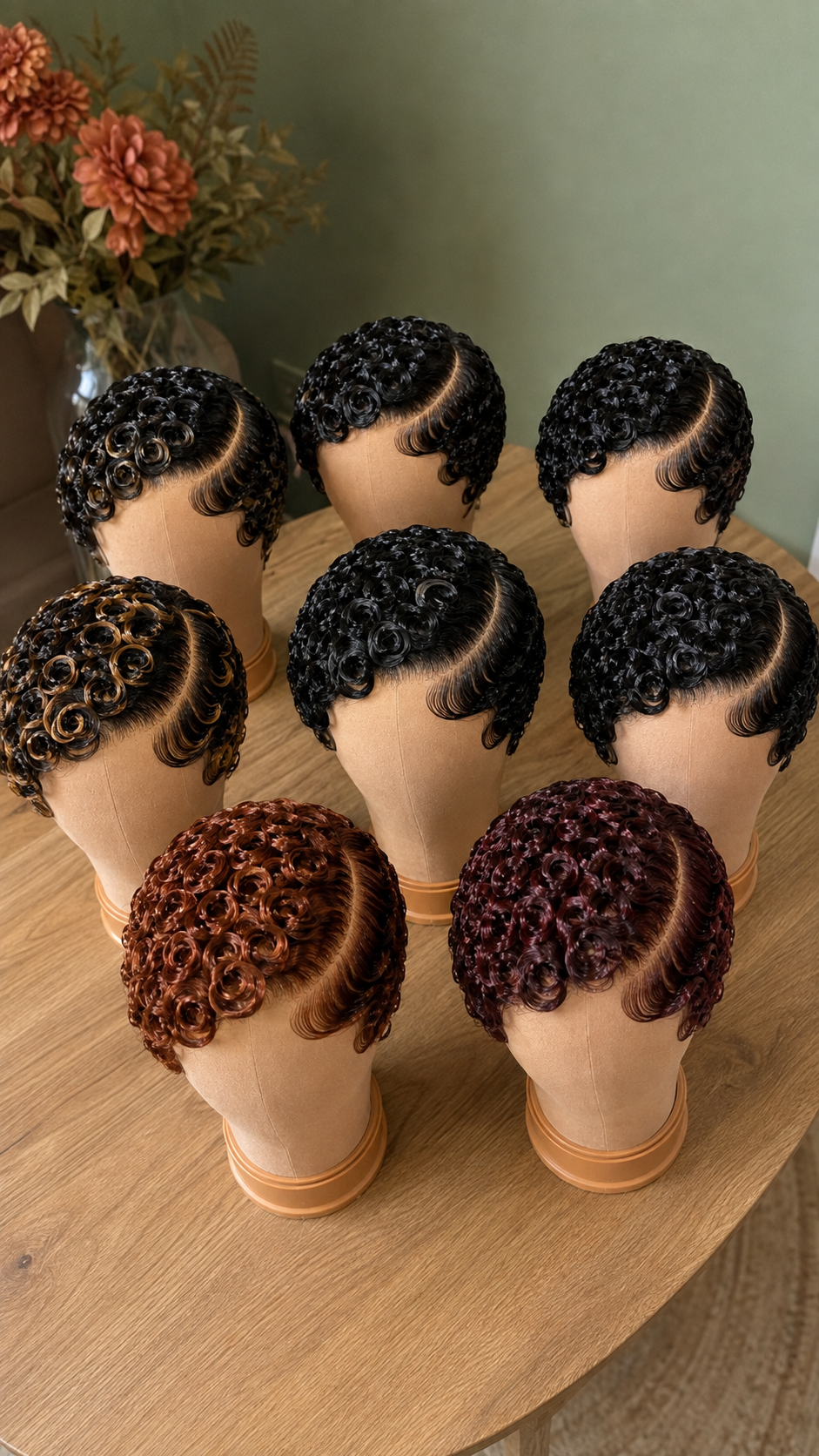
This table is not eight haircuts. It is one haircut in eight dye lots.
Eight canvas blocks, one silhouette: short coil cap, centre part, laid swoop at the front. Four of them are black. One is black with caramel ribbon. One is copper. One is wine. That layout is the information. The black heads are the control. The coloured heads are the variable. Shop them in that order or you will buy a hue and inherit a construction you never inspected.
Why The Black Units Come First
Black does not hide a crooked part. It does not hide a bald patch at the swoop. It does not hide a coil that was set looser on one side of the part than the other. What it does hide is dye damage. If these four black caps already disagree — different part widths, different swoop weights, different coil tightness — the copper and the wine will disagree more, because those colours needed extra process.
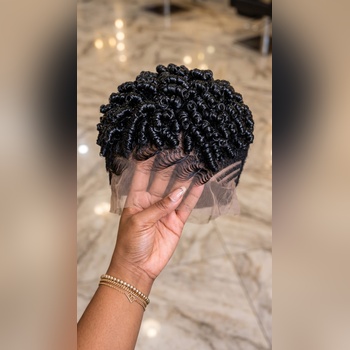
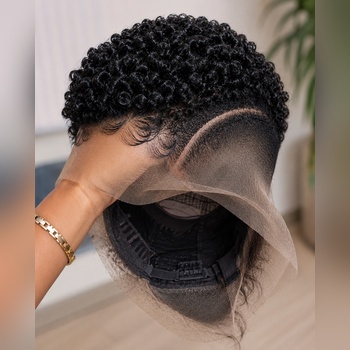
Art87 used a range photo as a seller-quality test: can they repeat a standard. This is the buyer’s method on the same kind of table. You are not grading the shop in the abstract. You are picking which SKU to pay for. Start with the blacks. If two blacks already look like cousins instead of twins, do not order the copper from this batch and hope.
The caramel-ribbon head is not a third family. It is a black unit with lift in selected pieces. Treat it as a coloured SKU. Judge its ribbons after you have accepted the black spec.
The Silhouette Is Locked On Purpose
Centre part, laid front, rounded coil mound: that is a factory shape, not eight custom cuts. You are not choosing bangs versus crop versus fade. You are choosing a dye lot on a locked part-and-swoop cap. That is useful. It means the construction questions are identical for every head on the table.
Ask them once, not eight times: cap size options, lace grade, whether the part is stitched or only styled, whether the swoop is pre-laid with product. Then spend your remaining attention on colour behaviour.
Copper will thin and warm. Wine will bleed and drift. Caramel ribbons will brass at a different speed from the dark hair they sit in. Black will do the least. If you want low maintenance, the majority of this table is already voting. Four black heads are not an accident of stock photography. They are what sells and what lasts.
What A Range Photo Still Cannot Show
You cannot see the back density. You cannot see the cap interior. You cannot see a washed coil. Eight pretty fronts on canvas blocks are still eight fronts. Ask for one unit flipped and one unit washed — preferably a black one, so you are not paying colour premium to inspect construction.
Canvas blocks also flatter a short cap. They are smooth, they are the right oval, they do not sweat. A block that looks snug can still lift on a real head if the size is wrong. Measure. The strap on these units, if they have one, will not rescue a base that was built for the block.
Identical swoops across eight heads can mean skill. They can also mean the same gel session the morning of the shoot. A swoop that matches on every colour is not proof it will match after your bathroom sink.
How Much It Costs
Human-hair coil pixies in this silhouette usually sit $160–$380 in black, then $30–$120 more once copper, wine, or ribbon highlight enters the fibre. That surcharge is process, not extra hair. Synthetic versions of the same cap often run $35–$120 and hold the fashion colours with less drama — the same pattern already true for grey, fantasy, and ash.
If you are building a small rotation from this table, buy the black spec first. Wear it. Learn the cap. Add copper or wine only if the construction survived your week. Two fashion colours and no black control is how people end up with three high-maintenance units and no daily one.
Shipping eight looks like a shop problem, not yours. You are buying one. Confirm the SKU in the photo — “third from the left, copper” is not a SKU. Get the colour name they use in the warehouse.
Where To Order This Coil Range
Use the table as a map, not as a checkout. Point to the black head whose part and swoop you would actually wear. Then ask whether the copper and wine were built in the same run.
[WhatsApp: +XX XXX XXX XX XX]
Require cap size, fibre, and a washed photo of at least one black unit. If they can only light the copper, they are selling the variable and hiding the spec.
A shop that will hold a black unit while you think, then dye-match a fashion colour from the same batch, is rarer and worth the wait. A shop that will only ship whichever head was closest to the camera is selling photography.
Before You Pay
Two black heads compared. If they already drift, stop.
Fibre in writing for the colour you actually want, not for “the range.”
Cap size against a tape, not against the canvas oval.
One washed photo. Gel on eight fronts is still gel.
Search Terms
curly pixie wig colour range, black coil pixie spec, copper wine highlight pixie set, centre part coil cap colours, laid edge pixie range, short curly wig dye lots, black versus copper pixie wig, coil pixie collection table
Final Thoughts
Eight heads look like choice. They are one construction plus a dye menu. Read the black ones like a spec sheet. Spend the colour premium only after that sheet passes. The copper will not fix a part the black heads already got wrong.