
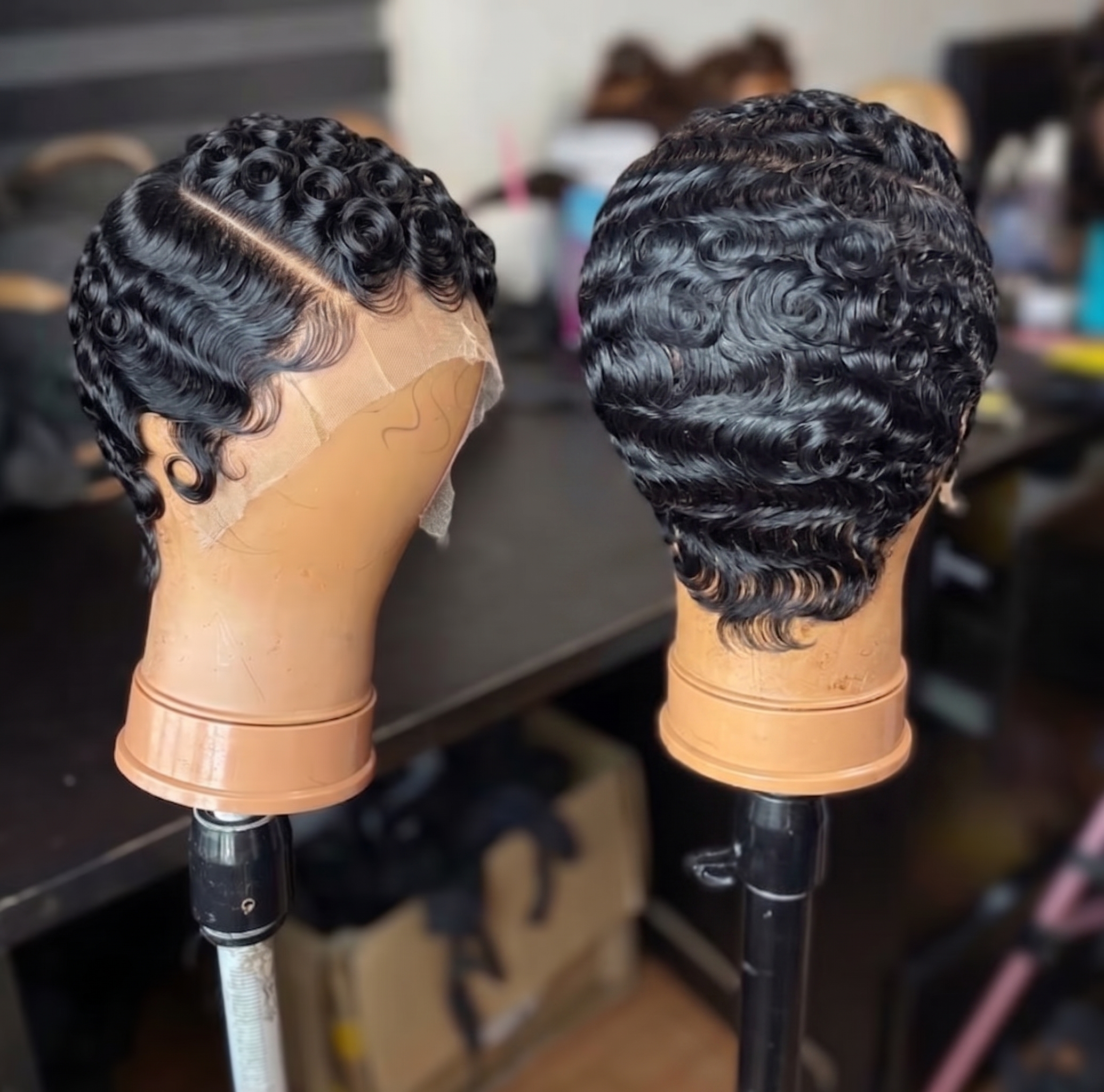
After the front is set for the camera, turn the stand around before you trust the density. The left head is the listing. The right head is the unit.
Why Sellers Put Two Heads On The Table
This photograph is doing a job a single face shot cannot. The left stand sells the center part and the hanging lace. The right stand shows whether those same curls still have weight, coverage, and a clean nape once nobody is looking at the hairline.
Short curly units cheat from the front. Coils stack, the part draws the eye, baby hair occupies the forehead. The back has no part theatre. If the cap was under-filled, if the wefts gap, if the nape was cut in a hurry, it shows as a flat patch or a thin horseshoe around the occipital bone.
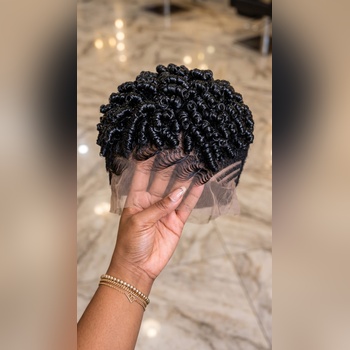
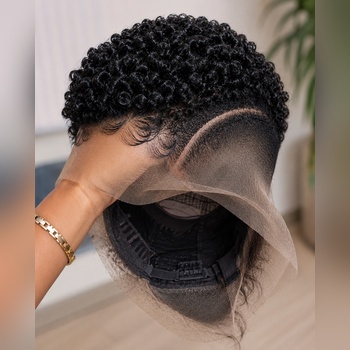
Art2 already covered the other back problem on black hair: untinted lace and visible knots at the nape. This is not that. This is quantity and distribution — whether the coil mass you paid for actually travels past the crown.
Follow The Part Until It Dies
The left head has a straight center part cut through the coils, lace still untrimmed at the cheek. That line is easy to believe. Trace it onto the right head. If the part reaches the crown and then dissolves into a random swirl, the parting was styled for one camera. A real through-part keeps a scalp-coloured channel over the top and only softens when the hair is meant to close.
You cannot confirm that from the left photo alone. You also cannot confirm it from a top-down beauty flat-lay. You need this pair: face-plus-part, then the back with the part still visible as a seam.
If a seller refuses the back stand, assume the density drops. It is the cheapest place to hide a shortfall.
Front Tight, Back Softer Is Not Automatically A Defect
On this pair the left coils look more defined and the right look slightly looser and wider. Lighting and lens do some of that. Product does the rest: gel and a pick at the hairline, less product at the nape.
Ask which photo is closer to a washed head. If only the left look survives in their video, the back you will wear is the softer one. That can still be a good unit. It is a different unit from the ringlet wall in the listing. Price and expectations should follow the back, not the part.
The Nape Is A Length Decision
The right head shows a few longer ends sitting on the neck. That is not leftover bulk. On a pixie it is a choice: cropped nape looks graphic and shows every cap wrinkle; a finger of length hides the band and reads less “cut.” Neither is better. It has to match the neck you have and the collars you wear.
Because there is no fade carved into this pair, the silhouette is a rounded coil cap, not the high-junction skin fade from a tighter editorial cut. If you wanted the shaved-side look, this photo is telling you that you are looking at a different product family. Do not order this and ask for that.
How Much It Costs
A human-hair short curly pixie with a defined center part typically lands around $160–$380. You are paying for even back density more than for the lace flap. Synthetic coil caps that hold the back as full as the front often sit at $35–$110 and make more sense if you want this exact wet-set look every day without restyling.
Do not pay a “full lace” premium unless the flipped cap proves it. Most units that photograph like this are lace-front with a wefted back — which is fine for a style you will not re-part at the nape.
Budget a first wash and a lace tint. The untrimmed mesh on the left is not included wear. Shipping on two-stand listings is the same as one unit; you are not buying two wigs.
Where To Buy This Parted Curl
Require the same four views every time: front with part, crown, back, cap interior. This photo already gives you two. Ask for the other two before money moves.
[WhatsApp: +XX XXX XXX XX XX]
A shop that photographs units on stands in pairs is usually easier to vet than a single glam mannequin. Still ask fibre, cap size, and whether the part is stitched or only styled. Stitched parts stay. Styled parts migrate after one sleep.
If they sell out of this exact look, ask whether the next unit was taken from the same batch. Back density varies more between units than the front part does.
Before You Pay
Back photo with the part still readable at the crown.
Nape length visible, not cropped out of frame.
Fibre stated in writing, not inferred from shine.
Cap size matched to a measured head, straps only for fine-tune.
Search Terms
front and back curly pixie wig, center part short curly wig, black coil pixie back density, untrimmed lace parted pixie, nape length curly pixie, two stand wig photo, defined part curly bob pixie, short wet curl pixie wig
Final Thoughts
The center part is a drawing. The back is the inventory. If the right stand looks thinner, flatter, or unfinished next to the left, believe the right stand.