
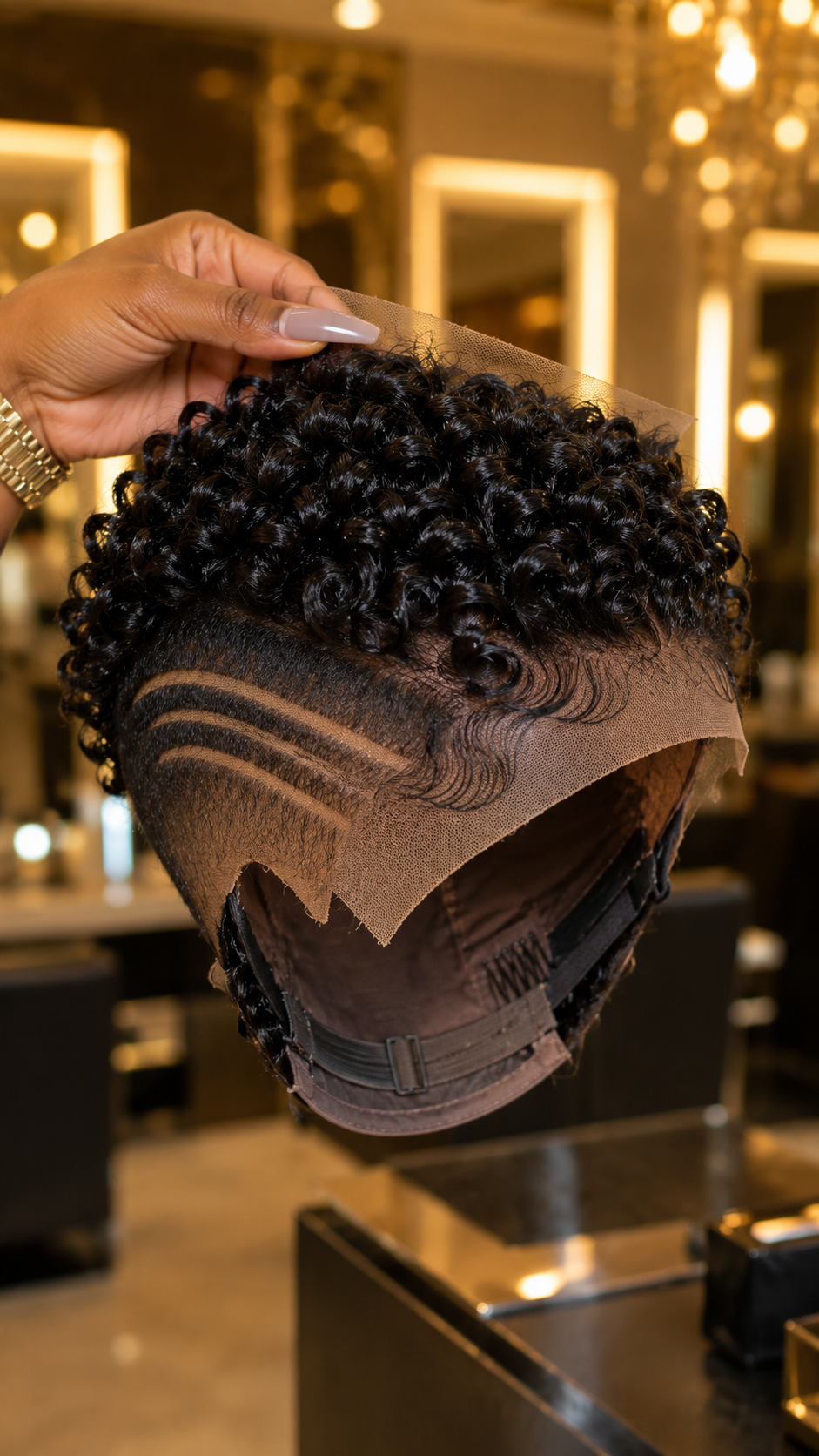
Flip almost any wig listing and you get the same thing: the curl, the color, the styled top, shot from above under good light. What you almost never get is this — the lace peeled fully back, the entire inside of the cap exposed, the elastic band and adjuster and hairline mesh all laid open at once. This is the half of the unit the buyer pays for but is rarely allowed to see before it arrives.
This is a black barrel-curl pixie wig with carved design lines at the temple, photographed from behind with the front lace flipped forward to reveal the full interior cap construction: the mesh dome, the sheer lace hairline, the elastic band running along the perimeter, and the adjustable fastener at the nape. The curl and the carved lines are almost secondary here. The real subject is everything underneath them.
For the hundredth unit in this series, that feels like the right thing to look at closely — not another curl pattern or color, but the construction that every single one of those curls and colors was built on top of, and that most buyers never learn to read.
Where To Buy This Barrel-Curl Pixie Wig With Full Cap Construction
Custom makers are the only sellers who will reliably show you this interior view before purchase, since they build the cap themselves and can photograph every layer of it on request rather than only the styled exterior.
Instagram and TikTok sellers almost never post the inside-out view shown here, because it is not the flattering, camera-ready angle that drives engagement — which is exactly why asking for it filters serious sellers from casual ones.
Etsy listings from construction-focused makers occasionally include an interior cap photo as standard, a strong signal they are confident in what their base looks like from the inside.
Marketplaces like Amazon, AliExpress, and Temu rarely show cap interiors at all, so the construction quality on mass-market units is usually a complete unknown until the package arrives.
Local beauty supply shops and salons let you turn a unit fully inside out yourself, the single most informative thing you can do before buying, and something no photo fully replaces.
Vendors and wholesalers direct are where cap construction is actually done, and a wholesale contact is often the only way to get detailed answers about mesh type, band elasticity, and adjuster quality.
Regionally, well-constructed barrel-curl units with quality cap interiors show up often through vendors in Lagos, Accra, Atlanta, London, and South African hair districts.
Vet the seller by asking for exactly this photo — the lace flipped, the full cap interior visible — before you pay. A seller who provides it readily is showing you they have nothing to hide inside the unit.
Red flags include any reluctance to show the cap interior, listings with only styled exterior shots, and vague answers about the band, mesh, or adjuster construction.
When you order, send your head circumference measurement so the adjustable band can be set appropriately, and ask specifically about the mesh and lace quality visible in the interior view.
Contact / order inquiries: WhatsApp [WhatsApp: +XX XXX XXX XX XX]
How Much It Costs
Tiered pricing for a barrel-curl unit with quality cap construction like this runs $175–$440 for human hair, with the construction quality itself — good mesh, a durable band, a reliable adjuster — accounting for a meaningful part of the difference between a $175 unit and a $440 one. A good synthetic version runs $70–$160, and a basic synthetic falls between $30–$75.
What that includes and excludes typically covers the constructed cap and styled hair as delivered, not replacement of a band or adjuster that wears out, and not the setting products needed to maintain the barrel curls on top.
Shipping and duty add $15–$60 depending on origin, with well-constructed units sometimes shipped on a form to protect both the curl set and the cap shape.
Ongoing costs are lower on the cap side than the styling side here — a good cap simply lasts, while the barrel curls need periodic re-setting and the carved lines need re-cutting. Budget mainly for styling upkeep, plus eventual band or adjuster replacement if the unit sees heavy long-term wear.
First-year total, including the unit, styling products, and one professional re-set, tends to land between $250 and $550 for a well-maintained human hair version.
Cost per wear on a $300 unit worn twice a week for a year comes out to roughly $2.90 per wear — and a well-constructed cap is exactly what makes that long wear life possible in the first place.
What a very low price signals on a unit is very often hiding in the cap: thin mesh that tears, a weak band that stretches out, or a flimsy adjuster that fails. These are the corners cut to reach a low price, and they are the corners this interior view would expose.
Deposit structure for custom orders commonly runs 30–50% upfront, remainder due before shipment, kept on a payment method that allows a dispute if the delivered cap construction does not match the quality shown or described.
Shipping, Delivery, And What To Expect After Ordering
A well-constructed cap with a fitted band and adjuster takes real assembly time — expect 7–14 business days before a custom order ships, longer if the barrel-curl set and carved lines are done as separate finishing steps. International delivery adds another 7–21 days.
What arrives should let you turn the unit fully inside out and inspect exactly what this photo shows: intact mesh, a band with genuine elasticity, and an adjuster that fastens securely without feeling flimsy. If any of those feel weak or poorly finished on arrival, that is worth raising immediately, before you wear the unit.
Photograph the cap interior the day it arrives, lace flipped exactly like this, before styling anything. That interior record is the one most buyers never take and the one that matters most if a construction fault shows up later.
Reading The Cap Interior — What Each Layer Actually Does
Start with the mesh dome, the main body of the cap. This is what holds the unit’s shape and carries most of the hair wefts. Good mesh feels sturdy but breathable; thin, papery mesh is the first thing to tear under repeated wear, and it is nearly impossible to judge from an exterior photo.
The sheer lace hairline, visible where the flipped section meets the mesh, is what creates the natural-looking edge at the front. Its quality determines how undetectable the hairline looks once worn, and how carefully it needs to be handled during trimming — the finer and more delicate the lace, the more natural the result but the more fragile the edge.
The elastic band running along the perimeter is what grips the head. It should have real stretch and recovery; a band that feels loose or already stretched-out when new will only loosen further with wear, undermining the whole fit.
The Adjustable Fastener At The Nape
The adjuster at the back is what lets you tighten or loosen the cap to your exact head size. Look at how it is attached — securely stitched into the band, not loosely tacked on — since this is a common failure point on cheaply made units. A well-integrated adjuster gives you a glueless, secure fit; a poorly attached one pulls loose and takes the security of the whole unit with it.
This is a distinct construction feature from the comb-and-strap, spiral-comb, and other securing systems covered elsewhere in this category, and each has trade-offs. An adjustable band suits wearers who want to fine-tune fit without glue or clips, but check the adjuster’s attachment quality closely, since it does the work of holding everything in place.
Barrel Curls And Carved Lines — The Exterior, Briefly
The exterior here — rounded barrel curls up top, carved design lines sculpted into the temple — echoes styling elements covered in detail on other recent units, so it is worth only a brief note rather than a full breakdown. The barrels are a set style that relaxes and needs re-setting after washing; the carved temple lines are created with product and precise cutting and wash out completely, needing to be re-done each time.
What is worth adding is how the exterior and interior relate: those carved temple lines sit directly over the mesh-and-lace transition visible in this photo, which means the lace quality underneath directly affects how crisp and natural those carved lines can look. A great carved design on a poor cap will never sit as cleanly as the same design on a well-constructed base.
Why This Interior View Matters More As A Unit Ages
On day one, almost any cap looks acceptable — even a cheaply made one holds together fresh out of the packaging. The differences this interior view reveals only become obvious after months of wear, which is precisely why learning to read them before purchase is so valuable. Thin mesh does not tear immediately; it tears after repeated stretching over a head, wash after wash. A weak band does not fail on the first wear; it slowly loses its grip until the unit no longer sits securely.
By the time these faults show up in daily use, the return window has almost always closed. That is the quiet reason sellers can get away with hiding the cap interior: the buyer does not discover the shortcut until it is too late to do anything about it. Studying this view up front — mesh thickness, band recovery, adjuster attachment — is the closest a buyer can get to fast-forwarding through those months of wear and seeing how the unit will hold up before committing to it.
Before You Pay
- Will the seller show you this exact interior view — lace flipped, full cap visible — before you pay?
- Does the mesh look sturdy and breathable, or thin and prone to tearing?
- Is the elastic band genuinely stretchy with good recovery, or already loose when new?
- Is the adjuster securely stitched into the band, or loosely tacked on?
- Does the lace hairline quality support the crisp carved lines shown on the exterior?
Trimming The Lace
Trim with real care here, since this interior view shows how close the delicate lace hairline sits to the carved design work at the temple — an uneven cut affects not just the hairline but how those carved lines read against it.
Work in small sections, checking the fit against your own hairline as you go, and leave a modest margin of lace beyond the last row of knots rather than cutting flush, especially near the fine hairline mesh visible in this photo.
Search Terms
barrel curl pixie wig cap construction · inside out wig cap interior · adjustable band pixie wig · carved temple line pixie wig · mesh dome wig cap quality · elastic band lace pixie wig · barrel curl carved design wig · full cap interior curly pixie wig
Final Thoughts
A hundred units into looking closely at curl, color, cut, and construction, the single most useful habit turns out to be the simplest: turn the unit inside out before you buy it. The curl on top is what sells the photo. The cap underneath is what determines whether the unit lasts a season or a year, fits securely or slips, holds its shape or falls apart at the band.
Sellers photograph the flattering half because that is what draws the eye. The half in this photo — the mesh, the band, the adjuster, the lace hairline laid open — is the half that actually answers whether a unit is worth its price. Learn to ask for it, learn to read it, and you will make better buying decisions than the styled exterior alone could ever guide you toward.